Thursday, 15 December 2022

From "Tiger By The Tail" To "The Saturn Game"

Let's appreciate how Poul Anderson constructed the Technic History by comparing the first six written instalments with the first six in fictional chronological order.

The First Six Written
"Tiger by the Tail" (January, 1951; Flandry)
"Honorable Enemies" (May, 1951; Flandry)
"Sargasso of Lost Starships" (January, 1952)
"The Star Plunderer" (September, 1952; Manuel Argos)
"The Warriors from Nowhere" (Summer, 1954; Flandry)
"Margin of Profit" (September, 1956; van Rijn)

At this stage, these six works have not yet been pulled together into a single series:

the Empire founded by Argos and expanding in "Sargasso..." has not yet been identified with the Empire defended by Flandry;

van Rijn has not yet been located in an earlier period of the same timeline.

The First Six in Chronological Order
"The Saturn Game" (February, 1981)
"Wings of Victory" (April, 1972; Ythrians)
"The Problem of Pain" (February, 1973; Ythrians)
"Margin of Profit" (September, 1956; van Rijn)
"How To Be Ethnic In One Easy Lesson" (1974; Adzel)
"The Three-Cornered Wheel" (October, 1963; Falkayn)

Later, Adzel and Falkayn will work for van Rijn. Still later, Falkayn will found a human-Ythrian colony on the planet explored in "The Problem of Pain." Van Rijn is Catholic and "The Saturn Game" introduces the future Jerusalem Catholic Church. Argos, then Flandry, live centuries later.

Sequence And Simultaneity

In a future history chronology, the titles are listed vertically down the page into the future. However, some instalments are contemporaneous and should really be presented horizontally, typographical space permitting. In Robert Heinlein's Future History, the six stories collected in Volume I, The Man Who Sold The Moon, form a linear sequence set during the second half of the twentieth century whereas the eight stories collected in Volume II, The Green Hills Of Earth, are all set around 2000. (There is still some future left: Volume III is entitled Revolt In 2100.)

In Poul Anderson's Technic History, "Margin of Profit," introducing Nicholas van Rijn, and "How To Be Ethnic In One Easy Lesson," introducing van Rijn's future employee, Adzel. are contemporaneous. These two stories are presented with "How To Be Ethnic..." first in The Earth Book of Stormgate and second in The Technic Civilization Saga, Volume I, The Van Rijn Method. I prefer the Earth Book order as presenting the background of the Solar Commonwealth and the Polesotechnic League before introducing the major player, van Rijn.

These remarks are prefatory to further observations about the Technic History but bear with me.

Wednesday, 14 December 2022

Merseian Influence

To generalize, a series hero has a continuing villain, whether individual or collective, who does not appear in every instalment. Thus, when Russian intelligence chiefs review Bond's file, they note that they had not been involved when he had tackled trans-Atlantic diamond smugglers the previous year. Similarly, Merseians were involved in events on Altai and later on Nyanza but not on Unan Besar although they might have been. A sufficiently insidious villain can always be shown to be lurking somewhere in the background. Flandry reflects that, if Nias Warouw hypnoprobes him, then Warouw will gain a lot of information about the Empire and about Terran Intelligence that he would be able to sell to the Merseians who could easily deploy one or two cruisers to make Unan Besar a protectorate.

Another collective villain is the barbarians, previously represented by the Scothanians. If Warouw helped other groups of barbarians to raid Terran planets, then he would share in their loot. (In the film of Thunderball, SPECTRE receives a consultation fee from the Great British Train Robbers.) 

Out Of Sequence

"Hiding Place" is:

the first of three Nicholas van Rijn stories collected as Trader to the Stars;

not in The Earth Book of Stormgate, a volume of previously uncollected items;

the last of eleven instalments collected as The Technic Civilization, Volume I, because by then at last the entire Technic History is collected in chronological order of fictional events.

This leaves us with two optional reading orders. Since the entire series should be read at least twice, maybe it could be read first in the original publication order and secondly in chronological order?

"It's always fun to see things out of sequence, so you can later go, 'Oh, that's why he's the way he is.'"
-Neil Gaiman, interviewed in Hy Bender, The Sandman Companion (London, January 2000), 5, p. 68.

A Dynamic History II

See A Dynamic History.

Textual dynamism is also generated by later additions of earlier instalments, by revisions of the reading order and by multiple potential starting points. The original Polesotechnic League Volume I, Trader to the Stars, a Nicholas van Rijn collection, began with "Hiding Place" (1961) although the van Rijn series as a whole begins with "Margin of Profit" (1956) which is quoted in Trader to the Stars and collected in the later published The Earth Book of Stormgate. That later collection begins with "Wings of Victory" (1972) although the still later collection, The Technic Civilization Saga, Volume I, The Van Rijn Method, begins with "The Saturn Game" (1981).

"Margin of Profit" is set earlier in van Rijn's career than "Hiding Place";

"Wings of Victory" comes earlier in the history of Technic civilization because it is set during the Grand Survey (early interstellar exploration) and describes the Discovery of Ythri;

"The Saturn Game" is pre-Technic because it describes early interplanetary exploration and the recovery from the Chaos on Earth.

Thus, the narrative, by reaching progressively backward through time, almost links the experience of Anderson's readers forward to the original starting point of van Rijn's era. When "The Saturn Game" refers to the passive entertainment of television, we recognize where we are. Van Rijn and the Polesotechnic League become slightly less implausible as longer term consequences of events on twentieth century Earth.

Tuesday, 13 December 2022

Warouw's Motivation

"The Plague of Masters."

"Modern police and intelligence methodology - even military science - didn't exist on Unan Besar. Poor damned Nias Warouw, a born detective forced to re-invent the whole art of detection!
"But he had done a surprisingly good job of it." (X, p. 91)

What did I say in the previous post about Nias Warouw? He knew that Flandry would find a way to survive and had to find out whether there was already an extraplanetary network on Unan Besar so he followed up what leads he had, helped by some clumsiness on the part of Flandry's ally, Luang.

But why does Warouw stay with what he knows is a comic opera regime? As Flandry points out, he would be able to gain all that he has and more in Technic civilization. That is not how Warouw sees it:

"'What would I be there, another little politician making dirty little compromises - or Nias Warouw whom all man fear?'" (XI, p. 105)

So Warouw has a definite choice - and makes the wrong one.

Police And Dictatorships

Flandry walks into a trap a quarter of the way down p. 82 but fights his way out, is chased and is captured half way down p. 86. Was such a long chase sequence necessary? On p. 87, he feels "...inwardly lepidopteral." What does this mean? 

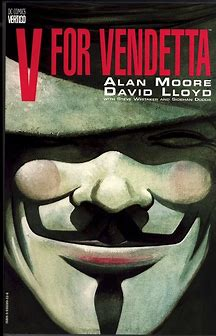
Fictional detectives include Nias Warouw, director of the Guard Corps of the Planetary Biocontrol on Unan Besar, who tracks down the fugitive, Flandry. Captured, Flandry has the option of remaining on Unan Besar for life as Warouw's special assistant. No, thanks. Some detectives, both real and fictional, work for a regime despite knowing how wrong the regime is. Another example is Eric Finch in Alan Moore's V for Vendetta. The anarchist terrorist, codename V, assassinates leading members of the Norsefire fascist dictatorship. Finch simply tracks down V as if the latter were a criminal in a democratic society. At some stage, "I am only doing my job" has to give way to "What kind of society am I supporting?" Finch has the self-confidence to tell the Leader that he does not go along with "England prevails" and is informed that he is left in his position only because he is so good at his job. Warouw has no respect for the directors of Biocontrol but also no need to tell them what he thinks.

Priests And Detectives

Searching for Montalbano, I also found the Saint and Father Brown because the authors' names are Camilleri, Charteris and Chesterton. Like Poul Anderson's Trygve Yamamura, Father Brown is a detective and, like Anderson's Axor, is a Catholic priest but how different in both cases. These examples demonstrate the comprehensiveness of language. Although the terms, "detective" and "priest," are specific and different in meaning, they are general and abstract enough to apply to such different characters in such different historical contexts, especially if we lose the adjective, "Catholic," but keep the noun, "priest." 


There were priests long before there were detectives. If the human race survives, then the same terms will be applicable in even more diverse contexts in future - will aliens convert to Christianity? - and will retain a historical significance even if the functions of detective and priest cease to exist.

Detectives can be police, private or amateur. Thus, Yamamura is private whereas Brown is amateur and their milieus could hardly be more different.

Some Detective Fiction

I suppose that a specialist mystery bookshop will stock Poul Anderson's Trygve Yamamura Trilogy and nothing else by Anderson? Anderson said somewhere that he wrote more sf than mysteries because the former paid better. That was fortunate. For a guest review of Anderson's Perish By The Sword, see here.

I tried reading Agatha Christie but disliked what I call the "crossword puzzle" aspect of the plots. Two detective series that I do recommend are Sherlock Holmes, of course, and Montalbano. After breakfast, I will stroll into town in search of more Montalbano titles. Meanwhile, I continue to reread Anderson's "The Plague of Masters."

Monday, 12 December 2022

A Dynamic History

Poul Anderson's Technic History is not linear but somehow dynamic. Sub-series proliferate and overlap: League, van Rijn, Falkayn, trader team, with Adzel and Ivanhoe off-shoots .Nearly every one-off instalment is a proto- (potential) series. Many one-off characters could have become series characters. I need hardly list the names. Reflecting on the connections between any two parts of the History, we remember other connections and wind up thinking about the whole History but always seemingly from a new perspective. The series never becomes just a static list of titles. In fact, we never read the full list of forty three titles except in the Chronology where they are surrounded by other information. A Wellsian future history, fictitious historical text, could be written about the Solar Commonwealth, the Terran Empire, the Domain of Ythri, the Dispersal of Ymir, the Roidhunate of Merseia, the Realm of Gorrazan, the Betelgeusean System, Hermes, Dennitza, Aeneas, the Commonalty etc. A step has already been taken in this direction with the contributions of Hloch and other commentators. No discussion ever exhausts all the possibilities. Is this true of any other future history?