Wednesday, 23 April 2025

Philippe Rochefort II

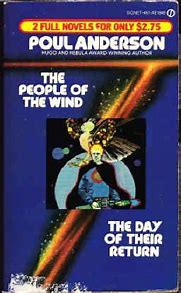
The People Of The Wind, XVI.

If the Terrans do land on Avalon, then Rochefort wants to:

"'...be in the first assault group...'" (p. 624)

Cajal points out that:

"'That's the most dangerous...'" (ibid.)

- and suggests that Rochefort has:

"'...earned better.'" (ibid.)

I would go further. Surely Rochefort has proved himself to be such an asset that his superiors would not want to risk him in a first assault? In any case, he seems to lead a charmed life which, of course, has something to do with the fact that Poul Anderson wants Rochefort to survive for a last conversation with Tabitha Falkayn before the end of the novel.

Rochefort will go on his way, Tabitha will marry Arinnian and, unfortunately, we will see no more of any of them.

Fair winds forever.

Tuesday, 22 April 2025

Admiral And Lieutenant

The People Of The Wind, XVI.

Rochefort's pre-dinner drink with Cajal is one of the most comfortable scenes in the novel. The older man tries to get the younger man relaxed and talking freely. Rochefort says something in favour of his former captors, the Avalonians, which is just the sort of thing that the Admiral needs to hear. 

Rochefort says, "'Body of Christ,'" (p. 624) then signs himself before the Admiral's crucifix. From their descriptions, I infer that van Rijn and later Cajal are old-style Catholics whereas Rochefort and later Axor are, we are told, Jerusalem Catholics. But that such a difference exists is partly inferred.

Is an Avalonian merchant who defects:

"'Despicable or realistic? No matter.'" (p. 621)

It does not matter to the Admiral. I once argued with a neighbour that it would be a good idea for him to join the union at work. I added that, in this instance, either self-interest or solidarity would suffice as a motive!

Rochefort is a good guy, Terran or no Terran. We will stay with him for a while longer if possible.

Philippe Rochefort

The People Of The Wind.

Maybe Philippe Rochefort is our main man in this novel.

Rochefort successively interacts with:

his crew, both killed in battle;
Eve Davisson on Esperance;
Hrill, Draun, Arinnian and Eyath on Avalon;
Admiral Cajal in the superdreadnaught, Valenderay -

- so he could be regarded as a unifying character.

Rochefort is like Dominic Flandry except that he does not save the day for Terra. But everyone cannot do everything.

A Philippe Rochefort series is one of many hypothetical extensions of Poul Anderson's Technic History. Where does Rochefort go and what does he do after Avalon? Hloch might have told us. He writes after the Terran War but does not incorporate The People Of The Wind into his Earth Book compilation. We would have welcomed another such Editor for the second half of the Technic History.

Monday, 21 April 2025

Since 1956

Poul Anderson has been with me personally since some time in the 1960's. I remember reading Twilight World while at boarding school in the Republic of Ireland, 1960-'67. In 1956, when the first Nicholas van Rijn story, "Margin of Profit," was published, I started to attend a boarding school in Scotland and knew nothing of Anderson as yet although I did read Robert Heinlein's Starman Jones while in Scotland. Over a much longer period, I have become very conscious of connections between Heinlein's Future History, Heinlein's juveniles, including Starman Jones, and Anderson's works.

When we reread such works, especially after very long intervals, they are not the same because we are not. I used to be satisfied if the characters had travelled in spaceships through the Solar System or to other planetary systems. Now considerably more than that is necessary. Anderson conveys some sense of what it is like to be an Ythrian or a Merseian or to be a human being in regular contact with other intelligent species. Merseians, who began as space opera villains, became a credible species with diverse cultures and languages and not every single one of them a villain - obviously.

The People Of The Wind about human beings and Ythrians seems to be inexhaustible in descriptive details and characterization although we approach its climax yet again.

Betrayals

The People Of The Wind, XVI.

Eyath, an Ythrian female, goes on heat when bereaved. Draun, knowing that this will happen, seeks her out. It is not a chance encounter. Draun has learned rape from human beings.

Arinnian challenges Draun. Tabitha/Hrill persuades them to postpone their duel until after the war.

Rochefort steals a spaceboat and escapes with military intelligence that he had persuaded Tabitha to divulge. But Arinnian had already persuaded Tabitha to trick Rochefort with misleading information.

Are any further betrayals possible?

The survivors will eventually arrive somewhere good.

High is heaven and holy.

Wind And Waves

The People Of The Wind, XV.

The elements play their part in a dramatic conversation between Tabitha Falkayn and Philippe Rochefort. When he urges her to divulge military intelligence, even saying:

"'If you love me, you will...'" (p. 604)

- we are told that:

"She stood in the middle of the wind." (ibid.)

Where else?

Then, when he agrees to give his parole, his voice briefly breaks as:

"Waves hissed at his back." (ibid.)

Waves can lap or murmur but these hiss. At him? Do they indicate that he will break his parole? Both find their conflicting loyalties stretched to breaking point. Arinnian plans that Rochefort will escape with misleading intelligence fed to him by his lover. She knows this but says it all in one breath anyway. Suddenly, a John le Carre character might feel at home on Avalon.

Grief And The Elements

The People Of The Wind, XV.

Pathetic fallacy. Eyath learns that Vodan has been killed in battle and nature responds:

night falls;
wind rises;
clouds break;
the moon, Morgana, flees;
surf threshes;
trees roar;
air chills;
Eyath flies alone.

An Ythrian grieves in the elements, not under shelter. Arinnian had thought that she could be the sun or the wind... Oneness with nature is natural for intelligent flying carnivores. 

Tension

The People Of The Wind, XIV.

At a meeting in Tabitha Falkayn's house:

"Arinnian wondered if the tension he felt was in the atmosphere or his solitary mind." (p. 593)

No way, the solitary mind.

Causes of tension:

two species;
two sexes;
two sides in a war;
personal jealousies and animosities.

Draun (Ythrian, male) looks surly, strokes his dirk and is anti-Terran.

Eyath (Ythrian, female) dislikes Draun and is a close galemate of Arinnian (human, male, human name "Christopher Holm").

Tabitha Falkayn (human, female, choth name "Hrill") is the business partner of Draun, who is her superior officer in the home-guard, and has become engaged to Philippe Rochefort, to the discomfiture of Arinnian.

Rochefort (human, male) is a Terran prisoner of war and Tabitha's house guest. 

Much conflict will ensue.

Blind Prejudice

The People Of The Wind, XIV.

"'What is honor to a Terran?' Draun snorted." (p. 594)

The Terran in question is the prisoner of war, Philippe Rochefort, who is supremely honorable. Anyone who deals with Rochefort, either as friend or as foe, has to start with that fact - just as it is also evident that Draun himself is blinded by prejudice.

The first casualty in any war is the truth. I once argued in a fanzine letter column that every state should be secular and was immediately denounced for advocating an Islamic state! That is an obvious contradiction/non sequitur but it fitted the context and the assumptions of my antagonist. The process is: "I strongly disagree with and dislike what someone has said. Therefore, I should denounce it in the strongest possible terms - even at the expense of completely misquoting it!"

Clearly, Draun cannot be trusted to quote accurately anything said by Rochefort. Later, Draun will get his wish. He will die killing Terrans. If he had survived the war, then he would have had to fight a duel with Arinnian. "They who live by the sword..."

I hang my observations on Poul Anderson's passages. Everyone else is welcome to do likewise.

Sunday, 20 April 2025

Familiarity

The People Of The Wind is the fourth and last appearance of the planet Avalon in Poul Anderson's Technic History and the sixth and second last appearance by an Ythrian or Ythrians in the Technic History. These finite numbers of instalments generate a sense of a much longer acquaintance with a place and a people.

David Falkayn's mother, Athena, and brother, John, each appear only once, in different scenes, in Mirkheim. But we know the Falkayn family.

(Tolkien has Mirkwood. Anderson has Mirkheim and Mistwood.)

The city of Gray on Avalon seems very real and familiar when Daniel Holm glances out his window:

a clear winter's day although, at this latitude and altitude, there is no snow so that the hills remain green with susin;

whooping wind, cold but exultant;

dancing whitecaps on Falkayn Bay;

cloak-clad men and women;

swooping Ythrians.

We are there.