Sunday, 26 January 2025

Stonehenge And China

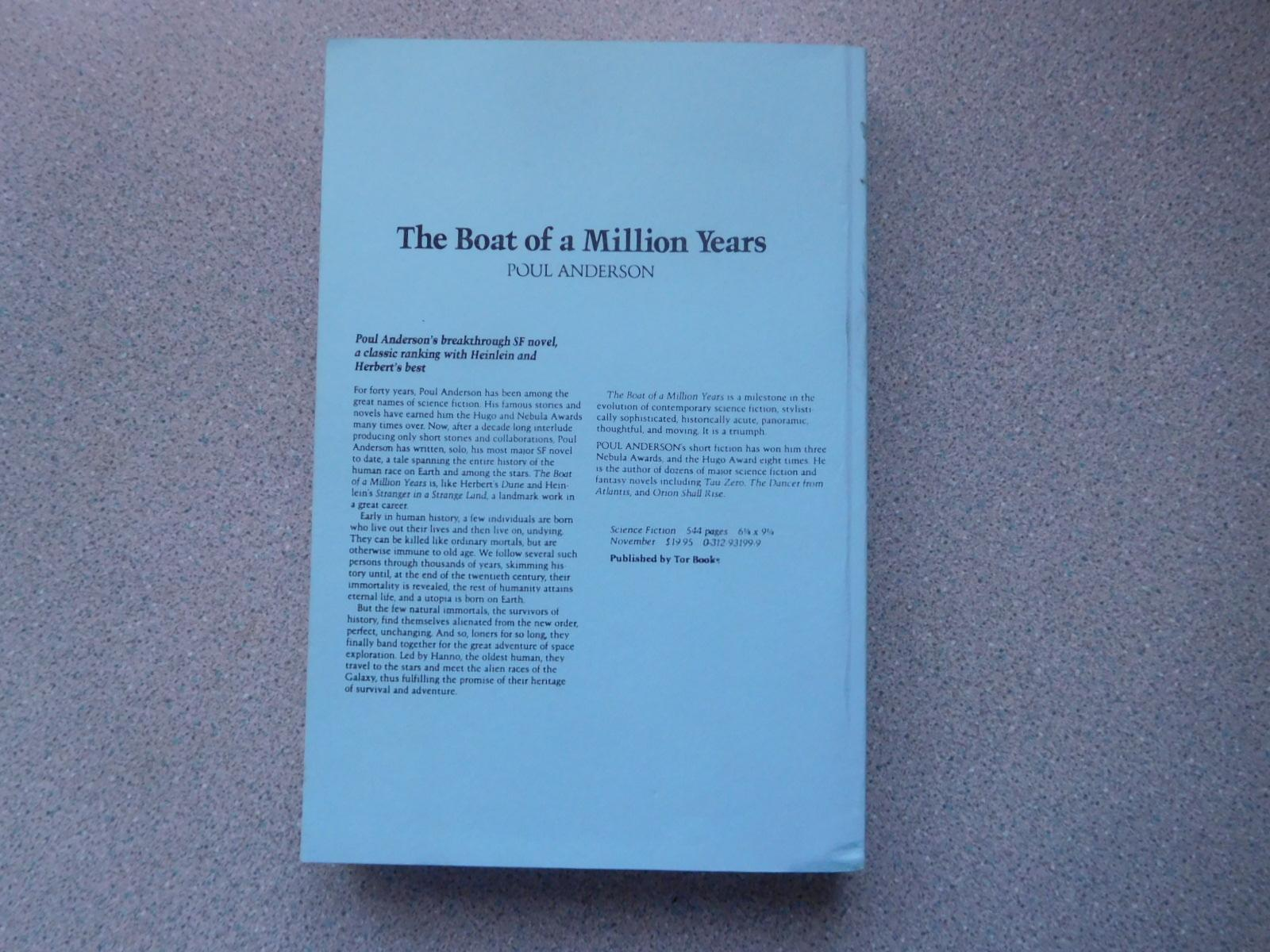
I have just reread Poul Anderson's The Boat Of A Million Years, Chapter I, and posted about it but not mentioned Stonehenge because we have covered this before. See here. We hover on the brink of Chapter II which is set in China. The Chinese New Year takes a long time to start. We had a concert in the Grand Theatre last Sunday and there will be street performances, including the dragon, today. This will always be associated in our minds with Poul Anderson because of his character, Adzel.

There is no doubt about the setting of II, The Peaches of Forever, because, in its opening sentence, the Emperor sends an inspector from Ch'ang-an:

"To Yen Ting-kuo, subprefect of the Tumbling Brook district..." (p. 33)

- where it is early summer. Nowhere could be further removed from the northern climes where Pytheas and Hanno voyaged in Chapter I. Clearly from the start, Boat is a novel about mankind throughout the world and its history.

Saturday, 25 January 2025

Farewell

The Boat Of A Million Years, I, 8.

Hanno, who says that he is "'...everywhere an alien...'" (p. 32) refuses Pytheas' invitation to stay and accept Massaliot citizenship. Pytheas exclaims:

"'What else is life but always bidding farewell.'" (ibid.)

There are always echoes between timelines:

"Well, I had been warned at the beginning that a Time Patrol agent's life became a series of farewells."
-Poul Anderson, "The Sorrow of Odin the Goth" IN Anderson, Time Patrol (Riverdale, NY, December 2010), pp. 333-465 AT 1980, p. 351.

Pytheas is an acquaintance of an immortal. Carl Farness, newly recruited into the Patrol, has become a time traveler. And we read about them.

Now I really must say, if not "Farewell," then at least "Good night." Next time, we visit China.

River Of Mist

The Boat Of A Million Years, I, 4, pp. 20-22.

"Overhead curved the Galaxy, a river of mist across which winged the Swan. The Lyre hung silent. The Dragon coiled half-way around a pole strangely high in heaven." (p. 22)

And there is another description of the galaxy which is usually seen from space in Poul Anderson's works.

Pytheas, always wanting to learn more, says, with completely unconscious irony:

"'Our lives are a million years too short.'" (ibid.)

At the very end of James Blish's Cities In Flight, as this universe ends, a philosopher says that we did not have time to learn all that we wanted to know and John Amalfi accepts these words as the epitaph for man.

Kindred spirits across fictional timelines.

Barbarians And Aliens

The Boat Of A Million Years, I, 3, pp. 16-20.

Hanno has met enough barbarians to be able to guess what to expect from the newly encountered Pictones.

Nicholas van Rijn has met enough aliens to be able to deduce what is going on with the recently discovered Cainites.

Competent Andersonian heroes display common skills in different periods and different timelines.

That is my last thought for tonight and it is a valid one. Tomorrow we might see more of Hanno and of some other immortals. Or we might be doing something else, of course.

The Wikipedia Article

Someone has done good research on Poul Anderson's The Boat Of A Million Years for a Wikipedia article, e.g.:

Immortal physiology

[edit]

As their name implies, at a certain point Immortals stop outwardly aging, generally at about twenty-five years, though apparently among East Asians possibly a little later. When the Immortals' teeth are damaged, they regrow. Immortals receive no permanent scars and also never contract contagious illnesses, even during times of plague. They remain fertile for as long as they live and can rapidly heal broken bones or other serious wounds. If the Immortal men are circumcised, their foreskins will regenerate. Speculation on "recurrent intactness" among women is left unanswered, with the possibility of the female hymen likewise restoring itself having been brought up at one point during dialogue in the novel. Immortals can and in the course of the novel do die, as they are not capable of recovering from injuries such as a stab to the heart or decapitation. There is also discussion about whether long-term exposure to tobacco smoke might present the possibility of lung cancer developing, though the researcher who opens the possibility admits he has no data on the matter.

-copied from here.


The Ithagene And Hanno

The Boat Of A Million Years.

On Xenogaia, the Survivors, as foreigners, manage to prevent a war about reproductive rights among the trisexual Ithagene whose scaled, quadrupedal bodies are non-humanoid and sound fairly disgusting. Anderson is working on his aliens: no head with two eyes above a nose and a mouth here. I mention this because it seems to be the single exotic detail that I have not so far included from the climactic Chapter XIX. The Ithagene appear only in this single incident and nothing about them affects anything else in the novel so Poul Anderson could have written them any way he wanted. But he did come up with something reasonably alien. It remains to reread the historical chapters which I had just started to do last night when it hit me that our Hanno might be the historical Hanno. Always surprises.

Hanno lets slip to Pytheas that he knows that the heavens change over the centuries. Also, Hanno is a man of wide experience and with no kin. Readers slowly suspect his nature. We will follow Hanno and others through history at a leisurely pace.

The Unexpected

Every time a space traveler lands on a new planet or every time a time traveler arrives in a new future period, anything can happen. The author is free to create something entirely new on his blank sheet of paper or blank computer screen. In Poul Anderson's The Boat Of A Million Years, the Survivors could have survived into an old-style sf future with hyperdrive and multiple alien species. They might even have survived into Anderson's Technic History. But this would have seemed inappropriate, especially since to us it would have been old. After that long historical build-up, we expected, and received, a more plausible-seeming extrapolation from then current knowledge. Slower than light interstellar travel and less easily found aliens fitted such a picture.

We would like to read a novel set in a rendezvous station or one set a million years later when the Survivors reconvene, having wandered the galaxy. But the latter was impossible. Few, if any, of the eight would survive for another million years. And they would surely be changed utterly. They might have spent time in environments that would change their physical appearance. They would even have trouble remembering anything from a million years previously. To remember anything, we have to think about it sometimes and how often would they be able to think about any particular experience out of so many?

A man who had changed psychologically and who never remembered or thought about having been Hanno would hardly be Hanno any more  - although spatiotemporal continuity does remain the criterion of personal identity.

Will lifespans be extended in future and, if so, for how long? People living then will find that their ancestors have speculated about it.

Stations

The Boat Of A Million Years.

Starfarers report their discoveries to rendezvous stations that they have established orbiting certain stars. Stations beam information to each other and to ships in transit. Also, ships visit the stations periodically because it is impossible to transmit data continuously to any ship travelling at any velocity. Information about Xenogaia transmitted by the Alloi to the nearest rendezvous has caused another race to decide to visit Tritos.

But these are organic space travelers. Usually, a civilization that wants to learn about life in other planetary systems but also to remain at home sends robot probes only about a light-century away for reasons of distance. However, they also send such probes further afield to:

other civilizations;
unusual stars;
star-generating nebulae;
supernovae;
black holes;
the galactic core.

In all but the first case, robot probes, having arrived at their goal, beam invitations and wait to be joined by other robots. At this point, Anderson makes a conceptual leap that is more fully explained only by reading Harvest Of Stars and Genesis. In the core civilizations, machine intelligence becomes superior and therefore displaces organic intelligence. Machines contemplate abstractions. Organisms usually become extinct but occasionally survive only to pursue enjoyment or "enlightenment" but not empirical knowledge. Why? Some machines and men can still seek and venture outward, surely?

In any case, the Survivor-Alloi alliance intends to buck this trend. 

Outward, with Poul Anderson's characters into the universe...

Long Lives And Interstellar Distances

The Boat Of A Million Years, XIX.

Immortals are suited to slower than light interstellar travel. Immortality plus time dilation means that hundreds or thousands of light-years can be crossed provided that there is no need to return home soon. In fact, home changes so that it is no longer home. Starfarers become spatiotemporal exiles. The Allos whom Hanno and Yukiko call "Star Wing" has "...the patience of ancientness." (31, p. 576)

"These beings had left Pegasi fifteen thousand years ago; no individual lifetime of theirs was shorter than half of that. They knew of explorations that had been going on, in other directions, a hundred times as long." (ibid.)

So their shortest lifetime is 7500 years and their longest explorations so far have lasted for 1,500,000 years unless my maths are wrong. (I have to count zeros on paper.)

The (human) Survivors:

"...boost continuously between stars..." (p. 575)

- to maximize time dilation whereas the Alloi approach light speed but then go on free trajectory in order to save on anti-matter. Terrestrial astronomers never spot interstellar craft because they are few and because they expend energy only at the beginning nd end of a passage. Thus, Poul Anderson partly explains the lack of evidence for ETI's (Extra-Terrestrial Intelligences).

The Allos whom the Survivors call "Volant" thinks that human hastiness might fill a need left by other starfarers' patience. The Alloi and others have carefully explored a "'...tiny segment of the galaxy...'" (p. 576) whereas the Survivors might cross the whole galaxy and "'...weave it together...'" (ibid.) in less than a million years. The Alloi will accompany the Survivors to Phaeacia, the planet that the latter intend to colonize, in order to continue inter-species cooperation. This support in turn will ensure the success and survival of the colony.

Friday, 24 January 2025

Beginnings

The Boat Of A Million Years, I, Thule, 1, pp. 9-13. 

The opening and closing chapters are entitled Thule. The opening line:

"'To sail beyond the world -'" (p. 9)

- is spoken by Hanno to Pytheas.

The concluding chapter opens with Hanno exploring Jupiter. 

Hanno speaks to Pytheas of his namesake, Hanno the Navigator. See here. Our Hanno is Phoenician. The Navigator was a Carthaginian. Carthage was a Phoenician colony. Are the two Hannos the same? Earlier chapters are of greater interest when read in the light of the concluding chapter. We are only just beginning...