Saturday, 23 November 2024

Life In Three Universes

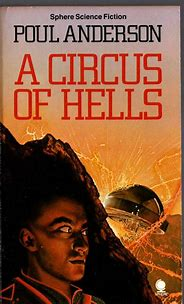
A Circus Of Hells, CHAPTER SIX.

In the Solar System, there are moons with heat inside, ice outside, therefore possibly liquid water containing life between them but, until that is confirmed, Earth remains the only known abode of life. In Poul Anderson's Technic History, there are many abodes of life. Biologists can generalize from many examples instead of from just one. In Anderson's concluding future history, Genesis, any kind of organic life is extremely rare and there is no mention of any extra-terrestrial intelligences whereas post-organic intelligences of Terrestrial origin spread through and between galaxies at sub-light speeds. Thus, we are able to  contemplate our universe and two very different Andersonian fictional universes.

Flandry in the Technic History thinks that life does not evolve on a planet where:

cold is deep and permanent;
air is tenuous;
metal is dominant;
radiation is high;
the planetary system has not yet finished condensing -

- so why is he attacked by "bugs" on Wayland? We continue to read.

Crater Wall And Cosmic Static

A Circus Of Hells.

As Flandry climbs a crater wall, he hears:

"...the moan of wind..." (p. 233);
crunching snow;
rattling stones;
his breath;
his heartbeat.

The crater floor is:

rock;
ice;
drifting snow;
ultraviolet radiation from which his faceplate protects him.

Above are:

ragged clouds;
alien constellations;
turbulent Regin, the gas giant of which Wayland is a moon.

Why list all these items? Well, Poul Anderson could just have written that Flandry climbed a crater wall and not thought to include all these details. In fact, there are more but I have to stop somewhere.

Chess, Merseians, Fair, Rain And Kree

A Circus Of Hells.

Do we really want to reread CHAPTERs SIX-NINE about Flandry and Djana gradually realizing that the conscious computer on Wayland is playing chess with robots shaped like life-sized knights, bishops etc? Or would we instead prefer to skip ahead to CHAPTER TEN where the two human beings leave Wayland and are captured by Merseians? I will dip into CHAPTER SIX although I do not expect to find much new in it to post about.

Today we attended the Lancaster Green Party Christmas Fair which I have mentioned before and which fills the Friends' Meeting House. I recognized some books on the book stall, having donated them. Other events have happened around town including a lot of rain but now we are back home for the evening.

Other reading emphasizes the extent to which superheroes are grounded in sf. In a history of Marvel Comics: it had been established that a species called the Kree controlled an interstellar empire before it was decided that the Kree would dispatch to Earth a spy called Mar-Vell, Captain Marvel.

Spacefarers II

Implacability is also inner: "inner space." When we look inside ourselves, we see that we are still the same person that we were yesterday and the day before that. This cannot be changed by an act of will or by a magic rite. A monk interviewed on television made the point that he had not become "Super-monk" immediately on taking his vows.

As a species and as individuals, we were active organisms long before we became reflective subjects. By the time that we begin to reflect on life, our lives already contain both the effects of past actions and a deeply rooted disposition to continue acting in the same way even though this has been problematic. This is the problem of "karma" (action) which need not involve rebirth. Actions matter because they have consequences, the same kinds of consequences for the same kinds of actions. Implacability again.

Poul Anderson's first future history series addresses the issue that the "protean enemy" of mankind is mankind. Practicing zazen means facing this fact twice a day. It does not involve realizing supreme enlightenment, unfortunately. We have to sit with whatever comes up but we don't have to like it. But self-knowledge is better than self-deception.

Friday, 22 November 2024

Whittering Wind On Wayland

A Circus Of Hells.

Shipwrecked on Wayland, Djana wants to send a message courier torpedo back to Irumclaw although this will get Flandry into no end of trouble with his superiors. They watch for the torpedo to depart. The view is desolate, black sky, boiling fog and steaming mist as carbon dioxide and ammonia snow vaporizes, exposing water ice and, of course:

"A whitter of wind came in through the hull." (p. 231)

A flying Waylander robot destroys the torpedo.

Good night.

Spacefarers

A Circus Of Hells.

"Now she faced the spacefarers' truth, that the one thing we know for certain about this universe is that it is implacable."
-CHAPTER FOUR, p. 224.

Cosmic implacability is perpetually evident to spacefarers because they have to be continually protected either from vacuum in space or from an unbreathable atmosphere and other hostile conditions on a planetary surface. Earth is the one place in the universe where we do not die immediately. But the implacability is here, nevertheless. Gravity gets us if we fall from a height. And I need hardly list other dangers and threats. Spacefarers see Earth as a borderless unity and the only (so far) abode of life so maybe life on Earth needs to be based on "the spacefarers' truth."

Jake

A Circus Of Hells. 

See:

Spaceships' Names

Terran Naval Craft

Flandry's scout boat is called Giacobini-Zinner because the boat is Comet class and Giacobini-Zinner is a comet.

Flandry nicknames his boat "Jake" for obvious reasons. I never wondered about that boat's name before but the recent encounter with the Comet class boats, Encke and Ikeya-Seki, gave me reason to check. Every background detail in the Technic History is fully consistent.

"Poul Anderson immerses you in the future... Anderson puts you into a whole new world."
-Larry Niven quoted on the back of Young Flandry.

The Narrator And Flandry

A Circus Of Hells.

The narrator, Flandry's biographer or whoever he is, that had opened CHAPTER ONE returns at least twice. CHAPTER TWO begins:

"Such was the prologue. He had practically forgotten it when the adventure began. That was on a certain night about eight months later." (p. 203)

Flandry saunters from the naval base into Old Town. Gradually the text transitions from objective descriptions of his movements and actions to the sharing of his experience:

"He was glad when..." (p. 206)

After a while, we are being told his thoughts:

"A million! Ye gods and demons!" (p. 208)

The biographer is back at the beginning of CHAPTER FOUR:

"The next stage of the adventure came a month afterward. That was when the mortal danger began." (p. 221)

This narrator describes the star, Mimir, its giant planet, Regin, and Regin's moon, Wayland. Lacking an adequate computer, Flandry must manually control his scout boat's approach to Wayland:

"It didn't bother him." (p. 222)

We are back inside his head again. He is taut and aware of vibrations, odour and weight and hears blood beating in his ears.

Later, in this novel, Djana and a Talwinian will be viewpoint characters.

The Lost Planet

A Circus Of Hells.

Rax asks Djana:

"'Where is the lost planet? What is its nature?'"
-CHAPTER THREE, p. 216.

An evocative phrase like "the lost planet" might have different connotations for different readers. In fact, googling brings up multiple references. In the 1950s, I saw some episodes of a TV series and read perhaps the first two juvenile novels connected with this series. See here. I am finding the Wikipedia accounts slightly inconsistent. I like the idea of Space Agent From The Lost Planet as the last of six Lost Planet books and the first of three Space Agent books. Similar crossover titles are Tarzan At The Earth's Core and She And Allan.

This has taken us a long way from Poul Anderson's characters, Rax and Djana, but that is the nature of literary connotations. Possibly Anderson intended the phrase, "lost planet," to have just a literal meaning with no other implications but that is not necessarily how it works in the minds of his readers.

Needless to say, Anderson's "lost planet," Wayland, is entirely his own creation and in no way derivative from anyone else's ideas.

Rax's Face


A Circus Of Hells.

"Rax placed itself before [Djana]. She had no way of reading expressions on that face."
-CHAPTER THREE, p. 215.

Nor have we since the face has not been described to us! All we have been told is that Rax's "...lumpy gray body..." walks on "...four thin legs..." (p. 213), that it has two tentacles and that the head at the middle of this body is about level with Djana's waist. Rax sounds like a Reardonite in Poul Anderson's Psychotechnic History although the latter has four tentacles and petals for a head. The only Reardonite that we see is called Smokesmith and he is completely different in character from Rax - opposite, in fact.

My points here are:

imagine the confrontation between Djana and Rax on screen;

film-makers would have carte blanche to give Rax any kind of face that they could imagine.

We would want a film to be both faithful and imaginative.