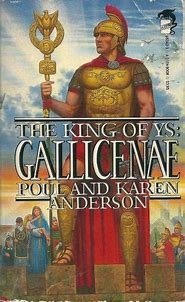
Tuesday, 11 July 2023

Dahut Confronts Corentinus


Gallicenae, XII, 5.

During celebrations in the Forum, Corentinus, backed by his small congregation, preaches from the steps of the former Temple of Mars, now his church. He tells Ysans that their Gods' time is past and that those Gods, now demons, are leading them:

"'...to the burning that waits down in hell...'" (p. 289)

Offensive nonsense. In the extremely unlikely event that an omnipotent creator has designed the universe in such a way, first, that most of us are damned and, secondly, that we do not believe that we are damned, then obviously we cannot do anything about it. We will continue to live and act according to our beliefs, not according to Corentinus'. If we are to be judged unjustly, that is out of our control.

Ysans ignore Corentinus except for Dahut who runs forward, momentarily making the preacher hope that maybe he has made a convert. Instead, she denounces him as a liar and affirms that the Gods are strong. Dahut is wrong in one respect. Corentinus is not deliberately speaking falsehood.

Ludicrously, he asks her:

"'...you have but seven years in this world. How can you know?'" (p. 290)

- a question that he would not have asked if she had embraced his Faith. But how can a seventy-year-old know anything about an alleged afterlife? And what is the relationship between the verbs, "believe" and "know"? Corentinus' religion is about belief, not knowledge.

The Ysan festival needs to generate enough music and other sounds to drown out Corentinus' sermon. At other times, when he is preaching without giving offense at a festival, some Ysans should stop, listen, ask questions, present alternative views and demonstrate their ability to "think," as he urges them to do.

Comets

Gallicenae, XII, 3.

Queen Bodilis:

"'Whatever comets are - Aristoteles thought them mere vapours in the upper air - the chronicles tell us they've come and gone with less serious consequences than so many thunderstorms.'" (p. 274)

"Adam had no superstitious horror of comets; unlike the mob, he knew what they were, and their place in the scheme of things. They were simply bodies of earthly fire which, because of an affinity for one of the fixed stars, had been sublimated and drawn into the sublunar heavens, there to share the motion of the star that had called them up. But it followed from this that on the earth there would be an infirmity or corruption in the men, plants and animals over which that star principally ruled.
"And the stars in the tail of the Dragon ruled those who ordered their lives by princes."
-James Blish, Doctor Mirabilis IN Blish, After Such Knowledge (London, 1991), pp. 1-381 AT VI, p. 137.

Well, that would follow, wouldn't it? Adam Marsh "knew" what comets were because Doctor Mirabilis, Chapter VI, is narrated from his point of view. Queen Bodilis is more appropriately agnostic on the topic. 

Monday, 10 July 2023

Young Dahut

Gallicenae, XI.

The remainder of this chapter recounts formative experiences for five-year-old Dahut who:

sees her father unlock the sea gate;
sees dead bodies in brine awaiting sea burial;
has nightmares;
goes alone out of the city;
hears wind boom;
sees "...a hawk on high..." (6, p. 263);
converses with a seal.

Chapter XII begins in the saga style that Poul Anderson uses elsewhere:

"There was a man called Flavius Stilicho." (1, p. 267)

I have no memory of this character so will reread with interest.

Meanwhile...

Gallicenae, XI.

When a narrative broadens out, some of its incidents are contemporaneous rather than sequential. Thus, in Poul Anderson's Technic History, while Nicholas van Rijn adventures in space, Adzel studies on Earth and, later, van Rijn and David Falkayn have simultaneous adventures on different planets. In Poul and Karen Anderson's The King of Ys, while Gratillonius settles Drusus in Aquilo, his deputy, Adminius, is married in the Ysan Nymphaeum. Various already established characters interact: Adminius, Cynan, Budic, Queen Forsquilis, Corentinus and Keban and even the Ysan God, Taranis, makes a nocturnal appearance. The Christian minister, Corentinus, must cope with the fact that his catechumen, Budic, has seen Taranis. Since Budic is not called to celibacy, might he agree to marry the newly converted Keban, who needs a good position, for the good of both their souls? Corentinus' ministry combines spirituality with practicality.

Three Senses In Aquilo

Gallicenae, XI, 1.

Gratillonius settles the veteran, Drusus, in Aquilo where he will lead a strong reserve force. While they speak, there is:

summer warmth

voices
footfalls
hoofbeats
wheel-creak
hammer-clash

smoke
green growth

In a short descriptive paragraph, the co-authors invoke three senses.

The local senator, Apuleius, can tell that Drusus' life has been:

"'...one endless march from battle to battle, homeless as the wind...'" (p. 238)

The wind serves many purposes in Andersonian texts.

Gratillonius and Drusus meet Apulieus' four-year-old daughter, Verania. The text begins to anticipate what Gratillonius' life will be like after the fall of Ys.

Sunday, 9 July 2023

The Gods Move

Gallicenae, X.

The Gods and the Queens and the other officials of Ys have a common problem. Although some action must be taken against Gratillonius because of his defiance of the Gods, he cannot yet be destroyed or deposed because he alone can protect Ys from the barbarians and the Romans. Even Rufinus, whom Gratillonius, by the Pact of Brennilis, should have sacrificed to Taranis has become a bulwark of civilization in Armorica. Queen Innilis begs the wind for no harm to Gratillonius. (IX, 3, p. 213)

Nevertheless, the Gods make a move. Quinipilis dies. The sign comes upon Semuramat, daughter of Queen Bodilis. Mithras forbids Gratillonius to continue having sex with Bodilis after consummating the marriage with her daughter. The Gods have not yet wedded Gratillonius to his own daughter - she is too young - but They are moving in that direction.

While discussing this problem, Gratillonius and Bodilis take a picturesque walk through Ys:

Elven Gardens
lanes
Lir Way
the Forum
Taranis Way
Goose Fair plaza
a staircase
the city wall
the Raven Tower
marine guards
battlements
war engines
the sea gate
towertops vulnerable to the sea which however murmurs Hush
clear air
a light on the island of Sena

There is so much that deserves to be preserved.

Two Uncertainties

Two uncertainties are built into the plot of Poul and Karen Anderson's The King of Ys. First, a challenger can arrive in the Wood at any time. This means mortal combat for the King and possibly a new King. Secondly, one of the nine Queens can die at any time. This means the sign appearing on a vestal who becomes the new Queen. The Gods of Ys choose which vestal and eventually will decide on a daughter of Gratillonius, knowing that Mithras, like Christ, abhors incest. That will be the beginning of the doom of Ys but the current rereading is only at the midpoint of Volume II where the narrative broadens out to encompass characters throughout Ys and Armorica and jumps over months during which many unrecorded events must occur. 

This week, hopefully, a visit to Andrea who has become a recurring character on this blog. Onward, Earthlings.

Saturday, 8 July 2023

Change In Armorica And Ys

Gallicenae, IX, 2.

Character interactions continue on a continental scale. Merowech the Frank and his sons, one-off characters, are ambushed by Rufinus' Bacauda band, now working for the anonymous King of a wonderful city. Outlaws become militia. Brigands become scouts for civilization against the barbarians. Gratillonius works good for all Armorica. Slaves bought to be sacrificed are rescued and freed. Wotan will have to be satisfied with animals - like Taranis when, earlier, Gratillonius had refused to sacrifice Rufinus. We project the Gods so we can tame them. The Three will wreak havoc but will then withdraw. What is happening now at the end of the Age of the Fish? (I began this paragraph with Merowech and did not expect to end it with the Three and the end of an age.)

Section 3 is about two Queens and a princess at the seaside. The incoming tide destroying Dahut's sandcastle, which she calls "Ys," symbolizes or summarizes the plot of the Tetralogy.

In Section 4, Gratillonius' granaries counteract the effects of poor harvests so that, if it is Taranis Who sends rainstorms, lightning and hail, then his attempted vengeance does not succeed and the King continues his triumph. Wind shrieks when Corentinus visits Gratillonius and keens when the Kings offers to pay for a Mass for Maximus. The two men plan the settlement of veterans in Armorica, then Queen Bodilis arrives to inform Gratillonius that Queen Quinipilis is dying.

The main theme of the Tetralogy is change.

An Alehouse In Winter

Gallicenae, IX, 1.

Gratillonius defies the Gods of Ys by sparing a defeated challenger but is too successful and popular as King of Ys for any (human) action to be taken against him. Even the fanatical Speaker for Taranis is relieved when he must accept that that is how things are.

Time passes between chapters so that new stories could be written to fill the intervals. Chapter IX begins in winter when three Romans enter an Ysan alehouse. Two Christian soldiers, Adminius and Budic, bring their new clergyman, Corentinus, to meet Ysans. Characters interact: the three Romans; Herun of the navy; the prostitute, Keban; the fisher captain, Maeloch. A spin-off series could be written about such subsidiary characters. Corentinus provokes Maeloch but then buys him a drink and tells stories and all is well.

Section 2 introduces some Franks and I have not reread that far yet.

Wind In Ys II

Gallicenae, VIII, 4.

As Gratillonius sets off to face the challenger in the Wood:

"The wind shrilled, sent dead leaves scrittling along the street, roused little breakers on rain puddles." (p. 184)

Dead leaves lead the King to a death, either his or the challenger's. Or so we think.

"...a squad of marines formed a line to hold back the crowd.
"Through the wind, Gratillonius heard shouted wishes for his victory." (p. 185)

The wind symbolizes the forces ranged against him and, against that, is the support of his subjects.

In the Wood where the fight must take place:

"Wind eddied about, wailed and mumbled." (p. 186)

Incessant threat.

When, by the royal oak, the Speaker for Taranis signs the kneeling King and challenger with holy water and invokes the Father God:

"Wind boomed. A raven flew overhead." (p. 187)

When Gratillonius and the challenger, Rufinus, already known to each other, go off alone and converse before fighting:

"Wind brawled, swirled under armour, made the Wood groan." (p. 189)

They do not want to fight. Groaning is appropriate.

When Rufinus promises to be gentle with the Queens and their daughters if he wins, he:

"...traced a sign with his spear, in the wind." (p. 189)

When they prepare to fight:

"Wind keened; the raven, settled on an unrestful bough, croaked hoarsely; fallen leaves squelped." (p. 190)

The Greek chorus of the wind has been joined by the raven and the leaves.

And again:

"Wind blew." (ibid.)

It never lets up. While they fight:

"Through the wind, Gratillonius heard how Rufinus panted, while blood soaked his breeches and footsteps." (p. 191)

When Gratillonius should, by the law of Ys, kill the defeated Rufinus, he remembers that Mithras forbids human sacrifice and:

"It was as if Bodilis were suddenly there in the wind and the wet, Bodilis whom Gratillonius would seek back to as soon as he was able." (p. 192)

Gratillonius extracts Rufinus' surrender and spares his life. The wind brings death and life.