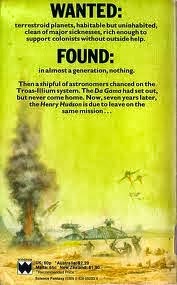
"Warp drive" and "hyperdrive" are two science fiction (sf) cliches for faster than light interstellar travel (FTL). These terms may be used interchangeably, if, for example, interstellar journeys are made through a "warp" in "hyperspace." Poul Anderson is always careful to clarify what he means by such terminology and also to differentiate between the means of FTL used in different fictitious scenarios.
Thus, in his Technic Civilization History, "hyperspace" is not a fourth spatial dimension but a series of instantaneous quantum jumps through three dimensional space. Disappearing at point A and re-appearing at Point B, a ship does not move between A and B and therefore is not limited to light speed but instead has a much greater "pseudo-velocity."
The warp drive in his Planet Of No Return (London, 1971) differs from this.
(i) "It does not take appreciably more time and energy to go 100,000 light-years than to go one." (p. 20) Consequently, interesting but distant stars are investigated before nearer but ordinary ones.
(ii) Going into warp involves the ship's engines roaring as they approach "...the potentials beyond which the omega effect set[s] in." (p. 25) The crew feels dizzy as the ship leaves "...normal energy levels..." and as atoms readjust in non-Dirac matrices.
(iii) There is complete blackness outside the viewports.
(iv) The ship, now irrelevant to the universe, has nothing to accelerate or spin in relation to, but centrifugal force is generated by rotating the inner hull in relation to the outer.
(v) Anderson writes that:
"It was like an endless falling through nullity." (ibid.)
But surely there is nothing to fall in relation to? Except that the ship and its contents were in free fall in relation to each other until centrifugal force was generated?
The first page of Chapter 4, having described "warp," introduces the fifth of the seven human "Cast of Characters," Tetsuo Hideki, Manchurian organic chemist.
Monday, 23 September 2013
Planet Of No Return II
Poul Anderson's Planet Of No Return (London, 1971) is a science fiction novel in which the "sciences" are both psychological and physical. Chapter 2 lists five flaws in human thinking:
contradictory beliefs;
inadequate thinking;
surface thinking;
conditioned reflexes;
rationalized emotions.
Chapter 3 lists five requirements for a habitable planet:
atmosphere;
radiation level;
temperature;
gravity;
ecology.
Miners, penal colonists and refugees have colonized Mars, Venus and the Jovian moons with domes and tank food but, for extra-solar colonization, terrestroid planets are sought and not found.
Atmosphere needs oxygen and other gasses, none of them poisonous. Gravity must be great enough to retain the atmosphere but "...not so great as to throw the human body fluid adjustment out of kilter." (p. 21) Edible plants and animals need bacteria, saprophytes and earthworms that in turn require an entire ecology. Separate evolution has probably produced inedible or poisonous organisms and cannot have duplicated all the vitamins.
An astronomical expedition has detected the first ever terrestroid extra-solar planet in the Lagrange system, so, at the beginning of the novel, a Lagrange Expedition II is being organized, Expedition I having disappeared. At first, I found the reference to "Lagrange" confusing because the term is applied to orbital points within the Solar System but here it is the name of a star.
contradictory beliefs;
inadequate thinking;
surface thinking;
conditioned reflexes;
rationalized emotions.
Chapter 3 lists five requirements for a habitable planet:
atmosphere;
radiation level;
temperature;
gravity;
ecology.
Miners, penal colonists and refugees have colonized Mars, Venus and the Jovian moons with domes and tank food but, for extra-solar colonization, terrestroid planets are sought and not found.
Atmosphere needs oxygen and other gasses, none of them poisonous. Gravity must be great enough to retain the atmosphere but "...not so great as to throw the human body fluid adjustment out of kilter." (p. 21) Edible plants and animals need bacteria, saprophytes and earthworms that in turn require an entire ecology. Separate evolution has probably produced inedible or poisonous organisms and cannot have duplicated all the vitamins.
An astronomical expedition has detected the first ever terrestroid extra-solar planet in the Lagrange system, so, at the beginning of the novel, a Lagrange Expedition II is being organized, Expedition I having disappeared. At first, I found the reference to "Lagrange" confusing because the term is applied to orbital points within the Solar System but here it is the name of a star.
The Byworlder: Conclusion
When discussing Poul Anderson's later novel, For Love And Glory, I drew attention here to a literary technique deployed quite often in that work. The concluding sentence or phrase of a chapter would indicate what was going to happen next: things were due to turn bad later etc. These anticipations encourage us to continue reading even though we usually forget them almost immediately.
The technique is used once in The Byworlder (London, 1974):
"...until the hour came when everything was ruined." (p. 162)
We empathize with the characters and vicariously enjoy their breakthrough in communicating with the alien so it is disturbing to be informed that everything is going to be ruined - and it is quite a long time before this happens.
As a result of violence in the spaceship, the Sigman and the Chinaman wind up dead. This leaves the potentially destructive ship under the sole control of a Byworlder, who does not turn it over to any Terrestrial government but instead monopolizes it for peaceful scientific exploration. Thus, a Byworlder saves the world, not from any external threat but only from itself. As I said a few posts ago (here), in a Poul Anderson novel, we can trust individuals, not governments, to make the right decisions. The death of the peaceful, beauty-seeking alien at the hands of an agent of the Chinese government is indeed ruinous but, even despite that, an ultimately satisfactory conclusion is reached.
When the Chinaman refers to the US government as "'...the fascists...'" (p. 180), the Byworlder replies:
"'You're supposed to be a semanticist. How can you think a swear word like 'fascist' means anything, or using it solves anything?'" (p. 181)
He is right. "Fascist" had a precise meaning in its original context but has become a swear word when extracted from that context and used in Chinese government propaganda.
The technique is used once in The Byworlder (London, 1974):
"...until the hour came when everything was ruined." (p. 162)
We empathize with the characters and vicariously enjoy their breakthrough in communicating with the alien so it is disturbing to be informed that everything is going to be ruined - and it is quite a long time before this happens.
As a result of violence in the spaceship, the Sigman and the Chinaman wind up dead. This leaves the potentially destructive ship under the sole control of a Byworlder, who does not turn it over to any Terrestrial government but instead monopolizes it for peaceful scientific exploration. Thus, a Byworlder saves the world, not from any external threat but only from itself. As I said a few posts ago (here), in a Poul Anderson novel, we can trust individuals, not governments, to make the right decisions. The death of the peaceful, beauty-seeking alien at the hands of an agent of the Chinese government is indeed ruinous but, even despite that, an ultimately satisfactory conclusion is reached.
When the Chinaman refers to the US government as "'...the fascists...'" (p. 180), the Byworlder replies:
"'You're supposed to be a semanticist. How can you think a swear word like 'fascist' means anything, or using it solves anything?'" (p. 181)
He is right. "Fascist" had a precise meaning in its original context but has become a swear word when extracted from that context and used in Chinese government propaganda.
Sunday, 22 September 2013
Planet Of No Return
The "CAST OF CHARACTERS" of Poul Anderson's Planet Of No Return (London, 1971) presents seven members of the crew of the spaceship Henry Hudson, each identified by name, nationality and profession.
The four pages of Chapter 1 introduce the first, Kemal Gummus-Lugil, Turkish rocket engineer. The eight and a half pages of Chapter 2 introduce the next three in conversation with each other:
John Lorenzen, Lunarian astronomer;
Ed Avery, North American psychomed;
Joab Thornton, Martian physicist.
As always, Anderson addresses profound issues with apparently casual confidence. When Thornton has left, Lorenzen comments on the apparent contradiction between the former's scientific brilliance and his religious beliefs. Avery replies that they are "'...finally getting a science of man...'" (p. 17) but that, for the time being, most people remain irrational:
believing contradictions;
not really learning how to think;
thinking "'...only with the surface of their minds...'" (p. 16);
responding with conditioned reflex;
rationalizing fears and hates.
This novel is not only about space travel but also about sanity and whether a science of man is possible.
The four pages of Chapter 1 introduce the first, Kemal Gummus-Lugil, Turkish rocket engineer. The eight and a half pages of Chapter 2 introduce the next three in conversation with each other:
John Lorenzen, Lunarian astronomer;
Ed Avery, North American psychomed;
Joab Thornton, Martian physicist.
As always, Anderson addresses profound issues with apparently casual confidence. When Thornton has left, Lorenzen comments on the apparent contradiction between the former's scientific brilliance and his religious beliefs. Avery replies that they are "'...finally getting a science of man...'" (p. 17) but that, for the time being, most people remain irrational:
believing contradictions;
not really learning how to think;
thinking "'...only with the surface of their minds...'" (p. 16);
responding with conditioned reflex;
rationalizing fears and hates.
This novel is not only about space travel but also about sanity and whether a science of man is possible.
More Evolutionary Differences
In The Byworlder (London, 1974), Poul Anderson imagines an extra-terrestrial that is genuinely alien, both physically and psychologically. The Sigmans:
"...swam in an ocean of sense data and responded to nuances on almost the molecular level." (p. 161)
A single individual Sigman can make a slower than light interstellar journey and spend years exploring the Solar System because its many interacting subpersonalities are never isolated in the midst of the cosmos. Curiosity, which is thought to have called forth intelligence in human beings, is a lesser motivation for Sigmans because their sensory apparatus already makes them fully open to, and intensely aware of, their environment. However, within this wealth of perception, they might have been driven to find, then make, "...harmonious conditions of life." (ibid.) Harmony is an aesthetic value.
Scientific method has two outcomes: knowledge and elegant resolutions of apparent chaos. Human beings and Sigmans value both of these outcomes but human beings emphasize knowledge where Sigmans emphasize elegance, an aesthetic criterion that prevents them from either waging war or polluting their environment, even when scientific discoveries have made possible potentially destructive technology. Anderson did imagine some man-like aliens but this is not one of them. From cells to soul, Sigmans are dissimilar.
This novel, set in the early twenty first century, was originally serialized in 1971, thirty years before 2001. Yvonne asks Skip:
"'Do you remember the turn of the century?'" (p. 165)
Readers can now answer, "Yes!" However, Yvonne goes on to contrast the optimism of the new millennium with the new hope offered by contact with the Sigman:
"'This is the same. Only it's not a youthful illusion now, it's real. It's forever!'" (p. 166)
"...swam in an ocean of sense data and responded to nuances on almost the molecular level." (p. 161)
A single individual Sigman can make a slower than light interstellar journey and spend years exploring the Solar System because its many interacting subpersonalities are never isolated in the midst of the cosmos. Curiosity, which is thought to have called forth intelligence in human beings, is a lesser motivation for Sigmans because their sensory apparatus already makes them fully open to, and intensely aware of, their environment. However, within this wealth of perception, they might have been driven to find, then make, "...harmonious conditions of life." (ibid.) Harmony is an aesthetic value.
Scientific method has two outcomes: knowledge and elegant resolutions of apparent chaos. Human beings and Sigmans value both of these outcomes but human beings emphasize knowledge where Sigmans emphasize elegance, an aesthetic criterion that prevents them from either waging war or polluting their environment, even when scientific discoveries have made possible potentially destructive technology. Anderson did imagine some man-like aliens but this is not one of them. From cells to soul, Sigmans are dissimilar.
This novel, set in the early twenty first century, was originally serialized in 1971, thirty years before 2001. Yvonne asks Skip:
"'Do you remember the turn of the century?'" (p. 165)
Readers can now answer, "Yes!" However, Yvonne goes on to contrast the optimism of the new millennium with the new hope offered by contact with the Sigman:
"'This is the same. Only it's not a youthful illusion now, it's real. It's forever!'" (p. 166)
Grand Tour
In Poul Anderson's The Byworlder (London, 1974), the extra-solar visitor and his three human passengers make an aesthetic (not scientific) Grand Tour of the Solar System. Thus, they experience, first, the alien spaceship which is like:
"...a plant-animal symbiosis, drawing energy from its private thermonuclear sun, nourishment from the gas and stones of space." (pp. 149-150)
The ever-changing interior contains:
rich, strange odours;
complex patterns of resonant, sibilant tones;
alternating breezes and calm, dimness and brightness;
rippling, waste-absorbing decks;
labyrinthine corridors;
passages expandable as rooms with temporarily grown furniture.
Outside the ship, the travellers see:
the "...hundred different umbers and rust-reds..." of Mars (p. 151);
"Jupiter, imperial world...," described in a poetic paragraph (p. 156);
the "...gigantic rainbows..." of Saturn's rings seen from below (p. 163);
Mercury, "...crags and craters under a black sky...pools of molten metal..." (p. 172);
"Sunward of Mercury...an unutterable white splendour..." (p. 174);
"(...[the Sigman] found Venus as unattractive at close quarters as men did.)" (p. 166)
The Sigmans have neither waged wars nor polluted their environment. The visiting Sigman seems to assume that humanity is as innocent as the few other races with atomic power that it has encountered. Has it found only innocent races because others have destroyed themselves? How will Sigman technology affect human society? I have yet to reread to the end of the novel...
"...a plant-animal symbiosis, drawing energy from its private thermonuclear sun, nourishment from the gas and stones of space." (pp. 149-150)
The ever-changing interior contains:
rich, strange odours;
complex patterns of resonant, sibilant tones;
alternating breezes and calm, dimness and brightness;
rippling, waste-absorbing decks;
labyrinthine corridors;
passages expandable as rooms with temporarily grown furniture.
Outside the ship, the travellers see:
the "...hundred different umbers and rust-reds..." of Mars (p. 151);
"Jupiter, imperial world...," described in a poetic paragraph (p. 156);
the "...gigantic rainbows..." of Saturn's rings seen from below (p. 163);
Mercury, "...crags and craters under a black sky...pools of molten metal..." (p. 172);
"Sunward of Mercury...an unutterable white splendour..." (p. 174);
"(...[the Sigman] found Venus as unattractive at close quarters as men did.)" (p. 166)
The Sigmans have neither waged wars nor polluted their environment. The visiting Sigman seems to assume that humanity is as innocent as the few other races with atomic power that it has encountered. Has it found only innocent races because others have destroyed themselves? How will Sigman technology affect human society? I have yet to reread to the end of the novel...
Saturday, 21 September 2013
Five Sisters
(This is the 100th post for September. The theory is that I now take a break or draft some notes to be posted early in October. However, practice can diverge from theory.)
Page 143 of Poul Anderson's The Byworlder (London, 1974) has an intriguing misprint:
"...they were coming to know one who fared between the stairs."
Obviously, the alien fares between the stars. However, this is a fortuitous error. I am sure that either Neil Gaiman, author of Neverwhere, featuring London Below, or China Mieville, author of Un Lon Don, would be able to write a juvenile fantasy about "One Who Fared Between The Stairs." That phrase should be able to inspire a novel - how many worlds might be concealed between the stairs from the front hall to the first landing? - although I am not able to write it.
Recently, as I mentioned at the time, we visited York and I meditated in the Minster. I noted references to York in Poul Anderson's novels. Here is another such reference. In The Byworlder, the alien "Sigman" has come to the Solar System in search of artistic inspiration. Terrestrials mistakenly tried to communicate with words instead of with shared art. Having realized their error, they now show him a large and varied selection of works of art, including the Five Sisters windows in York Minster. See attached image.
Sharing beauty from different periods and cultures kind of puts the political rivalries between the US and China into a different perspective. Hopefully, the novel approaches a happy resolution although, at least in his short stories, Anderson sometimes gave us anything but a happy ending.
Page 143 of Poul Anderson's The Byworlder (London, 1974) has an intriguing misprint:
"...they were coming to know one who fared between the stairs."
Obviously, the alien fares between the stars. However, this is a fortuitous error. I am sure that either Neil Gaiman, author of Neverwhere, featuring London Below, or China Mieville, author of Un Lon Don, would be able to write a juvenile fantasy about "One Who Fared Between The Stairs." That phrase should be able to inspire a novel - how many worlds might be concealed between the stairs from the front hall to the first landing? - although I am not able to write it.
Recently, as I mentioned at the time, we visited York and I meditated in the Minster. I noted references to York in Poul Anderson's novels. Here is another such reference. In The Byworlder, the alien "Sigman" has come to the Solar System in search of artistic inspiration. Terrestrials mistakenly tried to communicate with words instead of with shared art. Having realized their error, they now show him a large and varied selection of works of art, including the Five Sisters windows in York Minster. See attached image.
Sharing beauty from different periods and cultures kind of puts the political rivalries between the US and China into a different perspective. Hopefully, the novel approaches a happy resolution although, at least in his short stories, Anderson sometimes gave us anything but a happy ending.
The Underworld
In Poul Anderson's The Byworlder (London, 1974), early twenty first century society has divided into Orthos, Byworlders and Underworlders. To us, "organized crime" means illegal activities like protection and prostitution run by large criminal organizations sometimes, especially in the Italian tradition, controlled by powerful families. Anderson's "Underworld" seems to take organized crime to a new level, an entire social subculture, although we are not told many of the details.
When the heroine of the novel is professionally kidnapped by a man with faked Secret Service ID, the hero, putting his personal knowledge of the local Underworld to good use, tortures a knowledgeable consultant clairvoyant, thus learning some addresses to which he directs the FBI, who indeed then rescue the kidnap victim from an address on the list. Too easy? Implausible?
This part of the novel contains little science fiction except that:
the success of the hero's ploy seems to depend on a greater degree of "Underworld" cohesion than existed in the period when the novel was written;
a technological innovation enables him to smuggle a weapon into the clairvoyant's presence despite being searched by a bodyguard.
The kidnapping, and before that a murder attempt, make sense, in terms of the plot of the novel, because the heroine has made a breakthrough in communicating with the orbiting alien whose technology had better not be acquired by any one Terrestrial nation. The Chinese are clearly bad news although the heroine's opposite number among their scientists is a good guy. The Americans are also trying to get a monopoly on alien knowledge so is their government acting for the best?
In a Poul Anderson novel, we can depend on individuals to make the right decisions.
When the heroine of the novel is professionally kidnapped by a man with faked Secret Service ID, the hero, putting his personal knowledge of the local Underworld to good use, tortures a knowledgeable consultant clairvoyant, thus learning some addresses to which he directs the FBI, who indeed then rescue the kidnap victim from an address on the list. Too easy? Implausible?
This part of the novel contains little science fiction except that:
the success of the hero's ploy seems to depend on a greater degree of "Underworld" cohesion than existed in the period when the novel was written;
a technological innovation enables him to smuggle a weapon into the clairvoyant's presence despite being searched by a bodyguard.
The kidnapping, and before that a murder attempt, make sense, in terms of the plot of the novel, because the heroine has made a breakthrough in communicating with the orbiting alien whose technology had better not be acquired by any one Terrestrial nation. The Chinese are clearly bad news although the heroine's opposite number among their scientists is a good guy. The Americans are also trying to get a monopoly on alien knowledge so is their government acting for the best?
In a Poul Anderson novel, we can depend on individuals to make the right decisions.
Maury Station
In Poul Anderson's The Byworlder (London, 1974), Maury Station, staffed by respectable, conventional scientists, must be Ortho, not Byworld? Pages 100-104 present some minimal information about the Station. Still rereading the novel with 80 pages left, I cannot remember whether there is more about sea life later.
The purpose of summarizing interesting details from Anderson's novels is to convey an appreciation of the imaginative depth and wealth crowded into each work.
Fifty kilometers from the Oregon coast, platforms with projecting piers support buildings, machinery and a shaft with an elevator descending fifty fathoms to the central undersea dome which is surrounded by a ring of other domes kept at ambient pressure and connected by tunnels. Laboratory experiments include producing alcohol from plankton. When the Viking fleet delivers a cargo of refined metals, its flag ship, too large to dock, anchors at a safe distance while the concentrator ship lays alongside a pier.
"McPherson 'gills'..." (p. 103) extract oxygen for the artificially generated merfolk who are evolving dialects appropriate to the high-pitched speech caused by the helium content of the air in the decompression chambers joining the tunnels to the main dome. In the water, a man directs an orca. I think that there were earlier references to cetacean speech although I cannot find them looking back. There are transparent submarines. Soon, there will be a new undersea civilization. The oceans cover what, two thirds of the Earth's surface?
That is it. In mid-paragraph, the viewpoint characters who have visited the Station are back with the Viking fleet. I am sure that Anderson would have worked out a lot more detail for Maury Station and there might be more of it later in the book.
The purpose of summarizing interesting details from Anderson's novels is to convey an appreciation of the imaginative depth and wealth crowded into each work.
Fifty kilometers from the Oregon coast, platforms with projecting piers support buildings, machinery and a shaft with an elevator descending fifty fathoms to the central undersea dome which is surrounded by a ring of other domes kept at ambient pressure and connected by tunnels. Laboratory experiments include producing alcohol from plankton. When the Viking fleet delivers a cargo of refined metals, its flag ship, too large to dock, anchors at a safe distance while the concentrator ship lays alongside a pier.
"McPherson 'gills'..." (p. 103) extract oxygen for the artificially generated merfolk who are evolving dialects appropriate to the high-pitched speech caused by the helium content of the air in the decompression chambers joining the tunnels to the main dome. In the water, a man directs an orca. I think that there were earlier references to cetacean speech although I cannot find them looking back. There are transparent submarines. Soon, there will be a new undersea civilization. The oceans cover what, two thirds of the Earth's surface?
That is it. In mid-paragraph, the viewpoint characters who have visited the Station are back with the Viking fleet. I am sure that Anderson would have worked out a lot more detail for Maury Station and there might be more of it later in the book.
Terrestrial And Sigman Metazoans
Stages of Terrestrial Evolution
protozoa, some swimming with cilia;
a clump of aggregated cells;
a hollow sphere;
two concentric spheres;
spheres with specialized inner and outer walls and an opening at either end for intake and excretion;
colonies like sponges and corals;
cells joined end to end as segmented worms;
complex organisms retaining bilateral symmetry and an oral-digestive-anal tract;
branched-off organs like heart and lungs adopting the canal principle.
Stages of Sigman Evolution
spheroidal, not flat, protozoans with universally spaced cilia for swimming and whipping food towards the animalcule which is permeable, without orifices;
cells joined by linking cilia which became tubes for support and fluid conveyance;
complex organisms comprising spheroids connected by rods with axial or radial, not bilateral, symmetry and permeable skin;
possibly sensing and thinking with the whole body, not needing a brain, thinking more slowly but also more deeply.
Conclusion
Human beings have a lot to learn from the disgusting looking alien.
protozoa, some swimming with cilia;
a clump of aggregated cells;
a hollow sphere;
two concentric spheres;
spheres with specialized inner and outer walls and an opening at either end for intake and excretion;
colonies like sponges and corals;
cells joined end to end as segmented worms;
complex organisms retaining bilateral symmetry and an oral-digestive-anal tract;
branched-off organs like heart and lungs adopting the canal principle.
Stages of Sigman Evolution
spheroidal, not flat, protozoans with universally spaced cilia for swimming and whipping food towards the animalcule which is permeable, without orifices;
cells joined by linking cilia which became tubes for support and fluid conveyance;
complex organisms comprising spheroids connected by rods with axial or radial, not bilateral, symmetry and permeable skin;
possibly sensing and thinking with the whole body, not needing a brain, thinking more slowly but also more deeply.
Conclusion
Human beings have a lot to learn from the disgusting looking alien.
Subscribe to:
Posts (Atom)


