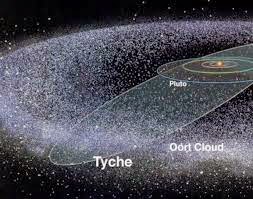
Showing posts sorted by date for query Oort Cloud. Sort by relevance Show all posts

Wednesday, 22 April 2026

HARVEST OF STARS: Summary II

See HARVEST OF STARS: Summary

What I missed:

Conscious AI dominated society which became stable, peaceful and prosperous but neither fulfilled nor content.

Synnoionts are human beings who have become human-AI interfaces.

Lunarians colonized a large, dense asteroid, Proserpina, on a two million year orbit, currently passing from the Kuiper Belt to the Oort Cloud, and mine bodies in those outer regions. 

Nicol did not know about:

Life Mothers guiding planetary ecologies and growing new organic bodies for downloaded personalities;

the colonization of three other extra-solar planets.

Friday, 3 April 2026

How It Looks To Fenn

The Fleet Of Stars.

We have read about:

the colonization of the Alpha Centaurian system;

the exploration of 82 Eridani, Beta Hydri and HD44594;

the colony at Beta Hydri IV;

download Guthrie's journey from Beta Hydri to Alpha Centauri, then to Proserpina in the outer Solar System.

Now we learn how news of these interstellar events filters through to Fenn in the inner Solar System:

"...few people ever came to space any more. Those inside Luna or the Habitat, even those on Mars, they didn't count, not really. The Lunarians at Proserpina and Alpha Centauri - and now fugitive stories of Terrans at three new suns, whole new worlds, and the galaxy open to them -" (4, p. 44)

Fenn wants to be out there and has to choke back his craving.

Most Lunarians in the outer System are not on Proserpina but:

"...in lesser colonies on smaller bodies and in mining bases on comets, thinly spread across immensities that dwarfed the inner Solar System, but growing, venturing, driving their frontiers ever outward, starward." (17, p. 213)

These Lunarians have far more solitude than among the crowded asteroids at Alpha Centauri. One Selenarch, Luaine of Phyle Janou, Wardress of Zamok Gora, represents the Captains of the Outer Comets. There is more activity in the Kuiper Belt and Oort Cloud than among the inner planets and there seems to be none among the outer planets. (Addendum: This last statement is mistaken. See here.)

Sunday, 29 March 2026

A Short Silence

The Fleet Of Stars, 3.

When Guthrie and Jendaire have conversed for a while and he has stated what he wants from her:

"She stood quiet for a while. He could guess how she was calculating. A thrush trilled, a butterfly zigzagged on gorgeous wings, a breeze bore scent of jasmine, the stars passed frostily by." (pp. 40-41)

These pauses can become crowded: thrush, butterfly, breeze, jasmine, stars. The conversation continues but we were grateful for that pause. 

One of the things that Jendaire has told Guthrie is that, although the Proserpinans make some attempt to spy on the inner Solar System, they are more interested in using their field-drive ships to expand through the Oort Cloud whose fringes mingle with the cometary clouds of others stars. A slow, steady route to the stars suitable for a species at home in low gravity and in enclosed but spacious environments.

Wednesday, 22 September 2021

A Contemporary Parallel

With a starting point in some works by Poul Anderson, we have discussed sf characters for whom interstellar space means escape and freedom from Terrestrial tyrannies and we have also compared these characters with the earliest European settlers of North America.  Perhaps to complete this picture, here is the voice of the black hero of a contemporary thriller:

"'I have no plans to ever return to the U.S. I'm seriously considering renouncing my citizenship and becoming a full-fledged Antiguan, and if I never set foot on U.S. soil again, I'll die a happy man...
"'The Feds nailed me once and almost ruined my life; it's not going to happen again. I'm lucky in that I'm getting a second chance, and for some strange reason I'm a bit hesitant to subject myself to your jurisdiction again.'"
-John Grisham, The Racketeer (London, 2018), CHAPTER 42, p. 364.

Different though the genres are, Grisham's hero reminds me of Anderson's Rinnaldir saying that the Oort Cloud is too close and Blish's former Okies congratulating themselves that their newly colonized Greater Magellanic Cloud is receding from the Milky Way.

Monday, 20 September 2021

Interstellar Flight And Freedom

The Stars Are Also Fire, 33.

In American sf, interstellar travel is the ultimate symbol of freedom both because it implies unlimited flight beyond the constraints of the Solar System and because it can also be presented as the ultimate escape from a repressive regime on Earth:

"...Rinnaldir...said more than once, like when recruiting for the migration, that the Oort Cloud itself is too close to Earth. Nothing less than an interstellar passage could give gap enough to stay free, to keep from being swallowed up eventually by the Federation.'" (p. 453)

The speaker in this passage, Aleka, adds, "'His idea of freedom, not mine.'" (ibid.)

This theme of escape from "the Federation" or an equivalent can also be found in:

Robert Heinlein's Future History, Volume III, Methuselah's Children
Poul Anderson's Rustum History
SM Stirling's Draka History
James Blish's Cities In Flight, Volume I, They Shall Have Stars

Tuesday, 10 August 2021

Falaire's Cabin And Proserpina

Harvest The Fire, CHAPTER 9.

Activated bulkheads:

a fantastic moving 3D forest encloses Falaire and Nicol;

they experience trees, stars, a large moon and a warm, audible, spice-scented breeze;

thus, the illusion addresses four senses.

Lunarians live like this all the time. It sounds dreadful to live inside a nickel-iron-stone asteroid in the Oort Cloud but, with knowledge and energy, anything is possible. Thus, in a Proserpinan public place, the ceiling simulates:

"...a violet sky where flames played in the clouds." (p. 142)

Proserpinans are accompanied by exotic metamorphic animals. Masked, plumed dancers precede a Selenarch and his lady. There is loud un-Terrestrial music. I am getting interested in the history of Proserpina as recounted in Volumes II-IV of the Harvest Of Stars Tetralogy.

The Oort Cloud:

"...mingled with the clouds around neighbor suns, an archipelago to lead multimillenial explorers ever onward...." (p. 141)

Imagine crossing an interstellar distance by moving from comet to comet while utilizing energy as lavishly as the Proserpinans.

Friday, 6 August 2021

Lunarian Politics

Harvest The Fire, CHAPTERs 2-3.

On the Moon, Lunarians are now outnumbered by Terrans who have become able to settle permanently. A few of Selenarchic descent retain "...a fragment of former wealth." (p. 47) Others have colonized Proserpina, an iron asteroid in the outer Solar System, from where they mine the Kuiper Belt and Oort Cloud. Because Earth, Luna and Mars now have an equilibrium economy, Earth is terminating its production of antimatter. Proserpinans want to continue using antimatter but have nothing to trade for it. Although they do have fusion power, robotics, industry and nanotech, they might have to stop expanding - which is probably what the cybercosm wants.

Captain Lirion from Proserpina has arrived on Luna and is meeting Lunarians, including leaders of the Rayenn. The cybercosm has sent Venator to spy on Luna. The game is afoot and the plot thickens.

Saturday, 18 April 2020

Beyond Pluto

Sf readers soon learn the difference between interplanetary and interstellar space but there are intermediate layers.

In "The Snows of Ganymede," when Hall Davenant is Coordinator of the Order of Planetary Engineers, men are on Pluto and the next stop is thought to be the stars. Not necessarily. Between Pluto and Proxima Centauri, there are:

hypothetical trans-Plutonian planets;
the Kuiper Belt;
the Oort Cloud;
presumably similar regions around Proxima.

See Cosmography.

Given a source of energy, there would be plenty to explore out there and maybe to colonize as in Poul Anderson's Harvest Of Stars Tetralogy.

Thursday, 29 November 2018

Fenn And Guthrie

Poul Anderson, The Fleet Of Stars, 29.

Fenn meets the legendary download Guthrie and they join forces, initially just to learn the truth, not necessarily to oppose anyone else.

Maybe when Anderson wrote this novel, he knew of the Kuiper Belt but not of the Oort Cloud? Wiki indicates that comets originate in the latter, not in the former.

Guthrie's ship enters:

"...the marches of the Solar System, the domain of the comets. None showed to the eye or the ranging instruments. Millionfold though they were, the Kuiper Belt spread too vastly. Sol itself was no more than the brightest in the horde of stars, at the cold river of the Milky Way." (p. 366)

They have seen images of the "...cosmic cybercosm..." (ibid.) but will shortly learn that these images have been faked. Is this discovery an anticlimax to the novel?

Monday, 19 November 2018

The Scenes So Far

I have reread Poul Anderson's The Fleet Of Stars as far as Chapter 6 (of 32) and p. 84 (of 403) and, so far, the settings have been:

the island of Tamura on Amaterasu, the terraformed fourth planet of Beta Hydri;

Zamok Sabyel', an orbiting stronghold in the system of Alpha Centauri A which is full of shards from a recent planetary collision;

Proserpina, a colonized asteroid in the Kuiper Belt of the Solar System;

the Habitat in Lunar orbit;

a Lunar city;

a plantation and a desert on the colonized planet, Mars;

download Guthrie's spacecraft as he makes two interstellar crossings -

- and we know of, although we are never shown, two other extra-solar colonies.

All this happens in a tiny volume of galactic space. Reading sf decades ago, I never knew that there was a Kuiper Belt or an Oort Cloud. Zamok Sabyel' and the Habitat are two enormous artifacts. The Proserpinan and Lunar environments are artificial and enclosed but spacious. Martian colonists live in airtight houses and cannot breathe the Martian air. Amaterasu already had oxygen in its atmosphere and is being made more Earth-like. Although this fictional universe is not human-friendly, two human species as well as post-organic intelligences are able to proliferate through it.

Thursday, 11 October 2018

On An Asteroid II

Sunday through Wednesday, Sheila and I in the Republic of Ireland without the laptop. It will be an absolute desert, like totally, for new blog posts. Meanwhile, regular commentators (you know who you are) and any new commentators, please send new comments that will be read with interest on our return.

Poul Anderson, The Stars Are Also Fire, 20.

Edmond Beynac postulates an ancient lost body, I do not know on what grounds. It is something to do with the distribution of the asteroids in the Belt.

The small remote asteroid that he and others explore is principally metals including iron and nickel which were once fused which means that this body is a piece from the core of another body which had been large enough to melt and form a core. This small asteroid has a flat section which is a fracture where the larger body broke in a collision. However, the type of traces on this asteroid indicate that the larger body was not entirely shattered. The collision probably pushed the main body and its fragments into an eccentric orbit. Jovian gravity flung them outward so that they either escaped the Solar System or entered an enormous orbit which, over billions of years, would have been extended further by the gravity of passing stars. (Beynac says that passing stars would "'...raise its perihelion...'" (p. 267) but should he have said "aphelion"?) A comet in the Oort Cloud changed the orbit of this small asteroid so that it has returned to nearer the sun but its orbit remains unstable so it must have returned in the last few million years. This suggests that the larger body is not currently at the farthest point of is orbit and it might be possible to compute where to search for it.

The asteroid is a rough cylindroid. Near its middle is the fracture plane, ten kilometers by twenty, surrounded by rock that either remained stuck to the core during the collision or fell back onto it, half-molten. Meteor strikes were rare in the Oort Cloud so there are few craters. To one side of the fracture scar is a peak visible from space, possibly formed by a shock wave hurling immediately congealing liquefied metal upward. There is more, which might be the basis of another post.

When discussing Satan And Mirkheim (see also The Surface Of Mirkheim), we sometimes found that natural processes can be as dramatic as historical events.

Sunday, 27 September 2015

Cosmography

The Solar System comprises:

the Sun;
four inner planets, including the Earth-Moon double planet;
the asteroid belt;
four outer planets;
the Kuiper Belt;
the Oort Cloud.

In Robert Heinlein's Future History, the Moon and two inner planets, Mars and Venus, are colonized;

in Larry Niven's Known Space future history, the Moon and the asteroid belt are colonized, the Belt becomes politically independent of the UN Earth-Moon government and a human protector hides in the cometary halo;

in Poul Anderson's History of Technic Civilization, two different extrasolar species are allowed to colonize Mars and the outer planet, Jupiter, respectively;

in Anderson's Harvest of Stars future history, Lunarians adapted to live in lunar gravity colonize the Moon and later Proserpina in the Kuiper Belt, from where they mine the comets of the Oort Cloud, and both Terrans and Lunarians colonize Mars;

the Oort Cloud "...mingled with the comet clouds of neighbor suns..." (The Fleet Of Stars, p. 38);

the nearest other star, Proxima Centauri, forms a triple system with Alpha Centauri A and B;

Lunarians have colonized asteroids of Alpha Centauri A whereas Terrans who colonized a doomed planet in that system have moved to systems further away.

Friday, 23 January 2015

Perspectives

Poul Anderson's Genesis (New York, 2001), Part One, Chapters I and III, describe either Christian Brannock's experiences or Wayfarer's memories of them. Part Two, Chapter III, adds a second perspective.

As Wayfarer traverses the Oort Cloud to enter the Solar System, Kalava's Gray Courser traverses the Windroad Sea to reach "...an unknown land." (p. 123) Never before have space travel and sea travel been so creatively conjoined.

Gods, nodes of the galactic brain, can disagree. Gaia questions why Wayfarer has come physically. In fact, her communications have been evasive. Wayfarer "'...wonders[s] if Earth should be saved from solar expansion.'" (p. 127) Gaia replies that:

"'The knowledge to be won by observing the unhampered course of events is unpredictable, but it will be enormous...'" (ibid.)

Wayfarer believes that Earth is uninhabited whereas the reader has seen Kalava and his contemporaries apparently on the globally warming Earth. So what happens when gods disagree and why is there a prima facie contradiction as to whether Earth is inhabited?

Thursday, 22 January 2015

Journey And Arrival

Wayfarer spends several minutes reliving the life of Christian Brannock before shutting down for the interstellar journey because he lacks Alpha's ability to spend travel time in intellectual or aesthetic activity. The ship reactivates him when crossing the remnant of the Oort Cloud. Coupling to instruments, he scans the Solar System:

Saturn's rings are depleted;
one Jovian moon has disintegrated into rings;
the Red Spot is gone;
Mars has lost its moons and tilted its axis;
the Sun is larger, whiter and brighter;
the solar wind is stronger;
ultraviolet has increased;
antimatter plants near the Sun and trans-Plutonian comet harvesters either were dismantled or have eroded;
some minerals on Venus are now molten;
Luna has lower mountains, newer craters and ground collapsed on empty cities;
Earth is almost entirely cloud covered, with glimpses of water and land but no ice or lights;
Gaia greets Wayfarer but there I end for today.

Tuesday, 8 July 2014

Multiverse: Bloodpride

Greg Bear and Gardner Dozois, Editors, Multiverse: Exploring Poul Anderson's Worlds (Burton, MI, 2014).

On closer investigation, this anthology includes two, not three, Technic History stories. In "Bloodpride," Gregory Benford accurately describes Poul Anderson's Ythrians, here called simply "Ythri," but changes their history and places them in a different fictitious future. Instead of hyperspace-traveling Terrans exploring extrasolar planets, including Ythri, Ythris in plasma drive spacecraft, seeking a Furian artifact, enter the Solar System through an Oort Cloud wormhole used by extrasolar races but concealed from humanity.

When the Furians' sun became a red giant, that now extinct race launched information-carrying solar sail Arks towards planets with detectable biospheres but as yet no evidence of intelligence. An Ark would use the light of a red giant to decelerate, then proceed towards a nearby dwarf star with a targeted planet. Four million years ago, a red giant passed close to Sol so Earth was targeted and the Ark should now be in the Solar System awaiting discovery by a space-traveling race. The Furians informed other races, including the Ythris, of their Arks by microwave.

SETI librarians, custodians of recorded transmissions from many extrasolar civilizations, might be able to help the Ythri to find the Ark in exchange for the coordinates of the wormhole. As a first step, one librarian gains the Ythri's respect by flying with them in Lunar gravity, as Lunar colonists and tourists do in Robert Heinlein's Future History.

This is a Gregory Benford interstellar future incorporating one race of Anderson aliens.

Monday, 11 March 2013

Cosmic Histories

Olaf Stapledon wrote:

a future history, Last And First Men;

a futuristic perspective on past history, Last Men In London;

an unfinished cosmic history, Nebula Maker;

a completed cosmic history, Star Maker;

a contemporary science fiction (sf) novel linked to Last Men and Star Maker, Odd John;

a short story set in one of the sonic universes created by the experimenting Star Maker, "A World of Sound."

Martians invade Earth. Terrestrials invade Venus and Neptune where they become Venerians and Neptunians, respectively. Neptunians mentally time travel. The Solar System is a different place after the catastrophe that led to the colonization of Neptune. The galactic mind briefly reviews Solar history, then merges into the cosmic mind which glimpses the Star Maker and his ultimate cosmos to which ours is related as a single particle.

Stapledon presents four Wellsian themes, time travel, space travel, Martian invasion and future history, in the first Last Men volume. Further, his fictitious history summarizes the entire human future whereas his predecessor, Wells, had initiated future histories by recounting two centuries including a major turning point. Stapledon, the ultimate sf writer according to Brian Aldiss, and also in my opinion, was at home in places that most people do not know about.

In my experience of reading sf, Stapledon's main successor is Poul Anderson. Readers of more recent cosmic-scale authors will have to tell me whether they think that those authors write as well as Wells, Stapledon or Anderson.

Anderson's much greater body of work includes several future histories. An outline of a cosmic history emerges from his Tau Zero, with significant input from "Pride" (IN Anderson, Space Folk, New York, 1989):

Sol's brown dwarf ("half-star" (p. 1); "sub-sun" (p. 20)) companion, Nemesis, has several large planets, one bearing life;

Nemesis' orbit intersects the Oort cloud, disrupting cometary orbits, thus causing some comets to fall towards the Sun;

cometary impacts kill many Terrestrial species, including dinosaurs, ammonites and Miocene mammals;

homo sapiens becomes dominant on Earth;

there are nuclear wars in the late twentieth century;

entrusted with maintaining world peace, Sweden becomes the single super power for at least two centuries;

Antarctica, the Moon and Mars are colonized;

a Bussard spaceship, Anna Lovinda, makes the four light year round trip to Nemesis, thus establishing that the four light year one way trip to Alpha Centauri is feasible;

Bussard spaceship crews explore and colonize several extrasolar planets;

one spaceship, Leonora Christine, accelerates uncontrollably until the universe contracts and re-expands;

the Leonora Christine crew colonizes a terrestroid planet in the new universe;

their descendants might become the Elder Race of that universe.

Anderson has no Stapledonian observer overseeing cosmic history but does present a continuous narrative from Nemesis in the far past to a human universe in an immeasurable future.

Despite the conceptual link between them, Anderson's Tau Zero and World Without Stars cannot occupy the same timeline because, in the latter novel, the early twenty first century is dominated not by Sweden in the aftermath of nuclear warfare but by the imminent production of the antithanatic. In any case, Tau Zero presents a relativistic universe where one character dismisses the notion of faster than light travel as a fantasy whereas a premise of World Without Stars is the possibility of instantaneous intergalactic jumps. These are two different and independent cosmic novels.

Sunday, 10 March 2013

"Pride"

Early references to spacemen of different nationalities speaking Swedish, to Stockholm as their capital city and to the Control Authority keeping world peace establish that Poul Anderson's "Pride" (IN Anderson, Space Folk, New York, 1989, pp. 1-28) is set in the same future timeline as his Tau Zero. Otherwise, "Pride" would have been simply an independent story of space exploration. I suppose that any number of stories set in space could be linked into a radial series if their texts were to incorporate such common background references.

The spaceship Anna Lovinda has two purposes:

to test the Bussard drive that might be used for interstellar journeys - and is in Tau Zero;

to investigate "Nemesis, long-unseen companion of Sol..." (p. 5), a "brown dwarf" (intermediate in mass between a star and a planet), and even to land smaller craft on some of its planet-sized satellites.

Nemesis is so called because it is the body whose passage through the Oort cloud disturbs the comets so that some fall towards Sol with catastrophic consequences if they hit the inhabited inner planet. James Blish's unfinished novel King Log features Beta Solis, the long unseen white dwarf companion of Sol, and its planets, including one that is inhabited.

My Anderson agenda has become:

to finish rereading "Pride" because of its connection to Tau Zero and because it is interesting in itself;

to return to rereading the fascinating World Without Stars, which is a companion volume to Tau Zero since both are transgalactic in scope;

to reread "Call Me Joe" because it is a further Anderson work set on Jupiter;

maybe to reread "A Bicycle Built For Brew" and one or two other early works with common backgrounds.

Rereading just became more complicated.

Saturday, 25 August 2012

Meanwhile...


Building on three previous volumes, Poul Anderson's The Fleet Of Stars is a rich sf novel. By p. 221, we have seen:

one of three new extrasolar colonies;

the system of Alpha Centauri, now filled with flying rubble from a planetary collision but still inhabited by the asteroid-dwelling Lunarians;

interactions between Terrans and metamorphs in the Inner Solar System where Earth and Moon are free from poverty and wars and there is a plan to terraform Mars;

the vast domain of the Lunarians among the planetoids and comets of the Kuiper Belt and the Oort Cloud;

the build-up to a confrontation between the free human beings in space and the artificial intelligence controlling the utopia-but-with-remaining-alienation-and-discontent on Earth and Luna.

Meanwhile over on www.comicsappreciation.blogspot.co.uk, I have posted about Garth Ennis' The Boys and have been sidetracked into rereading that series. While reading well-drawn graphic fiction, we simultaneously follow a narrative with characterisation and appreciate visual art.

Anderson's descriptive passages always appeal to several of the senses while presenting colourful, vivid accounts of natural or exotic scenes. The latter include for example Lunarian habitats where energy and space are devoted not only to survival but also to comfort and ostentation. Readers with good visual imaginations should be able to visualise what is described and to project how it could be filmed. However, since my thoughts processes are entirely abstract, "auditory digital" in Neuro-Linquistic Programming terminology, I remain very conscious of a qualitative difference between the verbal fiction of a novel and the visual-verbal fiction of a graphic novel.

Friday, 24 August 2012

Lunarians On Proserpina II

See Lunarians On Proserpina.

The Proserpinans have revived the old title of Selenarch because they still claim the Moon, now inhabited entirely by Terrans who must give birth in higher gravity in the orbiting Habitat. Three Selenarchs greet download Guthrie newly arrived from Alpha Centauri:

Velir, Convener of the Council of Forerunners, seigneur in Phyle Aulinn, Warder of Zamok Drakon, shareholder in spaceships and industries;

Catoul of Phyle Randai, who attends the Council for the Consultancy;

Luaine of Phyle Janou, Wardress of Zamok Gora, who attends for the Captains of the Outer Comets.

The tall, thin Lunarians usually stand in their low gravity, a telling detail that I have forgotten to mention till now. Of course, download Guthrie in his robot body does not sit, eat or drink.

Most Proserpinan buildings are on the surface because it is difficult to excavate in iron. Across the entirely urbanised surface, there are cultural and commercial nodes. Parks have outsize flowers, low gravity trees and fountains of water, fire or lightning. Passages and arcades with tiers of slender arches and colourful mirages on the ceilings are filled with softly moving Proserpinans accompanied by pets - birds, a squirrel, a monkey, a ferret, greyhounds, a dwarf bear, a leopard. Slowly falling water curtaining a door before flowing into a channel containing phosphorescent snakes stops falling when Guthrie approaches the door and resumes when he has entered a meeting room with an alabaster ceiling and gold-leafed walls where gems form calligraphic patterns.

The Proserpinans, who must always be inside an artificial environment, spaceship, spacesuit, space station, enclosed lunar or asteroidal dwelling, have moved to the cold and dark of the Outer System. Despite all this, they have materials, energy, technology, social and individual dynamism and ingenuity. Thus, they create and inhabit the kind of environment described here.

Lacking the copious solar energy of the Inner System, they must use all their fusion-produced antimatter except a reserve for emergencies and "defence" although it remains to be seen why defence is necessary.

Since the Oort Cloud overlaps with the cometary clouds of nearby systems, could the Proserpinans begin the colonisation of the Alpha Centaurian system in incremental stages falling short of a direct interstellar crossing?

Human beings by now inhabit six volumes of space, the inner and outer regions of the Solar System and four other systems, but it has not been easy and Anderson shows us this by taking four volumes to move his characters to this very early stage of galactic colonisation. 

Lunarians On Proserpina

Proserpina, a ferrous spheroid two thousand kilometers across, is on an eccentric two million year orbit that takes it between the Kuiper Belt and the Oort Cloud. Cometary impacts have deposited frozen water, organics and metal.

Lunarians, adapted to live and breed in lunar gravity, have inhabited Proserpina, now prosperous and populous, for centuries, covering its surface with domes, roofs, towers, masts, roads, rails and spacefields where ships come and go like fireflies. It is surrounded by satellites, habitats, factories, entrepots, supplementary harbours, naval bases, research centres and antimatter production facilities. A majority of Proserpinans are in lesser colonies on smaller bodies or in mining bases on comets.

Related families and their retainers form phratries. Related phratries form phyles to act cooperatively. Seigneurs, holding the balance of wealth and power, have strong bonds with their subordinate "companions." "Courai," either owned by seigneurial families or drawing their members from a single phratry, conduct most major enterprises. Because population is concentrated  on Proserpina, its phratries elect a Council of Forerunners which, by electronic consultation, sets policies, enacts safety regulations and organizes public undertakings, paid for by levies on their beneficiaries. The Council chooses a Convener. The Consultancy of seigneurs leading the phyles can review and veto the Council's acts.

Here is yet another of Anderson's carefully detailed future environments and societies.