Sunday, 22 November 2026
Predecessors And Successors
Monday, 15 June 2026
Romans
Romans in fiction by Poul Anderson and Neil Gaiman inspired me to request Gaiman's source, The Twelve Caesars, from the Public Library. Understanding of how an author has woven diverse historical data into a coherent narrative enhances our appreciation of his fiction.
Other but not unrelated Romans in fiction:
Alan Moore's Top 10 series has a parallel Earth where the Roman Empire has survived into the twentieth century, the first visual clue being a Police Commissioner wearing a head-band engraved with "SPQR." Their "barbaric" customs ask newly arrived travellers whether they are carrying any strange gods. ("Barbaric" is a joke by a "Praet" (Praetorian guard/cop).)
At Blog Central, we have just received our copy of SM Stirling's To Turn The Tide. The AFTERWORD mentions the following relevant earlier works:
Monday, 1 June 2026
Inspired By MAGIC, INC.
(ii) Anderson adds that Harry Turtledove has also presented a treatment of the same idea.
Sunday, 26 April 2026
Alternative Fiction
Anderson's main alternative historical speculations are in "The House of Sorrows," "Eutopia" and some installments of his Time Patrol series. More fanciful alternative histories feature not just events happening differently but also alternative laws of physics allowing magic to work. But, even here, historical events, Einstein originating relativity and Planck originating quantum mechanics, are given an alternative twist: Einstein and Planck cooperated in originating "rheatics," which led to the degaussing of cold iron and thus to practical magic.
See:
Imagining Alternative Histories
Characters in that alternative timeline imagine ours.
We sometimes draw attention to works by other authors in which ideas discussed here have been taken further or developed differently. Thus, our familiar fictional narratives might have taken alternative directions. Superman, as written by Alan Moore, experiences a scenario in which Krypton did not explode. A heckler interrupts a political speech by Jor-El, asking which catastrophe is coming now, the planet blowing up again or just floods and plagues this time. Jor-El laments the passing away of a noble and proud Krypton - the Krypton of the old comics! In Moore's Watchmen, superheroes in the real world caused comic books to switch from superheroes to pirates. A news vendor remembers that there used to be SUPER-MAN and FLASH-MAN...
Imaginative writers take us out of our reality and back into it.
Tuesday, 20 May 2025
Freakish Planets
Poul Anderson's works include both alternative histories and freakish planets. Perhaps Anderson's most Clementian planets are Diomedes and Ramnu. Such a planet must have an unusual environment and must also be inhabited. Perhaps Daedalus, the planet without a horizon, also qualifies as Clementian although it is merely colonized.
Satan and Mirkheim are unusual but in a different category. In the nature of the case, neither is either inhabited or colonizable but both are valuable and therefore fought over. We think of extra-solar planets as of interest if they are bearers of life but Anderson shows us that barren planets can be of immense significance to living beings from elsewhere.
Anderson also presents several humanly colonized terrestroid planets. I need hardly list the main names again.
Sunday, 15 September 2024
Five SF Themes
HG Wells presents time travel, space travel, alien invasion and future history in four separate volumes.
Olaf Stapledon presents these four themes in a single volume which is linked to three other works including a cosmic history!
CS Lewis' Ransom Trilogy and unfinished Ransom novel systematically reply to Wells and Stapledon in terms of these four themes.
Robert Heinlein, James Blish and Poul Anderson each address these four themes.
Another theme related to time travel is alternative histories which Wells also addresses in Men Like Gods and Anderson in several works. Some sf authors specialize, e.g.:
Wednesday, 10 May 2023
Some Of Foundation's Friends
Foundation's Friends also includes "Plato's Cave" by Poul Anderson. We might revisit this story, having posted about it a while back. See here. Anderson competently contributed instalments to future history series by several other authors. Thus, "Plato's Cave" has a very different status from Anderson's "The Star Plunderer" which had not been written as an instalment of any series but was incorporated into his Technic History.
Wednesday, 10 August 2022
Daggers In Darkness
I was involved in proof-reading this novel but have not reread it since its publication. I have recently acquired a copy.
This blog regards SM Stirling as a worthy colleague and successor of Poul Anderson. Anderson wrote some alternative history fiction. Certain other authors, SM Stirling, Eric Flint and Harry Turtledove, have specialized in this sf sub-genre. I have not read widely in it.
Its title page describes Daggers In Darkness as "Book Five of the Tales from the Black Chamber."
It is my practice to post about a work while (re)reading it so this will probably happen with Daggers In Darkness.
Thursday, 25 February 2021
Three Ideas
We notice that Wells gives us space travel in The First Men In The Moon, time travel in The Time Machine and parallel worlds in Men Like Gods but no FTL whereas Poul Anderson excels at all three of these ideas and some sf writers, notably Harry Turtledove and SM Stirling, specialize in parallel worlds.
Shortly, we will address another of Patrouch's remarks specifically in relation to some of Poul Anderson's works.
Saturday, 5 September 2020
War World
What concerns us here is that Poul Anderson contributed to both of these sub-series. We might also be interested in the War World stories by, e.g., SM Stirling and Harry Turtledove.
In Poul Anderson's collected complete works, maybe his Man-Kzin Wars tetralogy would comprise one volume and his contributions to other shared universes would fill one other?
Fictional universes that it would have been good if Anderson had contributed to:
Barsoom etc - Anderson would have been able to rationalize some of ERB's absurdities;
Superman - rationalization of Kryptonian superpowers;
SM Stirling's Draka - maybe an optimistic story ending with a hint of how the Draka might be overthrown?;
Doctor Who - making sense of the Time Lords' time travel.
What can an author do who inherits a logically impossible plot line? When Alan Moore re-created Swamp Thing, he made us realize that this was not a man who had become a plant but a plant that thought that it had been a man. When Moore re-created the British superhero, Marvelman, he consigned all previous Marvelman stories to a virtual reality that had been used to test the character's responses, including how much absurdity he could be induced to accept. The adult Michael Moran dreams of flying but cannot remember his magic word in Margaret Thatcher's Britain...
Fiction reflects reality. Reality can invade fiction...
Sunday, 5 July 2020
Actual And Potential Sequels
Operation Chaos
The High Crusade or
Three Hearts And Three Lions
In fact:
Poul Anderson himself had written a sequel to The High Crusade, as to others of his works like The Enemy Stars;
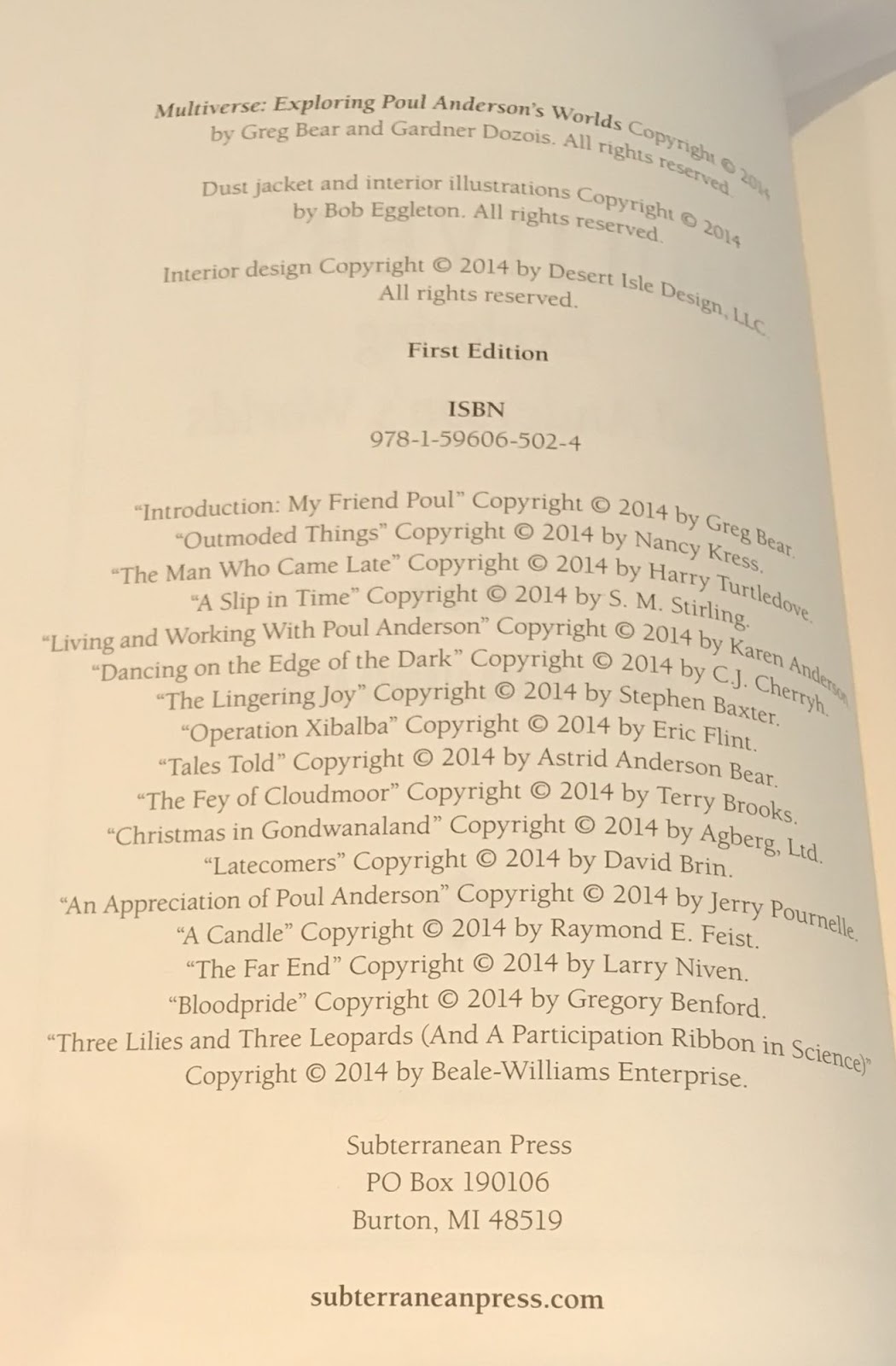
Harry Turtledove and Tad Williams wrote sequels to Three Hearts... for Multiverse;
Flint opted for Operation Chaos;
other Multiverse contributors wrote sequels to other works by Anderson;
so there are many sequels.
Another option is a prequel, which Anderson also sometimes wrote.
Flint decided against a sequel to The High Crusade because he would:
"...find it difficult to write a story in that setting that stayed true to Anderson's own vision of it. And doing so, I think, is important for this kind of anthology."
-Tad Williams, AFTERWORD IN Greg Bear and Gardner Dozois, Multiverse: Exploring Poul Anderson's Worlds (Burton, MI, 2014), pp. 181-182 AT pp. 181-182.
Whether it is important to stay true to Anderson's vision is a matter for the editors of an anthology. Larry Niven's Time Patrol sequel has nothing in common with the original series.
Please allow me an important pause for food.
Wednesday, 1 July 2020
A Few More Ways In Which Harry Turtledove Writes A Good Sequel
-Poul Anderson, A Midsummer Tempest (London, 1975), xii, p. 102.
"The feathered demons - or were they pagan gods? - who ate hearts and drank blood made her shiver in spite of herself."
-Harry Turtledove, "The Man Who Came Late" IN Greg Bear and Gardner Dozois, Eds., Multiverse: Exploring Poul Anderson's Worlds (Burton, MI, 2014), pp. 33-60 AT p. 47.
In Anderson's Three Hearts And Three Lions, Holger smokes a pipe (and steals a trick from Mark Twain). In "The Man Who Came Late," he has stopped smoking because doctors, in a world where doctors know what they are talking about, say that it shortens life.
Holger says:
"'I spent all those years wandering from one world to the next, or else in some of the places between them all.'"
-Turtledove, op. cit., p. 53.
Later, he confirms that the places between the worlds include the Old Phoenix but we would like to see some more such places.
When Holger is asked whether his stories are truth or yarns, he replies:
"'Truth... Oh, sometimes neatened up a bit for the sake of the story, and maybe the way I remember it now isn't exactly the way it happened then...'" (p. 47)
When Cluracan is asked whether the story that he has told in the Inn of the Worlds' End is the truth, he replies:
"All of it except the sword-fight with the palace guard, which I threw in to add verisimilitude, excitement, and local color to an otherwise bald and insipid narrative.
"And, ohh, I suppose there might have been a few other details and incidents I added or omitted, as seemed necessary to ensure the tale flowed properly."
-Neil Gaiman, The Sandman: Worlds' End (New York, 1994), p. 66, panels 2-3.
Holger says of the Old Phoenix:
"'It's one of those places between the worlds that I was talking about. It doesn't belong to any of them...'" (p. 58)
The Landlady says of the Worlds' End:
"This is a free house. It is no part of any kingdom or empire." (p. 141, panel 1)
We have seen one place between the worlds and another at their ends. The Worlds' End tavern:
"...is being continually created; after all, worlds are ending all the time." (p. 146, panel 2)
We have passed from Anderson through Turtledove to Gaiman but it is all one multiverse.
Time Is Not Absolute
In Anderson's Operation Chaos, when Valeria Matuchek is abducted to the hell universe, her rescuers arrive there before she does.
Thus, each universe has its own distinct time dimension. If I stop reading one book at p.100, then I can start reading another book from p. 1, not necessarily from p.101. Similarly, if I leave this universe and spend half an hour in another, then I am not obliged to return to this universe exactly half an hour after I left it.
However, since it takes a long time for Holger to return to the Carolingian universe, it is legitimate for Harry Turtledove to write a story ("The Man Who Came Late") about the passage of time, thus about Holger arriving back thirty years later.
Other authors would have written different kinds of sequels.
After Thirty Years
in Three Hearts And Three Lions, Poul Anderson tells us that Holger Carlsen wants to return to the Carolingian universe;
in A Midsummer Tempest, Anderson tells us that it takes some time for Holger to find his way between universes;
in "The Man Who Came Late," Harry Turtledove tells us that a lot of time elapses before Holger finds his way back to the Carolingian universe.
"And that was thirty long years ago now, even if it sometimes seemed like yesterday. It might seem so, but seeming was not reality."
-Harry Turtledove, "The Man Who Came Late" IN Greg Bear and Gardner Dozois, Eds., Multiverse: Exploring Poul Anderson's Worlds (Burton, MI, 2014), pp. 33-60 AT p. 41.
Thus, this sequel is about the passage of time, one of the main themes in world literature.
CS Lewis' fragment, "After Ten Years," presents three surprises:
gradually, we realize that the dark confined space occupied by Yellowhead and his comrades is inside the Trojan Horse;
Yellowhead Menelaus sees that Helen has aged during her ten years in Troy;
Agamemnon tells Menelaus that the real reason for the Trojan War was economic!
Menelaus' two shocks are to see Helen after ten years and to learn that her abduction was not the cause of the war. Holger's shock is to see Alianora with her husband and three grown-up children after thirty years.
But There Is More...
Multiverse: The Man Who Came Late
Holger's Personal Quest
Something Or Somebody
Inter-Cosmic Moralities
Finding Out For Sure?
When I said here that "...unfortunately, that is the last that we see of either Holger or Valeria...," I referred, of course, to works by Poul Anderson. We are all free to imagine sequels and even to write fanfic. Published authors are those who have been able to sell their imaginings.
Holger and Alianora do reappear in "The Man Who Came Late" by Harry Turtledove but each reader must judge whether he regards such a sequel as a valid addition to the canon. I am not sure about fully accepting any of the sequels in Multiverse, even the best of them, which is undoubtedly "A Slip In Time" by SM Stirling.
In the interests of thoroughness, I will shortly reread "The Man Who Came Late" to reassess where I think it fits in the fictional multiverse. After all, the multiverse concept enables us to consider alternative sequels as maybe happening in divergent timelines.
Tuesday, 12 May 2020
Comments On Anderson's Introduction To Operation Chaos
Heinlein's "dictatorship masquerading as a church" is in Revolt In 2100, Volume III of his Future History.
Fritz Leiber's novel about "opposition to such a pseudo-church" is Gather, Darkness!
Sean tells me that Harry Turtledove's novel about magic is The Case Of The Toxic Spell Dump.
Anderson's Introduction does not mention:
his own Psychotechnic History modeled on Heinlein's Future History, including his "The Troublemakers" addressing the theme of Heinlein's "Universe";
Brian Aldiss' Non-Stop, a reply to "Universe";
no doubt many other examples.
OPERATION CHAOS, Introduction by Poul Anderson
"It is an old and honorable practice in the science fiction and fantasy fields that, when a writer has published a story with a good, original idea in it, one or more others will explore the motif further. Thus, for example, Robert Heinlein told of a dictatorship masquerading as a church and invoking 'supernatural' powers that were actually superscientific. Fritz Leiber, then, with equal brilliance, proposed that the underground opposition to such a pseudo-church might adopt the name and trappings of witchcraft.
"Mr Heinlein also wrote a fantasy, 'Magic, Inc.,' - set in a world that is much like ours, except that magic works - and is treated quite matter-of-factly, as a set of technologies. There were many more possibilities in that concept. Since he didn't choose to deal with them, at last I ventured to try. Therefore I took the liberty of dedicating my book to him and his wife. He replied in a gracious and witty letter that still lies in my file copy. Recently Harry Turtledove has, just as legitimately, given the theme an excellent treatment of his own.
"Actually, Operation Chaos evolved gradually, from four separate tales. The first pair were done in rapid succession and the third came about three years later, but then ten years went by. I couldn't think of anything fresh and didn't want to repeat myself. What finally sparked me again were events during the 1960's - that 'low dishonest decade,' to borrow W. H. Auden's phrase for the '30s. Of course, I didn't issue a political tract, simply spun a yarn for entertainment. Yet all fiction, even the lightest fantasy, grows out of this real world where we live.
"Poul Anderson, 1995"
Monday, 11 May 2020
1940 And The 1960s
Thus, great things began in 1939-'40:
the Future History, which inspired the Psychotechnic History;
Magic, Inc., which inspired Operation Chaos.
The Psychotechnic and Technic Histories are sf and are each set in a different single timeline whereas the following six works:
Three Hearts And Three Lions
Operation Chaos
Operation Luna
A Midsummer Tempest
"House Rule"
"Losers' Night"
- are fantasies involving multiple timelines and "House Rule" connects with the Technic History.
I will now return to rereading Mike Carey's Lucifer which got me back into thinking about Operation Chaos. There should be more about the Psychotechnic History tomorrow.
Wednesday, 13 November 2019
Two Kinds Of Alternative Histories
realistic - history is different but the laws of nature are the same;
fantastic - magic works, supernatural beings exist.
HG Wells wrote one realistic alternative history novel whereas SM Stirling and Harry Turtledove have each written several such series and supernatural beings intervene in Stirling's Emberverse series;
Poul Anderson wrote four fantastic alternative history novels and two realistic alternative short stories;
however, two episodes of Anderson's Time Patrol series also present realistic alternative histories.
As ever, certain nuances occurred to me only when writing this post - over breakfast before a drive into the country.
Friday, 26 July 2019
Some Interesting Facts About Magazine And Post-Magazine SF
This anthology contains one story each by:
Robert Silverberg
David Brin
Robert Sheckley
Poul Anderson
Harry Turtledove
I will probably read only the story by Anderson just as I have read only the Man-Kzin Wars stories by:
Larry Niven
Poul Anderson
Jerry Pournelle & SM Stirling
- which means that I own but have not read Man-Kzin War stories by several other authors. I am interested in "The Burning Sky" as part of Poul Anderson's complete works, not as part of a multi-authored series.
Isaac Asimov: Introduction INVENTING A UNIVERSE IN Isaac Asimov's Universe: Volume I.
Summary
(i) After only ten or fifteen years of writing, Asimov came to be classed as one of the "Big Three," along with Heinlein and Clarke.
(ii) They remained the Big Three for nearly fifty years.
(iii) Heinlein died aged 80 in 1988 whereas Asimov and Clarke were still writing in 1990.
(iv) Publication of Heinlein's works, including a posthumous novel, continued.
(v) The Big Three remained on the shelves of bookshops whereas new works were continually replaced by newer.
(An aside: Bob Shaw once said in conversation that he had considered asking Asimov, out of his love for sf, to stop having his books republished. It seems, from this Introduction, that Asimov did feel responsible for keeping newer writers out.)
(vi) Not only the Big Three but several other important writers "...started in the early days of science fiction..." (p. vii):
Lester del Rey
Poul Anderson
Fred Pohl
Clifford Simak
Ray Bradbury
- and those who died young:
Stanley Weinbaum
Henry Kuttner
Cyril Kornbluth
(vii) Back then, magazines paid at most one cent per word.
(viii) There were no sf book publishers and few films.
(ix) For decades, the pioneers built the popularity of sf.
(x) As a result, a new writer earns more from a single novel than his predecessors did from ten years of effort.
(xi) In 1958, Asimov decided that he preferred writing nonfiction and wrote almost no sf until 1981.
(xii) However, his earlier sf remained in print while his articles in FSF kept his name before the public as a current author, still one of the Big Three.
(xiii) In 1981, in response to publisher insistence, then to bestseller status, he began to write one new novel per year.
(xiv) However, he also co-edited over 100 anthologies, lent his name to other publications, e.g., "Isaac Asimov Presents" and "Isaac Asimov's Robot City," and created "Isaac's Universe"/"Isaac Asimov's Universe," for other authors to write in.
But these endeavors still have Asimov's name all over them. I have argued on this blog that:
Anderson's History of Technic Civilization is better in every way than Asimov's Robots and Empire future history;
Anderson's many works on time travel are better in every way than Asimov's few;
Asimov invokes an sf cliche of "hyperspace" whereas Anderson presents an ingenious multiple quantum jumps hyperspace as well as several other original rationales for faster than light travel;
Anderson's Chunderban Desai analyzes actual history whereas Asimov's Hari Seldon wrongly states that individual actions cancel out in a galactic population just as molecular motions cancel out on a macroscopic scale so that mathematical psychohistory can become a predictive science;
Anderson's Psychotechnic Institute is a more convincing application of science to society than Asimov's Second Foundation;
Anderson's Time Patrol series is a much more concrete synthesis of sf with historical fiction than Asimov's Foundation series.
In my opinion, Anderson is the Big One and Heinlein is important as his precursor.