Showing posts sorted by relevance for query Conan. Sort by date Show all posts

Saturday, 26 July 2025

Conan The Libertarian

Conan The Rebel, VII.

(I googled "Conan the Libertarian" but found only a "Conan the Librarian.")

Do I really want to get back into this argument yet again? No. But the argument is in Poul Anderson's text. I am not importing it. First, I will paraphrase a dialogue between two characters on p. 68.

Conan: If enough serfs cooperated, then they would be able to overthrow the state.

Otanis: But that would end civilization, the heritage of the ages, learning, art and refinement!

Conan: Civilization has much to offer but the price of having a state is too high.

So Conan thinks that it would be better if humanity had remained in the kind of primitive barbarism in which he grew up? I disagree with Conan because I value heritage, learning and art. However, slavery and serfdom are not good.

Could history have proceeded differently with less of the bad and more of the good? It might be difficult to imagine how. But, in any case, we are stuck with how history did happen. But that in turn gives me reason to hope that Conan's preference for a stateless society might be realized in future. This is one theory of how humanity not only has developed but also might continue to develop:

Four Stages
(i) Primitive barbarism. No social surplus of wealth.

(ii) Agriculture. Cities. Slavery. A small surplus necessarily distributed unequally. A state, a body of armed men, necessary to maintain social order, i.e., to ensure the continued rule of the surplus-controlling minority, initially a priesthood, I think.

(iii) Industrial production of a much larger surplus still distributed unequally. Social tensions and conflicts of all kinds. Continued need for a state to prevent theft, looting, rioting etc.

(iv) Advanced technology now socially controlled. An even larger surplus now distributed equally. No ruling group needing a state to maintain its rule.

The fourth stage is arguably possible but evitable. The conflicts inherent in (iii), where we now are, can certainly drive humanity backward instead of forward.

OK. I didn't want to go through all that but, for me, it all comes out of what Conan and Otanis say so that's my take on the issue.

Thursday, 7 August 2025

Back To The Creator

Conan: Blood Of The Serpent, PART FOUR, 30, pp. 325-334, but text only from p. 327 after an internal title page and a blank page.

I did not realize this until I came to it but PART FOUR is extremely short, comprising only just over seven pages and a single chapter, and serves only to link SM Stirling's text in PARTS ONE-THREE to Robert E. Howard's text, Red Nails, which is reproduced on pp. 337-453, also beginning with an internal title page followed by a blank page. 

AT the end of PART FOUR, Conan has found Valeria. Near the beginning of Red Nails, Valeria is found by Conan. Stirling seamlessly merges his narrative with Howard's. 

Having read Conan The Rebel and Blood Of The Serpent and now begun Red Nails, we, editorially speaking, have moved from Conan as written by Poul Anderson, then by SM Stirling, to Conan as written by his creator, Robert E. Howard. (This is probably the only process that would have got me into reading Howard.) 

Conan as written by Howard does not like black women. (p. 345) Conan as written by Stirling had sex with a black woman.

This is where we have to say, "Less enlightened times, right?" I will follow with interest Howard's narrative before returning to Anderson's Rogue Sword from which Conan has been a, not unwelcome, interruption.

Friday, 12 October 2012

Prophecy


I think we expect that, if a man is to fulfill a prophecy, then the tasks necessary for the fulfillment of that prophecy are going be the major work of his life. In Conan's universe, it is all in a day's work, almost. In Poul Anderson's Conan The Rebel (New York, 1981), it has been prophesied that a legendary weapon, the Ax of Varanghi, will lie hidden for five hundred years but will then be wielded by a Northerner leading the liberation of the Taian people.

As soon as Conan arrives in Taia, it is revealed in a trance before the altar to a priest of the Taian god, Mitra of the Sun, that Conan is to be the Wielder. Conan himself protests that he has been a rover, barbarian adventurer, thief, bandit and pirate. Here, he refers to his exploits in previous volumes and even to earlier events in the current volume. The priest adds that, if he lives, Conan will also be a king, thus referring to events in later volumes. None of this matters. At this stage only, it is his sacred duty to wield the Ax.

Swearing by his own god, Crom, he accepts, expecting "...a glorious fight..." (p. 149) Next, he must undertake a Quest for the Ax which is guarded by monsters. Needless to say, the Quest is successful.

Some practical considerations are allowed to intervene. The militarily experienced Conan does wonder how mere possession of a single weapon is meant to guarantee victory. Might it not lead instead to overconfidence and defeat? On the other hand, the mere word that the Wielder will lead an army ensures that:

"From end to end of the country, boy, man, hale grandsire, strong maiden took weapons..." (pp. 189-190).

The Ax is so effective that it fills him with confidence. When, on the battlefield, he is incapacitated by magic, there is a danger that his army will bolt but, when his friends have eliminated the threat to Conan himself, there is no stopping them. Immediately after the victory, he surrenders the Ax to the Taian leader and it passes from him forever. As I said, all in a day's work.

At the very end of the novel, Conan tells a friend that everything he did was for Belit, the woman he is with at least in this novel; I do not know about the others. He does not mention Crom, let alone Mitra who had sent the Ax.

Saturday, 13 October 2012

Conan And Marius


There are some similarities between these characters but also what a contrast! Both were fearsome soldiers and neither was created by Poul Anderson. Conan was an already established fantasy hero. Marius was a really existent historical figure.

Conan is the central character of a novel whereas Marius is discussed by characters in a novel and a short story. Marius, good at soldiering and at nothing else, made the mistake of going into politics and causing chaos whereas Conan, disliking states, preferring barbarism to civilisation, had the good sense to stay with what he was good at. I understand that later in this multi-authored series Conan does become a king but I imagine that this involves one-man rule of a small kingdom with popular assent, a very different proposition from electoral office and power politics in the growing, soon to be imperial, Roman state.

Marius, a general, rallied Romans and annihilated barbarian invaders. Conan, a barbarian, inspired rebels who annihilated imperial invaders. Conan also performed the cinematic feat of swinging on a rope to attack his enemies from behind. Only in Poul Anderson's works is it possible to read both an assessment of the historical Marius' military and political careers and an addition to the fictitious Conan's military exploits.

Tuesday, 9 October 2012

Poul Anderson BC

Uniform editions of Poul Anderson's Complete Works could include a four-volume boxed set, to be entitled "Poul Anderson BC," containing three novels of different genres and one collection.

I am currently rereading the heroic fantasy Conan The Rebel (New York, 1981), the earliest in chronological order of fictitious events because set in a prehistoric civilization. The phrase, " 'Mitra, himself a warrior...,' " on page 38 recalls "'Mithra, etiam miles...' " (Mithras, also a soldier...) in Poul and Karen Anderson's King of Ys tetralogy, which would be the second boxed set.

Conan, viewed from a distance by the villain in Chapter I, first appears as viewpoint character in Chapter III but not again until Chapter VI. Anderson uses intervening Chapters to introduce characters who are specific to this novel and to establish the situation which Conan and Belit are approaching.

New characters introduced in Chapter IV include Ausar, a chieftain of the rebelling Taians, and his daughter Daris. We are told that "...he had been unhappy about her wish to fare along in his roving force...," so that here he seems to be the viewpoint character of this section of the Chapter. (p. 33) However, later in the same section, Daris "...gasped in dismay as she realized...The Stygians had kept themselves fully ready to fight..." so the narrative point of view is now hers. (p. 36) She is either knocked out or killed - we do not yet know which although we soon learn - and the next section of the Chapter returns to Ausar's point of view.

Conan fans reading this far might resent the fact that he is off-stage so much - even Chapter III is mainly Belit recounting her story to Conan - but presumably he will soon return to center stage and remain there for most of the rest of the novel? Although not interested in reading any more of the Conan series, I appreciate Anderson's ability to construct a novel in this genre and within an established series. Conan The Rebel deserves to be republished as a volume both of the Complete Anderson and of the Complete Conan.

Wednesday, 30 July 2025

In Pteion

Conan The Rebel, XVIII.

Conan and his men fight:

dried corpses made to stand, march and attack;

ghouls;

horrific animals that Poul Anderson must have invented;

falling buildings (not fight, just avoid);

a man riding a winged monster (since by now Conan has found the Ax, this last threat is easily dispatched).

The man on the monster, killed by his own magic when it rebounds from the Ax, turns out to have been the wizard, Topathis, so Conan is clearly triumphant although Nehekba still plays some game that neither Conan nor we, the readers, understand as yet. All will be made clear in the remaining two chapters which will conclude Poul Anderson's contribution to the Conan chronicles.

Would we have liked more Andersonian Conan? Not me, but I would have welcomed more Technic History. Like The Lord Of The Rings, that series is long but also too short.

Thursday, 24 July 2025

Conan And Many Others

Conan The Rebel.

Poul Anderson clearly did not want to write just about Conan or from Conan's pov. 

In Chapter I, Tothapis converses with Set who gives Tothapis a remote viewing of a conversation between Conan and Belit. Mitra detects and interrupts Set but remains off-stage.

In II, Tothapis converses with Ramwas and Nehekba and gives them a remote viewing of Jehenan and his guards.

In III, Belit tells Conan about Hoiakim, Shaaphi, Jehanan, Aliel, Kedron, Ramwas and three men that she killed. We read not only her dialogue but also some flashbacks.

In IV, Shuat converses with his adjutant, then Ausar addresses his men and converses with his daughter, Daris.

I have not reread any further yet. Clearly, Conan is one of a large cast of characters. There are XX chapters and I am probably going to reread Larry Niven or someone else for the rest of this evening. 

Wednesday, 10 October 2012

Prehistoric Politics


In Poul Anderson's Conan The Rebel (New York, 1981), Conan suggests that the serfs could fight, preferring freedom or death to continued servitude. He mentions not only "'...their overlords...' " but also, specifically, "'...the state...' " as oppressing them (pp. 67-68). Quite advanced political thinking for a prehistoric barbarian?

Otanis replies that " '...that would bring the end of civilisation!' " (p. 68) My reply would be, "Not necessarily," but Conan cheerfully agrees. Otanis continues that a serf rebellion would abolish learning, art and refinement for "'...those beasts of burden...' " (p. 68).

My reply to this would be that no human being is a beast and that liberation of serfs need not mean abolition of learning etc. Conan's reply is that the price of civilisation, " '...having a state...' " is "'...always...too high.' " (p. 68) Really? I do not agree with this. I prefer a civilised state to barbarism and also hope that civilisation will transcend the need for states but to say that is to take the political discussion to a later era - later than ours, not just than Conan's.

Otanis concludes, " 'Best we not discuss politics...' " (p. 68). Indeed. Conan and Otanis are characters in a sword and sorcery novel which is not the sort of text in which the issue of the state is usually discussed! Soon, Conan must return to the more straightforward business of simply fighting the agents of the local oppressive state.

Tuesday, 29 July 2025

In The Temple Of Set

Conan The Rebel, XIII. 

The temple is empty by day. Inside the only unlocked door, a long, cold, dank staircase cut from living rock descends to dimly lit crypts with sinister murals. The low ceiling of the staircase obliges Conan and Daris to bow to full-relief images of serpents above their heads. Conan vows vengeance. There are "...enormous sarcophagi..." (p. 132) and a shrine whose altar bears a bronze lamp of burning oil and a life-sized golden cobra. On the floor, a crystal bowl of milk has been left for a sacred cobra that lives in the crypts. Conan and Daris sleep in the shrine.

There is no battle either with the living cobra or with any returning priests/sorcerers. However, Conan must console Daris who grieves for Jehanan. Earlier, surrounded and outnumbered, Conan and his two companions attacked. They would either escape or die fighting but not surrender. In fact, Jehanan held off the enemy at the mouth of a narrow alley while Conan and Daris escaped. He did not.

Monday, 4 August 2025

Conan, Carter And Others

Wind and rain in Lancaster. 

A copy of SM Stirling's Conan: Blood Of The Serpent has arrived by post, an "earlier" instalment of the Conan series than Poul Anderson's Conan The Rebel.

I grew up on John Carter (sword and science), not on Conan (sword and sorcery). Everyone knows of Carter and he is occasionally referenced, at least once by Anderson, but no one has added to his series yet.

In my reading experience, the comic strip characters, Dan Dare and Jet Ace Logan, preceded Anderson's Nicholas van Rijn, David Falkayn and Dominic Flandry.

Reading Stirling's Conan will be yet another interruption to rereading Anderson's Rogue Sword and Larry Niven's The Smoke Ring. In Rogue Sword, we, editorially speaking, have reached CHAPTER V which summarizes complicated military and imperial conflicts of the fourteenth century. Difficult reading but necessary background.

Tuesday, 5 August 2025

How To Live

Conan: Blood Of The Serpent.

(Map, pp. 8-9)

"'I never want to see or smell a city again,' [Conan] declared to no one. 'This is how to live. Plenty of land, no politicians, lots of animals, clean air.' His exultation lasted far longer than he would have expected.
"Then it was back to the business at hand." (p. 218)

Conan seems to have left behind the scenario of Parts One and Two as we start into reading Part Three. 

I thought that that soliloquy was worthy of quotation. Conan declares how to live. Plenty of land to support animals. Enough animals to eat. Clean air to breathe. No politicians. What more could anyone want? Well, quite a lot as a matter of fact but apparently this city-less life would suit Conan and it should be there for anyone who wants it. Earth has room enough for every way of life. I would like to visit his wilderness but not to stay there. Conan would be an excellent guide. He could hear yarns of urban life and politicians if he wanted to.

Crom does not intervene in events but does bestow strength. A good god.

Wednesday, 30 July 2025

Conan's Mood

Conan The Rebel, XVI.

Conan, accompanied by Daris and Falco, leads a hundred Taian troops through hot, dry, mountainous country toward the haunted abandoned city of Pteion where he hopes to find and wield the Ax of Varanghi in fulfilment of a Mitran prophecy. Conan encounters a kind of obstacle that might not exist in any other book of the series. He is in a foul humour, bad tempered and resentful, and this has an adverse affect on those around him. We know that Nekekba still follows as an eagle and that her spellcraft probes and exacerbates Conan's weaknesses. Daris suspects a spell but Conan is unable to accept her help. This kind of problem would exist in the Hyborian Age and requires a chapter without physical action.

Friday, 25 July 2025

Conan's Absence

Conan The Rebel, IV-V.

I have been using this lap top to follow world events so have not used it to blog for a while.

Conan is absent from Chapters IV and V. We meet several other characters and learn some history, geography and prophecy. There is an Andersonian action scene, a battle, in which Daris, daughter of the Taian rebel leader, is captured. She is transported to Khemi in the magically fast wingboat of Set, the equivalent of a hyperspace spaceship. 

Conan, off-stage for these two chapters, is kin to the Taians and will fulfill one of their prophecies although that destiny is unique to this novel by Poul Anderson and should not affect events in any other volume of the Conan series.

This Hyborian Age literally had good and bad gods and it would have been right to serve the former and to oppose the latter. Maybe this is another timeline or maybe the gods have withdrawn from the human realm since then? Both Poul Anderson and Neil Gaiman present explanations of the latter possibility.

Conan will return to the page in VI which we might reread tomoz. Earth Real conflicts also impact consciousness. Parallel narratives: as I heard a hospital porter ask, after grinning when shown a tabloid headline: "Wha'? In real life or int' soap?" We live in two worlds. 

Sunday, 27 July 2025

Crom

Conan The Rebel.

Belit, the heroine of Poul Anderson's Conan novel, was a Robert E. Howard character.

I saw a scene from Conan the Barbarian where Conan played by Arnold Schwarzenegger asked his god, Crom, for help and added "But, if not, to Hell with you!" My attitude to the gods is: "We ask your help but, if not, we'll do it ourselves."

According to Anderson, Crom bestows, on those that he favours, strength and heart but nothing else. We are pleased to learn that Crom Cruach was an Irish pagan god who ran afoul of St. Patrick, of course. 

I was pleased to find Crom in Conan The Rebel because Mitra seems too civilized a god for Conan. With some gods, the message basically is that we are on our own and that it is up to us what we do.

Thursday, 4 October 2012

Conan The Rebel

My son-in-law used to have several Discworld books on a shelf. When visiting, I would pick a book off the shelf, read a couple of pages and put it back without getting into it. Another book that I sampled in this way was Almuric by Robert E Howard. Apart from that, I have read no Howard.

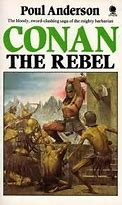
The only Conan book that I have read is Conan The Rebel by Poul Anderson. This novel is one volume both of the Conan series and of Poul Anderson's Complete Works but I have read it only for the latter reason.

Notionally, if we were to read all of Anderson's heroic fantasy, historical fantasy, historical fiction, contemporary fiction and science fiction in chronological order of fictitious events (while remembering, of course, that Andersonian time is broad and deep as well as long so that there is no single linear chronology for all his works), then we would have to start with Conan The Rebel. It is the earliest, being set in a prehistoric civilisation.

However, it is not the book that we would recommend for anyone to start reading Anderson. His heroic fantasy began with The Broken Sword, which is chronologically preceded by Poul and Karen Anderson's Ys tetralogy and by other solo Anderson works, and his sf began with Brain Wave which is contemporary, not futuristic, in setting.

Anderson very skilfully contributed to a number of series created by other authors. Having read his single Conan book only once immediately after purchasing it, I might reread it next after finishing The Dancer From Atlantis.

Monday, 28 July 2025

Conan's World View

Conan The Rebel, XII.

Poul Anderson spells out Conan's world view for us. I imagine that this is consistent with the character as presented by Robert E. Howard. Conan cares nothing for fine distinctions between Stygian commoners on the one hand and their "'...overbearing nobles and fanatical priests...'" (p. 119) on the other.

"In his world view, apart from fierce immediate loyalties, the hand of every man was against every other man. At best there was truce, for practical reasons and always fragile. That did not mean that individuals could not share work, trade, enjoyment, liking, respect. He had been sorry to kill certain men in the past, though he lost no sleep afterward. Strife was the natural order of things." (pp. 119-120)

If there is ever any "Judgment" of human actions, then everyone will have to be judged in accordance with the perspectives and values that had made sense to him. Conan's experience teaches him that every man's hand is against every other and that strife is natural but how does he conduct himself within that world view? He is loyal and honourable. Dominic Flandry's mentor, Max Abrams, said that virtues amount to loyalty. See The Wisdom Of Max Abrams. For Flandry's loyalties, see Loyalty.

Conan should heed class conflicts. He might find allies among commoners against nobles and priests. A heroic fantasy novel by Poul Anderson raises such issues.

Sunday, 27 July 2025

Conan In Khemi

Conan The Rebel, VII-VIII.

(I am posting during a gap in gardening if anyone out there is interested in keeping up with the minutiae of Lancaster life. It is not all plays and Festivals.)

Four prisoners are allowed to meet and converse in comfort so that their captor, Tothapis, can gather intelligence by remote viewing and eavesdropping. We are familiar with three of the prisoners, Conan, Daris and Jehanan, and have read a reference to the fourth, Falco. Conan The Rebel is a multi-character narrative unlike any other instalments of the series, I believe. 

Capturing Conan and taking him alive is an expensive business. He kills five and wounds nearly everyone else in a Stygian squad before they pummel him into unconsciousness. If there had been fewer of them, then he would have escaped as Manse Everard did in similar circumstances. Next, Nehekba will attempt his corruption. 

Khemi is so haunted that Conan had to overcome his fear of the supernatural to enter it.

Thursday, 31 July 2025

CONAN - BLOOD OF THE SERPENT by SM Stirling

We have just reread and posted about Conan The Rebel by Poul Anderson. It has been brought to our attention, editorially, that SM Stirling has written Conan: Blood Of The Serpent. 

Since this blog recognizes SM Stirling as a worthy successor of Poul Anderson, we have ordered a copy of Blood Of The Serpent on eBay and expect its arrival early next week. Reading it will be interrupted by the monthly visit to Andrea above the Old Pier Bookshop.

We gather that Stirling's novel is set early in Conan's life. It should therefore precede Anderson's novel and probably also Conan's relationship with Belit.

Anderson and Stirling have also both contributed to the Man-Kzin Wars sub-series of Larry Niven's Known Space History. We can follow these two authors' contributions to other authors' series without necessarily reading any other instalments of those other series.

Quite a while ago now, I was rereading and posting in detail about Poul Anderson's Rogue Sword. However, this was interrupted by problems with the computer. When a working computer had been restored, I had lost my focus on Rogue Sword and instead began to post about the Ythrian stories in Anderson's Technic History. It might be time to return to Rogue Sword but time will tell.

See:

The Merman's Children In Context

More Reflections On The Blog

result of blog search for "Lucas"

Wednesday, 10 October 2012

The Wingboat


In Poul Anderson's Conan The Rebel (New York, 1981), the white, metallic, fifty-foot "wingboat" does spread wings but does not fly. Instead, controlled by gestures and magic words, it skims along the surface of a river with supernatural speed, a curious combination of magic and science:

" '...the last of its kind...The magical formula of its making was lost when Acheron perished, three thousand years ago.' " (p. 45)

I do not know whether Acheron, sounding like Atlantis or Numenor, was invented by Anderson to account for this single mechanism or whether it is part of the background of the Conan series but, in either case, Conan's prehistoric world is spatio-temporally vast if casual reference can be made to a magical realm of so long ago.

Another curious mechanism is a small mirror worn by the priestess Nehekba. Touching it releases either a dark paralysing ray or a light language-imparting ray. Like the metallic boat, a mirror emitting rays sounds like technology although again its power source is magical. Conan the barbarian addresses Nehekba as he would if she did wield scientific technology. He is not, he says:

" '...as stupid as you took for given. You civilized people think that because we barbarians have no cities or books we must be a lot of dumb animals. Hell, we need our wits more than you do!' " (pp. 92-93)

Conan has fared widely, has assessed civilised countries and now speaks like a civilised man.

I have linked this novel to Anderson's The Dancer From Atlantis since both are set BC although Dancer is science fiction. Its futurian time travellers use a language-imparting device, the mentator, which, of course, is technological, transferring data between the speech centres of brains, whereas Nehekba, casting her magic spells, knows nothing of brains or their speech centres.

Tuesday, 29 July 2025

Conan Consoles Daris

Conan The Rebel, XIII.

Conan reminds Daris that she is "'...born of a warrior folk...'" (p. 133) and then expounds:

"'Death comes to us all when fate wills it,...'" (ibid.)

This reminds us of "brave Horatius." 

It might be best to quote the remainder of Conan's remarks in full:

"'...whether we spoil our lives by skulking in fear of the end or enjoy the world while it is ours and depart it uncowed. Jehannan died in glory, in joy. He had had his revenge and he was giving his comrades back their own lives. If his belief was true, at this moment he, made hale again, rides a unicorn through the queendom of Ishtar, toward a tower where a beautiful woman waits to become the mother of his children. If his belief was wrong, well, then he has forgotten, he is at peace. He wanted us to remember him, Daris, but I do not think he ever wanted us to mourn him.'" (ibid.)

Here we meet Conan the Philosopher. His remarks inspire several thoughts.

(i) Don't mourn.

(ii) In Plato's Phaedo, Socrates says that death is either another country where we will meet the great men of the past or a dreamless sleep. In the latter case, eternity is a single night. However, people have imagined other possibilities.

(iii) Bearing children in the hereafter? Not usually but, again, every possibility is imagined by someone.

(iv) I have ordered from the Public Library a recently published book, The Case For The Hereafter by Chris Carter. I am prepared to consider evidence, if any, and in any case am interested in the various phenomena, like near death experiences, spiritualism, apparitions and apparent memories of previous lives, which are cited as evidence. The whole subject is frustrating. On the one hand, spiritualists cannot establish regular, verifiable communication in the way that we can unquestionably speak by telephone with someone across the Atlantic. On the other hand, we will all die soon and will then know - or not know as the case may be. If there is no hereafter, then we will never know. That is what makes this question different from any other. If an eclipse is predicted for noon tomorrow, then, in the afternoon, we will either know that there was an eclipse or know that there was not an eclipse. But we cannot know that we no longer exist.