Showing posts sorted by relevance for query Chunderban Desai. Sort by date Show all posts

Sunday, 20 May 2012

Memorable Conversations

It can be satisfying to reread a single chapter of a novel as if it were an independent short story. For this purpose, I usually prefer rich conversational passages as against action sequences although the space battles in Poul Anderson's The People of the Wind and Ensign Flandry are good also. In conversation, characters reveal themselves and reflect on their situations, thus often outlining the plot of a novel.

Desai

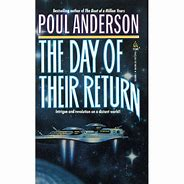
In Chapter 3 of The Day Of Their Return, Chunderban Desai:

recalls a conversation with Uldwyr of Merseia;
experiences a conversation with Aycharaych of Chereion;
replays a holographic recording of his conversation with Peter Jowett.

Uldwyr is one of several well realised Merseian characters. Like several of his species, with the exception of Tachwyr the Dark, he appears only once. Desai and Uldwyr are fluent in each other's principal languages but it is easiest for Desai to speak Anglic and Uldwyr to speak Eriau. By referring to the planets Starkad, Talwin and Jihannath, Uldwyr alludes to the previous three novels in the History.

If we have read the series in publication order, then we know before Desai that Aycharaych works for Merseia. When Desai views his conversation with Jowett, we can feel that the point of view has shifted to that of the Desai engaged in the conversation although Anderson reminds us that the real time Desai is watching the recorded conversation by writing "...the image of Jowett said..." (1)

Desai asks for Jowett's help, then:

"- He snapped of the playback." (2)

- returning us abruptly to Desai's present. The Desai point of view chapters in this novel are the ones that I reread most often.

Flandry

In Chapter Three of A Knight of Ghosts And Shadows, Dominic Flandry converses with the Duke of Mars, then with Emperor Hans and later with Chunderban Desai. These four men personify aspects of the Empire: 

the Duke is a decadent holder of public office, with extrasolar colonists of Mars as his subjects;
Hans is the pragmatic usurper holding the Empire together;
Flandry is a gifted professional Intelligence officer;
Desai is the competent professional diplomat and theoretician of the fall of empires, a much more plausible character than Isaac Asimov's Hari Seldon.

In Chapter Nine, Flandry has definitive exchanges with his opponents, Tachwyr and Aycharaych.

Van Rijn

Earlier in the History, the entirety of the story "The Master Key" was a conversation. Two characters described combat that they had been involved in but there was no flashback narrative. The reader could see that the characters were seated comfortably while recounting their ordeal. The conversational style of fiction has a lot to recommend it.

(1) Anderson, Poul, The Day Of Their Return, London, 1978, p. 34.
(2) ibid., p. 35.

Monday, 14 November 2022

The Main Viewpoint Character

The Day Of Their Return.

The main viewpoint character of The Day Of Their Return is not Chunderban Desai but Ivar Frederiksen.

Chapter POVs
1 Jaan the prophet.
2 Ivar Frederiksen.
3 Chunderban Desai.
4-6 Ivar.
7 Desai.
8 Ivar.
9 Desai.
10-12 Ivar.
13 Ivar, then Desai.
14 Ivar.
15 Jaan, then Desai, then Tatiana Thane (but see below).
16-17 Ivar.
18 Desai, then Tatiana, then Ivar.
19-20 Ivar.
21 Desai, then Jaan.

The concluding passage of 15, on pp. 193-194, is dialogue between Tatiana Thane and Gabriel Stewart. Tatiana speaks in exultation. Stewart frets. She laughs. He considers. She gestures. He exclaims. She speaks. He remarks. She speaks, concluding the passage. We are not told what either character inwardly thinks or feels. Thus, the passage might be narrated from either or neither pov. It could be like a scene in a play where there is dialogue but no viewpoint character.

In any case, Ivar is the predominant viewpoint character in the novel although sometimes viewed by others.

Saturday, 1 June 2013

Flandry And Desai

Having read about Chunderban Desai in "his" novel, The Day Of Their Return, it is good to be able to move ahead to his only other appearance, a conversation with Dominic Flandry in A Knight Of Ghosts And Shadows. If we have read the History of Technic Civilization in chronological order of fictitious events, then we already know both Flandry and Desai but it is good to learn that they know each other.

During a bon voyage party at the Coral Palace before Emperor Hans leaves Terra at the head of a barbarian-quelling armada, Flandry and Desai converse alone after midnight in a garden with an ocean view twenty meters above a courtyard with a floodlit, colored, musical fountain. Desai, teaching at the Terran Diplomatic Academy for a year before retiring to Ramanujan, still uses his ivory cigarette holder. What is of interest apart from the colorful context is the conversational content.

First, he thinks that the Spican sector should be not only reinforced but also restructured with new administrations, laws and economics but that this should be done by a competent viceroy and staff with extraordinary powers. Flandry asks, "Who's both competent and trustworthy...?" (Sir Dominic Flandry: The Last Knight Of Terra, New York, 2012, p. 385) - apart from those already overworked elsewhere. That rings a bell from the Foundation Trilogy which in turn was based on the Fall of the Roman Empire: in the decadent empire, a competent general was not trusted to stay with generalship and keep out of politics so he was recalled before he could complete the job of securing the disintegrating galactic perimeter. Rereading further, I see that Desai goes on to make the same point: the Empire's "'...competent people become untrustworthy from their very competence; anyone who can make a decision may make one the Imperium does not like. Incompetence grows with the growing suspiciousness and centralization.'" (p. 387)

In any case, Desai thinks that Hans should stay at home to prevent further civil wars. When asked why he speaks of civil wars in the plural, Desai reminds Flandry first of McCormac's rebellion, twenty two years previously, then of the messianic religion that nearly started immediately afterwards on McCormac's home planet. Civil wars have deep causes that persist and generate further conflicts. From his experience, study and reflection, Desai expounds a theory that Flandry had not known and that the Empire would not want.

Sunday, 7 September 2014

Chunderban Desai

Chunderban Desai:

is a native of the human-colonized planet, Ramanujan, where there is a Mount Gandhi;

is married with seven children, four grown and settled on different planets (imagine living in such an immense civilization);

had worked in regions facing Betelgeuse and Merseia;

was assigned to the Terran diplomatic delegation that ended the Jihannath crisis, where his Merseian opposite number was Uldwyr;

is fluent in the principal Merseian language, Eriau, as Uldwyr is in Anglic;

is now a commissioner, thus intermediate between a resident in a single culture and a governor of a galactic sector;

specifically, is High Commissioner of the Virgilian System at the opposite end of the Terran Empire from Jihannath;

thus, is based in Nova Roma on the human-colonized planet Aeneas which had spearheaded the revolt of Sector Alpha Crucis against the Empire;

later, will teach at the Diplomatic Academy on Terra for a year before retiring to Ramanujan where he will continue to develop the cyclical theory of history that he explains to Flandry.

One of the many characters that we would like to know more about, Desai's single reappearance, to converse with Flandry in a later novel, is both unexpected and highly enjoyable.

Sunday, 20 August 2017

Chunderban Desai: Crises

Chunderban Desai, in conversation with Dominic Flandry, does not address the Dennitzan crisis but does discuss crises. See here.

Desai claims that there are over fifty examples of a particular historical cycle on Earth alone. The few cases that he cites are:

three in China;
three in Egypt;
the Roman Empire;
India;
Technic civilization.

The stages are:

growth;
wrong decisions;
breakdown;
wars;
an Imperial Pax;
dissolution of the Pax;
its reconstitution;
its disintegration;
a dark age;
a new society from the ruins.

The Technic wrong decision was the transformation of the Polesotechnic League into a set of cartels. Prevention of, or recovery from, breakdown is possible but difficult. Usually, the cyclical theory is rationalized, then ignored, then suppressed. What age are we living in?

Thursday, 16 November 2023

Something Wrong

Chunderban Desai expounds a specific sophisticated cyclical historical theory to Dominic Flandry:

"'Growth until wrong decisions bring breakdown...'"
-Poul Anderson, A Knight of Ghosts and Shadows IN Anderson, Sir Dominic Flandry: The Last Knight of Terra (Riverdale, NY, March 2012), pp. 339-606 AT III, p. 388.

Desai summarizes:

growth
wrong decisions
breakdown
wars
Imperial Pax
dissolution
reconstitution
disintegration
dark age
ruins of old society
new society beginning in the ruins
growth
etc

"'Technic civilization started on that road when the Polesotechnic League changed from a mutual-aid organization to a set of cartels. Tonight we are far along the way.'" (pp. 388-389)

With metaphorical appropriateness, he says, "Tonight...," not "Today..."

Desai and Flandry live during either the initial Pax or its reconstitution, I am not sure which. Later, Flandry tells Miriam Abrams that she and he are living during the interregnum between the principate and dominate phases of the Empire. I had thought that Molitor, the usurper, represented the dominate phase and therefore the reconstitution but maybe not. Desai says that a "'...centralized divine autocracy...'" (p. 388) still lies ahead.

We have summarized all this before. My present point is that I think that Desai's exposition captures something that we might feel:

that there is something wrong in society;
that we can see many symptoms but not identify any specific cause;
that people in pivotal positions might be able to set things right if only they knew what decisions to make;
that most of us are helpless most of the time;
that a catastrophe is bearing down on us.

I describe this as a feeling, not an analysis, and maybe not everyone feels it. To me, Desai's account rings true although that is certainly not to defend all its details.

Tuesday, 16 February 2021

The Anarchic Phase Or Interregnum Of A Universal State

I am looking more closely at the terminology used by Chunderban Desai when conversing with Dominic Flandry. Desai says that the Terran Empire is in its anarchic phase or its "'...interregnum, or whatever you wish to call it.'" (p. 387) But why call it either of those?  "Anarchy" means "no rule." "Interregnum" means "between kings." The Empire is neither without rule nor between kings.

Desai also says that:

"'...the Terran Empire is the universal state of Technic civilization...'" (ibid.)

So what is a universal state? Googling disclosed Toynbee's meaning which is that, when a civilization is breaking down, a dominant minority tries to maintain its inherited position by force. Toynbee recognized nineteen major civilizations, four abortive civilizations and five arrested civilizations. He described civilizational "breakdown," another term used by Desai, and also discussed contacts between civilizations in both space and time, two terms with different implications for sf readers.

Tomorrow, I will check whether any more links can be made between Toynbee and Desai.

Wednesday, 17 February 2021

Desai And Toynbee

My mission, should I choose to accept it, will be, first, to reread earlier blog posts about the Hord/Desai theory of history, secondly, to extract a summary of Toynbean theory from Wikipedia and, thirdly, to compare them. Not an in-depth study but maybe sufficient for present purposes.

For John K. Hord on the blog, see here.
For Chunderban Desai, see here.
For Desai on the stages of a historical cycle, see here.
For Toynbean stages, see here.

According to Toynbee:
 
response to challenge transforms primitive societies into civilizations;

a cycle of challenge and response causes growth;

in 1939, the challenge for Modern Western society was to create a political world-order and the framework for an economic world-order;

a civilization breaks down when its "Creative Minority" degenerates into a "Dominant Minority";

in the final breakdown, the"Dominant Minority" creates a universal state to preserve its power.

Desai refers to growth, breakdown and the universal state.

Monday, 8 September 2014

The Pathetic Fallacy And Commissioner Desai

The pathetic fallacy is the literary pretense that nature reflects human feelings. It rains when a character is sad etc. I quoted some powerful pathetic fallacies from Poul Anderson's Time Patrol series. In The Day Of Their Return, the last passage to feature Chunderban Desai begins:

"Chimes rang from the bell tower of the University. They played the olden peals, but somehow today they sounded at peace."
-Poul Anderson, Captain Flandry: Defender Of The Terran Empire (New York, 2010), p. 232.

And the passage ends:

"As Desai closed the door behind him, he heard the tadmouse begin singing." (p. 236)

Bells are artificial, not natural, but "...the olden peals..." should sound as before. However, Desai has just helped to prevent a war so the peals sound peaceful to him. The Aenean household pet singing confirms for the reader that, thanks to Desai and others, including the tadmouse's owner, Aeneas will remain at peace.

Friday, 18 September 2020

Dinner And Desai


Let's take a break from the Time Patrol and remember one of my favorite Poul Anderson characters, Chunderban Desai, a good Terrestrial name no doubt although Desai is from Ramanujan, not from Terra. (I will shortly drive Aileen and Yossi for an afternoon of bird-watching and hopefully also a meal in the Plough so there will be no more posts for a few hours.)

One of my favorite scenes in all of Anderson's works is to be found in:

Poul Anderson, The Day Of Their Return IN Anderson, Captain Flandry: Defender Of The Terran Empire (Riverdale, NY, 2010), 3, pp. 82-85.

After the negotiations to end the Jihannath crisis, Desai and Uldwyr have dinner in a private room in a restaurant where there are (poor) wall animations but:

"...an inspired combination of human and Merseian dishes." (p. 83)

Uldwyr drinks Merseian ale whereas Desai prefers tea. Each is fluent in the other's principal language but finds it easier to speak in his own: Eriau or Anglic. They refer to Starkad, Jihannath, Talwin, Sector Alpha Crucis and the Domain of Ythri, all names that resonate in this series. These four pages summarize much. Back here later.

Monday, 25 September 2023

Desai And Uldwyr

The Day Of Their Return, 3.

One of my favourite passages in Poul Anderson's Technic History is Chunderban Desai's after dinner conversation with his opposite number, Uldwyr. The passage informs, or reminds, us that the Merseian has a "...crocodilian tail which counterbalanced his big, forward-leaning body..." (p. 83) but omits to add that he would have been squatting on this tail while conversing with the seated Desai.

Uldwyr refers to:

Starkad
Jihannath
Talwin
the recent insurrection in Sector Alpha Crucis
the Domain of Ythri

- and thus touches on the contents of the previous four novels in the Technic History. (The Jihannath crisis and the Alpha Crucis insurrection were contemporaneous, therefore featured in a single novel.)

Desai knows that he is:

"...Uldwr's honorable enemy, therefore his friend. By giving him opposition, I give meaning to his life." (p. 84)

That is the social psychology of the Merseian Roidhunate. Many beings find meaning without opposition. "Honorable Enemies" is, of course, the title of the second Captain Flandry story, published earlier although set later.

In Ensign Flandry, Brechdan Ironrede had explained to one of his sons why the Roidhunate cannot simply expand around the Terran Empire and Desai here confirms Brechan's words:

"Lest the balance of power be upset, we block them, we thwart them, wherever we can; and they seek to undermine us, grind us down, wear us out." (p. 84)

The Roidhunate must (!) deal with the Empire before it can expand any further. The Empire performs the historically useful role of demoralizing the Roidhunate so that, millennia later, it is not in control of the galaxy.

Tuesday, 8 December 2020

Desai Saves The Day

Some novel titles used to be a full sentence beginning with the central character's name, e.g.:  

Mr. Britling See It Through by HG Wells;
Biggles Sees It Through by WE Johns;
The Saint Sees It Through by Leslie Charteris; 
Henrietta Sees It Through by Joyce Dennys;
Ben Sees It Through by J. Jefferson Farjeon;
Miami Sees It Through by Patricia and Fredrick McKissack;
Bertie Wooster Sees It Through by PG Wodehouse;
Bulldog Sees It Through (but this one is a film);
Bulldog Drummond Stands Fast by Gerard Fairlie.

Sorry, folks. I meant to avoid a list, then I found eight times "...Sees It Though." Why couldn't Drummond have seen it through?

My point, however, was that Chunderban Desai is the unsung hero of Poul Anderson's The Day Of Their Return and that an alternative title could have been Desai Saves The Day (or even ....Sees It Through). Check it out:

the Sector Governor's office is taken in by Aycharaych;
Desa lets Aycharaych travel on Aeneas because the Governor has ok'ed it;
however, Desai also has a hunch and checks with Terra;
he learns the truth about Aycharaych;
he tells Tatiana Thane;
she tells Ivar Frederiksen;
Ivar asks Jaan to describe an Elder;
the description matches Aycharaych...;
Ivar pulls back from the brink...;
of course, Aycharaych escapes and fights Flandry later.
 
But well done, Desai.

Sunday, 16 April 2023

Ydwyr And Desai

A Circus of Hells, CHAPTER SEVENTEEN.

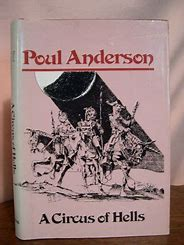
In conversation with Dominic Flandry in A Knight of Ghosts and Shadows, Chunderban Desai outlines a theory of civilizational and Imperial decline. Desai thinks that the Merseians know this theory and have based their inter-imperial policies on it. In conversation with Djana, Ydwyr confirms this:

"'The breakdown of legitimate authority into weakness or oppression - which are two aspects of the same thing, the change of Hands into Heads - is a late stage of the fatal disease.' (p. 331)

Legitimate Imperial succession has not been lost when Ydwyr speaks to Djana but will have been when Desai speaks to Flandry. In Eriau terminology, the usurper, Molitor, is a Head as against a Hand. Meanwhile, during Flandry's career, we see many examples of weakness and oppression. 

Desai thinks that Merseia might also be decadent although Ydwyr does not consider this possibility. Merseians of the Roidhunate expect an uninterrupted ascent.

Brechdan Ironrede:

"'...the highest end of all - absolute freedom for our race, to make of the galaxy what they will.'"
-Ensign Flandry, CHAPTER THREE, p. 27.

Ydwyr the Seeker:

"'...our endeavor is, ultimately, to impose Will on blind Nature and Chance.'"
-A Circus of Hells, ibid.

I agree with Ydwyr's formulation provided (which, of course, he does not mean) that it is by multi-species cooperation, not by Merseian domination.

I think that the Merseian decline begins with the disappointment felt by Tachwyr the Dark at the end of The Game of Empire. They have lost Aycharaych and the last scheme that he had bequeathed to them has been thwarted.

Monday, 27 January 2020

An Annotated Text

Nowadays, I can reread Poul Anderson's A Knight Of Ghosts And Shadows while simultaneously consulting my own previous notes on its text, e.g.:

Dominic Hazeltine
spiral arm
Catalina
Mayor Palatine
niello
Trohdwyr
zmay
ychani
Gwyth
Zorkagrad
etc

The first three chapters of A Knight... make many references to earlier installments of the Technic History:

Persis d'Io in Ensign Flandry;
Fenross who was Flandry's superior in "Hunters of the Sky Cave" and "The Warriors from Nowhere";
Scotha in "Tiger By The Tail";
Princess Megan in "The Warriors from Nowhere";
Avalon in The People Of The Wind;
van Rijn on Diomedes in The Man Who Counts;
Manuel Argos in "The Star Plunderer";
Kheraskov from The Rebel Worlds;
Chunderban Desai from The Day Of Their Return;
the McCormac rebellion in The Rebel Worlds;
the potential Aenean jihad in The Day Of Their Return;
the Polesotechnic League becoming cartelized in Mirkheim -

- and, in a later chapter, a flashback scene is set on Talwin which was introduced in A Circus Of Hells.

But we are also told the sequels to some of the earlier events:

Persis' son by Flandry;
what happened after Emperor Josip, against whom McCormac had rebelled, died;
what happened in Sector Tauria after Flandry's rescue of Princess Megan;
what Chunderban Desai did after his spell on Aeneas;
what Flandry has been doing - taking it easy.

Thus, we are introduced to an entire new period in Imperial history with a new set of threats and also to the later phase of Flandry's career.

Tuesday, 30 June 2026

Favourite Chapters And Stories

My favourite chapters in Poul Anderson's Technic History include The Day Of Their Return, 3, and A Knight Of Ghosts And Shadows, III.

In the former, Chunderban Desai converses with:

Uldwyr of the Vach Hallen;

Aycharaych, supposedly of "Jean-Baptiste";

Peter Jowett of the industrial Web in Nova Roma on Aeneas.

In the latter, Dominic Flandry converses with:

the Duke of Mars;
Emperor Hans Molitor;
Chunderban Desai. 

A spectacular cast of characters. I agree with Sean Brooks that A Knight Of Ghosts And Shadows could also have included a conversation with an ennobled Leon Ammon, the man whom Flandry had met when he, Ammon, was still a gangster on an Imperial border planet. Future histories include fictional biographies, like those of Falkayn and Flandry, and Ammon would have been a sound addition. 

My favourite Technic History short stories are "How To Be Ethnic In One Easy Lesson" and "Lodestar" for reasons previously stated. The Technic History is better than good both as a series and as a (large) number of individual narratives.

Friday, 4 December 2015

The Laws Of Cultures

The interpreted past meets the imagined future (see here) when Chunderban Desai exhaustively analyzes Terrestrial history. However:

"'...we don't have the knowledge to say how far [the historical pattern] may apply to nonhumans, if at all,' Desai admitted."
-Poul Anderson, Sir Dominic Flandry: The Last Knight Of Terra (New York, 2012), p. 390.

But he intends to find out. When Flandry questions whether the Merseians are also decadent, Desai asks:

"'...what is decadence to a nonhuman?'" (ibid.)

I think that the Merseian resolve begins to weaken shortly afterwards when the Magnusson Rebellion fails. Tachwyr's rationalization:

"'By adversity, the God tempers the steel of the Race. Let us get on with our quest.'"
-Poul Anderson, Flandry's Legacy (New York, 2012), p. 447 -

- rings hollow.

By contrast with Desai, the Vro-Hi in "Flight to Forever," having advised the First Galactic Empire of many intelligent species on a billion planets, has learned "...the great laws in the rise and fall of cultures..." -Past Times (New York, 1984), p. 262.

If transported to the History of Technic Civilization, the Vro-Hi would be able to assess Terra, Merseia, Ythri etc - unless "...the great laws..." differ between timelines? But I doubt it.

Friday, 13 December 2019

Desai's Office

Poul Anderson's The Day Of Their Return was published in 1975. Chunderban Desai's office in the thirty-first century has:

"...communication and data-retrieval consoles that occupied one wall..." (3, p. 85)

No desk-top personal computer, lap-top computer or smart phone. What will they have in the real thirty-first century - assuming the survival of a technological civilization? Brain implants for artificial telepathy? A Dirac beep in every brain? (See also here.)

Activating the transparency in another wall, Desai looks out across Nova Roma and sees, among many other sights that have been detailed in previous posts:

"...the broad bright sweep of the River Flone, and ancient high-arched bridges across it; beyond, the Julian Canal, its tributaries, verdant parks along them, barges and pleasure boats on their surfaces..." (p. 87)

Although this novel is set in our future, Aeneas has been colonized long enough for the bridges across the Flone to be described as "ancient." Anderson picks place names well and deploys them with apparent familiarity. There is also social change, represented, on the horizon, by the garishly-colored modern buildings and the industrial haze of the Web where the manufacturing, mercantile and managerial classes of recent generations have become more supportive of the Terran Empire which Desai serves than, currently, are the longer established Aenean scholars and squires.

Anderson has created a plausible history for this future history.

Monday, 30 September 2013

Valti, Desai And Seldon

In "Marius," the first story in Poul Anderson's Psychtechnic History, Professor Eino Valti:

uses sociosymbolic logic to plan the strategy for the liberation of Europe from Red Army occupation after World War III;

shows that a military leader turned politician would be a disaster for Europe as Marius had been for the Roman Republic;

predicts a second nuclear war fifty years after the first unless society changes direction - which, fortunately, it does, under his reforms as chairman of the Council, after the overthrow of "Marius";

remains off-stage and is merely referred to by the participants.

Since one difference between the timelines of the Psychotechnic History and of Anderson's independent novel, Planet Of No Return, is that the latter includes a World War IV, maybe Valti's timely intervention is what makes the difference?

Anderson's Eino Valti and Isaac Asimov's Hari Seldon have much in common:

each is mentioned at the start of a future history (the prequels in which Seldon appears were written later);

each applies mathematics to society and makes testable predictions;

thus, each helps to avert worse disasters later.

But Anderson's account is less implausible. Valti's science of society works within limits but does not prevent technological unemployment, a Humanist Revolt and the subsequent banning of psychotechnics itself. Apparently, the science is then misused in "The Snows of Ganymede," which I have yet to read.

Anderson's other social theoretician is Chunderban Desai in the History of Technic Civilization. Desai, applying not mathematical analysis but historical knowledge, predicts the Fall of the Terran Empire just as Seldon predicts the Fall of the Galactic Empire. Unlike Seldon, Desai cannot manipulate the course of future events but does warn Flandry and probably also others who are able to ensure that some colonies remain strong enough to preserve planetary civilization after the Long Night has ended interstellar contact.

So the Psychotechnic and Technic Histories each have their own, far more credible, counterpart to the Foundation's psychohistorian, Hari Seldon.

Thursday, 30 May 2013

The Rebel Worlds And The Day Of Their Return


It is not immediately apparent to the reader how Poul Anderson's The Day Of Their Return follows from his The Rebel Worlds. In the former, the series character Dominic Flandry deals with Hugh and Kathryn McCormac. In the latter, we meet a new one-off viewpoint character, Ivar Frederiksen.

However, we were told that Kathryn's maiden name was Frederiksen. Hugh was Firstman of Ilion on Aeneas. When, at the end of The Rebel Worlds, Hugh and Kathryn went into exile, her brother, Edward, succeeded to the Firstmanship and Ivar is his son.

Thus, despite the absence of Flandry and the McCormacs from The Day Of Their Return, we are dealing with Kathryn's nephew who is also the heir of Hugh's successor. Anderson writes a direct sequel but disguises it by changing the characters and even the surname of the Aenean first family.

He also introduces a completely new character, Chunderban Desai, who has, since the McCormac's exodus, been appointed High Commissioner of the Virgilian System where the humanly colonized planet is Aeneas. Thus, the reader sympathizes both with Ivar trying to lead a new Aenean rebellion and with Desai trying to prevent it.

A commissioner is intermediate between a resident and a sector governor. Desai's superior is the Governor of Sector Alpha Crucis and the incumbent of that position has also changed since The Rebel Worlds. Desai has interesting conversations with Uldwyr of Merseia, Aycharaych of Chereion, Peter Jowett of the Web, Tatiana Thane of the University of Virgil, Colonel Mattu Luuksson of the Companions of the Arena and eventually with Ivar Frederiksen.

Like The People Of The Wind, The Day Of Their Return is a rich novel in Anderson's History of Technic Civilization that does not feature any of the series characters of that History.

Wednesday, 5 June 2013

Flandry's Theoretical Understanding

In A Knight Of Ghosts And Shadows, Chunderban Desai expounds to Dominic Flandry a theory of history that the latter has never heard before. In the next novel, A Stone In Heaven, Flandry has mastered the theory and uses some of its terminology that Desai had not mentioned.

In his youth, Flandry supported the legitimate Emperor, however abominable, because, without legitimacy, the Empire is a convenience at best, force at worst. In his old age, the Empire is force. The Usurper tried but failed to restore the legitimacy of Imperial institutions which, however, have retained too little trust or loyalty.

Now power is claimed by strength, not by right. Fear makes the rulers oppressive but this increases unhappiness and motivates the ambitious. These are symptoms of the interregnum between the principate and dominate phases of the Empire and this interregnum is a critical stage of Imperial decline. Since speaking to Desai, whom he does not name here, Flandry has also spoken to other historians, psychodynamicists, philosophers and nonhuman observers, has read and meditated, and now expounds the theory that he had heard from Desai.

Like Isaac Asimov's Hari Seldon but far more plausibly, Flandry tries to make his period "'...less terrible than it'd otherwise be...buying years for sentient beings that they can live in ...'" (Flandry's Legacy, New York, p. 75) - a far nobler aim than van Rijn's although van Rijn, less directly, had also worked towards a civilization where beings live in peace rather than continued want and conflict.

Flandry expects the surviving sophont races to "'...build fascinating new civilizations...'" (ibid.), and we see some of these later in the Technic History, but these civilizations will be built, after the Long Night, by entire species and populations, not by any Andersonian equivalents of Asimov's mentally powerful social manipulators.

Flandry sees promise in cultures of mixed species like Avalon but this is one of the many aspects of the History that Anderson did not have enough time to develop any further. We see three later stages of human social development but not what has happened to any of the other species that were either ruled by or opposed to the Terran Empire.