Showing posts sorted by relevance for query Bactra. Sort by date Show all posts

Saturday, 15 February 2014

Part Two

In Poul Anderson's The Shield Of Time (New York, 1991), the list of Tor books by Poul Anderson includes:

Alight In The Void*
Tales Of The Time Patrol*

*forthcoming

- whereas, when the Time Patrol collection was published, its title was The Time Patrol, so there is an altered timeline, if you like.

PART TWO

1985 A. D. Private Garshin in Afghanistan.
  209 B. C. Everard approaching and entering Bactra.
1987 A. D. Everard and Wanda in Palo Alto.
  209 A. D. Everard in Bactra.
  976 B. C. Everard and Merau Varagan in the Aegean.
  209 B. C. Everard in Bactra.
1987 A. D. Everard and Shalten in Oakland.
  209 A. D. Everard in Bactra.
1988 A. D. Everard and Wanda in San Francisco.
  209 B. C. Everard four miles northeast of Bactra.
1902 A. D. Everard and Shalten in Paris.
1985 A. D. Private Garshin in Afghanistan.

Saturday, 26 May 2018

Military Intelligence In 209 B.C.

Euthydemus, King of Bactria, besieged in his capital city, Bactra;

Zoilus, minister of the Bactrian treasury, client of Theonis;

Raor, Exaltationist, posing as Theonis, courtesan, in Bactra;

Draganizu, Exaltationist, posing as Nichomachus, kinsman of Theonis and priest of the temple of Poseidon that she has endowed just outside Bactra;

Buleni, Exaltationist, posing as Polydorus, aide to Antiochus and devotee of Poseidon;

Antiochus, King of Syria, besieging Bactra.

This is the torturous route by which military intelligence can pass from Euthydemus to his enemy, Antiochus. The Exaltationists do not use radio because the Time Patrol would detect it.

Wednesday, 3 May 2017

Additional Complications

When Manse Everard of the Time Patrol arrests Raor of the Exaltationists in Bactra in 209 BC, she knows that he is the agent who nearly captured her clone-mate, Merau Varagan, in Colombia. Everard adds that he almost caught Varagan in Peru and did in Phoenicia.

(iv) Colombia, 1826 AD;
(iii) Peru, 1610 AD;
(i) Phoenicia, 976 BC;
(ii) Bactra, 209 BC.

(i)-(iv) is the historical/chronological order of these Patrol-Exaltationist encounters.

After some Exaltationists escape in Phoenicia, the Patrol lays a trap for them in Bactra. Thus, for both the Patrol and the Exaltationists, the encounter in Bactra, 209 BC, comes "after" the encounter in Phoenicia, 976 BC. Further, Everard captures Varagan in Phoenicia. Therefore, for both of them, Phoenicia comes "after" Colombia and Peru. However, Varagan might have experienced Peru before Colombia.

In general, there is no reason why two time travelling groups groups should experience their encounters in the same order. But think of the additional complications if, e.g., Everard met for the first time a Varagan who had already met Everard for the first time. In fact -

- worst case scenario:
younger Varagan kills older Everard;
younger Everard kills older Varagan.

Friday, 25 May 2018

Religious Buildings In Bactra

There is a vihara on Ion's Lane in Bactra but:

"The topes and stupas whose ruins Everard saw in twentieth-century Afghanistan would not be built for generations."
-Poul Anderson, The Shield Of Time (New York, 2018), 209 B.C., p. 47.

The Patrol agent in place in the vihara is Chandrakumar of Paliputra.

The Bactrian Greeks identify the Asian goddess, Anaitis, with Aphrodite Ourania and have built a fane to her beside the Stoa of Nicanor. There are ithyphallic herms along the Sacred Way. Theonis, reputed to be an avatar of Anaitis, has endowed a temple of Poseidon outside the town.

Chandrakumar gathers intelligence not because he is among enemies - far from it - but because the Patrol must know the history of Bactra in order to protect it against threats like the Exaltationists. That Theonis has endowed a temple just outside a city that is about to be besieged is a crucial link in the Exaltationist plan to alter the history of the siege.

Sunday, 16 February 2014

Stoa And Song

Poul Anderson, The Shield of Time (New York, 1991).

In the besieged Bactra, "Everard...worked his way quietly through street and stoa, around the city..." (p. 77)

A stoa is a covered walkway (see image) and the Stoic philosophy is named after one, which I had not known. I still have to consult a dictionary when reading Anderson.

I mentioned in a previous post that I thought that the Exaltationist language was said to sound like song. It seems that it is a single Exaltationist's voice rather than their language that is so described. Timotheus, a slave dealer whom Everard meets in a bath, has heard a description of the courtesan Theonis which includes "...voice like song..." (p. 50). And when Everard spies and eavesdrops, "...her voice sang more than said." (p. 83)

The language, which Everard has had imprinted and will have scrubbed only when the last Exaltationist is caught, comprises precise, concise, euphonious purrs and trills.

The Exaltationists Still At Large
Raor, the female of Merau Varagan, is the courtesan, Theonis.
Draganizu is her kinsman, Nicomachus, a priest of Poseidon.
Sauvo is Xeniades, Theonis' majordomo.
Buleni is Polydorus, an aide to King Antiochus and a Poseidon devotee.

While Antiochus besieges Bactra, Nicomachus, under safe conduct, will convey military intelligence to Buleni at a temple outside the city. Thus, the Exaltationists will engineer the unhistorical fall of Bactra.

In 209 BC, the time travelers on Earth comprise:

the Exaltationists;

hundreds of historical investigators, scientists, entrepreneurs, esthetes and esoterics;

Patrol stations in Rome, Egyptian Alexandria, Syrian Antioch, Hecatompylos, Patalipushtra, Hien-yang and Cuicuilco;

smaller regional posts;

Unattached agent Everard.

Monday, 27 July 2015

Benegal Dass In Bactra

Poul Anderson, The Shield Of Time (New York, 1991), pp. 51-54.

Bactra was the capital city of Bactria. Benegal Dass, born in the late nineteenth century, wrote a thesis on Indo-Bactrian society that attracted a Time Patrol recruiter.

Dass spends decades in the city, each time arriving and departing by local means of travel, not on a timecycle. He adopts different identities. As Rajneesh, he worked in a silk dealership. As Rajneesh's cousin, Chandrakumar, he seeks enlightenment and stays in a Buddhist monastery while studying Greek philosophy. Usually his visits are "...separated by timespans of a length to preclude recognition..." (p. 53) but urgent Patrol business brings Chandrakumar to Bactra soon after the departure of Rajneesh, necessitating a kinship story to explain their resemblance.

On holiday back home, "...he must lie to family and friends about what he did for a living." (p. 54) He observes and writes the entire history of the city. His work is read within the Patrol and in the distant future. Thus, the Patrol knows what events it must protect in this historical backwater.

Folk are being real swell about page views right now. However, it is tempting to pause posting at the round number of 80 posts for this month. I am sure that Poul Anderson's Time Patrol series is inexhaustible but I will temporarily exhaust my ability to find new details to post about. Would anyone else like to write their completely different take on this series and email it to be posted on the blog?

Sunday, 20 July 2014

In 209 BC

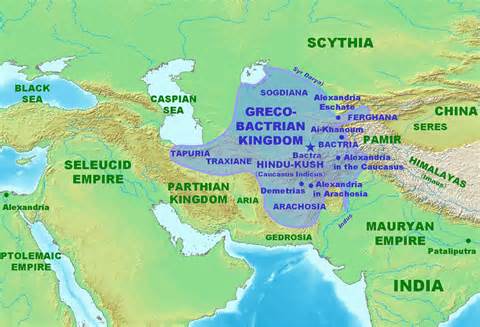
Alexander's generals, including Seleucus, divided his conquests, including the Persian Empire, between them. In 209 BC, the Seleucid Antiochus III rules "Syria," comprising Syria, Persia, Mesopotamia and parts of Turkey and the Mediterranean seaboard. Sixty years previously, Parthia (northeastern Persia) and Bactria (in northern Afghanistan) had declared themselves independent kingdoms. Antiochus has reconquered Parthia and now besieges Bactra, the city of Euthydemus, King of Bactria.

Thus the history. Manson Everard, Unattached agent of the Time Patrol, must enter Bactra just before the siege starts because he hopes that the Exaltationist time criminals have followed planted evidence that, by changing the outcome of a battle outside Bactra, they can gain control of subsequent history. Everard hopes to arrest the last of the Exaltationists.

Yet again, Poul Anderson seamlessly melds historical fiction with science fiction.

Thursday, 24 May 2018

Into Bactria

Everard travels with a caravan along a highway on the right bank of the River Bactrus. The camels are one-humped although the two-humped species will later be introduced and will come to be called "Bactrian." Harness bells do not yet exist.

Everard joined the caravan in Alexandria Eschates on the River Jaxartes. (An unmanned spacecraft had tracked the caravan and confirmed that it would reach Bactra on a day suitable for Everard.)

They have traveled south through Sogdiana. Crossing the Oxus brought them into Bactria. Hipponicus, leader of the caravan, is a Hellene, whose ancestors came from the Peloponnessus. The Anatolian strain is not yet prominent in Greece. Everard's persona is Meander the Illyrian from the Balkans north of Macedonia. Antiochus, king of Seleucid Syria, is attacking Bactria. King Euthydemus retreats.

The Achaemenid shahs deported troublesome Ionians to Bactra.

Everard remembers Turkic-Mongolian Uzbegs in Afghanistan in 1970 and reflects:

"A lot of change and chance would blow from the steppes in the millennia to come. Too damn much."
-Poul Anderson, The Shield Of Time (New York, 1991), 209 B.C., p. 22.

The people around Everard experience changes and chance events but have no conception of the meanings of those words for a time traveler in a variable reality.

The caravan enters Bactra through the Scythian Gate. The palace is modeled on the one in Seleucid Antioch.

There is more historical detail in this chapter but I hope that I have conveyed the flavor. We are far removed from the abstract arguments about the theoretical basis of causality violation.

Thursday, 10 September 2020

A Shrine

The Shield Of Time, PART TWO, 209 B.C.

A spring in a poplar grove on the side of a hill four miles from Bactra is sacred to the god of underground waters. Offerings are made for protection from earthquake, drought and murrain. I used to feel sorry for people asking for help where there wasn't any. Now I realize that they did not expect help every time and, in any case, were recognizing sacredness.

Theonis has had the shrine remodeled and rededicated to Poseidon and sends a priest to conduct rites. Local people identify Poseidon with the earlier deity, sometimes still use the old name and feel that the rededication might have benefited their horses. The poplars surround a low wall enclosing "...the temenos, the holy ground." (p. 102)

If I were a Patrol agent based in Bactra, then I would visit the shrine to meditate and participate in rites. However, the Exaltationists cynically use the shrine for their subversive ends:

the Syrians besiege Bactra;
the city defenders formulate battle plans;
the plans are known to Zoilus, government minister;
the courtesan, Theonis, learns the plans from Zoilus;
Theonis relays the plans to the priest who visits the shrine;
a high-ranking Syrian is an Exaltationist posing as a devotee of Poseidon;
he visits the shrine when the priest is there...

- as does Everard.

Sunday, 16 February 2014

Clean Cold Winds

Poul Anderson, The Shield Of Time (New York, 1991).

For story purposes, all that Poul Anderson needs to tell us is that a group of Time Patrol agents flies from a temple of  Poseidon to the city of Bactra. Instead, we read this vivid descriptive paragraph:

"The three hoppers lifted high enough to be no more than glints to any eyes that might chance to catch them, and glided toward Bactra. Below them the land rolled vast from the mountains in the south, fields green and brown, spotted with trees and tiny buildings, the river mercury-bright, the city and the invader camp toylike. No hint of hatred and misery reached these clean cold winds, save what the riders bore with them." (p. 116)

Anderson never forgets that his characters move through an environment that should be kept constantly before his readers' minds - almost as if they were watching a film.

I am not always sure about what Anderson is doing with temporal paradoxes. Everard warns colleagues:

"'...we will not play games with causality and risk setting off a temporal vortex...'" (p. 116)

He means, in this case, that he and one other agent will attempt to arrest the Exaltationists but that, even if they fail and are killed, the other Patrollers watching from a distance must not travel back in time to prevent them from being killed. But what is a temporal vortex and how could one be "set off" by such an attempt to change the past?

In this story, the Patrol has "'...been tinkering with reality...'" (p. 122). A Patrolman masquerading as a Soviet Army captain planted some fake archaeological evidence in 1985, then this was "'...removed, annulled.'" (ibid.) How might this have been done?

Let us suppose that the "captain" was based in the Patrol Academy in the Oligocene. From there, he travels to 1985 to plant the evidence. In 1987, there is press coverage of the recently discovered letter from Antiochus. This induces the remaining four Exaltationists to travel to 209 BC, when they are apprehended by the Patrol. When milieu HQ in Moscow, 1890-1910, has been informed of Patrol success in 209 BC (two Exaltationists killed, two arrested), HQ sends a message to the "captain" at the Academy telling him not to travel forward with his faked evidence to 1985. This annuls:

an event in 1985 - the "captain" handing the metal box containing the forged latter to Private Garshin;
the press coverage in 1987;
the Exaltationists reading that press coverage and drawing conclusions from it;
a conversation in 1987 during which Shalten of the Patrol informed Everard of the letter and the press coverage.

However, it does not prevent the Exaltationists from having arrived in 209 BC and been killed or arrested by the Patrol. We are told that time travelers in a deleted timeline are deleted with it so is this what happens to the Exaltationists who read the news reports and to the Shalten and Everard who discussed those reports?

At the end of the story but back in 1902, Shalten tells Everard:

"'In your position among us, you need to know the whole truth. For you to learn it later in this century could pose a hazard. Causational loops can be very subtle. Your experiences and accomplishments in Bactria [in 209 BC] must continue to have happened. Therefore you must be informed well pastward of our preparations for them.'" (ibid.)

But Everard's activities in 209 BC are well "pastward" of any events in the twentieth century and therefore cannot cease to have happened even if some of those twentieth century events are changed. Shalten is speaking to the Everard who did defeat the Exaltationists in 209 BC. That Everard is not going to forget what he did in Bactra, let alone cease to have done it. Now that the events in 209 BC have safely happened, Shalten feels it is better (I am not sure why) to delete the planting of the evidence and the events that followed from that even including a 1987 conversation between himself and Everard. I do not understand why, after all this, he thinks that he needs to discuss the matter with Everard in 1902 in order to keep the timeline the way he wants it.

Addendum, 17 Feb '14: Maybe, for the Time Patrol scheme to work, the "captain" would have to set off not from the Oligocene but from a date between 209 BC and 1985 AD. Thus, the prevention of his departure from that intermediate date would delete the forgery-related events in the twentieth century but would not prevent the Exaltationists from having arrived in 209 BC. (I woke up in the night dreading that someone else would make this point before I did.)

Tuesday, 1 September 2015

Spring And Shrine

Where there is a spring outside Bactra, there is a shrine:

"...to the god of underground waters."
-Poul Anderson, The Shield Of Time (New York, 1991), p. 102.

The Exaltationist Raor posing as the courtesan Theonis remodels the shrine, rededicates it to Poseidon and appoints her kinsman Nichomachus, really the Exaltationist Draganizu, as its priest. The temple will be the venue of two or three meetings between Draganizu, coming from the city, and Buleni, another Exaltationist posing as an aide to Antiochus while that Seleucid ruler besieges the city.

In fact, the temple instead becomes the site of the defeat of the Exaltationists by the Time Patrol. Thus, powerful forces from beyond the world of 209 BC really do meet and clash in the temple. In fact, Everard of the Patrol reassures a local by explaining to her that the Patrol agents who appeared on timecycles and stunned the Syrian soldiers were enacting the wrath of Poseidon. The war through time fits easily into the world view of the period, as it did when Time Patrollers and Exaltationists fought in the air above a ship from Tyre.

Because of the location of that spring and its significance to the people of the third century BC, great events of world historical importance occur outside Bactra.

Sunday, 27 July 2014

Bactria, 209 AD

Poul Anderson, The Shield Of Time (New York, 1991), pp. 17-25.

Economic assessment: the stone houses are small but many so the country is rich.

The capital city, Bactra:

smoke and noise from behind tall, turreted, seven mile perimeter walls above river docks;
settlements in land kept clear for defense;
traffic entering and leaving through great, guarded gates;
a Scythian Gate, a Sacred Way and a temple of Anaitis, that goddess identified with Aphrodite Ourania;
Iranian and Greek inhabitants;
crowded streets between vividly painted buildings;
Anderson, as ever, lengthily lists people, sounds, smells, public buildings and market stalls;
sidewalks and stepping stones as signs of Greek civilization.

And now we are given a time traveler's perspective:

"To Everard the scene was eerily half-familiar. He had witnessed its like in a score of different lands, in as many different centuries. Each was unique, but a prehistorically ancient kinship vibrated in them all." (p. 24)

I did not know that Everard was quite that widely traveled. We have missed a lot of his career. It rings true that ancient cities would have much in common but not every writer would realize that. How many cities, ancient, modern and alternative, does the Time Patrol series describe?

New York, London, Pasargadae, Bactra, Tyre, Amsterdam, Paris...

Saturday, 15 February 2014

The History Of The Exaltationists

Poul Anderson, Time Patrol (New York, 1991).

In the thirty first millennium, a race of reckless, fearless supermen, called "Exaltationists," is genetically engineered "...to adventure on the cosmic frontier." (p. 43)

(By contrast, the Neldorian time bandits are from the two hundred and fifth millennium.)

First Attempt
The Exaltationists seek to rule in order that their wills may be entirely free. Failing to seize control of their civilization, they steal timecycles and escape into space-time.

Second Attempt
The Exaltationist Merau Varagan, becoming Simon Bolivar's evil genius, tries to make Bolivar overreach himself so that Varagan will be able to build an empire in the ensuing chaos. Manson Everard of the Time Patrol arrests Varagan but the latter is rescued by his future self.

Third Attempt
Exaltationists visit the court of the Inca Huayna Capac in 1524 and try unsuccessfully to persuade him not to give Atahualpa enough power to rival Huascar. This would have prevented the civil war that let the Spanish invade and conquer.

Fourth Attempt
The Exaltationists try to steal Atahualpa's ransom but find a Time Patrolman and a conquistador in the treasure house. Taking these unexpected prisoners for interrogation in their base at Maccu Picchu, where they number about thirty, the Exaltationists are hit first by their prisoners' escape on a timecycle, then, immediately afterwards, by a Patrol squadron.

Fifth Attempt
Contacting the Patrol base in Hiram's Tyre, the Exaltationists threaten to destroy Tyre with explosives unless they are given "...the data necessary for the construction of a Trazon matter transmuter..." (p. 257), but the Patrol kills or captures most of them.

The Trap
Knowing that some Exaltationists must visit the US in 1987 in order to gather intelligence on Wanda Tamberly, who was instrumental in their defeat at Maccu Pichu, the Patrol arranges press coverage of a recently discovered letter from Antiochus, suggesting that a different outcome to his siege of Bactra could have changed history.

Sixth Attempt
The Patrol apprehends the remaining Exaltationists as they try to intervene in Bactra.

I suspect that even the author can be confused by this rapid sequence of events. When Shalten says to Everard:

"'You have pursued the Peruvian affair to a conclusion, and paid attention to the charming young lady...'"
- Anderson, The Shield Of Time (New York, 1991), p. 71,

- I think he should say "...the Phoenician affair..." because that is also now behind Everard on his world line.

Shalten also claims to know that at least one Exaltationist is "...in northern California on thirteenth of June 1980..." (p. 68)

- because that is when and where they had demanded that the Trazon transmuter data be transmitted. However, if they had intended to travel to 1980 to receive the data after completing their visit to the court of King Abibaal, then they were prevented from doing so.

From 976 BC To 1988 AD

Poul Anderson, The Shield Of Time (New York, 1991).

Part Two has twelve chapters set in six years:

  976 BC (one chapter)
  209 BC (five)
1902 AD (one)
1985 AD (two)
1987 AD (two)
1988 AD (one)

The five chapters set in 209 BC are the main story about the pursuit of the Exaltationists.

The remaining seven are bookends or flashbacks -

- two each about:

Yuri Garshin in Afghanistan;
Everard in conversation with Wanda;
Everard in conversation with Shalten -

- and one about Everard in conversation with Merau Varagan.

Chronologically, the first chapter with Wanda, set in 1987 AD, occurs between two chapters of "The Year Of The Ransom" and the one chapter with Varagan, set in 976 BC, occurs between the concluding two sections of "Ivory, and Apes, and Peacocks." Thus, this novel hooks onto what I call the "Thieves of Time," i.e., the two previous encounters with the Exaltationists.

As it progresses, the Time Patrol series becomes more like a single continuous narrative. Everard is based in 1980 in "The Sorrow of Odin the Goth" but ends "Star Of The Sea" in 1986, the year he meets Wanda. Thus, the transition from discrete stories with gaps between them to the more continuous narrative occurs between the two "Gods of Time" works.

As Everard enters Bactra in 209 BC:

"To [him] the scene was eerily half-familiar. He had witnessed its like in a score of different lands, in as many different centuries. Each was unique, but a prehistorically ancient kinship vibrated in them all." (p. 24)

To the reader also  the scene is half-familiar because we have read Anderson's earlier descriptions of ancient cities. Everard entered Tyre in pursuit of Exaltationists and now enters Bactra for the same purpose.

The series also hints at future eras, although not always with dates. Everard kids Wanda that, instead of him, she might have preferred to meet:

"'...a hotshot glamour boy, like maybe from the Planetary Engineers milieu.'" (p. 32)

- a different set of Planetary Engineers from the Order of that name in Anderson's Psychotechnic History.

Sunday, 20 July 2014

Cover Story

Manson Everard feeds Benegal Dass, the Time Patrol researcher in Bactra, an elaborate cover story. Concealing his own Unattached status in the Patrol, Everard claims to be Specialist Jack Holbrook, born Toronto, 1975, a researcher in military history, whose present task is merely to relay information gathered by Dass in his role as Indian seeker of enlightenment, Chandrakumar.

The supposed plot is for a usurper to overthrow King Arsaces of Parthia, denounce Arsaces' peace treaty with the Seleucid ruler Antiochus, attack Antiochus' army on its return from India, killing Antiochus in the process, then establish an earlier version of the Sassanian dynasty. "Holbrook" will, according to Everard's story, join the army of the Syrian invaders, accompany them to India, relay Chandrakumar's information to another Patrol agent and try to protect Antiochus with an energy weapon. In reality, Everard will remain in Bactra and use any information about strange visitors to the city to try to track down any Exaltationists that may be there.

Elaborating his story, he suggests that "'...a small band of fanatics...'" with stolen time vehicles may want "To lay a groundwork for Mohammed and the ayatollahs to take over the world?'" -Poul Anderson, The Shield Of Time (New York, 1991), p. 55. Surely changing history that much would prevent the birth of Mohammed but maybe "fanatics" would not realize that? Or maybe they would be able to start something like Islam at about the right time out of the same social conditions.

L Sprague de Camp's Martin Padway, changing history during the later Roman Empire, predicts the birth of a heretical teacher called Mohammed. Again, Padway's changes would prevent that birth but then that is what he is trying to do, with no Time Patrol to stop him, to preserve a unified civilization - with Christianity as its belief system because that set of doctrines was already in place before he arrived.

The "Holbrook" story misleads the Exaltationists when one of them is able to interrogate Dass after his arrest.

Friday, 3 June 2022

Time Patrol Specialists

Instalments could be written entirely about the work of Time Patrol Specialists without needing any input from Unattached agents. The nearest approach to this is "The Sorrow of Odin the Goth" about Carl Farness interacting with four generations of Goths. However, Unattached Manse Everard, has to tell Farness how to act at the pivotal moment. Specialist Benegal Dass spends a total of decades in the city of Bactra  (see here) and Specialist Janne Floris lives for fifteen uninterrupted years as a member of a Germanic tribe but we read only the briefest summaries of these activities.

In Poul Anderson's Technic History, I want to know more about the lives of people living in the Solar Commonwealth and the Terran Empire. In the Time Patrol series, I want to know more about the lower ranks of the organization and also about people living in periods after the discovery of time travel when the Patrol is able to operate openly from a public office and to advertise vacancies without having to disguise itself as Engineering Studies Co. etc.

Poul Anderson was able only to scratch the surfaces of the multiple worlds that he imagined. 

Thursday, 10 September 2020

Everard Does It Right: Thinking Like A Time Traveler

The Shield Of Time, PART TWO, 209 B.C.

The four remaining Exaltationists are in 209 B.C. Raor and Sauvo are in Bactria. Draganizu and Buleni are in the nearby temple of Poseidon where they are guarded by Syrian soldiers and watched by Everard. Draganizu wears a stolen Time Patrol communicator in the form of an Athene medallion.

Everard kills Draganizu, lays out Buleni and says into the communicator, "'Unattached Everard. Come immediately. Combat.'" (p. 113) Patrol agents arrive on timecycles and stun the Syrians. Alarms in Raor's house in Bactra will have sounded at the arrival of the timecycles but it is already too late. Everard and his colleague, Ruszek, arrive in the house a minute earlier, blocking the route to the chamber with the Exaltationists' timecycles. Ruszek kills Sauvo and Everard arrests Raor. End of the Exaltationists and of a very smooth operation.

Monday, 7 September 2020

Everard's Equipment

The Shield Of Time, PART TWO, 209 B.C.

Everard takes to Bactra:

a flashlight disguised as a religious charm;

a low-wattage transmitter in a finger ring;

a two-way communicator in a medallion of Athena's owl;

a twenty-shot stun beam projector in the hilt of a knife;

an energy gun in the haft of his sword.

However, when he is on the run, all but the flashlight have been left at his host's house and that leads to a further problem to be addressed in another post.

Later, the medallion of Athena's owl becomes pivotal.

Thursday, 23 October 2025

Precise Deployment

Poul Anderson, 209 B. C. IN Anderson, The Shield Of Time (New York, 1991), pp. 102-118.

Contrast the Time Traveller's mad flinging of himself "'...into futurity.'" with Manse Everard's precise deployment of timecycles while apprehending the last Exaltationists in 209 BC.

At a temple of Poseidon outside the city of Bactra, a priest, a devotee and a pilgrim are two Exaltationists and Everard in disguise. One Exaltationist, Draganizu, wears a stolen Time Patrol communicator disguised as a medallion. Despite several Syrian soldiers guarding the Exaltationists, Everard attacks and kills Draganizu, disables his companion, snatches and activates the medallion and says in Temporal:

"'Unattached Everard. Come immediately. Combat.'" (p. 113)

Time Patrol agents on five timecycles arrive and stun the soldiers. Another two Exaltationists in the city have a detector that will inform them of the arrival of timecycles. Everard, taking charge of one timecycle, leads two others in flying above the city. Everard and Imre Ruszek, on their single timecycle, appear in the Exaltationists' dwelling one minute before the detector sounds its alarm. They arrive in front of a locked door previously noticed by Everard, thus blocking access to the Exaltationists' timecycles. One Exaltationist runs around a corner and is shot dead by Ruszek. The other surrenders.

Everything depends on the five timecycles arriving when Everard calls them, then Everard and Ruszek arriving before the alarm sounds, which means that Everard and Ruszek arrive in the Exaltationists' house one minute before the five timecycles arrive at the temple.

Tuesday, 21 October 2025

Change And Chance

Poul Anderson, 209 B. C. IN Anderson, The Shield Of Time (New York, 1991) AT pp. 17-25.

This is the first of five chapters headed 209 B. C. in PART TWO of Volume II of the complete Time Patrol collection.

Physically, all that happens in this chapter is that Hipponicus' caravan, including the guard Meander (Manse Everard), approaches and enters Bactra. But high technology is at work. An unmanned spacecraft had tracked the caravan, revealing that it would suit Everard's purposes to join it. So Meander was with the caravan when it was tracked. 

We read the usual Andersonian details about the countryside, then the city. Everard recalls Afghanistan, 1970, and reflects:

"A lot of change and chance would blow from the steppes in the millennia to come. Too damn much." (p. 22)

Too much? But we would not want the region or the world to remain as it was in 209 BC? "Change and chance" is an evocative phrase encapsulating much that is to be found in Poul Anderson's historical fiction, historical science fiction, time travel fiction and future histories. That phrase says it all. The particular works fill in the details.

Change and chance...