Showing posts sorted by relevance for query Alfheim. Sort by date Show all posts

Wednesday, 13 May 2026

Fictional Species

The Broken Sword, XIV.

Of Poul Anderson's science fictional species, the Lunarians most closely resemble elves. However, other comparisons can also be made.

When preparing for war:

"Each province of Alfheim was readying itself alone; the elves were too haughty to work well in concert." (p. 95)

"'Overweening pride, bickering, haggling about details. We Ythrians - our dominant culture, at least - don't fit well into anything centralized.'"
-Poul Anderson, The People Of The Wind IN Anderson, Rise Of The Terran Empire (Riverdale, NY, March 2011), pp. 437-662 AT II, p. 456.

The trolls, about to attack Alfheim, conceal their preparations by screening their lands with magic. The Terrans, preparing to attack Ythri, conceal their preparations by assembling in interstellar space.

Finally, for now, trolls, like Merseians, use every period of peace to prepare for the next war while the Merseians also treat diplomacy as continuation of war by other means.

Sfnal and fantasy realms reflect reality.

While reading hard sf, it is impossible to conceive that realms ruled by magic instead of by physics might also exist. However, multiversal scenarios accommodate the coexistence of every imaginable kind of universe.

More Mixed Mythologies In Works By Three Authors

In Neil Gaiman's The Sandman: The Kindly Ones, Morpheus' raven, Matthew, visits (Norse) Swartalfheim - and indeed is involuntarily yanked away from there when ravens gather in the Dreaming because it is threatened by the (Greek) Furies. Swartalfheim, home of the dark elves or dwarves, and Alfheim, home of the light elves, are two of the Nine Worlds in the Ash Tree, Yggdrasil.

Alfheim (scroll down) is in Poul Anderson's The Broken Sword. Yggdrasil is in Anderson's Operation Luna and in Mike Carey's Lucifer, the sequel to Gaiman's The Sandman. Carey also gives a big role to Fenris Wolf. Firespear's elf-hounds had:

"...blood of Gram and Fenris and the Wild Hunt's dogs in them."
-The Broken Sword, XII, p. 89.

In The Sandman: Season Of Mists, messages from the (Biblical) One God are relayed by an angel and the former appears as an elderly gentleman in modern garb in Lucifer. He exists but remains in the background in Anderson's The Broken Sword and Operation Chaos.

Tuesday, 18 September 2012

Tyrfing


The cursed sword Tyrfing figures in an Edda, a saga and a novel.

The novel is Poul Anderson's The Broken Sword (London, 1977), where the giant Bolverk says:

" 'Me it was whose help Dyrin and Dvalin besought, when they must make such a sword as this to ransom themselves from Svafrlami...' " (p. 163)

The attached image shows Odin's grandson Svafrlami securing Tyrfing.

Anderson's novel accurately reproduces the properties of the sword, the nature of its curse and eventually even its name as given in the Elder Edda. Thus, Anderson not only bases his heroic fantasy generally on Norse mythology but also more specifically presents a continuation or direct sequel to the Edda and the saga. Odin gives Tyrfing to Anderson's hero Skafloc because this superior weapon will enable Skafloc Elven-Fosterling to drive back the trolls who might otherwise overrun the elven realm, Alfheim. (The trolls are secretly aided by the gods' enemies, the giants, whereas Alfheim is potentially friendly or at worst indifferent and neutral.)

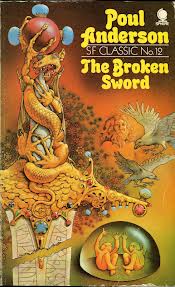
The Broken Sword, a thin paperback of fantastic content, is deceptive in appearance because the reader must look beneath its surface to find that it does not merely imitate Norse mythology; it also continues a story begun in the Elder Edda.     

Saturday, 15 September 2012

The Broken Sword

In Poul Anderson's The Broken Sword (London, 1977), when Imric the elf-earl visits a witch, she says:

" 'Not often of late lifetimes have the elves gone forth among men...' " (p. 19)

We accept this. Even if it is imagined that elves used to visit humanity, it must be acknowledged that such visits have declined or ceased. Thus, fantasy acknowledges reality. A story in which elven visits remained common would have to be set in an alternative reality - and Anderson wrote those also.

Imric replies:

" 'Aye, we have been too busy in our war with the trolls...But now truce has been made, and I am curious to find what has happened in the last hundred years.' " (p. 19)

Thus an idea that could have filled a book or a series, a hundred year war between elves and trolls, is passed over in a single sentence. Imric speaks:

"...in his voice that was like a wind blowing through trees far away..." (p. 19)

Here is more reality-fiction interaction. If an elven voice is like wind in trees, might wind in trees really be elven voices?

In Norse mythology, Alfheim/Elfland and Midgard/Earth are two of the Worlds among the Nine in the Tree but, by Anderson's account, Alfheim had extensive holdings in Midgard. Imric is the elf-earl of Britain. However, elves with their dwellings and belongings are invisible and apparently even intangible to anyone without witch-sight. Thus, human and elven realms occupy the same space. Imric sees Elfheugh not as a tor but as a castle. A scientific rationale might be different vibrational rates.

"In those days the Faerie folk still dwelt upon earth, but even then a strangeness hung over their holdings, as if these wavered halfway between the mortal world and another..." (p. 21)

They have long since withdrawn to the other.

Although Anderson is better known for sf than for fantasy and although this fantasy was very early, it is as imaginative and readable as any of his works.

Thursday, 17 May 2018

Vampires

I have searched the blog for references to vampires. (Scroll down.) Poul Anderson's "Interloper" gives us a fictional origin of vampire legends.

I strongly dislike the whole idea of vampires and cannot understand how one author has written a whole series about them. (There are also some Young Adult series.) Alan Moore developed the idea that, although vampires cannot cross running water, they might be able to survive and thrive by living under the surface of still water - until someone causes the water to flow.

SM Stirling's Shadowspawn turn out to be vampires among other things which does not endear them to me. However, I remain interested in their evolution, history, mental powers, means of social control, civil war and dilution by interbreeding.

The Shadowspawn are homo sapiens nocturnus and the Alfar in "Interloper" are nocturnal life. See Alfheim. Anderson also has "half-world" organisms that dissolve in sunlight when dead in his Operation Luna. See Magic And Goetics.

There is a very old tradition that a different kind of life coexists with familiar life forms on Earth and imaginative authors can tap into this idea. It is as if they were confirming something that we already knew.

Sunday, 10 July 2016

Odin

Poul Anderson, The Broken Sword (London, 1977), Chapter XXVI.

I meant to summarize Odin's explanation (see here). However, that explanation is already a summary. I would merely have been repeating his phrases in list form so let's just quote his dialogue:

"'Not yet is this game between Aesir and Jotuns and the new gods played out. Tyrfing still gleams on the chessboard of the world. Thor broke it lest it strike at the roots of Yggdrasil; I brought it back and gave it to Skafloc because Bolverk, who alone could make it whole again, would never have done so for As or elf. The sword was needed to drive back the trolls - whom Utgard-Loki had been secretly helping - lest Alfheim be overrun by a folk who are friendly to the foemen of the gods. But Skafloc cannot be let keep the sword, for that which is in it will make him seek to wipe out the trolls altogether; and this the Jotuns dare not allow, so they would move in, and the gods would have to move against them, and the doom of the world would be at hand. Skafloc must fall, and this child whom I wove my web to have begotten and given to me must one day take up the sword and bear it to the end of its weird.'" (p. 196)

That is complicated and will require some discussion. Odin mentions "...the new gods..." but still does not explain how they fit in with everything else.

Wednesday, 6 May 2026

Mythological Metaphysics

The Broken Sword, V.

Imric's fleet raids a troll town:

"Though war was still not declared, such forays and tests of strength were growing common on either side." (p. 36)

Does that sound familiar to us now? There are powers that do not want to break a ceasefire but cannot make peace either. War and life become synonymous. 

This novel has a complex metaphysics. How do beings from all the mythologies coexist with each other and with the new god Whom elves etc cannot name? Alfheim is not just one of the Nine Worlds in the Tree but is also coterminous with the human world, Midgard.

Imric's elves defeat:

"...a group of exiled gods, grown thin and shrunken and mad in their loneliness but wielding fearsome powers even so." (pp. 36-37)

Who are these gods, neither Aesir nor Olympians? Maybe they are some that we have never heard of.

Neil Gaiman's The Sandman remains the most appropriate parallel text for Poul Anderson's fantasies that I know of. All gods exist as long as they are believed in. They begin and end in the Dreaming and linger in a Dream Country after their worship ceases.

Monday, 27 June 2016

Out In The Weather

When Imric the elf-earl rides out at night:

"Presences moved in the night, but they were not men -" (The Broken Sword, p. 20)

We expect other supernatural beings but the presences turn out to be a wolf, a wildcat and small animals which:

"...were aware of the elf-earl's passage and shrank deeper into the gloom." (ibid.)

Animals would sense what most human beings would not.

In the elven castle, which looks like a tor, flutes have "...voices like mountain brooks..." (p. 21) and a troll-woman's voice is "...like a thunder..." (p. 22) Again, supernatural beings merge with natural phenomena. The troll is a prisoner and there are dwarf thralls. We can safely deduce that in this narrative every kind of mythological being exists.

"Mountainous in the east, with runes of lighting scribbled across, a storm stood on the horizon." (p. 23)

"...lighting..." should be "lightning"?

We have become very familiar with wild winds in Anderson's works and, sure enough, in the next sentence:

"Wind hooted and howled." (ibid.)

Shortly after that, thunder is:

"...boom and bang of great wheels across the sky." (ibid.)

No sooner have we thought of Thor than:

"Imric urged his horse to yet wilder speed. He had no wish to meet Thor out here in the night." (ibid.)

Gods also exist and an elf fears a god as the animals feared the elf. After stealing a human child, Imric sees Odin leading the Wild Hunt. A bad sign...

Finally, at the beginning of Chapter IV, the stolen child, Skafloc, begins to grow up in Alfheim where elven lays are:

"...like sea and wind and soughing branches." (p. 26)

Other Beings
Skirnir, messenger of the Aesir, attends Skafloc's naming-feast.
Sprites, dimly seen, inhabit waterfalls.
Gnomes live under trees.
Goblins live in caves.
Skafloc meets an exiled faun.

In the south:

Pan is dead;
the priests of the new god cut down the sacred groves;
exorcisms have killed dryads;
temples are empty and crumbling;
nymphs and Olympians are no more.

One world culture is being imposed.

Meanwhile, Skafloc, bridging the realms of men and elves, also learns from foxes and otters which might be kin to elves.

Thursday, 30 January 2014

Alfheim

In Poul Anderson's "Interloper" IN Anderson, Fantasy (New York, 1981):

long ago, maybe in the Archaeozoic, there was a common origin for "ordinary" life and another kind thriving in darkness and seeing by infra-red but unable to bear actinic light;

the difference is metabolic, not chemical;

the two kinds are mutually digestible but cannot interbreed;

nocturnal life evolved a telepathic humanoid species, the Alfar (Anderson uses "...to telepath..." as a verb (p. 191));

the nocturnal metabolism involves high rates of both anabolism and catabolism, entailing centuries of life but also rapid decay after death, leaving few or no fossils;

the nocturnals cannot compete with ordinary life which endures both day and night and reproduces faster;

the Alfar are declining and nearly all other nocturnal animals are extinct;

silver, iron and other metals catalyze rapid proteolysis and oxidation of Alfar tissues;

neolithic and Iron Age humanity drove out the Alfar and destroyed their cities;

the Alfar now hide in wastelands;

the last Alfar-human encounter was three hundred years ago;

the Alfar king is Oberon - was that last encounter with William Shakespeare (who died a little more than three hundred years before the publication of "Interloper")? 

Tuesday, 14 June 2016

Elves And The Sea

Why do we post about elves and also about the sea? What connects mythical and magical Alfheim with the factual and formidable North Sea? People. The same people who live by and travel across the sea also populate their environment with imaginary beings - and sometimes see them. My Northern Irish aunt-in-law saw horses and riders in the waves of the North Sea. I have no reason either to doubt that she had that visual experience or to believe that a film of the waves would have shown them taking the forms of horses and riders. Brains process sensory impressions in diverse ways.

Why does offering to Freyr lift the elven spell from Hadding? The elves were afflicting Hadding with bad weather and:

"...Frey...became lord of the weather..."
-Roger Lancelyn Green, The Saga Of Asgard (Penguin/Puffin Books, Harmondsworth, Middlesex), p. 40.

Presumably a god can overrule elves? Later, warlocks and the Wanderer waged war with winds and weather. (pp. 196-197) Later still, Rupert Bear helped Elves of Autumn to apprehend one Imp of Spring who refused to hibernate and instead created pockets of spring in the Nutwood Autumn.

Freyr is a Van but where did the Vanir originate? The Aesir, like the jotuns, originated in Ginnungagap but the Vanir are a different pantheon and would originally have had their own distinctive mythological cosmology. I suspect that Green invents some details to tie his narrative together but, wherever he got it from, his account of the Vanir is as follows:

"The Vanir were the shining ones who had been born out of the upper air and dwelt first in Uhland, above the high top of Yggdrasil. They never came to Asgard nor Midgard, nor ever even set foot upon firm ground..." (p. 35)

If they "...dwelt first in Uhland...," then maybe they later moved to Vanaheim which Anderson describes as:

"West of Asgard..." (War Of The Gods, p. 9)

In one mythological passage of "Star of the Sea":

"Out of the east, the morning behind them, rode the Anses into the world." (Time Patrol, p. 557)

The Vedic sky gods who became Anses/Aesir came west with the Aryans.

Saturday, 25 June 2016

Animals And Plants

Poul Anderson, Hrolf Kraki's Saga (New York, 1973).

If there are intelligent supernatural beings, are there also animals and plants? Is the "Half-world" a world?

The Stone Age

There were mammoths, bears and cave men but also dragons, centaurs, elves and even "half-world...plants..." (p. 126). Dead half-world organisms dissolve in sunlight and natural chemistry and therefore leave no fossils. This difference caused human fear or abhorrence so that Stone Age art shows little or nothing of the half-world. Some shamans contacted it but warlocks and witches mainly tried to control the elements.
-copied from here.

"White too were [the elves'] horses, slim and wind-swift, bounding from worldedge to worldedge in a few heartbeats."
-Poul Anderson, War Of The Gods (New York, 1999), p. 35.

In Hrolf Kraki...:

"'...a great and horrible beast...a winged and flying thing...'
"...a leathery rustle and a rushing as of mighty winds...
"...a featherless thing of huge sickling wings, cruel claws and beak, tail like a rushing rudder, scaly crest above snaky eyes...
"The monster hissed...
"The troll-being...
"A rank smell...
"The heavy body...
"...grinning sharp-toothed jaws...
"...its cold blood..." (pp. 176-177)

Bjarki not only kills the troll-being but makes the weakling and coward Hott drink its blood and eat its heart. The effect is remarkable:

"'Why, the world is beautiful.'
"'I feel ...as if I'd wakened from death.'" (p. 178)

Addendum: See also Alfheim.

Sunday, 12 June 2016

From Elven To Elfin

Elves dwindled in folklore but were revived in fiction.

(i) Poul Anderson wrote that elves were originally gods. Warship crews returning home removed dragon heads in order not to offend the elves. -The Broken Sword (London, 1977), p. 10. Does this prove that elves had been gods?

(ii) In any case, by the time Northern Europeans began to write, elves had become tutelaries like Greek dryads or Japanese kami. Some attend the gods.

(iii) Tall, fair "light elves" inhabit Alfheim whereas Svartalfheim, "home of the dark elves," is probably inhabited by dwarves rather than by a different kind of elf.

(iv) Folkloric elves shrank into sprites and lost their connection with dwarves.

(v) The medieval and Renaissance realm of Faerie retained beautiful, magical inhabitants of human size.

(vi) Tolkien restored light elves, making them also wise and benevolent. I have thought that Tolkien's elves were unlike the diminutive folkloric variety and more like gods - powerful beings, "elven," not "elfin."

(vii) Young Poul Anderson, writing The Broken Sword, made ninth century gods and elves amoral and ruthless like the people who had imagined them and as they are shown in the Eddas and sagas.

(viii) Anderson writes in his Foreword to The Broken Sword that this text contains some scientific rationalization although I do not see it there. It is in his "Interloper" and Operation Luna. The rationalization that he mentions is the idea that magic is mental control of external phenomena and that a race exercising such control would be able to live indefinitely and change shape. Their metabolism was unable to bear sunlight and reacted disastrously with iron. Their technological advances included alloys of nonferrous metals, ships with frictionless hulls and anachronistic castles but their conservative, aristocratic, warrior culture would not develop science very far and therefore would not have gunpowder or steam engines.

(ix) Rupert Bear adventures with an ecological bureaucracy including Elves of Autumn, Imps of Spring and a Clerk of the Weather.

Wednesday, 29 June 2016

Faerie Alliances

Poul Anderson, The Broken Sword (London, 1977).

This "Faerie" is not a single realm ruled by Auberon but several realms, including Alfheim and Trollheim. In their coming war against the elves, the trolls' allies will be:

most goblin tribes;
demons of Baikal;
Shen of Cathay;
Oni of Cipangu;
Moorish imps;
werewolves;
vampires;
ghouls;
dwarf thralls -

- whereas the elves might be helped only by some goblins and dwarves and the Sidhe. However, trollish spies have ascertained that the Sidhe will fight only if they are attacked, which the trolls will not do this time.

As with the Merseians of the Roidhunate, accurate military intelligence would disclose that the trolls use each truce only to prepare for the next war "'...while the elves loafed and intrigued among themselves and took their pleasure.'" (p. 91) It would be necessary to act on such intelligence, with a preemptive strike, permanently depriving the trolls of the ability to wage war. I do not like to talk about extermination. In the Technic History, the Merseians on Dennitza are proof that not all of their race serve the Roidhun.

Friday, 5 June 2020

Saving The Appearances

See:

Fairy Lands Forlorn
Elves Versus Trolls
Elves And The Sea 

Operation Luna, 13.

If there were dragons, centaurs and elves in the remote past, then where have they gone and why have they been forgotten except as myths?

First, their bodies crumble after death so they leave no fossils.

Secondly, fear might explain why they were not recorded in Stone Age art.

Thirdly, folk tales of fleeting visits to strange realms might preserve memories of "'...those eerie, evanescent elfin civilizations...'" (p. 126), with their "...soaring spires..." (ibid.), shimmering like rainbows.

Fourthly, Bronze Age kings and warriors discouraged magical competition.

Fifthly, the paranatural ecology withdrew before the Iron Age.

For a similar history, see Alfheim.

For a more detailed summary of the goetic history, see Magic And Goetics.