Saturday, 20 January 2024

Identities

Hloch is Ythrian by species, Avalonian by planet of origin and again Ythrian in interstellar politics because Avalon belongs to the Domain of Ythri. By these criteria, Tabitha Falkayn is human, Avalonian and Ythrian. She identifies as Ythrian when speaking to the captured Terran, Philippe Rochefort. Tabitha's ancestor, David Falkayn, was human and Hermetian and Hermes was then independent. David Falkayn's employer, Nicholas van Rijn, was human, Terrestrial and Solar. 

During the Terran War, all Avalonians, both human and Ythrian, are anti-Terran. However, the term, "Terran," can also be applied to species:

"This is the tale, told afresh, of how Avalon came to settlement and thus our choth to being. This is the tale as told not be Rennhi and those on whom she drew for the Sky Book, but by Terrans who walk the earth."
-Poul Anderson, INTRODUCTION WINGS OF VICTORY IN Anderson, The Van Rijn Method (Riverdale, NY, December 2009), pp. 75-77 AT p. 77.

The Sky Book is told by Ythrians; the Earth Book by human beings.

Friday, 19 January 2024

The First Generation Of Avalonians

Poul Anderson, "Wingless" IN Anderson, Rise Of The Terran Empire (Riverdale, NY, March 2011), pp. 293-306.

For story purposes, Anderson needed David and Coya Falkayn's grandson, Nathaniel, to be the only human boy of his own age among a host of young Ythrians for many cycles of Morgana. No problem. But was the whole history of the early colonization of Avalon specially written just to bring about this result? We are aware of imbalances in the Technic History, e.g., sixteen instalments, including three novels, about the Polesotechnic League but only one short story about this crucial period of Avalonian history or two if we include "Rescue on Avalon" but that is about the second stage of colonization.

In the first stage, the colonists settle on the Hesperian Islands before they are ready to tackle the Coronan continent. Furthermore, human beings and Ythrians settle on different islands to begin with. This is not segregation, just taking it a step at a time before moving toward fuller integration. The first challenge that both species have to cope with is their new environment which is smaller than Earth but larger than Ythri, an ideal setting for joint colonization as the earliest explorers had realized. But there are hazards to guard against and adjustments to be made.

The Falkayns live in Chartertown whereas the main location for the Ythrians is Trauvay/Wingland. When Ythrians visit Nat's grandfather or his father, the conversation is usually in Planha which Nat learns at school. Eventually, Nicholas Falkayn, an engineer, travels to Trauvay and stays there for many lunar cycles as part of a research and development team for continental colonization. Since Nicholas is accompanied by his family, the narrative at last reaches the point that Anderson had been aiming it at.

The story has two authors: Poul Anderson on Earth Real and Judith Lundgren on Avalon. Willingly suspending disbelief, we accept that it is the latter who adds the fictional dialogue:

"'Hyaa-aah!' In a whirl and thunder, Keshchyi left the balcony floor and swung aloft. Sunlight blazed off his feathers." (p. 296)

For the first time, we are reading about the daily life of Ythrians just as we had read about the daily life of Terrestrials in the Solar Commonwealth in "How To Be Ethnic In One Easy Lesson" and, to a lesser extent, in "Lodestar."

Although Lundgren presumably imagines the dialogue, she is not creating a fiction but fictionalizing history. This experience of Nat Falkayn did happen in her recent past. But any further discussion of it here will have to be postponed into my near future.

Fair winds forever.

High is heaven and holy.
Morgana, Moon And Magazine


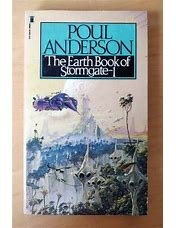
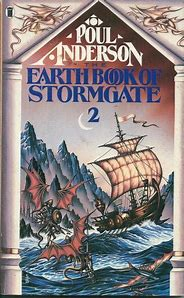
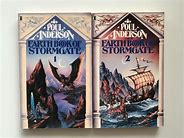
"The Problem of Pain," introducing the planet that will be Avalon, mentions that the planet has a single small moon. That moon will be called Morgana. A periodical will be named after the moon. Judith Dalmady/Lundgren will write short stories to be published in that periodical. Centuries later, Hloch will collect three of those stories in The Earth Book of Stormgate. Also in Hloch's time, the Terran Navy will bombard the moon, Morgana, so that mountains crumble and afterwards the moon shines less brightly than before. See here.

Reading the references to a small moon in "The Problem of Pain," we do not suspect that so much history still lies ahead of us - unless, of course, staying with the original publication order, we read The People Of The Wind before The Earth Of Stormgate. In that case, we already know of Avalon and its later history and are interested to learn how it was first explored by Ythrians employing some human beings.

The Trader Team: Three Phases

The entire career of Nicholas van Rijn's original trade pioneer crew of David Falkayn, Adzel and Chee Lan begins and ends within The Technic Civilization Saga, Volume II, David Falkayn: Star Trader. Four instalments show just five incidents:

"The Trouble Twisters," Ikrananka
"Day of Burning," Merseia
Satan's World, Satan and the Shenna
"Lodestar," Tametha; Mirkheim

In true future historical style, this sub-series is interrupted by a contemporaneous account of van Rijn lounging on Earth while solving a problem on another planet, Cain:

"The Master Key"

- and by a second narrative recounting yet other events elsewhere in space:

"A Little Knowledge"

The entire career of the original team plus Coya Conyon/Falkayn occurs between one section of the Prologue and the opening chapter of the first Technic History instalment collected in Volume III. Falkayn reminisces about just two scenes from that period:

"...Coya beside him beholding the crooked towers of a city on a planet which did not yet have a human-bestowed name...
"Coya bringing him sandwiches and coffee when he sat far into a nightwatch studying the data readouts on a new world the ship was circling..."
-Poul Anderson, Mirkheim IN Anderson, Rise Of The Terran Empire (Riverdale, NY, March 2011), pp. 1-291 AT VI, p. 109.

The original team without Coya is reassembled just once and for a different purpose in Mirkheim. And that is our last sight of all these characters.

Between the disbandment of the crew that included Coya and the temporary emergency reassembly of the original crew, Chee Lan had joined another trade pioneer crew so there is another potential series.

New Narratives

Staying with the planet Avalon, we jump directly from "The Problem of Pain," the third story in The Technic Civilization Saga, Volume I, to "Wingless," the second story in Volume III. Between these two stories are the sixteen instalments, including three novels, about the Polesotechnic League. Although the League endures throughout a historical period, all of these instalments are set within the lifetimes of a single group of characters. Adzel ages from studenthood to retirement while David Falkayn matures from apprentice to acting CEO of van Rijn's company.

The League is explained in the first Nicholas van Rijn story, "Margin of Profit," and in the fictional introduction to Trader To The Stars. The Solar Commonwealth, which is the political arrangement during the League period, is explained by Hloch in his Earth Book introduction to "The Problem of Pain." By the time of "Wingless," the League is in terminal decline. Falkayn has led his family and others out of human space and has founded the colony on Avalon. Thus, the scene is set for new narratives about Avalon although on an entirely different basis.

Thursday, 18 January 2024

Disparate Plot Elements

In The Earth Book Of Stormgate, the first four instalments successively introduce:

the race of Ythrians;
the planet, Avalon;
the Wodenite, Adzel;
the Terrestrial, Nicholas van Rijn.

The earlier collection, The Trouble Twisters, had introduced the Hermetian, David Falkayn. These five disparate plot elements, a species, a planet and three individuals, combine and recombine. Thus, just staying within the Earth Book:

the eighth instalment features the trader team of Falkayn, Adzel and Chee Lan;

the tenth instalment features the trader team, van Rijn and Ythrians;

in the eleventh instalment, Falkayn has led the joint human-Ythrian colonization of Avalon and his grandson is growing up on that planet.

And so on into the future beyond the Earth Book. We will stay with Avalon for a while but not any more this evening.

Aenean And Avalonian Continuity

Reading Poul Anderson's History of Technic Civilization in chronological order of fictional events in Baen Books' The Technic Civilization Saga, we find Ythrians and Aeneans exploring Avalon in the third instalment in Volume I and an Avalonian Ythrian on Aeneas in the second instalment in Volume IV. One of the Aenean explorers on Avalon, Peter Berg, is a Christian and a graduate of the University of Nova Roma. The later instalment, set on Aeneas, presents a detailed description of the University of Nova Roma and also displays deeply ingrained religious belief on Aeneas. We are impressed by this close future historical continuity between two such widely separated instalments. We also realize that these two instalments together with four others featuring Ythrians were published in 1973 and that the only other Ythrian instalment was published in 1972. We are impressed by such a concerted burst of creativity while also recognising that this sequence of narratives about Ythrians is a comparatively small part of the whole Technic History.

Why The Universe Was Created

"The Problem of Pain."

These posts are written while reading or rereading. Thus, I missed a point. At the end of this story, Peter Berg explains that, according to the Ythrian New Faith, when a conscious being gives God the Hunter:

"'...a good chase, a good fight.
"'Then He wins honor....
"'That's why God created the universe.'" (pp. 133-134)

So God the Hunter is God the Creator. OK, this might be Berg reading his Biblical concept of creation onto the Ythrian ideas. Nevertheless, the word, "created," is used at this one point. 

Meanwhile, the planet Gray, not yet given its final name of Avalon, acquires some of its local terminologies. Olga Berg has christened "atlantis weed." The tree whose waving thin branch slices off Enherrian's left wing is later called the surgeon tree. The bush whose vapours poison and kill Olga has already been named the hell shrub.

Misunderstandings continue. Peter Berg wonders whether God would really blame the crippled Enherrian if he committed suicide whereas Whell is horrified at the suggestion that her husband might rob God of honour.

That atlantis weed is a good adaptation of plants to life not in but on the ocean. Why has something like it not evolved on Earth? Could intelligent beings colonize the floating islands, living on platforms and fishing while cultivating smaller plants that grow on the weeds?

"God"

There is no suggestion in Poul Anderson's Technic History that the "God the Hunter" of the Ythrian New Faith is also God the Creator so maybe this monotheism is not a projection of agency onto the universe? "The God" of the Merseian Roidhunate is believed to have a purpose for the Race.

That single syllable, "God," gets a lot of use. In Indian philosophy, Jainism and the Hindu Samkhya system are atheist. Both posit beginningless and endless souls and matter without a creator. The Yoga system accepts Samkhya metaphysics but also catalogues meditative practices, including devotional theism. In order to fit such devotion into an essentially atheist system, the Yoga Sutras define God as a special kind of soul permanently free from reincarnation but not a creator. The word "God" can also be applied to the object of mystical experience even when that object is not regarded as a transcendent person.

Although Anderson's Fr. Axor seeks the Universal Incarnation, maybe Hinduism or Buddhism would be better equipped to incorporate or at least to cope with the multiplicity of beliefs discovered in Anderson's Technic History?

Mutual Incomprehension

"The Problem of Pain."

Arrach, the young female Ythrian, has been lost at sea. Miscommunications multiply. First, Arrach's father, Enherrian, assures her mother, Whell, that Arrach would have fought well and given God honour. Peter Berg wonders whether this means that Arrach prayed and confessed while drowning. It does not. Berg does murmur that Arrach is in heaven but must say this in Anglic, not in Planha. Christians cannot know where anyone has gone in the hereafter, especially not members of another species. In any case, Enherrian thinks that Arrach cannot be anywhere since she is dead. When Berg starts to ask about Arrach's spirit, Enherrian interrupts that that spirit:

"'Will be remembered in pride.'" (p. 122)

- and returns to his work. When Olga Berg completes her husband's question as to belief in spirits outliving bodies, Enherrian expresses incomprehension and closes the conversation not with words but with posture and plumage. They really are at cross-purposes here.

Berg reflects:

"How sorry I feel for these my friends, who don't know they will meet their beloved afresh!" (p. 122)

Sorry, Pete. You do not know that. You only believe it. But, even if there is a hereafter, it has got to be a big place. How do you know that you and Olga will survive in the same "mansion"?

And what is Berg's argument for survival? He continues:

"They will, regardless. It makes no sense that God, Who created what is because in His goodness he wished to share existence, would shape a soul only to break it and throw it away." (ibid.)

Assuming God's existence, it makes sense that He will do whatever He sees as best. If a human life is finite in time, with a beginning, a middle and an end, does this mean that it is broken and thrown away? This is wish fulfilment disguised as reasoning.