Showing posts sorted by date for query hovering. Sort by relevance Show all posts

Wednesday, 7 October 2026

Recognizable Narrative Elements

Poul Anderson, "Conversation in Arcady" IN Anderson, Dialogue With Darkness (New York, February 1985), pp. 223-233.

We recognize:

yet another hovering bird of prey -

"High overhead a fish hawk went circling." (p. 223);

a small shuttle boat that descends to Earth because an interstellar mother ship is too big to land;

interstellar travellers who should have benefitted from time dilation and from "Anti-Eld" (p. 224) but not from FTL;

a life of comfort and ease on Earth.

We remember time travellers visiting future periods in "Flight to Forever."

We expect the conversation to be a culture clash but will find out tomoz.

Saturday, 25 October 2025

Impoverished

Before Wanda Tamberly attends the Time Patrol Academy, Manse Everard tells her that pre-civilization Earth was "'...fit for gods...'" (Searching the blog reveals that we have quoted this phrase several times.)

In Beringia in 13,212 BC, Wanda sees for herself. Nine kinds of birds fly "...in their hundreds...":

"After two years she still found marvel in the lavishness of life, at the very gates of the Ice. Not before leaving her home world had she really known how impoverished it was."
-Poul Anderson, 13,212 B. C., I, IN Anderson, The Shield Of Time (New York, 1991), pp. 139-149 AT p. 140.

In case I have made anyone curious and they do not have the book to hand:

gulls
ducks
geese
cranes
swans
plover
snipe
curlews
one hovering eagle

But the main point here is that our world is impoverished. That is a point not to be read past but to be pondered. Maybe we have a responsibility to restore that lavishness of life? And to put industries into space?

Tuesday, 14 October 2025

Castelar And Varagan Escape, Lucifer Falls

"The Year of the Ransom" is carefully slotted into its place in Poul Anderson's Time Patrol series. Castelar, escaping from the Exaltationists, stabs Merau Varagan but:

"...wasted no time finishing him." (p. 666)

Castelar cannot finish Varagan because Everard must apprehend the latter in "Ivory, and Apes, and Peacocks." However, by the same token, Varagan's wound is so bad that two of his men immediately whisk him off for medical attention elsewhen which means that they are not in Macchu Picchu to be apprehended by the Patrol agents who attack as soon as Castelar has escaped. Again, Varagan has to be around later so he cannot be apprehended now.

Not every loose end is tied up satisfactorily but these are.

Now I must eat some curry and return to reading Neil Gaiman and maybe also some of Mike Carey who inherited the retired Lucifer Morningstar from Gaiman. 

In "The Year of the Ransom," an Exaltationist who had been hovering on a timecycle above Macchu Picchu:

"...fell as Lucifer fell." (p. 721)

Sometimes all fiction feels like a single series.

Friday, 1 August 2025

Lucas Back In Constantinople In April, 1306

Rogue Sword, CHAPTER I.

Surging humanity:

citizens, self-styled Romans
a noble in a palanquin carried by slaves
an Orthodox priest
English
Flemish
Germans
French
Iberians
Italians
Turks
Arabs
Russians
Mongols
"...half the world poured down the throat of New Rome." (p. 26)

"...ocean-like roar..." (ibid.) from:

voices
shuffling, clattering feet
ringing hoofs
rumbling wagon wheels
grumbling, grinding city

Thick, rolling smells from:

dust
smoke
cooking oil
sweat
sewage
horse droppings

Colour:

sun lighting white seagull wings (more hovering scavengers)

Three senses.

Tuesday, 29 July 2025

Eagle And Silvery Cataract

Conan The Rebel, XIII.

Conan, Daris and Falco proceed by wingboat to Taia. Daris has declared her love for Conan and he could make love to her. However, Belit would reproach Conan not for disloyalty to her, Belit, but for treachery to Daris when leaving Daris to return to Belit. Falco remains besotted with Senufer, not accepting that Senufer must be Nehekba. 

"High above the boat, on wings that shone golden in the sun, an eagle kept pace." (p. 135)

At first sight, yet another hovering bird of prey. However, if we remember Nehekba's earlier dialogue, then we know that this eagle is Nehekba in magical bird form following the wingboat. In how many works by Poul Anderson do sorceresses spy in bird form? (Maybe I can get blog readers to do some of the research work?)

This will be a good place to break off because, turning the page, we must cope with a description of Taia as the wanderers arrive there:

"XIV WAYFARERS IN TAIA" (p. 136)

And we spot on the facing page a "...silvery cataract of Milky Way..." (p. 137) that we seem to have missed before.

Sunday, 27 July 2025

Soaring Hawk

Conan The Rebel, XI. 

Conan and his three companions are fugitives and Daris suggests that they steal the lightly guarded wingboat. Conan ponders, staring into heaven. And what happens while he does this?

"A hawk soared there." (p. 107)

Not the wind this time but yet another hovering bird of prey. Such birds are another Andersonian motif although not as ubiquitous as the wind. This hawk might represent the troops searching for the fugitives or the freedom of the fugitives if they steal the wingboat. 

We realize that the text has been carefully constructed. Both Daris and Falco have been been transported in the wingboat and have heard the monosyllabic spells spoken by the acolytes to control the motion and speed of the boat. Probably escape by this route will proceed as planned but we will have to read on to find out and, as some of you might now, I turn to other reading at this time of the evening. I will be up early tomorrow morning for an adventure of sorts in another town but should be back to blogging again later in the day.

Thursday, 15 May 2025

Ramnuan Plants And Animals


A Stone In Heaven, I.

Grass equivalent: nullfire, tall on the veldt, a thick turf elsewhere.

Kinds of trees: brightcrown; saw-frond.

Other plants: fragrant nightwort; rattling spearcane.

Small twilight creatures: darters; scuttlers; light-flashers.

A hovering flyer: something strange from beyond the Guardian Range.

Ramnuans spread vanes and ride onsars. Yewwl carries an infant in her pouch.

Poul Anderson creates distinctive organisms for each new planet. We become familiar with Ythrian hammerbranch etc. However, imaginative new names of trees must be invented for Ramnu: brightcrown etc.

Friday, 4 April 2025

A Cool Breeze

The Avatar, L.

In Ireland, after everything:

"A cool breeze bore odors of sea and soil and growth. High overhead a lark sang." (p. 400)

Appropriate to the ending of this novel: not a cold wind bearing storm clouds but a cool breeze etc.

For once a character comments on the wind as it comments on the conclusion:

"'Aye,' Caitlin said. 'As if the country would bid us goodbye with a blessing.'" (ibid.)

And, even closer to the end, yet another of Poul Anderson's many hovering birds of prey:

"From behind a ridge, a hawk swung to hover where the sun turned its wings golden." (p. 404)

Anderson's The People Of The Wind ends with the last line of a song:

"High is heaven and holy."

The Avatar ends with the last line of another song:

"Rejoice in the joy that comes after!" (ibid.)

Tuesday, 18 March 2025

Demetrian Biology

Poul Anderson's The Avatar is a richer work than we had remembered but this is always the case. Anderson invests care and attention in minute details that his readers forgot unless they reread and analyze a lot. The previous post should have included data that were becoming too involved so have been held over until now:

lodix, the clover-like Demetrian ground cover, is blue-green and trilobate;

petalled arrowhead and sunbloom grow among the lodix;

there are also coppices of native trees - redlance (tall) and daphne (supple);

swarming insectoids are flamewings (gorgeously coloured), hopshrubs (which leap) and humbugs (which are many);

bright frailie cruise;

a minstrel warbles from a branch;

bucaeros swoop;

a drague hovers (yet another of our hovering predators);

what sound like birds are hypersauroids, the only kind of Demetrian vertebrate;

a cooling south breeze carries half-familiar pungencies;

across the road is pasture for imported cattle that have become fantastically red and also imported barley;

Caitlin plucks moonberries, pearl apples and dulcifruct which, although edible, lack some vitamins and amino acids;

she walks from the bus at Freidorp to Trollberg on a ridge ahead with the Phaecian snowpeaks and Mount Lorn beyond;

Caitlin meets a garm, a gray, tiger-sized carnivore which never attacks Terrestrial animals, disliking their scent;

the Upland Folkmeet has declared garms protected;

neither fears the other.

More details than I had expected when I began to summarize them.

Tuesday, 25 February 2025

The Horn

Maurai And Kith.

What is the sound that Jong Errifrans thinks that he hears on an unknown planet? It is described as:

"...the distant blowing of a horn. It would begin low, with a pulse that quickened as the notes waxed, until the snarl broke in a brazen scream and sank sobbing away." (p. 215)

That seems to be more than just something that might or might not be there as a background noise. It goes through four stages: a low pulse; quickening, waxing notes; a brazen scream; a sinking sob. And he hears this same sequence several times. 

In his sleeping bag, he thinks that he hears the horn.

He hears it briefly but louder the following day on the beach. It reminds him of a hunter's bugle on a frontier planet. This is just before he sees inhabitants of the planet carrying the body of his friend.

Just before he is lowered into the sea to recover his friend's body, he hears, in the stillness of his helmet, his own breath and pulse and:

"...the hunter's horn, remote and triumphant." (p. 232)

But this last is given three possible explanations:

"- some inner sound, a stray nerve current or mere imagination -" (ibid.)

The first explanation offered for a sound that no one else heard had been:

"'Some trick of the wind...'" (p. 215)

In the concluding paragraph:

"I wonder what that sound was, he thought vaguely. A wind noise, no doubt, as Mons said. But I'll never be sure. For a moment, it seemed to him that he heard it again, in the thrum of energy and metal, in the beat of his own blood, the horn of a hunter that pursued a quarry that wept as it ran." (p. 239)

That was what he had seen on the frontier planet.

In the concluding paragraph, he is inside a spaceboat as it leaves the planet so he cannot possibly hear anything back down on the planetary surface any more than he could have heard anything through his space helmet before he was lowered from the hovering spaceboat.

When he seems to hear the horn in the thrum of energy and the beat of blood, it is clear that at this stage the sound has become part of him. We are left with the mystery of whether there really was any external source of the sound on the planetary surface.

Thursday, 19 September 2024

Back To The Multiverse

Regular blog readers will remember that I recently bought a copy of the Foundation Trilogy, Volume III, Second Foundation, by Isaac Asimov, bypassing Volumes I and II. The purpose of the purchase was not to reread this book but just to quote and analyze certain passages because of their parallels with certain recently reread or remembered passages in Poul Anderson's Psychotechnic and Technic Histories. There my renewed interest in Asimov ends, at least for the time being. This intellectual exercise was both interesting and entertaining, especially since I had completely forgotten some of the relevant details and also because it was necessary to reread the text very carefully in order to uncover exactly what it was that Asimov was or was not saying. There were some surprises. Poul Anderson does not tie himself in such philosophical knots and writes more convincing fictional history in any case.

Having, I think, concluded any renewed engagement with Asimov at least for now, my attention is left hovering between the two mentioned Andersonian future histories and, by implication, between several other future history series by Anderson and his contemporaries. Imagine their respective time chats displayed in parallel on a wall-sized sheet or screen. We notice comparisons and contrasts. World War III occurs in the Psychotechnic History but not in the Technic History. Seeing the timelines in parallel, we are bound to wonder about any interaction between them: not only spaceships and time machines but also inter-timeline machines? Rhysling from Heinlein's Future History and van Rijn from Anderson's Technic History do both make it into Anderson's inter-universal inn, the Old Phoenix. A much greater story remains to be told here.

Saturday, 22 June 2024

"After such knowledge" In GENESIS

Poul Anderson, Genesis (New York, 2001), PART TWO, X.

Two further passages are set in the eighteenth century emulation:

"Early morning in the garden, flashes of dew on leaves and petals, a hawk aloft on a breeze that caused Laurinda to pull her shawl about her. She sat by the basin and looked up at him where he strode back and forth before her, hands clenched at his sides or clutched together at his back. Gravel grated beneath his feet." (2, p. 218)

Andersonian attention to detail: flashing dew, a hovering bird of prey, a breeze, our last sight of the fish basin, grating gravel - three senses.

"They followed a lane to a hill about a kilometer away. Trees on its top did not obscure a wide view across the land. The sun stood dazzling in the east, a few small clouds sailed across a blue as radiant as their whiteness, but an early breath of autumn was in the wind. It went strong and fresh, scattering dawn-mists off plowland and sending waves through the green of pastures; it soughed in the branches overhead and whirled some already dying leaves off. High beyond them winged a V of wild geese." (6, pp. 229-230)

This is the last sight of eighteenth century England both for the characters and for their readers. We see this emulation only when they do. Thus, the breath of autumn and the few dying leaves are appropriate. I do not fully appreciate all these nuances until I blog about them.

Christian and Laurinda will be together but as memories in Alpha. Gaia will not maintain them in an emulation:

"'After such knowledge as they have tasted of, how could they return to me?'" (XII, p. 246)

I don't see why not. But I have just noticed James Blish's title, After Such Knowledge, a quotation from TS Eliot, in Anderson's text. There is always more to be found.

Sunday, 2 June 2024

Four Senses And A Hovering Carrion Bird

Fire Time, V.

" A wind boomed cruelly hot. The canes where Arnanak stood rattled in its blast. It smelled of seared brush. Red and white light together cast double shadows of different lengths and colors, weirdened the whole landscape..." (p. 48)

Stop there. There is more but that is plenty. 

Bodily sensations: wind; cruel heat.
Sounds: boom; rattle; blast.
Smell: seared brush.
Sight: red and white light.

Two suns contend. Conflicting sources of light and shadow alarmingly change the environment as if the end were nigh although everyone knows of old that Fire Time is a cyclical event. Other colours mentioned are yellow shrubs, grey soil, ocherous crags and brazen sky. In that sky:

"A carrion ptenoid hovered far, far aloft..." (ibid.)

This time, appropriately, it is a carrion bird, not a bird of prey.

Thursday, 7 September 2023

Arzunian Powers


"Sargasso of Lost Starships."

"A lonely bird, cruel-beaked and watchful, hovered on great black wings far overhead, waiting for them to die." (V, p. 408)

This hovering bird is a scavenger, not a predator.

Arzunian life is:

"'...linked to the primary atomic probabilities...'" (IV, p. 406)

OK. Atomic movements are not deterministic but probabilistic and living organisms can affect them.

"'...psi functions...give the continuous field-distribution of matter-energy in space-time.'" (ibid.)

Thus, conscious Arzunian organisms, animals as well as the intelligent humanoids, can:

"'...control...external matter and energy by conscious will acting through the unified field which is space-time. Telekinesis.'" (ibid.)

"'...their type of matter-control is heterodyned by living nerve currents.'" (IV, p. 407)

Never having had to develop much technology, Arzunians carry spears. They can turn aside blaster bolts or missiles but might be caught unawares by a sudden sword thrust. Consequently, the Terrans use their blaster flames to shape weapons from the metal of their wrecked ship. Yet another rationalization of sword fights in an otherwise high tech future.

Sunday, 3 September 2023

A Hermetian Bird Of Prey

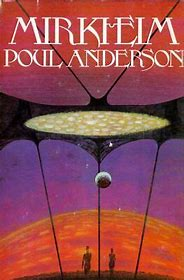
Mirkheim, XVI.

Above the Falkayn domain at Hornbeck:

"Far overhead a steelwing hovered, alert for prey." (p. 215)

I note this here first because it is yet another hovering bird of prey and secondly because it is one that I seemed to have missed in all previous readings. Its presence is symbolic in this passage. The Falkayn settlement has withdrawn:

"- as if in preparation for onslaught." (ibid.)

What better reminder of the orbiting Baburite occupation fleet than a hovering "steelwing"?

David Falkayn and his mother walk and talk about the crisis. This is the first and only time that we encounter Athena Falkayn. Poul Anderson conveys much with little. 

Sunday, 16 July 2023

Wind And Hawks


Dahut, XI, 2.

Tommaltach and a hooded Dahut walk in the countryside:

"Ys sank from sight. It was as if they had the world to themselves, they and the wind and a pair of hawks wheeling high above." (p. 242)

Significances:

the omnipresent Andersonian wind;
hovering birds of prey;
Dahut beginning to lead her first young man astray.

In Chapter IX, Corentinus foreknew that:

"'If Dahut does not come to the Light, she will do such ill that it were better that she had died in her mother's womb.'" (7, p. 209)

That latter process is just beginning. It is all downhill from here.

Wednesday, 5 July 2023

Saint Corentin

Gallicenae, VII, 3.

When Gratillonius rides out of Aquilo, he adds to our list of hovering birds of prey:

"...a falcon afar." (p. 144)

Gratillonius is an overnight guest in the tiny, cylindrical, conically thatched, wicker and clay hut of the hermit, Corentinus, who eats only once a day except when fasting although, on this occasion, he does eat a little extra but only to keep his guest company. 

This reminds us of Reverend Peter of Rochdale Zen Retreat who rises at an unGodly hour, 5:00 AM, I think, meditates for two hours before breakfast and, in the Indian tradition, usually eats nothing after lunch. On the evening of the fortieth anniversary of our meditation group, Peter accompanied us to a pizza restaurant where, without glancing at the menu, he ate the pizza with the simplest topping and no sweet course although some members of the lay Sangha indulged in cheese cake with ice cream.

Nicholas van Rijn praises God by savouring the best food and wine.

"Wisdom is justified by all her children." (Luke 7:35)

And Poul Anderson shows us every kind of character.

Addendum: Also, in SM Stirling's Emberverse series, a Christian monk ate bread and drank water while his companions feasted.

Wednesday, 14 June 2023

Change And Decay

Roma Mater.

One aspect of social change is decline. In the Mithraeum, the Father and the Heliodromos are aged:

"Their deaths would surely spell the end of worship here." (p. 30)

The curial class to which Gratillonius belongs is in economic decline. Whitewash peels from walls and Marcus, Gratillonius' father, has had to sell their land to a corrupt Senator. Marcus says that the Republic rotted but Rome endures...

We recognize shrilling wind and a golden-winged hovering hawk as the two men walk around what is left of their estate. The Andersons set the scene. There will be much more change before their Tetralogy ends.

(Look at that cover image but what is wrong with it?)

Sunday, 4 June 2023

The Past In The Time Patrol Series: Miocene-Pliocene Transition

Poul Anderson, "Gibraltar Falls" IN Anderson, Time Patrol (Riverdale, NY, 2010), pp. 113-128.

Animal species in the Iberian peninsula:

hovering hawks and vultures
zebra-striped ponies
primitive rhinoceros
ancestors of giraffe, resembling okapi
red-haired, large-tusked mastodon
peculiar elephants
sabretooths (also in the Oligocene)
early big cats
hyenas
ground apes, sometimes walking upright
six-foot high ant heaps
whistling marmots

The Atlantic has broken through the Gates of Hercules and will take a hundred-plus years to fill the Mediterranean basin which is ten thousand feet below sea level and has been a desert for a million and a half years. The inflow of 10,000 cubic miles per year makes the transition from Miocene to Pliocene.

Saturday, 27 May 2023

Some Descriptive Details

"Fortune Hunter."

"...a splendidly antlered wapiti..." (p. 203)

An elk but I never heard it called a wapiti before.

"...an eagle hovered. He caught on his wings the sunlight..." (p. 204)

Another hovering bird of prey.

"I heard an owl hoot to his love. In royal blue, Venus kindled. The air sharpened..." (p. 207)

Three senses in quick succession.

"...the Milky Way would be a white cataract..." (ibid.)

"...when Jupiter rose there would be a perfect glade across the water." (ibid.)

Readers might be able to recognize Poul Anderson's style even without being told the author's name.