Showing posts sorted by date for query The Bible. Sort by relevance Show all posts

Sunday, 9 August 2026

Moran

See Wells And Verne

Of course the list from Mary Shelley to Poul Anderson and his successors covers the modern sf tradition. Anderson's other literary antecedents are:

the Bible
the Eddas
the Sagas
Saxo Grammaticus
Der Nibelungenlied
William Shakespeare
Rudyard Kipling
Arthur Conan Doyle

- and maybe some that I don't know about.

We have noticed the many Holmesian references in Anderson's works, particularly the appearance of a private investigator and his amanuensis in "Time Patrol."

In SM Stirling's The Lords Of Creation, one of the Brittanians is named Colonel Sebastian Moran although their ancestors came to the Sphere pre-Doyle so this is a coincidence although it conveys the ambience of the Brits.

(End of posting for a while. We will walk to Morecambe for a concert and tomorrow will visit Bowness on Windermere. On Tuesday, I will visit Andrea above the Old Pier Bookshop. On Wednesday, there will be a solar eclipse here.)

Tuesday, 7 July 2026

Language

Diverted from rereading The Anubis Gates, we are concurrently reading two recently acquired volumes, one about interpretations of the Bible, the other describing a divergent timeline in which paper and printing with punctuation, upper- and lower-case letters and spaces between words are introduced in the Roman Empire in 167 CE. This convergence of texts focuses our attention on communication and we will now post about that subject, referring of course to our favourite authors, including Poul Anderson, but placing them in a wider context. 

That cooperative manipulation of the environment which generated speech differentiated homo sapiens from all other animal species. Consider the following progression:

spoken language
written language
literature
scriptures

We have evolved a long way from non-, then pre-, linguistic organisms and indeed before them from inanimate matter. The latter is not just inert and dead. Its capacity to change (energy) overcomes its resistance to change (inertia). Without these two contradictory forces, no events would occur and no objects or organisms would remain in existence from one moment to the next. There is spiral development to more dynamic levels of energy-inertia interaction, from inanimate matter through unconscious organisms and animal consciousness to ascending levels of human (and other?) intelligence and self-consciousness. At this stage, we can imagine more highly developed consciousnesses helping and guiding less developed consciousnesses as in the Cosmenosist philosophy in Anderson's The Day Of Their Return. However, this is unnecessary. Ascent to more dynamic and creative levels of consciousness continues - at present - even if only in a single species. At the same time, social inertia pulls us back towards self-destruction. Interaction continues but with unpredictable outcomes: continued ascent or abrupt descent?

Spoken Language
Until they spoke, our ancestors were at most pre- or proto-human. They developed oral traditions which - those that survived - have long since been written down. We read Homeric epics and Buddhist scriptures in Penguin paperbacks.

Written Language
The earliest written language was still largely oral, i.e., with no spaces between written words, people read aloud to make sense of the text and also for the benefit of those who were still illiterate. It was a big discovery that it was possible to read without being heard! Scriptures are still ritually read aloud in places of worship.

Literature
Written language could be just signs, hand-written notes or instructions, shopping lists, private correspondence etc. However, literature, writing handed down the generations, transmits knowledge and culture, improving on the work of the earlier oral traditions. All our friends are here, including Poul Anderson following:

the Bible
the Verse and Prose Eddas
the Sagas
Shakespeare
Mary Shelley
HG Wells
L. Sprague de Camp
Robert Heinlein
etc

Scripture
We have already mentioned Buddhist scriptures, the Bible and the Book of Thoth.

Scripture is literature regarded as authoritative and foundational. Every religious tradition has scriptures. Also, I regard certain texts as proto-canonical, i.e.:

the Greek "Homer and the poets" formally parallel the Hebrew "Moses and the prophets" and were also regarded as divinely inspired authorities on theology and morality;

the Eddas are not called "scriptures" only because that was not done in pagan traditions but they are our sources for Norse myths, knowledge of the gods.

When a text is canonized, it is universally known that it is officially regarded as authoritative even by those who can neither read nor understand it and it becomes effectively a blank screen onto which later generations project whatever they want. Christian Nazis: Jesus was Aryan, not Jewish. An extreme example but nevertheless an example. He is also a shaman, a yogi, a Bodhisattva, an astronaut and everything else imaginable.

SM Stirling's American time travellers arrive after the closure of the Christian and Jewish canons but nevertheless they radically change history and also introduce printing very early. How will that affect later uses of the Bible in public worship, private reading, social ideology etc?

One of Poul Anderson's time travellers must avoid changing the content of the Germanic literature that he studies.

In one of Anderson's divergent timeline, a medieval theocracy survives into the twentieth century. Clergy rule in the name of the Bible but, obviously, most people will not need to read even a word of it. It will not even have been translated into the vernacular. The church controls printing.

Now I want to get back to some reading! (And a little eating and drinking. Satisfy the inner man.)

Tuesday, 21 April 2026

Ezekiel, Monet, Bach And Lunarian

The Fleet Of Stars, 27.

Fenn does not know where he has read:

"Come from the four winds, O breath, and breathe upon these slain, that they may live." (p. 347)

We know either from our scriptural knowledge or from the Internet that it is Ezekiel 37:9 and therefore is yet another of Poul Anderson's many Biblical references.

See, in particular:

A Note On Anderson's Use Of The Bible by Sean M. Brooks

Guthrie's spaceship has a projection of Monet's "Cliff at Varengeville" in the saloon. See the attached image. Guthrie plays Bach's Fourth Brandenberg Concerto.

We read a single sentence of Lunarian:

"'Aou, scavaire ti sielle.'" (p. 374)

I interpret this as:

"Hail, make yourself known."

Other languages are in the background of Poul Anderson's works but never come to the fore.

There is an account of the visuals of a cosmic civilization but, because this will turn out to be a deception, I do not want to summarize it.

After all this build-up, Guthrie and Fenn have become an unbeatable team as we approach the end of the tetralogy.

Monday, 16 March 2026

The First Uru Work Of Art

After Doomsday, 13.

"The Battle of Brandobar," is an Uru ballad translated, with notes, into English. The Brandobar Cluster is between Vorlak and Mayast. The two sides in the battle were:

an alliance of Vorlak, Monwaing and lesser races;

the Kandemirian Grand Fleet, comprising clan units and non-Kandemirian subjects recruited as auxiliaries. (Numerically stronger than the alliance.)

Uru, one of the interstellar lingua francas, had previously been used for records, scientific treatises and translations from planetary languages but not for original literature.

Will the survivors of Earth be able to preserve the Bible and Shakespeare for translation into Uru? I understand that many people would be able to reproduce these works from memory alone but, in After Doomsday, the human population has been drastically reduced! However, one of the surviving ships will contain at least one Bible.

What can we say about "Brandobar" that we have not said before? Maybe not much but we should certainly reread it. Because the ballad comes immediately after Chapter 12, we understand very clearly what is meant by its second stanza:

"And the proudest king, the Vorlak lord,
"(The stormwinds clamor their grief)
"Had been made the servant in all but name
"Of a planetless wanderer chief." (p. 103)

And, of course, in an Andersonian work, the wind must make itself heard.

Wednesday, 4 March 2026

An Unexpected And Extremely Obscure Literary Connection

This blog focuses on Poul Anderson and places him in several literary contexts:

Eddas and Sagas
The Bible
Shakespeare
Mary Shelley
HG Wells
Robert Heinlein
other sf writers and future historians, including my favourite, James Blish

I am concurrently reading Colin Dexter's Inspector Morse novels. In The Jewel That was Ours (London, 1922), a character visits Holywell Cemetry, Oxford. Buried there are "eminent Oxford men," (Chapter Nine, p. 51) including:

James Blish (1921-1975)

Well...

Meanwhile, in Lancaster, sunny weather summons us for a walk.

Sunday, 25 January 2026

Detective Fiction

Anyone who reads a lot of Poul Anderson leads some particular lifestyle (in the case of the present blogger, retired) and also reads other authors. Consequently, over time, some other stuff should could come through in a blog. We can focus on details within Anderson's works but can also appreciate those works in their wider literary contexts of the Bible, Eddas, Sagas, Shakespeare, Mary Shelley, Arthur Conan Doyle, HG Wells, Olaf Stapledon, Robert Heinlein, James Blish etc. 

Detective fiction is relevant to Poul Anderson Appreciation, first, because Anderson wrote three novels and at least one short story about a fictional detective, Trygve Yamamura, and would have continued to write detective fiction if sf had not paid better and, secondly, because of the Holmesian influence on several of his works. (An alternative literary history: Anderson writes a long Trygve Yamamura series and many other detective novels and only a few sf works!)

In the course of blogging, we have mentioned some other fictional detectives, e.g., Father Brown and Inspector Montalbano. (Scroll down.) Here is one more before we return to Ythrians, maybe, this evening. Today, while out for a walk, we bought for £10 in a charity shop a boxed set of all thirteen Inspector Morse novels by Colin Dexter. That might constitute my late night other reading for a long time to come. Early in the opening novel, a minor viewpoint character compares Morse unfavourably to Holmes and Poirot. And Holmes referred disparagingly to Poe's Dupin. Detective fiction authors always acknowledge their predecessors. British ITV dramatized Morse and cleverly created both a sequel and a prequel.

As Kevin, whom I meet in the Gregson Institute, once said, "It's endless, i'n't it?"

Wednesday, 14 January 2026

Future Historiography


From the beginning of Poul Anderson's Technic History, its readers are closely engaged not only with fictional future events but also with the historiography of those events.

"The Saturn Game" presents four extracts from a report published by Apollo University Communications, Leyburg, Luna, 2057.

"Wings of Victory" is preceded by the introduction to the much-cited (on this blog) The Earth Book Of Stormgate, published many centuries later on the Lauran planet, Avalon.

"Wings of Victory" itself is an extract from an autobiography.

Other narratives in the Earth Book comprise correspondence, a journal or even previously published works of fiction although every text in this third category is based on some biographical or historical material.

The Earth Book rivals the Bible in the diversity of its sources. It does not include any Ythrian myths although perhaps some such had been included in the earlier companion volume, The Sky Book Of Stormgate.

Relevance In The Technic History And The Time Patrol

Poul Anderson's Technic History suddenly became more immediately relevant to its current readers with the late (1981) addition of "The Saturn Game," set much closer to our present and featuring interplanetary although not yet any interstellar space travel. Before this belated addition, the Technic History had begun with "Wings of Victory," (1972) set some time, maybe, in the twenty-second century and featuring the interstellar Grand Survey, a very different kind of science fictional scenario although one that was familiar enough to Anderson's readers from sf in general and from, e.g., Star Trek in particular. ("Wings..." even mentions a planned comparison of experiences by different Survey crews after five years.) The first four stories collected in The Earth Book Of Stormgate, beginning with "Wings...," were the first four instalments of the Technic History but then the first five stories in The Technic Civilization Saga, Volume I, beginning with "The Saturn Game," became the first five instalments.

Sf that addresses important issues periodically regains relevance depending on what is currently happening in the real world. Thus, Simon Bolivar is discussed in the Time Patrol story, "Ivory, and Apes, and Peacocks," and Venezuela is currently in the news or at least competing for space in the news with several other major conflicts! 

"Ivory..." also mentions Solomon and shows us Hiram of Tyre. (For both, see here.) "Brave To Be A King" shows us Cyrus the Great. It may be thought that none of these three ancient rulers is currently relevant but it occurs to me that they might be regarded as perennially relevant by regular Bible readers? Sf readers spend a lot of their time in speculative futures. Bible readers spend perhaps even more time in a theologically interpreted past. And we all meet in the present.

Tuesday, 13 January 2026

"Get Thee Behind Me..."

I thought that I had read the phrase, "Get thee behind me, Satan!" in Poul Anderson's Nicholas van Rijn story, "Territory," or maybe early in the next story, "The Master Key," but now cannot find that phrase in either of these stories. I mention this because it is a common reading experience. I have been doing other reading so maybe the phrase was somewhere in a work by, e.g., Conan Doyle. But the blog can be a collective effort. Can any blog reader either locate this phrase in one of these van Rijn stories or alternatively confirm that it is not there?

I wanted to quote the phrase because it would have been yet another Biblical quotation. Searching the blog, we find that we have previously quoted "Get thee behind me, Satan," but from a Psychotechnic History story, "The Big Rain," not from a Technic History story. See "A Missed Biblical Reference" etc here. (Scroll down.)

The Bible on the blog.

Monday, 29 December 2025

Darwinian Thinking

War of the Wing-MenIX.

It has become natural to think in Darwinian terms. Van Rijn deduces how the Diomedeans became intelligent. Their environment offers only two options:

"Hibernate or migrate! And if you migrate, then be smart enough to meet all kinds of trouble, by damn!'" (p. 57)

More generally, he reflects that:

"'Natural selection...is all well and good, if nature is obliging to pick you for survival. Otherwise gives awful noises about tragedy.'" (ibid.)

But surely the fact that all life is temporary local negative entropy makes it tragic even for the survivors?

In the summer of 1973, I worked in a gift shop in Maine where we sold scrimshaw. The shop manager, Sewell, told me that whales swim forward with open mouths and a single row of teeth that trap plankton. I asked, "How can they have a single row of teeth if they have never used them for chewing?" Sewell replied, "That's the theory of evolution!"

Me: Yes, but don't you believe in it?
Sewell: Nope. Nowheres in the Bible...

CS Lewis' Perelandra is anti-Darwinian and therefore implausible.

Sunday, 7 December 2025

Translations

In The Earth Book Of Stormgate, Hloch tells us that:

Arinnian of Stormgate/Christopher Holm has translated Ythrian works into Anglic (this must mean works in different Ythrian languages, not just the dominant Planha);

Arinnian wrote "A Little Knowledge"

Hloch and Arinnian wrote both "Day of Burning" and "Lodestar."

Although I said here that I thought that Technic AI would be able to translate satisfactorily, I also know that there is no such thing as a single definitive translation of any given text. Thus, both AI's and sophonts like Arinnian would make their different translations.

A guy who attended our meditation group was making his own translation with commentary of the Buddhist text, the Dhammapada, because he, a scholar of the subject, thought that no existing translation was satisfactory.

I overheard a conversation in which it sounded as if someone thought that the many translations of the Bible meant that the Churches could not even agree on which was the single correct translation!

I think that there are also people who think that Old Testament Hebrew was translated into Greek which was translated into Latin which was translated into King James English which is translated into modern English instead of, as is the case, OT Hebrew and NT Greek being directly translated in English and other modern languages from the oldest available manuscripts.

Will extra-solar intelligences even have spoken or written languages? How anthropomorphic and terrocentric are we being?

Friday, 28 November 2025

Longer Narratives

Time travel and future histories: the two best kinds of sf, provided that they are done right. And, if they are to be interconnected, then that has to be done right as well.  

Poul Anderson's There Will Be Time, a very elaborate time travel novel, incorporates Anderson's Maurai future history series into a longer fictional history - of both past and future.

(The incorporation of a historical narrative into a longer and vaster narrative sequence begins with the Judaeo-Christian scriptures where the Torah becomes the first five books of the Christian Bible, thus gaining a completely different significance.)

Anderson's The Earth Book Of Stormgate incorporates his Polesotechnic League series into a longer history extending from early interstellar exploration through the League period and into the early Terran Empire. The Earth Book also covers the exodus of a people from an old world, Ythri, to a new world, Avalon. Thus, if the New Faith has scriptures, then they might include the Sky Book, which we do not read, and the Earth Book, which we do read, both published in Planha and Anglic on Avalon.

Monday, 24 November 2025

Temporal And Esperanto

"Star of the Sea."

"The Patrol speech had a grammar capable of handling chronokinesis, variable time, and the associated paradoxes, but when it came to human things was as weak as artificial languages generally are. (An Esperantist who hits his thumb with a hammer will not likely yell, 'Excremento!'") (pp. 482-483)

One of my regrets is that I am not fluent in several languages, including Esperanto. I have not had enough exposure to Esperanto to gain fluency although I did understand when an acquaintance met on Morecambe Promenade said, "Ci tio estas mia amikino. Si ne komprenas Esperanton do mi povas diri kion mi volas!" ("This is my girlfriend. She does not understand Esperanto so I can say what I want!") 

An Esperantist who hits his thumb will probably swear in his national language and that will be sufficiently expressive to "samideanoj" of other nationalities. However, I am not sure that Esperanto is weak in human things:

it is not completely artificial but is based in Romance languages (with Greek "kaj" instead of Latin "et" for "and");

it is a living language;

I heard that some people have met and been married in it (this is certainly possible);

the Bible and Shakespeare have been translated into Esperanto;

Esperanto has its own original poetry and prose short stories with humorous or emotional conclusions (I read some in a group);

new words can be coined from word parts in conversation, thus -

Si diris,"Jes" (She said, "Yes");
Si respondis jese (She responded yesly);
Si jesis (She yessed).

("Sam-ide-an-o-j" means "members of a group with the same idea.")

Koro ama = a loving heart;
Amo kora = a hearty love.

(Samideanoj, please correct any erarojn.)

Friday, 12 September 2025

Topical References By Time Travellers

Caleb Wallis from the nineteenth century says:

"'Shucks, I admire your Israelis, what I've heard about them. A mongrel people, racially no relation to the Hebrews of the Bible, but tough fighters and clever.'"
-There Will Be Time, VII, p. 69.

The Zorachs, an Israeli couple, maintain a Time Patrol base in Tyre in 950 BC but they also:

"'...manage to help local people now and then. Or we try to, as much as we can without causing anybody to suspect that there's anything peculiar about us. That makes up, somehow, a little bit, for...for what our countrymen will do hereabouts, far uptime.'"
-Poul Anderson, "Ivory, and Apes, and Peacocks" IN Anderson, Time Patrol (December, 2010), pp. 229-331 AT p. 246.

Time travel does not always take us away from current affairs. 

Sunday, 31 August 2025

A Double Standard Of Truth

The Merman's Children, Book Three, VIII-IX.

Tauno suspects that Haakon lies and challenges him to swear on the Cross:

"Haakon sat. He stared." (p. 171)

He had lied. Later, when Haakon wants Tauno's cooperation in battle, he says:

"'If you win, you both go free. That oath I will give you on the Cross.'" (p. 173)

So Haakon has a double standard of truth. Some of us prefer, when giving evidence in court, to affirm instead of to swear on the Bible. The Bible itself tells us not to swear on anything: Matthew 5:37. If we do not believe in the Bible, then we should not swear on it. If we do believe in the Bible, then we should not swear on it. Whether or not we believe in the Bible, we should not swear on it because we should not have a double standard of truth as the Quakers in particular say. If we are definitely telling the truth when holding a Bible, then we might be lying at other times. A Quaker that I respected once said that he thought that, if some of his co-religionists were really honest, then they would acknowledge that they did not believe in God. That goes against the principle of no double standard. Non-theists can practice silent contemplation.

Muslims swear on the Koran. When we had a Hindu Prime Minister, he once gave evidence in public and swore on the Gita. Huck Finn felt ok about lying when a girl asked him to swear on a dictionary!

Tuesday, 26 August 2025

Psalm 30


Quick breakfast post before riverside walk to gym. Other reading generates posts although they are sometimes off at a tangent. Poul Anderson quotes from the Bible a lot. Last night, after noting that Dominic Flandry and Modesty Blaise have each been described as a tiger by the tail, we found Modesty's assistant, Willie Garvin, quoting Psalm 30: 5. However, this was a one-off and a significant piece of characterization. Modesty comments that, between the two of them, he is the expert in such matters because he is the one who had spent a year in a cell with nothing to read but a Psalter!

We hope to return to Poul Anderson's The Merman's Children this evening.

Onward with imagination in all its forms.

Addendum: That was not a one-off. Willie later quotes Psalm 120:7.


Friday, 22 August 2025

Mediterranean And Mussulman

The Merman's Children, Book Two.

The Mediterranean is:

"...a narrow sea divided between Christian and Mussulman with naught of Faerie surviving." (IV, p. 94)

Islam is:

"...a faith which kindled still more zeal against Faerie than Christendom generally did." (I, p. 75)

Again, this narrative is much closer to that end of Faerie that Poul Anderson had predicted at the end of his FOREWORD to The Broken Sword.

I read, and might still have somewhere upstairs after a house move (in fact, it is here), a nineteenth century work of Roman Catholic apologetics by an American clergyman who:

described the Paris Commune as a "many-headed monster";

said that the Holy Land was "profaned by the foot of the Mussulman";

accused Protestants of "monstrous ingratitude" because they accept the Bible but not the early Church that formulated the Christian canon of scripture;

accepted a literal Adam and Eve and Annunciation by Gabriel to the Virgin Mary.

This demonstrates what I was told as a trainee Religious Education teacher in Manchester, that there is no unchanging religious tradition. A city centre Church incorporated a Centre for the Study of Religion in the Urban Environment which printed documents for different religious communities. We, a group of students, were taken on a tour which included a synagogue. We had access to nineteenth century Christian missionary material which, however, was not on public display because some of it was regarded as offensive. Nowadays, where they exist, Pagans are just another religious group.

Traditions will have changed again in the kinds of futures projected by sf writers.

Monday, 18 August 2025

Responsibilities And Rewards Of Kingship

The Merman's Children, V.

For duties, see King Vanimen

And another responsibility is added in the following paragraph. He is:

"...expected to be hospitable and openhanded..." (p. 28)

His rewards, before the destruction of their city, were:

to live in a hall instead of a simple home;

to have his needs provided when he did not want to hunt;

to receive splendid gifts;

to be highly respected by an otherwise irreverent tribe.

Only the fourth reward remains.

He does not seem to have had any counsellors.

In the Bible, the people of Israel want a king to be like other nations even though they are warned that he will exploit them. In CS Lewis' A Preface To Paradise Lost and Perelandra, kingship is inherent in the first unFallen man whereas, in Lewis' Narnia Chronicles, Aslan institutes human kingship of Narnia only because a human being has introduced evil into that newly created world. In this case, kingship is a stopgap measure.

Those of us who are republicans have to regard kingship as an earlier way of doing things. The Romans were the first to depose a king and establish a republic. We have a long tradition with ancient precedents.

Thursday, 24 July 2025

Ivory, Apes, Peacocks And Jealous Gods

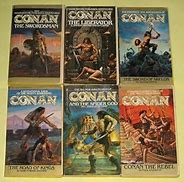
Conan The Rebel, III.

"'With what ivory, apes, and peacocks we could muster, I sent back a commission for a warcraft to be built and outfitted.'" (p. 29)

For some history of the phrase, "ivory, and apes, and peacocks," see two previous posts here.

Belit says that Conan and she will have:

"'...a life together. If the jealous gods allow.'" (ibid.)

Probably series editors and authors will not allow but I cannot remember what shape the Conan-Belit relationship is in at the end of this volume and will wait to find out.

We know of one "jealous god" in the Bible but what is the origin of this phrase? Were other gods "jealous"?

Belit's remark reminds us of Manse Everard's realization that the gods are "...a miserly lot." Time travellers who spend a lot of time in the past probably learn to think that way.

I expect to be doing more gardening than blogging tomoz.

Laterz.

Tuesday, 13 May 2025

Future Forms Of Christianity

Jerusalem Catholicism
Jean Broberg was brought up as a Jerusalem Catholic in the mid-twenty-first century. That form of Christianity should be starting about now. In the Terran Empire, Philippe Rochefort and Fr. Axor are Jerusalem Catholics and the latter, a Wodenite convert, seeks evidence for a non-human Incarnation.

Unspecified Catholicism
Nicholas van Rijn with his Martian sandroot statue of St. Dismas.
The Nuevo Mexicans: Admiral Cajal with his crucifix.
Djana who recites the Ave Maria and imagines a Merseian Christ.

Others
Peter Berg from Aeneas.
Christmas on Ivanhoe.
"Christian variants" on Nyanza: no information given.
OrthoChristianity on Dennitza.
Bible-and-blaster backcluster Christians on Aeneas. (I borrow this description from James Blish's The Triumph Of Time.)