Showing posts sorted by date for query Doctor Who. Sort by relevance Show all posts

Monday, 20 July 2026

Some Time Travel Comparisons

(i) Poul Anderson's Time Patrol series and SM Stirling's Make The Darkness Light series are opposite answers to the question whether to change history. (Assuming that you can, of course.)

(ii) Anyone who is just starting to time travel cannot know whether their timeline is mutable or immutable. Anderson's Jack Havig tries to prevent his father's death before he learns not to try. All the evidence indicates that Audrey Niffenegger's Henry DeTamble also inhabits an immutable timeline. However, wanting to be sure that he will always return to the future in which he is married to Claire, DeTamble takes extra care not to do anything that might change the course of events. Stirling's American time travellers have to find out what kind of timeline they are in. Recruits to Anderson's Time Patrol are told as part of their training.

(iii) Both HG Wells' The Time Machine and Anderson's There Will Be Time, the latter featuring Havig, describe events rushing past a time traveller.

Thus, we compare Anderson with Stirling, Niffenegger and Wells. Anderson's comprehensive treatment of both time travel paradoxes, causality violation and circular causality, makes his works a pivotal point of comparison with other time travel authors.

Now consider a time travel conundrum in Tim Powers' The Anubis Gates. I could have discussed this on the Logic of Time Travel blog but far fewer people would have read it there. In fact, I have tried to redirect readers from that blog to this one: see About Time Travel. We will find that issues raised by Powers have already been addressed in (i) or (ii) above. 

Trapped inside a burning tent, Doctor Romany can escape only by jumping through time:

"...he tried to decide what time to jump to. Sometime in the future? No, not when it meant leaving tonight's debacle as established history. Better to jump into the past, fix things up so that the situation tonight's aborted effort was supposed to remedy never would have arisen in the first place."
-Tim Powers, The Anubis Gates (London, 1986), 9, p. 274.

Romany, thinking in terms of (i), does not yet known that he is living in an immutable timeline as in (ii). Nevertheless, it is sensible, from his point of view, to travel into the past when he can use his knowledge from the future to try to counteract the effects of the situation that he had wanted to remedy. You can do a lot in the past as the hero of Robert Heinlein's The Door Into Summer learns.

Also in The Anubis Gates, in 1810, Brendan Doyle finds a hand-written volume recording events on 4 February, 1684. On the endpaper, in his own handwriting although faded with age, he reads:

"IHAY, ENDANBRAY, ANCAY OUYAY IGITDAY?" (8, p. 258)

Needless to say, later in the novel, Doyle visits 1684 and writes this mocking note to his younger self.

If I knew at what point to start writing a circular causality narrative, I would do it.

Friday, 17 July 2026

A Case In Point

There is a particular kind of time travel paradox that is characteristic of narratives set in immutable timelines. Robert Heinlein presents this paradox very well in "By His Bootstraps" and The Door Into Summer and Poul Anderson in The Corridors Of Time, There Will Be Time and The Dancer From Atlantis as we have discussed here before but there are other examples.

In Tim Powers' The Anubis Gates, thief lords, banqueting in a subterranean grotto beneath nineteenth century London, are surrounded by shabby men and boys and, beyond them, derelicts who will fight for the left-overs afterwards. The Gypsy King, Doctor Romany, is furious when a very old and disfigured man laughs madly and mocks something that he, Romany, has just said.

"'Can't you put this wretch out of his misery, Horrabin?' [Romany] asked quietly.
"'You can't because you didn't!' cackled the ancient man."
-Tim Powers, The Anubis Gates (London, 1986), 4, p. 105.

Horrabin merely has the man removed but, as he is being carried away, this ancient human wreck winks at Romany and stage-whispers:

"'Look for me later under different circumstances...'" (ibid.)

- then again laughs crazily.

The alert fan of time travel sf might guess (correctly) that, later in this narrative, Romany will time travel to a very remote past date, will live for a very long time, will become so disfigured as to be unrecognizable and will, of course, mock his much younger self at the thieves' banquet.

We can appreciate it but we can't all write it.

Sunday, 21 June 2026

Identifying

I do not spend much time identifying with fictional characters but which ones might I identify with?

Of Nicholas van Rijn's trade pioneer crew, neither David Falkayn nor Chee Lan but maybe Adzel because of his meditation and studiousness.

Of James Blish's magicians: none. (A book with nothing but villains!) 

Of Alan Moore's Watchmen: Doctor Manhattan.

Of Neil Gaiman's Endless: Destiny.

Of SM Stirling's five American time travellers, Mark, who says:

"'I'm really not good at the nonverbal stuff, you know.'"
-To Turn The Tide, CHAPTER TWENTY-TWO, p. 337.

Paula, who has been dropping hints, has to spell out that, when she suggests going to bed, she means together - a woman who realizes the need to take the initiative.

(We are just about to go to our daughter's place for Fathers' Day.)

Wednesday, 17 December 2025

United Humanity

"To his Excellency Eric Tamarin-Asmundsen, in appreciation of his gallant efforts, from a member of United Humanity."
-Poul Anderson, Mirkheim IN Anderson, Rise Of The Terran Empire (Riverdale, NY, March, 2011), pp. 1-291 AT XII, p. 170.

Eric remembers that United Humanity are:

"A mildly racist association, naturally jingoistic about Babur." (ibid.)

In my experience, racist associations are not mild but Eric will not have had any contact with them. Nor is he about to. The note from a supposed United Humanity member is a cover for a letter from his father, Nicholas van Rijn.

Racist associations proliferate in alternative fictional futures. Robert Heinlein's The Star Beast has both the Keep Earth Human League and The Society for the Preservation of the Status Quo. (Chapter XII, p. 128)

Fiction reflects life.

Decades ago, I knew a church-going Irish medical student who disliked black people and said, "Keep Ireland white!" I hope that he either learned better or failed his exams. (A racist doctor!)

The current situation on Earth is volatile, as we know. How will we respond to aliens?

Friday, 17 October 2025

Time Travellers And Famous People

"Ivory, and Apes, and Peacocks."

Manse Everard has an interview with King Hiram of Tyre. What happens when time travellers meet famous people? Different things. Keith Denison is Cyrus the Great in one timeline.

The Doctor met:

Henry VIII who threw (I can't remember what) at him which the Doctor threw back and was sent to the Tower - where the TARDIS was concealed;

Marco Polo who decided not to write about journeys through time because that would not be believed;

Winston Churchill, but they already knew each other whether from a previous episode or from an incident between episodes;

Queen Victoria who founded an organization to defend the British Empire against threats either extraterrestrial or supernatural.

OK. A trivial introduction to a big topic before going out for the evening.

Tuesday, 14 October 2025

A Time Machine In A Spaceship

I was in a science fiction bookshop that sold no science fiction at least not in the sense that I was looking for. There were no novels by Wells, Heinlein, Anderson etc. The "science fiction" of this bookshop was all media-related:

Star Trek
Star Wars
Doctor Who
Battlestar Galactica
Alien
etc

We might as well be talking about different genres.

In Poul Anderson's "The Year of the Ransom," Manse Everard's timecycle appears in the receiver bay of a black spacecraft orbiting Earth on 15 April 1610. This reminded me of Kirk etc "transporting" on and off the Enterprise in Star Trek: a very rare occasion for something in sf proper to remind me of something in sf media-related. 

I first knew of Star Trek before it came on British TV because I was looking for sf by James Blish and came across his first ST adaptation collection. (See the attached image.) That is one of the few links between the two kinds of "sf."

Tuesday, 16 September 2025

Kinds Of Time Travel Narratives

A time traveller can travel to a single other time, remain in that time for the entire duration of a prose narrative or screen drama, then return home - or not - at the end.

Thus, in Poul Anderson's The Dancer From Atlantis, Duncan Reid is pulled back to the era of Atlantis and is returned to the twentieth century only at the end.

In James Blish's A Midsummer Century, John Martels is time projected to about 25,000 AD and eventually opts to remain in that era.

Originally, Doctor Who would spend say six episodes in one past period on Earth, then six in an extraterrestrial or future setting, then back to the Terrestrial past and so on but there was never any time travelling back or forth within any six-episode segment.

I once spoke to someone who thought that that was the only kind of time travel story. The existence of a Time Patrol was a revelation to him.

The other kind of time travel story:

in Anderson's "Flight to Forever," Martin Saunders travels only into the future but keeps on going through many future periods;

Anderson's Time Patrollers, mutant time travellers and Wardens and Rangers travel back and forth in time many times during a single narrative.

Let us return to the Wardens and Rangers (The Corridors Of Time) next.

Wednesday, 2 July 2025

Jenzik And Maleldil

Vault Of The Ages, Chapter 11.

Lenard, escaped from his Dalesmen captors, leads his Lann warriors into the City. When one warrior mumbles that such places are cursed, Lenard snaps that the power of their own gods is with them. The warrior replies:

"'Our gods are far away in the north...'" (p. 107)

- but their "Doctor," i.e., priest, claims to carry what he calls "'...the House of Jenzik...'" (ibid.) with the god in it. After chanting ancient words over "...a small iron box...," (ibid.) he claims that he and his companions are now guarded against spells.

Carl thinks that the chanted words:

"...must be in the old language itself, which had changed greatly since the Doom." (ibid.)

But might they be even older? Latin? What is in the box? The god's name begins, "Je..." Biblical names beginning with "J" are derived from the Mosaic tetragrammaton. (Carl thinks that he makes out a few words but many English words have Latin roots.)

If someone who has been displaced or exiled believes that he has left his gods behind, then there are several possible solutions:

a god can be carried around or made to be effectively present;

other gods are really the same gods under different names;

one god is omnipresent.

Christian slaves in the Roman Empire had the first and third solutions. One god can be both omnipresent and also specially, sacramentally, present in material form in a particular place or places.

In Chapter 1 of Perelandra, Lewis as narrator mentions a mysterious being called Maleldil, obeyed elsewhere in the Solar System, adding:

"I knew what Ransom supposed Maleldil to be."
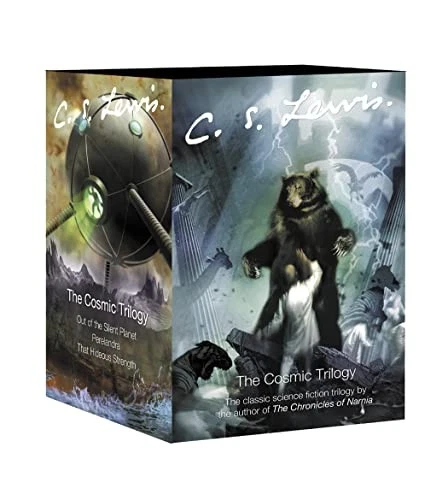
CS Lewis, Perelandra IN Lewis, The Cosmic Trilogy (London, 1990), pp. 145-348 AT 1, p. 155.

En route to Ransom's cottage, Lewis passes a "...little Wesleyan chapel..." (p. 154) Is Maleldil more actively present there than anywhere else on Lewis' journey?

Most sf fans are not concerned about such theological issues.

Wednesday, 2 April 2025

Caitlin And People

The Avatar.

Caitlin Mulryan is able to use sex for love, friendship, pleasure or therapy and is able to handle a number of men who, without her help, would have been jealous, possessive, judgmental, conflicted, in general negative. Is this just how she is, what I call her "karma," or is it because she is an avatar of the Others who, we gather, have a positive attitude to all life? Caitlin achieves remarkable results with a young man who is initially hostile because she is his brother-in-law's mistress and who then becomes infatuated with her. I have read as far as Chapter XXXIX of L and so far nothing has gone wrong. (Roman numerals are tiresome.)

Caitlin also helps other women. Susanne does not want to marry because it would be wrong to have children in a lost spaceship with limited supplies and there is no contraception available but maybe Caitlin as the ship's doctor and with access to its database can do something about that?

As with Poul Anderson's Tau Zero, a novel about a long space journey has to address both the universe outside the spaceship and the people inside it. But the people can be very different.


Wednesday, 19 February 2025

Experience Before Understanding

Before he is shuttled to the Oligocene, Manse Everard has been carefully warned that the organization that is recruiting him patrols time. Some other characters experience a disorienting dislocation and must then come to an understanding of what has happened to them. In Poul Anderson's The Dancer From Atlantis, Duncan Reid is snatched by the vortex and black thunders and deposited in a desolation where, he thinks, he must be dreaming, delirious or dead. Needless to say:

"A wind boomed..."
-Poul Anderson, The Dancer From Atlantis (New York, 1972), III, p. 25.

Reid must learn that he is in the time of Atlantis.

("...vortex..." is a terminological parallel with Doctor Who.)

In James Blish's A Midsummer Century, John Martels finds himself not only in a strange environment but also in the wrong body and is stunned to be told that, by his reckoning, he is now in about 25,000 A.D. In this respect at least, his experience is closer to that of Wells' Time Traveller than of Anderson's visitors to historical periods.

In Anderson's The Corridors Of Time, Malcolm Lockridge travels along what looks like a long underground tunnel before being told that the tunnel has taken him and his companion to a historical period.

We encourage blog readers to remember other examples. 

We are puzzled by this long detour into time travel and might return to Starfarers tomorrow.

(Timefarers would make a good title.)

Monday, 10 February 2025

Time Machines In Transit

Why are time machines invisible in transit? Are they always?

(i) HG Wells' Time Traveller tells his dinner guests that his Time Machine moves too fast to be seen but it doesn't move anywhere. It remains stationary on the Earth's surface in a state of time dilation so it should resemble a statue. The "Time Traveller" does not travel anywhere or when. In The Space Machine, his sequel to The Time Machine and The War Of The Worlds, Christopher Priest explains that the Time Machine in transit is attenuated.

(ii) Doctor Who's TARDIS disappears into and re-emerges from the "time vortex" where, according to the villainous Master, E = MCcubed.

(iii) Poul Anderson's Time Patrol timecycles do not exist between departure and arrival. They disappear from one set of spatiotemporal coordinates and (re)appear at another.

When a timecycle appears/arrives, it might have disappeared/departed from:

same place, earlier time;
same place, later time;
different place, earlier time;
different place, later time;
same place, prevented future;
different place, prevented future -

- but it cannot arrive from a prevented past.

Tuesday, 19 November 2024

Languages

Ensign Flandry.

"Like almost every intelligent species, the Merseians had in their past evolved thousands of languages and cultures..." (CHAPTER ELEVEN, p. 104)

It would be interesting to learn about some of the few exceptions.

In a Doctor Who episode, someone had transported the Doctor to a planet which they identified only by a number. When the Doctor said that he preferred names, he was told: "Skaro." The planet of Daleks and Thals! But, of course, the answer should have been something like: "Its name, in the principal language of its dominant species through most of its history, was 'Skaro.'" Someone travelling through space and time needs to give any name some kind of context.

The passage in Ensign Flandry goes on to explain that the process of domination by one culture and unification of the planet has not gone as far on Merseia as on Terra. For some, Wilwidh laws and customs remain a mere overlay and their native languages come more easily than Eriau. Olaf Magnusson, who will enter the Technic History in a later volume, will be fluent in Eriau and two other Merseian languages. I would like to speak at least one other language fluently. We were taught French atrociously.

Saturday, 13 July 2024

The Time Traveller's Successors

HG Wells' Time Traveller is definitely the literary precursor of:

Poul Anderson's Time Patrolmen who time travel seated on timecycles;

Anderson's Jack Havig who sees events speeding past him as he time travels;

Anderson's Martin Saunders who travels into the far future;

Anderson's Wardens and Rangers who walk or drive along corridors rotated onto the temporal dimension;

James Blish's Service agents who discuss time as a fourth dimension but communicate instead of travelling along it;

Blish's John Martels who is projected into a far future perpetual summer;

the Doctor in the Doctor Who TV series, an eccentric scientist, whose Daleks and Thals somewhat resemble Morlocks and Eloi.

Read or reread The Time Machine.

Friday, 17 May 2024

Individuals And Organizations II And Some Other Stuff

A Time Patrol instructor says that, even if a time traveller married her former father, she would not become her own mother because any children would have only half her chromosomes. But surely her chromosomes come from her mother (herself) and her father (the same man as if she hadn't time travelled) so her daughter could be her? In any case, thanks to a combo of time travel and complete sex change, the narrator of Robert Heinlein's "All You Zombies" is both of her own parents and winds up as a solipsist, believing that only she exists. Since she is also an agent of the Temporal Bureau, this is the ultimate time travel individual-organizational antithesis.

Some strange parallels emerge. Wells wrote both The Time Machine and The Invisible Man. Wells argues that the Time Traveller is present, although invisible and intangible, while time travelling - although this proposition is nonsensical. Christopher Eccleston played both the time travelling Doctor in Doctor Who and an invisible man in Heroes. To benefit from his invisibility, the Invisible Man must remain naked. Audrey Niffenegger's time travellers arrive naked. The power of time travel or invisibility contrasts with the vulnerability of nakedness. Poul Anderson's mutant time traveller, Jack Havig, carries his clothes and a few hand-held small objects through time but nothing else. He must have a chronokinetic aura. One theory of Superman was that an aura of invulnerability protects his skin-tight costume but nothing else so that, in that version, his cape was always being shredded. Havig's chronokinesis is a mutant superpower so the comparison with Superman, the original superhero, is appropriate.

Death And Time Travel

Poul Anderson's Time Patrollers have a rule that, after they have heard of a colleague's death, they no longer travel to any time or place where they would meet him but how can this be avoided? An Unattached agent of the Patrol lives an indefinitely prolonged lifespan and exists at many times both before his birth and after his death. Therefore, the actual date of his death is almost an irrelevance. Everyone is alive at some times but not at others and time travellers are more acutely aware of this. In fact, although this is against their rules, a Patrol agent who learns that he had died on a particular mission in the past can decide not to embark on that mission. This will not prevent him from having arrived and died in the past but it will mean that the version of him who has decided not to embark on the mission will live on and die at some other time.

Because Audrey Niffeneger's Henry DeTamble and his daughter, Alba, are both time travellers, Alba knows and fully accepts the fact that she meets her father even though she has lived past the time of his death. Sometimes he visits her in her present. At other times, they meet in the past. Unlike him, she has some control over her chrono-displacement.

The Doctor Who TV series presented the absurd idea that the Doctor was the last surviving Gallifreyan and therefore was unable to meet any other Time Lords. Suppose that they had all died in 2000. The Doctor can travel to any time before 2000. They were time travellers so some of them will have travelled to times later than 2000. Some of them might exist now or, if not now, then definitely later. Bad time travel narratives are bad indeed.

Tuesday, 30 April 2024

Man

Writers can play various tricks with the ambiguities of the word, "man."  Consider the following juxtapositions:

Man and Nature
Man and God
Man and Machine
Man and Woman

Suddenly, "Man" means male human beings, not human beings. 

In Between Time and Timbuktu, Neil Armstrong's first words on the Moon are mercilessly parodied and, as part of this, they are attributed not to Armstrong but to "Man."

Succeeding Superman, several subsequent superheroes were called "-man" or, of course, "Woman." Alan Moore has a character misremember the Flash as "Flashman," who, of course, is the villain of Tom Brown's Schooldays and the central character of sequels by another author. Also in Moore's Watchmen, after the superhero, Ozymandias, has publicly unmasked and revealed his secret identity, a reporter reflects on this revelation by referring to Adrian Veidt as "Ozyman-" but then breaking off mid-word, thus effectively inventing a new superhero name. The superheroes had banded together as "Minutemen," despite the "Watchmen" of the title. (And a later superhero, Doctor Manhattan, had been a watchmaker.) (My emphases.)

All of this is a long-winded way of leading back to the fact that Poul Anderson plays with "-man" in The Byworlder. An alien comes from the direction of Sigma Draconis and therefore is called "the Sigman," plural: "Sigmans," not "Sigmen." Presumably, another Sigman could come and might play a more prominent role on Earth but, whatever s/he did, s/he would not be a man from Sig.

Sunday, 28 April 2024

History And Biography

Young Flandry is three novels.
Captain Flandry is two collections and one novel.
Admiral Flandry is two novels although Flandry only cameos in the second because the central character has become his daughter. Thus, a potential new series.

Future history includes future biography. Flandry has a son and daughter. His Starkadian friend, Dragoika, has a son who becomes a friend of Flandry's daughter. Falkayn had a daughter, son and granddaughter. Van Rijn has a granddaughter who marries Falkayn and a son who will become the Grand Duke of Falkayn's home planet. Emperor Hans Molitor had three sons, a granddaughter and a grandson.

The spaceship on this cover of The Trouble Twisters resembles a Klingon Bird of Prey, I think. Trekkies need to read Anderson, of course. There are two levels of sf. I was in an sf shop that had no sf novels, no Wells, Anderson etc, only media-related items, Star Trek, Star Wars, Doctor Who etc. Some people say that they like sf and mean that stuff. Anderson does future histories, interstellar wars and time travel better. It ought to be easier to communicate that message.

Saturday, 27 April 2024

A Soothing, Then Unsettling, Helicopter Ride

The Byworlder, VI.

Almeida flies Yvonne home by helicopter:

"The ride was balm. Only a murmur of blades and wind, the gentlest quiver through seat and flesh, broke stillness." (p. 53)

The wind always plays along in Poul Anderson's texts. Yvonne is enjoying a metaphorical quiet after the storm so this wind merely murmurs. During the journey, she becomes unsettled when Almeida challenges her liberal intellectual world-view. Consequently (?), on arrival:

""A cold wind streaked by, ruffling hair and slacks, sheathing her face." (p. 56)

While they are still airborne, Anderson places them in their cosmic context by listing some visible stars and constellations:

Deneb
Vega
Pegasus
the Great Bear
Draco
Polaris

Almeida's profile joins our list of objects:

"...seen against the Milky Way..." (p. 53)

Almeida:

"'I think [America] can better be trusted than anyone else -'" (p. 56)

How many people think that their country can be trusted better than any other? But this time it happens to be true? They all say that as well. I happen to think that the world needs something more than just one of the current super powers gaining more power than any of the others. Do I think that my view is right? Of course I do. Otherwise, it would not be my point of view. Does my thinking that my view is right prove that it is right? Of course not! How many people need to grasp this distinction?

The BBC TV series, Doctor Who, primarily aimed at school children, was also watched by University students. When a stereotypical militarist, Brigadier Lethbridge-Stewart, said (paraphrasing), "And, of course, the only country that all other countries could trust not to misuse military intelligence in its own interests was Great Britain!," University students laughed. Was that script written very cleverly as nationalist propaganda for one age group but as satire for another?

Friday, 26 April 2024

Poul Anderson's Time Travel

We would like to see uniform editions of Poul Anderson's time travel works presented as a single discrete sub-category of his complete works. Thus, the Time Patrol series would be reissued in either two or four volumes. A revised and completed Past Times collection would still of course culminate in "Flight to Forever." There Will Be Time should be presented as the culminating volume of a trilogy beginning with the collected Maurai short stories and continuing with the long novel, Orion Shall Rise. Of these three volumes, only There Will Be Time deals with time travel but it nevertheless belongs with the Maurai History since, in this case, Anderson merged time travel with future history. That leaves The Corridors Of Time and The Dancer From Atlantis as two one-off time travel novels although I also link the latter to Conan The Rebel and The Golden Slave because these are Anderson's three novels set B.C. Anderson's time travel works considered as a whole are one massive successor to H.G. Wells' contrastingly brief The Time Machine.

We would also like to see long and detailed screen and graphic adaptations of Anderson's time travel works. A single actor would be able to play Brann in The Corridors Of Time and Merau Varagan in the Time Patrol series - as well as the Master in the Doctor Who series. In particular, the many future periods visited in "Flight to Forever" deserve different and special visual treatment. There is the climax of the restoration of the Galactic Empire followed by several even remoter future periods leading to the dissolution and reconfiguration of the universe, then a journey forward through Earth's past and back to this time traveller's starting point. These concepts and images deserve to transcend their original formulations as prose fiction.

Sunday, 15 October 2023

Alien Paganism

The Game of Empire, CHAPTER THIRTEEN.

Targovi, an Imhotepan Tigery, to Wo Lia, a wandering Cynthian (both currently on Daedalus):

"'Pray to your little gods that you never have to be locked up.'" (p. 327)

Are Cynthians polytheists or is Targovi merely projecting his paganism onto them?

Wo Lia to Targovi:

"'If you fail, I will kindle a light for your ghost. Wan jin rao.'"(p. 328)

(Three untranslated words of Cynthian.) Do Cynthians kindle lights for ghosts or is Wo Lia acknowledging Tigery custom?

Would the purpose of the light be to help the ghost to find his way home? I read a Chinese story about a doctor who was called out of his body to treat a patient in the supernatural realm where some kind of riot or disturbance was taking place. The patient, having recovered, went out and addressed the crowd, "You are still my subjects! They lied who told you the King of Death was dead!" The doctor, appalled, fled back toward a light that been left shining beside his comatose body. If it had not been for that light, he would not have found his way home.

Will different intelligent species project distinctive pantheons that will merge when there is interstellar travel? Will there also be mutually incompatible monotheisms like "the God" of the Merseian Roidhunate or "God the Hunter" of the Ythrian New Faith? I strongly suspect that nothing will be as sf writers have imagined it.