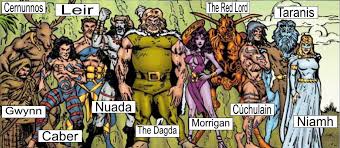
Showing posts sorted by date for query Cernunnos. Sort by relevance Show all posts

Thursday, 10 August 2023

Old Gods

The Dog And The Wolf, XXIV, 5.

Nemeta tells Tera:

"'But you serve the old Gods yet... Not the Gods of Ys but of your own people, Cernunnos, Epona, Teutatis, Those Who once were mighty here and may still keep a little, little strength to help Their last few worshippers.'" (p. 486)

In a pagan perspective, "Which Gods (exist and) are active here?" and "Which Gods are worshipped here?" are the same question. In that sense, the perspective is empirical. To answer the question(s), it is necessary merely to inquire to Whom local prayers and temples are dedicated.

What becomes of Gods Who are no longer worshipped? There is a short story by Lester del Rey in which They become human. The best fictional answers that I know are in Neil Gaiman's The Sandman. See:

Where Do Gods Go?

And Death Says...

A joke answer by Alan Moore is mentioned in:

The Approach To Ys

See also:

Where Did The Gods Go?

My own reflections on gods, God and the One have been revised since the last time I linked to them.

Tuesday, 8 August 2023

Into Battle

The Dog And The Wolf, XXI, 2.

Scouts report an advancing Germanic host. Skirmishers draw them on. Dwellers in a nearby village flee. Gratillonius, Saloman and other mounted men wait on a hill. Below them, three thousand men, members of defence brotherhoods, stand in four lines. To one side is a group of Roman veterans, former Ysan marines, with young men that they have trained, and Frankish volunteers. Foresters hide in the woods.

Mounted men
Brotherhoods
Veterans etc
Foresters

Surviving skirmishers run down the opposite hill, followed by about two thousand loping Germani carrying standards and forming a wedge, soon hit by arrows and shots from slings. Brotherhood men lower pikes as the Germani strike. The line holds. Gratillonius sends a boy to tell the foresters to emerge from the woods and sends Saloman to join the veterans who have made assaults reel back so that the Germani now go round them. Reserves from the rear join the now ragged line. Cadoc leads the foresters whose wedge pierces the Germanic wedge in flank and rear. When Gratillonius' trumpeter sounds the charge, Saloman leads the veterans against the Germanic left. Gratillonius rides behind the line encouraging the men in the names of Christ, Lug, Epona, Cernunnos and Hercules. Then, going in front of the line with his fellow riders, he leads them in a charge, some with lances but most with swords. His horse, Favonius, kicks and bites. The Germani break. Armorican archers and slingers butcher some small defensive groups. Horse and infantry chase and kill the fleers. About a hundred escape but most will be killed by the populace. A very few will tell the horde what they had met: a line that held and three counterattacks.

Sunday, 23 July 2023

Adjustments II

The Dog And The Wolf, I, 2.

Nemeta invokes the nymph, Ahes, then the gods, Cernunnos, Epona, Sucellus and Lug, but stops short of calling on the Three of Ys. She is not sure whether, in her trance, she sees the Three. The underpriestess, Runa, counsels Nemeta first that their Gods have disowned them and secondly that it is in any case unwise to invoke those Gods while dealing with Christians. The survivors of Ys must endure, learn and avoid slavery and might even prevail. It might take until after they are dead to learn whether the Gods of the land still live. (In the new dispensation, those Gods will become either demons or saints but we must let history take its course.)

Sunday, 7 February 2021

More On Zacharian Divine Names

Yesterday, I published a post which I then entitled "Divine Names II" and linked from it to an earlier post entitled "Divine Names." Since then, I have had to re-entitle the post of yesterday "Divine Names III" and to add to it links to two other earlier posts entitled "Divine Names II" and "The Zacharians." For the corrected post of yesterday, see here.

The full list of divine names used by Zacharians becomes:

Ares
Cernunnos
Pele
Kulkulan
Vishnu
Heimdal
Kwan Yin
Isis
Izanami
Izanagi
Astarte (see image)

All of these have relevant links in the previous posts except Tangaroa who is linked here.

Saturday, 6 February 2021

Divine Names III

The Game Of Empire, CHAPTER SIXTEEN.

See:

I missed two Zacharian divine names. On p. 361, Pele refers to both Ares and Cernunnos.

For previous references to Cernunnos on this blog, see here. (Scroll down.)

He is the horned god. Perhaps we saw one of his manifestations in the US Capitol recently?

Ares is the villain of the 2017 Wonder Woman film.

There are some very different gods out there.

Saturday, 2 November 2019

The Golden Slave, Chapter XVI, Concluded

This evening, posting was interrupted by Light Up Lancaster. Tomorrow, it will be interrupted even more by a Festival at Throssel Hole. (Scroll down.) Now let us finish rereading The Golden Slave, Chapter XVI, and leave XVII for a future occasion.

"Well, Mithradates was a soldier, too." (p. 216)

- reminds us of:

"Tene Mithra etiam miles..." (Scroll down)

"[Mithradtes] sat in the canton chief's high seat, which was shaped like the lap of stag-horned Cernunnos." (ibid.)

"Eodan remembered the king, motionless on the knees of a conquered god." (p. 218)

To conquer a people was to conquer their gods.

"Around the room gleamed [Mithradates'] unmoving hoplites..." (p. 217)

We have had hoplites before. See here and here.

That is all for now unless anyone wants to reread this chapter and tell me what I have missed? Flavius returns by the way but I am not presenting a mere plot summary. The next chapter has an interesting discussion about the relationship between civilization and barbarism.

Sunday, 16 July 2017

Wild Cattle

SM Stirling, The High King Of Montival (New York, 2011), Chapter Thirteen.

"A herd could flee with its most timid, or charge with the most aggressive." (p. 259)

Unfortunately, this is also true of human beings. However, it does mean that individuals or small groups can give a lead, sometimes in a good direction.

When the travellers kill several wild cattle, Cernunnos, St Hubert and Ullr are invoked. (p. 261)

Before the Change, each person knew a small part of the "'...scientific arts, and they traded the results among themselves, and there were so many that that was workable.'" (p. 255) After the Change, the important knowledge is how to:

farm;
fight with a sword;
hunt with bow or spear;
milk or butcher a cow;
make butter;
tan leather;
shoe a horse.

I think that the optimum society would be one whose members enjoyed the benefits of technology but who would also be able to survive and thrive if those benefits were lost.

Meanwhile, Greater Britain thrives under William the Great! (p. 269)

Friday, 24 March 2017

Aspects

SM Stirling, A Meeting At Corvallis (New York, 2007), Chapter Two, p. 60.

Aspects of the Wiccan God and Goddess:

the Green Man;
Cernunnos;
Pan;
Brigid;
Lugh;
Cerridwen;
Arianrhod and Ogma;
Apollo and Athena;
Zeus and Hera;
Freya and Odin;
Sif and Thor.

Many of these figures, referenced before, can be found by searching the blog.
Here, all mythologies are regarded as manifesting the same male and female principles.
Odin and Thor, regarded as father and son in Norse mythology and in related fiction, e.g., by Poul Anderson, are also regarded as aspects of a single divinity.
We are used to different versions of a story. Here is another example.

Thursday, 9 March 2017

Carved Log Walls

More gods carved in Juniper's place (SM Stirling, The Protector's War, p. 199):

the Green Man
Cernunnos
Pan
Brigid
Cerwidden
Arianrhod
the four Quarters
the four Elements

Jack-in-the-Green prances through.

On p. 201, there is a reference to the Gae Bulg of the Sedanta.

I knew of Cuchulain but not that he was called "Sedanta." These texts need to be not read but studied.

Wednesday, 8 June 2016

Strange Gods

Nemeta was the last worshiper of the Three of Ys. Tera still worships the Gods of the land:

"'...Cernunnos, Epona, Teutatis, Those Who once were mighty here and may still keep a little, little strength to help Their last few worshippers.'"
-Poul and Karen Anderson, The Dog And The Wolf, Chapter XXIV, section 5, p. 486.

We have encountered Epona and recognize the name Cernunnos but I neither recognize the name Teutatis nor remember it from previous readings - although it is there, nevertheless. A world of myth remains to be discovered or rediscovered by rereading works like The King Of Ys. From what I do remember, an alliance between Christian and pagan forces will be necessary to silence the siren songs of Dahut, which are empowered by the Three.

Sunday, 5 June 2016

A Battle

Today we have Lancaster Comics Day in the Public Library, 11.00-6.00, then Sheila and I attend a friend's birthday meal in a Morecambe pub from 7.00 so this might be the only post for today. Thank you for 470+ page views yesterday and so far 100+ today.

About two thousand Germani invaders come over the snow-covered hill, already detected by scouts and drawn on by skirmishers. Gratillonius and Salomon on horseback look down their hill towards their three thousand motley foot soldiers, not a single army but a gathering of local brotherhoods. In a block to one side are veterans, Ysan marines with their younger trainees and Frankish allies. The Franks had tried to kill Gratillonius but now they face a common enemy. In the woods are the foresters. Behind the hill are supplies, wagons and animals, unguarded because the rations have been used up.

Arrows and sling pellets fell quite a few Germani, who are trampled underfoot. Then the invaders strike the four-deep Armorican line. When a man in the front falls, the one behind him comes forward. Gratillonius sends the order for the foresters to come out. The Armorican line thins but holds. Untrained reserves come down from behind. The veterans repulse their attackers but, as ordered, do not pursue. The forester wedge pierces the Germanic one. The cavalry charge downhill. Some combat horses bear chamfron and pectoral of leather. Salomon's followers shout, "Salaun!" - the Gallic pronunciation of his name. The Armorican infantry stand or crouch behind windrows of killed and wounded. Gratillonius rallies his men in the names of Christ, Lug, Epona, Cernunnos and Hercules. His banner shows not the Eagle (impolitic) but the Wolf of Rome. He leads the charge.

(Interrupted.)

Monday, 30 May 2016

After Ys

In the concluding volume of their King of Ys Tetralogy, Poul and Karen Anderson must cast the net wide. The focus has shifted from the King of a city to the survival of his people and the reader may become disoriented.

Ys is gone. Time passes. Seasons turn. Ysans adjust - in different ways. Gratillonius reorganizes and rebuilds. His enemies plot. Rufinus spies. Corentinus evangelizes. The Empire recedes. Barbarians return. Nemeta lives by witchcraft. Midsummer rites become the feast of St John. Drusus, retired soldier, farmer and Christian, employs Tera, former Ysan inlander, because she is a good worker who knows the landwights. Inlanders had called on the local Gods, not on the Three.

Tera:

is reputed to be the daughter of a God but is really the daughter of an unknown human father;
knew a few spells but no longer uses them;
sees signs in wind, water or stars;
has seen Cernunnos three times;
moves in with Maeloch, the fisher captain, in Confluentes;
delivers Gratillonius' grandson;
accepts that her children will go to Christ;
says, "'They're ghosts of what They were, the Gods are.'"
-Poul and Karen Anderson, The Dog And The Wolf, Chapter VIII, section 5, p. 169.

Ghosts of Gods! The awesome reduced to the eerie. Neil Gaiman, who is surely an authority on such matters, describes five phases in the life-cycle of a God:

the Dreaming;
the land;
back to the Dreaming;
the realm of Dream's older sister, Death;
complete non-existence.

Tera's Gods have entered the third stage or maybe the fourth. Maeloch no longer serves the Three but will not forsake the spirits in the sea. He will remember Dahilis and kindle a torch on Hunter's Moon eve. Corentinus' duty:

"...was to purge the observances of their openly pagan elements." (Chapter IX, section 3, p. 182)

I can only decry this. If there is to be monotheism, then I would prefer that it be an inclusive one on the Hindu model.

Thursday, 26 May 2016

Uncertainties About Gods

Runa says that the Ysans' Gods have disowned them. Nemeta retorts that the Gods of the land must still live. Meanwhile, Maeloch, negotiating with Scoti and Dani, drains a goblet to Lug, Lir and Thor.

Gratillonius feels that all Gods are gone and wonders whether they ever existed. His hostess urges him to call on Christ but then amends that to what God he will: Mithras? She confides that she sometimes invokes one of the old Goddesses.

This is quite a list. In times of social upheaval and uncertainty, people become uncertain about their Gods. Ninian Smart suggested that, in Religious Studies (not in Mathematics), 1+1=7!

Two religions: A and B.
Each influences the other to some extent. Thus: Ab and Ba.
Some propose a complete synthesis: AB.
Some on both sides react against any external influence. Thus: AA and BB.

That does total seven. I was worried that it would not work out right.

Addendum: In fact, Nemeta invokes "'Cernunnos, Epona, Sucellus, almighty Lug!'" (Poul and Karen Anderson, The Dog And The Wolf, Chapter II, section 2, p. 46)

Monday, 23 May 2016

When Niall Met Dahut

In the atrium of Dahut's house in Ys:

Niall walks across a mosaic of seals and dolphins;
pillars are marmoreal;
the ceiling is gilt-trimmed;
panels bear pictures of the Gods, including -

- Cernunnos,
Epona the Rider,
She of the Teeth Below (Nan?);
Taranis of the Hammer;
Belisama of the Evenstar;
the many-armed sea monster, Lir -

- furnishings are sumptuous;
there is a hint of incense.

Niall is a barbarian but also a King and knows how to bear himself like one. The deal between him and Dahut is as good as sealed.

Saturday, 17 November 2012

Change But Not All At Once

In The Dog And The Wolf (London, 1989) by Poul and Karen Anderson, worldviews change but gradually, sometimes imperceptibly, as they do in real life. Nemeta, who had been the last worshiper of the Three of Ys, became a Christian but then Dahut, agent of the Three, killed Nemeta's husband, Evirion, as she had already killed another woman, Tera's, husband, Maeloch.

Knowing that this is forbidden to Christians but doing it anyway, Nemeta joins with Tera to invoke "'...the old Gods...Cernunnos, Epona, Teutatis...,'" curse the Three and summon "...the Old Folk from their dolmens." (pp. 486-487) Receiving intelligence on Dahut from Cernunnos, Nemeta relays it to Bishop Corentinus who, in turn, speaks to Dahut's father, Gratillonius.

Gratillonius, converted but not yet baptized, therefore not ringing any alarm bells in Dahut's preternatural sensory apparatus, is able to lure Dahut into the open where Corentinus, emerging from concealment, can exorcise her. Thus, an extraordinary heathen-baptised-unbaptised-episcopal alliance neutralizes the last expression of the power of the Three. (This is at last the end of the Three that I had been looking for when rereading the tetralogy.)

As I am sure any Bishop would tell us, they would not be able to do it that way these days.    

Thursday, 15 November 2012

Battle

Chapter XXI, section 2, of
The Dog And The Wolf (London, 1989) by Poul and Karen Anderson presents an excellent description of a battle to repel barbarian invaders. Although I have read the entire King of Ys tetralogy two or three times, I have no memory of this battle and might as well be reading it for the first time. I will remember it better after blogging.

The former centurion, Gratillonius, leads a makeshift army of local "brotherhoods" whose standards include tree, fish, horse, Cross, evergreens and auroch horns. His own banner, black on gold with a red border, shows the Roman She-Wolf that fed the Founder of the City. His brother-in-law, Salomon, training for leadership, has a gold cross on a blue shield, a precursor of medieval chivalry.

Gratillonius addresses his men, a mixed bunch:

" 'In Christ's name, by Lug and Epona and Cernunnos and Hercules, we go!' " (p. 418)

"Hercules" had been a favourite oath of Gratillonius when he was a Mithraist.

He instructs Salomon as the enemy advance. They observe that the Germani lope forward with spaced standards, forming their customary wedge but lacking finer coordination. Their petty king has combined shrewdness and boldness with leadership skills to bring them this far.

Some horses, not trained for combat, bolt but Gratillonius' pedigree animal Favonius fights with hoofs and teeth and must be kept away from friends. The minimal military organisation that the former centurion has been able to impose holds. The enemy are slaughtered or flee.

Wednesday, 14 November 2012

The Last Ysan Worshipper


Questions are answered as the text continues, in Poul and Karen Anderson's The Dog And The Wolf (London, 1989). Nemeta, Gratillonius' daughter, self-proclaimed last worshiper of the Three of Ys, sacrifices her newly born son, the King's grandson, to the Three and curses the men who had raped her. And she must do this in secret because it breaks the Roman Christian law against infanticide.

This is indeed a dark ending but, unless something else significant happens before the end of the novel, it really does seem to be the conclusion of the vengeful story of the Ysan Triad.

There are two other items of unfinished business. Nemeta's curse includes this invocation to Lir:

" 'Let her who haunts the ruins torture their souls forever.' " (p. 181)

Having scavenged in the ruins of Ys, Nemeta knows that someone haunts them.

Secondly, former worshipers of the Three have gone over to either:

" '...the new God of the Romans or the doddering old Gods of the Gauls.' " (p. 181)

The latter include Tera who had invoked Cernunnos and Epona and threatened the wights while delivering Nemeta's son. There are always more than two alternatives. Life remains varied and diverse despite attempts to fit it into a single pattern.

Bribing Gods And Threatening Wights

(Illustration by Joanna Barnum.)

Poul and Karen Anderson's The Dog And The Wolf (London, 1989) remains fascinating in its presentation of a period of religious change against a background of historical fantasy. The authors convey the joy of a Christian convert receiving baptism and putting away heathenry. Meanwhile, however, Tera continues to bargain with her Gods although she had said earlier that they are now mere ghosts of their former selves.

While delivering a child, she offers three bulls to Cernunnos and a walrus ivory figure for ritual use to Epona. But the real sign of changing times is the threat that she makes to elves, nymphs, ghosts and every wood or water dweller. She can lead " '...the Christian wizard...' " to their haunts which he would give to his saints. (p. 175)

Behind the scenes, the supernatural conflict is not only between the one new God and many old but also between saints and elves etc, or, at least, that is how it is bound to appear to someone like Tera who has seen Cernunnos.

http://www.joannabarnum.com/gallery/pinup/epona

http://www.etsy.com/listing/160039015/epona-goddess-illustration-print-in 

Monday, 12 November 2012

"Where Did The Gods Go?" III


Now this has to be the answer. Tera, who has seen Cernunnos three times - and had another vision although that might have been a hemp dream - , says:

" 'They're ghosts of what They were, the Gods are. For sure, my children will go to Christ. Else their age-mates'll mock them, and why should they suffer?' " (Poul and Karen Anderson, The Dog And The Wolf (London, 1989), p. 169)

When Christianity has passed a critical mass, social pressure ensures further conversions. But, meanwhile, Tera who has experienced Gods knows that They have become ghosts. She was an Ysan but an inlander calling on the Gods of the Gauls or the Old Folk, not on the Three. She befriends Maeloch who no longer serves the Three after what They did but still lights a torch for the dead at Hunter's Moon. These are the people who did not give in to the social pressure of Christianity.

My Wiccan neighbour has an altar with images of the Horned God and the Goddess. Cernunnos is back.