Showing posts sorted by date for query Beta Centauri. Sort by relevance Show all posts

Friday, 17 April 2026

News And Thunder

The Fleet Of Stars, 16.

From Vernal, Fenn telephones Wanika in the Pacific where data search has located her on the shiptown, Malolo. She relays a recorded message for him from Mars. Kinna tells him that:

"'...a ship from Alpha Centauri is approaching Proserpina.'
"Thunder rolled through his skull." (p. 206)

Observations
We, the readers, already know that an Anson Guthrie download is coming from Beta Hydri via Alpha Centauri but, because of the distances and times involved, what is known to us is news to them.

We are very used to elemental forces like wind or thunder emphasizing the dramatic moments or pauses in Andersonian dialogue. Here it happens again although this time the (metaphorical) thunder is only inside Fenn! Pathetic fallacies and metaphors are Anderson's punctuations.

Vernal, the Pacific, Mars, Proserpina and Alpha Centauri gradually come together. The convergence is slow but we expect a climax.

Thursday, 9 April 2026

Fenn Arrives On Earth

The Fleet Of Stars, 8.

In response to an invitation received from Iokepa Hakawau of the mid-Pacific Ocean polity called the Lahui Kuikawa at the very end of Chapter 6, Fenn travels from Luna to Kamehameha Spaceport in Hawaii from where he proceeds by air to a large, crowded, floating platform:

"As he stepped from the volant onto the airfield, into a wind lulling mild across three thousand kilometers of equatorial ocean, a brown girl gave Fenn a white smile and laid a garland around his neck." (p. 102)

A mild wind and a white smile belong together! Andersonian winds growl, roar, sigh, lull, caress, whisper etc as appropriate. 

Three thousand kilometers of equatorial ocean set the scene for this section of the narrative. So far, Anderson's text has transported its readers from the colonized fourth planet of Beta Hydri via Alpha Centauri and the Kuiper Belt to the orbiting Habitat, Lunar passageways and both country and city on the colonized solar planet, Mars.

A boy, not a machine, carries Fenn's bag. This greeting is not an artificial observance, as elsewhere on Earth and Luna, but a ritual "...as natural as breathing." (p. 103)

We find all these details in the opening three paragraphs of Chapter 8 and the in first sentence of the fourth paragraph. It pays to read carefully and to take notes. One kind of sf is the futuristic travelogue. See also Anderson's The Game Of Empire.

Friday, 3 April 2026

How It Looks To Fenn

The Fleet Of Stars.

We have read about:

the colonization of the Alpha Centaurian system;

the exploration of 82 Eridani, Beta Hydri and HD44594;

the colony at Beta Hydri IV;

download Guthrie's journey from Beta Hydri to Alpha Centauri, then to Proserpina in the outer Solar System.

Now we learn how news of these interstellar events filters through to Fenn in the inner Solar System:

"...few people ever came to space any more. Those inside Luna or the Habitat, even those on Mars, they didn't count, not really. The Lunarians at Proserpina and Alpha Centauri - and now fugitive stories of Terrans at three new suns, whole new worlds, and the galaxy open to them -" (4, p. 44)

Fenn wants to be out there and has to choke back his craving.

Most Lunarians in the outer System are not on Proserpina but:

"...in lesser colonies on smaller bodies and in mining bases on comets, thinly spread across immensities that dwarfed the inner Solar System, but growing, venturing, driving their frontiers ever outward, starward." (17, p. 213)

These Lunarians have far more solitude than among the crowded asteroids at Alpha Centauri. One Selenarch, Luaine of Phyle Janou, Wardress of Zamok Gora, represents the Captains of the Outer Comets. There is more activity in the Kuiper Belt and Oort Cloud than among the inner planets and there seems to be none among the outer planets. (Addendum: This last statement is mistaken. See here.)

Tuesday, 31 March 2026

Two Space Drives

The main practical advantage of a field-drive is:

"...no more need for jets and their horrible wastefulness..."
-The Fleet Of Stars, 3, p. 37.

See also the post on The Tahirian Field-Drive.

However, the field-drive is not to be confused with The Quantum Gate Field Drive, nicknamed the "zero-zero drive." See also here.

Although a c-ship is a small field-drive ship able to approach light-speed, it has to approach c by acceleration, unlike a "zero-zero" ship which jumps straight to light-speed, then back down to the normal state, without needing to accelerate, then decelerate.

When download Guthrie travels from Beta Hydri to Alpha Centauri in a c-ship, a laser beam transmitted  shortly before his departure arrives three Earth-years before him whereas he makes the crossing from Alpha Centauri to Sol in a larger, therefore slower, field-drive cruiser, taking thirty five years to traverse four light-years.

Thinking about all this, it is very easy to get times and distances wrong.  

Saturday, 28 March 2026

Extra-Solar Colonies

The Harvest Of Stars Tetralogy
Harvest Of Stars (1993)
The Stars Are Also Fire (1994)
Harvest The Fire (1995)
The Fleet Of Stars (1997)

In Harvest Of Stars, 61, the only extra-solar colonies so far are Demeter and the asteroids in the Alpha Centauri system. The Astronomy Web in that system detects planets with oxygen atmospheres in orbit around:

82 Eridani;
Beta Hydri;
HD44594 in Puppis.

A near-light-speed spaceship bearing a Guthrie download is sent to each of these systems. On their return, each of the downloads is merged with the original. HD44594 II, Bion, is already full of complex life but another planet in that system, with more rudimentary life, is suitable for terraforming, even more so than those at 82 Eridani and Beta Hydri. 

In The Fleet Of Stars, there are colonies on:

Beta Hydri IV, Amaterasu;
Hestia at HD44594;
Isis, which must therefore be at 82 Eridani.

From casual references in the text and dialogue, we are able to deduce the connections.

Wednesday, 16 April 2025

Interstellar SF

"Interstellar sf" can mean just any story or novel featuring interstellar travel at any speed and on any scale. Thus, in Poul Anderson's Tau Zero, a single relativistic spaceship accelerates indefinitely so that the journey becomes intergalactic, then cosmic, but we are not informed of any other journeys between stars in the volume of space around Sol.

Robert Heinlein presents three accounts of early interstellar travel -

in his Future History, Orphans Of The Sky, a first interstellar expedition (spaceship Vanguard);

in his Future History, Methuselah's Children, a first interstellar round trip, developing FTL en route (spaceship New Horizons);

in his Juvenile Future History, Time For The Stars, a first interstellar round trip, developing FTL en route (first spaceship Avant-Garde.)

James Blish has two first interstellar journeys: 

FTL round trip to Proxima Centauri in "Common Time";

STL one-way trip to Beta Sol in "Darkside Crossing."

Poul Anderson's works do not feature a first interplanetary or a first interstellar journey as far as I know.

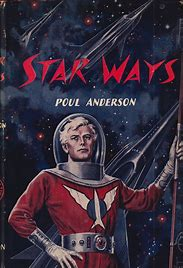
However, interstellar sf can mean narratives with a background of regular FTL travel in an interstellar civilization. Such civilizations emerge in Anderson's Psychotechnic and Technic Histories and also exist in one-off works like After Doomsday and World Without Stars. Heinlein's juvenile novels with this kind of background are The Star Beast, Starman Jones, Starship Troopers and Citizen Of The Galaxy. "Stars" is a much used word. We have since had Star Trek and Star Wars and Anderson's Psychotechnic History includes Star Ways.

Although interstellar distances allow a lot of space for different things to happen, these works do not usually form a consistent series because they diverge in details like the means of FTL used and the course of future historical events.

Monday, 7 April 2025

Preparations For War

The People Of The Wind.

This is nothing that we haven't said before but preparations for war will affect many individuals throughout society and on both sides:

Second Marchwarden of the Lauran System Daniel Holm and his son, Christopher;

Arinnian and Eyath of Stormgate Choth (Arinnian is Christopher Holm);

Daniel Holm and First Marchwarden Ferune;

Arinnian and Hrill of Highsky Choth who is also Tabitha Falkayn;

Eyath and Vodan, the chothmate to whom Eyath will be betrothed;

the Imperial governor and the Admiral's daughter;

Lieutenant Rochefort and his crew.

And, since this novel is an instalment of a future history series, there are multiple references to previous instalments:

Tabitha refers to Manuel I;

the governor refers to the Antoanite-Kraokans around Beta Centauri, to the Troubles, to the Merseians and to the colonization of Avalon;

one of Rochefort's crew is a Cynthian, male this time;

Rochefort's mother ship is called Ansa.

(All of these references are relevant.)

As Le Matelot said in the Introduction to Trader To The Stars, we do not know where we are going but we are on our way.

Friday, 21 March 2025

K'thrr'u/Gaoung Ro Mm

The Avatar, VII.

The Betan, Fidelio (not his real name), is not from Beta Centauri or from any other second star in a constellation but from the second planet of a star which human explorers called "Centrum" after a T machine had transported them to it.

Fidelio has two Betan names:

"K'thrr'u'" on land;
"Gaoung Ro Mm" in water.

OK. That is really alien. Human beings have to say "Fidelio." However, Fidelio has two eyes and two ears. That is too terrestroid. I know that two is a sensible number of eyes and also of ears but extraterrestrial evolution is going to find different ways to deploy sense organs. An sf writer like Poul Anderson knows how to alienize. The eyes are large and uniformly blue with nictitating membranes for underwater sight. Fidelio is furred and unclothed, although his reproductive organs are retractable, and three times the size of a Betan female.

His chemosensitivities do not correspond exactly to either taste or smell. Finally, without listing every other detail, he is a six-limbed biped which means that he has two sets of arms like some other fictional extraterrestrials that are known to us. For a cover illustration featuring Fidelio, see here. I think that he is insufficiently alien but this will be a continual debate until we meet some.

Wednesday, 12 June 2024

Fictional And Real Astronomical Objects

The rogue planet, Satan, orbits around Beta Crucis and back out.

In "Lodestar," the trade pioneer crew is on the planet Tametha. The nearest major League base is on Irumclaw which, later, is on the Terran frontier of the Betelgeuse sector. When leaving Tametha, Falkayn looks at the Crab Nebula which is over a thousand parsecs away.

We are trying to get some sense of where Poul Anderson's fictional locations are in relation to each other and also to real astronomical objects. So far, in our comparisons, the real objects, working backward for convenience, have been:

the Crab Nebula
Betelgeuse
Orion
Taurus
Rigel
Alpha Crucis
Beta Crucis
Beta Centauri
Antares
Hercules
Arcturus
Pegasus
Lupus
the Milky Way
Polaris

That is more than we might have expected, fifteen so far, and might give an astronomer some sense of a vast three dimensional space with fictional spacecraft moving around in it instead of just a list of names.

Sectors Pacis And Alpha Crucis

Continuing from the end of the preceding post, Avalon is about eighty light-years from Ythri and joins the Domain of Ythri which stretches across about 80 light-years as against the Terran Empire's 400. Imperial Sector Pacis, centred on the star, Pax, and its colonized planet, Esperance, is close to the Domain and the Empire attacks the Domain from there.

Also close to the Domain is Imperial Sector Alpha Crucis, centred on the star, Virgil, and its colonized planet, Aeneas. Ythri is about 100 light-years from Aeneas toward Beta Centauri. Alpha and Beta Crucis are close enough to Aeneas to cast shadows on its surface at night. I think that someone looking at the Aenean night sky sees the stars of the Empire and beyond them those of the Merseian Roidhunate but am having trouble finding that passage. Part of the reading experience is remembering but sometimes uncertainly.

Addendum: To be more precise, Sector Alpha Crucis is governed from the city of Catawrayannis on the planet Llynathawr and Sector Navy HQ is on the planet Ifri in another system but the McCormac Rebellion of the Sector against the Empire is led by the Firstman of Ilion on Aeneas. (As complicated as real life.)

Thursday, 25 January 2024

Future Historical References

The People Of The Wind, III.

Ekrem Saracoglu's conversation is rich in future historical references:

"'...the Antoranite-Kraokan complex around Beta Centauri...'" (p. 473);

Dathyna;

Merseia;

the Grand Survey ship that discovered Ythri and Avalon;

joint human-Ythrian colonization of Avalon;

the Troubles;

the founding of the Terran Empire;

the fact that he is discussing all this on the planet Esperance and with a young woman from Nuevo Mexico.

But he also adds new information:

Avalon had been under Ythrian protection from the outset;

it was this that led to some Ythrians joining the colony;

Ythri had responded to the Troubles by building its Domain just as Terra had responded with the Empire.

Saturday, 30 December 2023

Stars And Their Planets

"Lodestar."

"'I was taught that giant stars, able to become supernovae, do not have [planets].'
"'Well, they is still scratching their heads to account for Betelgeuse,' van Rijn remarked." (p. 666)

In other words, Poul Anderson wrote about Betelgeuse having many planets, then learned that it should not have had any. Van Rijn's remark is an effective incorporation of this new knowledge into the Technic History. Scientists are always scratching their heads about currently inexplicable phenomena.

Elsewhere in the Technic History, David Falkayn discovers that, although Beta Centauri should not have had any planets, it had captured an entire rogue planetary system. Until Falkayn made this discovery, the inhabitants of that system had a perfect hiding place. No one would look for them there.

Sunday, 13 August 2023

Information

Poul Anderson, Satan's World IN Anderson, David Falkayn: Star Trader (Riverdale, NY, March 2010), pp. 329-598.

The Serendipity computer knows David Falkayn's name in connection with:

"'...episodes involving Beta Centauri, Ikranaka, and Merseia.'" (p. 349)

If we are reading the Technic History in its original publication order, then we also know of Ivanhoe but do not yet know about Merseia but we also know that Falkayn has been involved in a lot more than just three or four episodes.

An author can impart information about a text, how and why it was written etc, in a Foreword or Afterword. Within the text, background information, whether real or fictional, can be imparted by:

the omniscient narrator;
a viewpoint character's thoughts and reflections;
dialogue between some of the characters.

Sometimes one character lectures another unnecessarily just in order to tell the reader something. David Falkayn wonders why Thea Beldaniel lectures him about information storage, retrieval and usage. So do we. Will Poul Anderson draw attention to Beldaniel's odd behaviour but leave it unexplained? No. Right at the end of Chapter II, Falkayn realizes:

"He believed he could tell why she behaved the way she did, dwelt on elementary details though she must realize he knew most of them already. He'd encountered that pattern elsewhere. It was usually called fanaticism." (p. 347)

Saturday, 5 August 2023

Space Travel

The theme that I addressed least in the previous post was space travel but this has become an sf cliche and part of a general fictional backdrop. Poul Anderson's Dominic Flandry series is not about space travel. It just assumes it.

Questions that might be asked about space travel
(i) What would happen if someone travelled to the Moon? 

In the previous post, this question was variously answered by Wells and Heinlein. Lewis also wrote a "first man on the Moon" story, "Forms of Things Unknown."

(ii) What would happen if someone travelled to Mars? 

Answered in the previous post by Lewis and Blish. The latter also wrote two very different accounts of a first interstellar crossing: "Common Time" (to Proxima Centauri); "Darkside Crossing" (to Beta Solis).

(iii) What would happen if someone travelled as fast and as far as possible in a relativistic, cyclical universe? 

Poul Anderson answers this question in Tau Zero, a "space travel" novel but as different as possible from Wells' The First Men In The Moon.

Anderson's works are culminations of Wellsian themes.

Wednesday, 12 April 2023

Interstellar Empires And Cosmic Events

Interstellar sf need not be about clashes between interstellar empires! See Poul Anderson's:

Rustum History
Kith History
Tau Zero
Starfarers
Geneisis
Harvest of Stars Tetralogy

All of these works involve slower than light interstellar travel which tends to rule out imperialism. Future histories involving faster than light travel are more likely to feature interstellar empires. Despite his much smaller output, James Blish has more such empires than Anderson. Blish argued that interstellar distances meant that such conflicts could remain inconclusive.

Blish's "This Earth of Hours" ends as conflict is about to begin between the telepathic Central Empire and the Terrestrial Matriarchy.

Blish's second Jack Loftus novel ends as conflict is about to begin between the Heart Stars and a new alliance led by Earthmen, dolphins and energy beings called Angels.

In Blish's "A Style in Treason," there is a long term stand-off between the Green Exarchy and High Earth.

In Blish's Cities in Flight, Arm II of the galaxy is successively ruled by an unnamed civilization, by the Vegan Tyranny, by the Earthman culture and by the Web of Hercules. While Earth is ascendant, it favours interstellar trade by flying cities as against several interstellar empires proclaimed by rebel Admirals etc.

In Anderson's Technic History, the Terran Empire and the Merseian Roidhunate wear each other out so that neither of them is still around in a story set several centuries later.

Anderson also focuses on cosmic events:

Beta Centauri captures rogue planets;
a rogue planet orbits close to Beta Crucis;
a supernova covers a planetary core with supermetals;
a rogue planet impacts the star Saxo;
another star passes through the system of Siekh, disrupting planetary orbits;
a supernova blasts the hydrogen and helium away from a super-Jovian planet;
a globular cluster on an eccentric orbit between the galactic centre and the rim periodically gathers interstellar matter which condenses into new stars whose close proximity causes intense radiation and frequent novae. 

The Beta Crucis rogue, the supermetals planet and the globular cluster are sources of immense wealth.

Anderson excels with these events.

Sunday, 5 December 2021

Mercantilism And Astronomy

Satan's World.

David Falkayn's discovery that the nebula which condensed into Beta Centauri slowed down by friction and captured a system of rogue planets inspired the Lemminkainenian search that discovered a rogue planet falling toward Beta Crucis.

Falkayn's inquiry with the Serendipity computer disclosed the industrial value of a rogue falling past Beta Crucis.

Falkayn hypothesized, sought and discovered the even more valuable planet, Mirkheim.

These are his specifically astronomical achievements, Polesotechnic League equivalents of discovering a new oil field or gold mine.

Saturday, 4 December 2021

Mentioning Previous Installments

A series gathers momentum as it gains new installments. In From Russia, With Love, Bond's enemies summarize his cases to date, only four at this early stage: Le Chiffre, Mr. Big, Hugo Drax and some diamond smugglers.

When van Rijn interviews Falkayn, he mentions what the latter did on Ivanhoe but not what he did at Beta Centauri because that story, although set earlier, had not been written yet. Later, the Serendipity computer tells Falkayn:
 
"'Your name is associated with a number of accounts in these data banks, most notably the episodes involving Beta Centauri, Ikrananka, and Merseia.'"
-Satan's World, III, p. 349.
 
The less notable will include Ivanhoe and some others that we do not know about and that does summarize Falkayn's career to date. After Satan's World, he will appear only in "Lodestar" and Mirkheim. Although it feels like it should be more, all that significance and substance is concentrated into these seven installments.

Sunday, 14 November 2021

A Spaceship Approaches

The Fleet Of Stars.

When interstellar travel is not only slower than light but also rare, the approach of an interstellar vessel is a major event:

"'Fenn,' she said, 'a ship from Alpha Centauri is approaching Proserpina.'
"Thunders rolled through his skull." (16, p. 206)
 
(For once, the thunder is internal, not external.)
 
How does the vessel's occupant experience the arrival?
 
"Guthrie woke." (17, p. 210)
 
Download Guthrie has been deactivated, not asleep and dreaming but dead, for thirty-five years. He was at Alpha Centauri at the end of Chapter 3. Chapters 4-16 have recounted Fenn's life in the Solar System. Download Guthrie has been deactivated but traveling all that time while his organic original remained at Beta Hydri and there is an organic Guthrie in each of two other planetary systems. We have to stop thinking in terms of a single, continuous Guthrie.

Tuesday, 9 November 2021

Travelogues

The Fleet Of Stars becomes partly a futuristic travelogue. Guthrie from Amaterasu at Beta Hydri visits Zamok Sabely' at Alpha Centauri and Proserpina en route to the inner Solar System. Fenn from Luna visits the Pacific, then Mars. In other works by Poul Anderson, Dominic Flandry tours Merseia in the company of young Merseians of equivalent rank, then later treks across Dido and, later again, through the Kazan, the Obala and Zorkagrad on Dennitza. Other characters travel a long distance down the Flone on Aeneas. Flandry's daughter similarly travels on Imhotep and Daedalus.

More sf could be like this. Fictional futures contain many exotic places that could be visited peacefully and described interestingly without having to become settings for violent conflicts between intelligent species and their interstellar civilizations.

Tuesday, 2 November 2021

Three New Suns

The Fleet Of Stars, 4.

Fenn thinks about:

"The Lunarians at Proserpina and Alpha Centauri - and now fugitive stories of Terrans at three new suns, whole new worlds, and the galaxy open to them -" (p. 44)

The "three new suns" are:

82 Eridani, Beta Hydri and HD44594

How unfortunate then that we read only one chapter set on only one planet of one of these three stars. A further long novel could have recounted the adventures of incarnations of Anson Guthrie and Demeter Daughter in all three systems with little direct communication between them.

The Fleet Of Stars shows us the colonized Proserpina and this future history's version of Mars for the first and last time.