Showing posts sorted by relevance for query Gaiman. Sort by date Show all posts

Friday, 29 August 2014

Changes In Supernatural Realms

I have compared Poul Anderson to:

James Blish (they both wrote hard sf, historical fiction and fantasy);

Neil Gaiman (they both based fiction on the same two Shakespeare plays, among other parallels).

Another comparable author is Mike Carey, whose Lucifer is a sequel to Gaiman's The Sandman.

In Poul and Karen Anderson's King of Ys Tetralogy, the Olympians, the Three of Ys and Mithras withdraw before the new God of the Piscean Age. In Poul Anderson's The Merman's Children, other unacceptable beings are driven out by Christian exorcisms. In Blish's, Gaiman's and Carey's works, there are further changes in the supernatural realms. God leaves and is replaced and there are comparable regime changes in Hell.

Carey's unique contributions are:

to make Lucifer the central character of a series after, according to Gaiman, he had resigned as Lord of Hell;

to continue the narrative with renewed imagination even when the characters' virtual omnipotence seems to rule out any further conflicts or plot developments.

Like Anderson in The Broken Sword, Gaiman and Carey dramatize interactions between beings from different mythologies. Anderson's long sequence of interconnected fantasy novels is a prose equivalent of Gaiman's and Carey's extended graphic fictions.

Sunday, 23 July 2023

Niall And Shadow-Truth

The Dog And The Wolf, 1, 3.

Niall of the Nine Hostages ensures that the destruction of Ys is not listed among his achievements and also that his name is not mentioned anywhere in the legend of Ys. That explains why he is the villain of the story only in a work of fiction published in the twentieth century!

Something written by Neil Gaiman is relevant both to The King of Ys and to Poul Anderson's A Midsummer Tempest. Watching the first ever performance of A Midsummer Night's Dream, before Auberon's court, Puck comments:

"This is magnificent - - and it is true!
"It never happened; yet it is still true. What magic art is this?"
-Neil Gaiman, The Sandman: Dream Country (New York, 1995), p. 75, panel 9.

Gaiman's title character, who had inspired the writing of the play, explains:

Morpheus: They shall not forget you. That was important to me: that King Auberon and Queen Titania will be remembered by mortals, until this age is gone.
Auberon: We thank you, Shaper, But this diversion, although pleasant, is not true. Things never happened thus.
Morpheus: Oh, but it IS true. Things need not have happened to be true. Tales and dreams are the shadow-truths that will endure when mere facts are dust and ashes, and forgot.
Titania: If you say so, Dream Lord. We are honored.
Titania (in the play): This is the silliest stuff that ever I heard.
-Gaiman, op. cit., p. 83, panels 3-6.

Gaiman's mentor, Alan Moore, wrote:

"The battle, far too big to be contained by simple FACTS, has spawned so many different LEGENDS, each with its own adherents; as valid, if not more so, as the TRUTH.
"APOCRYPHA, IMAGINARY tales: the library at Olympus has a THOUSAND such upon its shelves."
-Alan Moore, Miracleman, No. 15 (Forestville, CA, November 1988), p. 9, panel 6.

So is there some verisimilitude to the narrative of Niall destroying Ys?

Saturday, 30 August 2014

Another Parallel Between Poul Anderson And Neil Gaiman

Neil Gaiman has also written time travel:

two Doctor Who scripts;
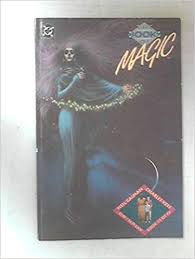
The Books Of Magic, Book 4;
one scene in Neverwhere (TV series and novel by Gaiman, graphically adapted by Carey) (two villains in the historical past accept a job in the present).

Apart from that brief scene in Neverwhere, all this time travel occurs in other writers' and editors' fictional universes, the BBC Whoverse and the DC Universe. Although The Books Of Magic is fantasy, not hard sf, I found enough time travel logic in it to post about (see here).

Both Anderson and Gaiman have written powerful fantasies informed by, and infused with, mythology and literature. (I prefer Gaiman's graphic fiction to his prose fiction whereas Anderson's, of course, is entirely prose - although not prosaic.) The main difference between them is that Anderson was also a master of other genres, historical fiction, detective fiction and hard sf.

Saturday, 16 November 2019

As Good As Or Better Than

Better Than
Whenever I see a Foundation, Dune, Star Trek or Star Wars volume on a bookshelf, I think how much better is Poul Anderson's History of Technic Civilization. Whenever I see a reference to the Doctor Who TV series, I think how much better is Anderson's Time Patrol series. There may be other examples but, for me, the Technic History and the Time Patrol are two essential texts. How bad their competitors can be highlights how good they are.

As Good As
In this second category are:

Neil Gaiman's Inn of the Worlds' End and Anderson's Old Phoenix Inn;

Gaiman's immortal Englishman, Hob Gadling, and Anderson's immortal Tyrian, Hanno (both mention the Wandering Jew);

Gaiman's and Anderson's adaptations of Norse mythology;

Gaiman's long The Sandman series (fantasy throughout history) and Poul and Karen Anderson's The King Of Ys Tetralogy (historical fiction with a fantasy element) (both feature the Roman Empire).

But there are several major and minor parallels between Gaiman and Anderson.

Friday, 30 September 2016

Poul Anderson, Neil Gaiman And Time Travel

I have mentioned many parallels between Poul Anderson and Neil Gaiman but not that Gaiman also wrote about time travel.

See:

Time Travel In The Books Of Magic
Time Travel In The Books Of Magic II
Time Travel In The Books Of Magic III
A Little More On Time Travel 

There are more differences than similarities. Anderson's time travel fiction is prose hard sf. Gaiman's is graphic fantasy set in a shared universe that had already incorporated a future history and time travel. In a four volume story, Tim Hunter (a British schoolboy who is a powerful magician, wearing glasses and with a pet owl) is shown magic past, present, future and in the far realms. Thus, in the past, he meets Merlin; in the Land of Summer's Twilight, Titania. When he ventures into the sometimes Wellsian future, paradoxical questions arise which I have tried to address. See the above links.

I think that time travel came up because it fitted this story rather than because it was an issue that Gaiman wanted to address.

Saturday, 18 August 2012

Poul Anderson And Neil Gaiman


In Poul Anderson's "The Only Game In Town," the Time Patrol must prevent the Mongol invasion of North America. Kublai Khan and Marco Polo are mentioned. Rereading that reminded me of Neil Gaiman's Sandman story about Marco Polo.

There are other parallels. In The Sandman, Shakespeare writes A Midsummer Night's Dream and The Tempest for Morpheus. Anderson wrote A Midsummer Tempest about a parallel Earth where Shakespeare was the Great Historian, not a great dramatist, thus his characters really existed. That novel features Anderson's inn between the worlds where characters from different universes and fictions meet, as in Gaiman's Inn of the Worlds' End.

Anderson imagines a Roman in the reign of Augustus who speculates that the Empire might either conquer the whole world or, as then current policy suggested, stay approximately as it was. Gaiman shows us Augustus formulating the latter policy and tells us why he did it.

Both quote James Elroy Flecker, including "...the Golden Road to Samarkand." Anderson refers to and quotes Kipling. Gaiman described his Sandman story, "Hob's Leviathan" as "...me doing Kipling..." Kipling has an Indian Prime Minister who becomes a mendicant. "Hob's Leviathan" has an Indian king who becomes a mendicant.

Monday, 16 August 2021

Two Anderson-Gaiman Parallels

Beings from different mythologies coexist with each other in Poul Anderson's The Broken Sword and in Neil Gaiman's The Sandman and there is another parallel. Puck, speaking to Loki, says:

"Or ever the silver cord be loosed..."
-Neil Gaiman, The Sandman: The Kindly Ones (New York, 1996), Part Three, p. 1, panel 3.
 
Remembering this phrase from previous readings but not knowing its source, I googled and learned that it is from Ecclesiastes 12:6. Thus, the second parallel is an unexpected Biblical quotation.

My favorite myth-mix is Lucifer Morningstar and Michael Archangel discussing the Buddha and the Upanishads in Mike Carey's Lucifer, a sequel to Gaiman's The Sandman. After appreciating Anderson's Old Phoenix inn between the universes, fantasy readers might like to visit Gaiman's Inn of the Worlds' End.
 
Addendum: Loki warns an attacker:
 
"Kill me...and the curse of a god will...follow you down the halls of time..." (p. 13, panel 1)
 
Variations on "the corridors of time" have become a blog sub-theme.

Sunday, 27 March 2022

More From Gaiman

Reading on, we find more dialogue relevant to Poul Anderson's The Broken Sword, Hrolf Kraki's Saga The Merman's Children, Three Hearts And Three Lions, Operation Otherworld and A Midsummer Tempest. Anderson also has a version of Atlantis but in historical sf, not fantasy.

Tim Hunter: It doesn't seem like there's any real magic anymore. Not like it was. Where did all the magic go?

The Phantom Stranger: Much magic was lost when the last vestiges of Atlantis sank - - although misplaced would perhaps be a more precise term.

The Phantom Stranger: Between the Dark Ages and the Middle Ages many of the powers of Faerie and Gramarye left this plane for good. Some for one place, some for another.

The Phantom Stranger: And as science arose it left little room for magic.

Tim Hunter: Why?

The Phantom Stranger: The difference in viewpoint.
Science is a way of talking about the universe in words that bind it to a common reality.
Magic is a method of talking to the universe in words that it cannot ignore.
The two are rarely compatible.
 
Tim Hunter: So what are you saying? That magic died out by my time?
 
The Phantom Stranger: No. But wild magic is a thing of the past.

-Neil Gaiman, The Books Of Magic, Volume I, The Invisible Labyrinth (New York, 1990), p. 40, p. 41, panels 1-2.

"...the Otherworld, the halfworld, Faerie, whatever you want to call it."
-Poul Anderson, The Merman's Children (London, 1981), Author's Note, pp.vii-x AT p. vii.

Tim Hunter: Constantine said we were going to FAIRYLAND. He was kidding, wasn't he? 

Doctor Occult: We travel through the fair lands, child. Call them AVALON, or ELVENHOME, or DOM-DANIEL, or FAERIE, it matters not. It id the Land of Summer's Twilight.

-Neil Gaiman, The Books Of Magic, Book III, The Land Of Summer's Twilight (New York, 1991), p. 5, panel 5.

Although Anderson and Gaiman parallel each other in fantasy, Gaiman does not write sf.

Thursday, 13 September 2012

Between Worlds

When a character moves between worlds, how does the author describe the transition? Sometimes, the character imagines another world, then enters it - and later wonders whether it was real - but usually the other world is unequivocally real. I will mention only a few examples from the works of three fantasy writers, CS Lewis, Poul Anderson and Neil Gaiman.

Lewis' most famous entrance to another world is a wardrobe but there is a better example in a later book. The characters look at a painting of the ship the Dawn Treader until it seems that the waves are moving, then they fall into the sea and are rescued by the ship's crew. Lewis never explains how a painting of a contemporary Narnian ship came to hang in an English house.

The hero of Poul Anderson's Three Hearts And Three Lions, fighting Nazis on a Danish beach, finds himself in the Carolingian mythological universe. Later, mission accomplished in that universe, he returns to the Danish beach with no loss of time, like a returned ruler of Narnia.

In Anderson's A Midsummer Tempest (London, 1975), Puck tells Prince Rupert of the Rhine's companion, Will Fairweather:

"'...to speak of inns and such - My friend, if sorely pressed for shelter, think of this. There is a tavern known as the old Phoenix, which none may see nor enter who're not touched by magic in some way. It flits about, but maybe you can use his ring to find it, or even draw a door towards yourselves...'" (pp. 55-56) (Oberon and Titania have given Rupert a magic ring.)

Sure enough, the ring lights the way to the inn which appears before Rupert and Will although it remains invisible to their Puritan pursuers. A regular of the Old Phoenix tells us:

"Look for it anywhere, anytime, by day, by dusk, by night, up an ancient alley or in a forest where hunters whose eyes no spoor can escape nonetheless pass it by unseeing...you must be alert for its fleeting presence..." (Anderson, "House Rule" IN Anderson, Fantasy (New York, 1981), p. 9).

This regular finds it many times, once unbelievably on ship at sea, another time more reasonably on a country road after dark where he knows that:

"The inn might waver from sight at any instant." (Anderson, "Losers' Night" IN All One Universe (New York, 1996), p. 107)

It sounds like Neil Gaiman's Inn of the Worlds' End:

"Up the lane aways is the Inn. You just have to be SURE it's there, though. If you AREN'T sure, then fizzlywinks, it's only goin to be fireflies and treeses" (Gaiman, Neil, The Sandman: Worlds' End (New York, 1994), p. 22.

One Worlds' End guest enters it in stages. Brant Tucker is driving to Chicago at night on the interstate. So far then he is travelling though not as yet between worlds. (However, his Earth is that of the DC Universe where anything not only can happen but routinely does happen.) Then:

he was very tired, so did he dream everything that followed?;
he didn't think it was weird when it started to snow in June;
a large, strange animal ran in front of the car (we see this since we are reading graphic fiction);
the car went off the road, across a field, down a hill and into an oak tree;
Brant, carrying his unconscious co-driver, Charlene Mooney, could not find the road;
he was directed to the Inn by an apparently disembodied voice (see above - the reader realises that the speaker is a hedgehog; regular readers recognise the speaking hedgehog from Gaiman's The Books of Magic);
Brant finds a country road;
at the end of the road, is a light;
first it is fireflies in a hedge, then it is the Inn.

I think that the transition between realities began with the apparent snow storm which, we learn, was a reality storm, stranding travellers from many realms in the Inn. A sailor's account is different:

"Y'see, there was a storm, come up out of nowhere at midnight - - we were swept onto the rocks where there shouldn't've been rocks neither, nohow." (p. 67)

Brant and the sailor then disagree about whether the date is June, 1993, or September, 1914.

And a Necropolitan says:

" 'A dark thunderstorm arose suddenly, and the brougham in which my companions and I were travelling was washed into a river.' " (p. 42)

Making an ordinary journey seems to be the beginning of the process.

The landlady explains:

"This place is the Inn at the end of all worlds. None of you were BROUGHT here. Each of you was travelling, and was caught in an unseasonable storm of some kind. You made your way here by luck, and took refuge and advantage of the hospitality offered. And you WILL leave here, when the storm is over." (p. 139)

However, Charlene is allowed to stay to work in the Inn and we see her there in a later series, The Furies by Mike Carey. The characters offer different theories about what causes a reality storm. A common feature of the Old Phoenix and the Worlds' End is the telling of stories and some of these stories offer other routes between worlds:

"...the silver road...glittered and glimmered away beyond a street market." (Gaiman, p. 29)

The man who sees the silver road works in an office in a modern city where gravestones can have "...letters from forgotten alphabets..." (p. 28). That odd touch, if taken literally, means that the modern city is certainly not on any Earth like ours. The narrator of this story asks:

"Is there any person in the world who does not dream? Who does not contain within them worlds unimagined?" (p. 28)

And that is where the other worlds are.

Tuesday, 6 December 2022

Late Night Other Reading

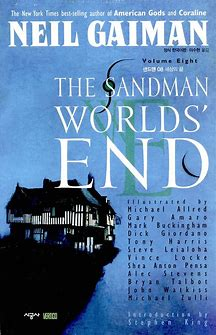
Neil Gaiman, "A Tale of Two Cities" IN Gaiman, The Sandman: Worlds' End (New York, 1994), pp. 27-41.

We have found parallels between Poul Anderson and Neil Gaiman. Here we find an echo of Anderson in Gaiman.

"A cold wind blew down the thoroughfares and avenues..." (p. 32, panel 2)

The cold wind is a physical condition but also a threat. The viewpoint character, Robert, has found himself in a mysterious aspect of his familiar city.

"'I think...' The old man paused. There was a cold wind, up there on the bridge." (p. 34, panel 3)

An even greater threat, underlining the porteniousness of what the old man in saying and might say next.

"I like to believe that it was only the cold that made me shiver..." (p. 41, panel 1)

Only the cold? But we have learned that that in itself is part of the threat. The cold wind underlining the old man's as yet unarticulated thought is extremely Andersonian although the story as a whole is intended to be Lovecraftian.

Saturday, 23 May 2020

Operation Luna And American Gods

I think that Neil Gaiman's masterpiece is The Sandman, not American Gods. However, for the latter as discussed:

on this blog, see here;

on Comics Appreciation, see here;

on Personal and Literary Reflections, see here.

A particular theme is common to Poul Anderson's Operation Luna and to Gaiman's American Gods. In both works, Europeans bring the Little People/Good Folk/brownies/pixies/leprechauns etc to America. In the Matuchek's first house, a resident brownie played with the children and Steve left out a bowl of milk for it at night.

This idea is addressed beautifully both in the novel and in the TV adaptation of American Gods. The aged Widow Richardson shucks peas in her garden. A grinning, green-garbed, red-haired stranger addresses her by name:

"'Essie Tregowan?'"
-Neil Gaiman, American Gods (London, 2001), COMING TO AMERICA 1721, pp. 80-88 AT p. 87.

She recognizes him as a Cornishman although he tells her that he is now:

"'...here in this new world, where nobody puts out ale or milk for an honest fellow, or a loaf of bread come harvest time.'"
-op. cit., pp. 87-88.

Realizing who he is, she says that she has no quarrel with him. He has none with her although she brought him here:

"'...into this land with no time for magic and no place for piskies and such folk.'"
-ibid., p. 88.

She thinks that he has done her many a good turn although he replies:

"'Good and ill... We're like the wind. We blows both ways.'"
-ibid.

She accepts his hand, seeing with her failing eyesight that the hairs on the back of it glow "...golden in the afternoon sunlight." (ibid.)

Then:

"She was still warm when they found her, although the life had fled her body and only half the peas were shelled."
-ibid.

The best scene in the novel and perhaps the best passage that Neil Gaiman has ever written?

Wednesday, 3 August 2022

Multi-Diversity

This is becoming clearer. If the Exaltationists had stolen Atahualpa's ransom in 1533, then that would have changed history in ways that would have prevented them from leaving the thirty-first millennium with the intention of stealing the ransom in that year but it would not have prevented them from arriving in 1533 and committing the theft. Nor (I now think) would it have prevented them from establishing a base in 1610 before proceeding to 1533. Time Patrol agents must be able to gauge the exact consequences of temporal alterations before they perform such alterations in "Brave To Be A King," "The Year of the Ransom" and The Shield Of Time.

We admire diversity but there are different kinds of it.

Poul Anderson: diversity of genres within a single medium, prose fiction;

Neil Gaiman: diversity of media - graphic, prose and screen.

Anderson's fantasies and sf could be appropriately adapted into visual media although he himself never created in those media. His fantasies include the prose novel, A Midsummer Tempest. Gaiman's fantasies include:

The Sandman, with "A Midsummer Night's Dream" and "The Tempest" instalments (graphic fiction);

American Gods (prose novel);

Neverwhere (TV drama series);

The Sandman: The Dream Hunters (an illustrated prose story).

Each of these works by Gaiman has been adapted into other media, whether by Gaiman or by another creator, and the same can be done with Anderson's works.

Monday, 5 December 2016

Immortals Meet

How often do the few immortals meet down the millennia in Poul Anderson's The Boat Of A Million Years? The meetings should all be listed here.

Neil Gaiman describes one such meeting. Anderson's immortals are science fictional, mutants, whereas Gaiman's are magical or supernatural: personified Death has agreed not to collect Hob Gadling and the Indian has eaten the fruit of life. When Mr Gadling boards the Sea Witch as a passenger, we have already met him so we know that he is immortal. When the Indian gentleman is apprehended as a stowaway, Gadling pays his passage to Liverpool. Later, the former stowaway, now a second passenger, tells a story about a king who ate the fruit of life and walked out into the rukh. Later again, we hear Gadling saying:

"...time, you don't owe me anything. There's few enough of us around. Least we can do is watch out for each other."
-Neil Gaiman, The Sandman: Worlds' End (New York, 1994), p. 88.

Gaiman said in an interview that this story was him doing Kipling - doing it very well.

Sunday, 17 May 2026

Two Inns

As we have seen, one idea common to Poul Anderson and Neil Gaiman is an inn between the worlds - 

Anderson: the Old Phoenix; 
Gaiman: the Inn of the Worlds' End. 

Gaiman's Inn is not only between worlds but also at the end of every world. However, it is being continually created because worlds are continually ending and those who travel between the worlds encounter it occasionally whereas the Old Phoenix is a place to which a favoured few from different worlds are invited for an occasional overnight stay. There are differences as well as similarities. Valeria Matuchek deduced the existence of an inter-universal nexus and of somewhere like the Old Phoenix whereas regular guests just find themselves entering the inn unexpectedly.

In an Anderson collection along the lines of Gaiman's The Sandman: Worlds' End:

each story would be narrated by someone from a different historical period or from a different alternative history;

there would be framing passages set in the inn and also an entire episode in which the guests discussed multidimensionality and similar concepts.

Thus, potentially, a series of instalments not only from different series but also from different kinds of series. We can only speculate about the possibilities.

Tuesday, 19 September 2023

Accessible Texts

Yesterday my lap top went into the shop for an overnight service. Now it is back. Meanwhile, other, not entirely unrelated, reading has generated reflections relevant to Poul Anderson although placing him in a wider context.

The accessibility of a text to a reader is first a function of which language it is written in. Obviously. A Chinese or Japanese text is impenetrable to most of us here. However, there are several other factors. How long ago was the text written? Is it poetry, prose, drama or graphic story-telling? How dense or complicated is it? How archaic, obscure or specialized is its vocabulary? To which genre does it belong? What literary conventions or references does it assume familiarity with? An English text can be effectively unreadable. We have become familiar with the cliches that have accumulated within sf but imagine if the only sf that we had ever read was the pre-cliched texts of Wells and Verne.

Some Texts Referring To Fairies As Supernatural Beings Distinct From Gods, Angels Or Demons
William Shakespeare, A Midsummer Night's Dream (1595 or 1596)
Edmund Spencer, The Faerie Queen (1590-1596)
Percy Shelley, Queen Mab (1813)
George MacDonald, Phantastes (1858)
Poul Anderson, A Midsummer Tempest (1974)
Neil Gaiman, The Sandman (1989-1996)

Accessibility
I have seen A Midsummer Night's Dream performed maybe five times. (Plays are written to be seen and heard, not read.)

I have never considered reading The Faerie Queen or Queen Mab.

I have just broken off a first reading of Phantastes and turned to a rereading of The Sandman as infinitely more accessible. (Yet Phantastes "baptised" CS Lewis' imagination when he read it in about 1914.)

I made perhaps two attempts to read A Midsummer Tempest before getting properly into it but now commend it as Anderson's most literary work.

The Sandman is endlessly rereadable.

Gaiman parallels Anderson in fantasy but has written no sf. Thus, both Gaiman and Anderson rework Shakespeare's A Midsummer Night's Dream and The Tempest. The Dreaming incorporates all myths, including Odin, Thor and Loki. Gaiman's Inn of the Worlds' End parallels Anderson's Old Phoenix.

Wednesday, 7 March 2018

Norton, Twain, Anderson And Gaiman

Mark Twain based a character on Emperor Norton.

A Connecticut Yankee In King Arthur's Court by Mark Twain is a literary predecessor of Poul Anderson's Time Patrol series.

Anderson mentioned Emperor Norton in his Operation Chaos. See combox here.

In a Sandman story by Neil Gaiman, Norton appoints Twain as official story-teller of the United States. Either this happened or Gaiman imagined it as a plausible and appropriate event.

Anderson and Gaiman have several parallels as documented elsewhere on this blog.

Thus, one madman and three authors have several creative connections.

Monday, 22 September 2025

Werewolves


Steve Matuchek, the narrator of Poul Anderson's Operation Otherworld, is a werewolf. "The Hunt" in Neil Gaiman's The Sandman: Fables And Reflection, which I am rereading late at night, is narrated by a werewolf. I was looking for a connection and realized that this was it. Synchronicity time, again.

We have found several parallels between Anderson and Gaiman. See here. However, the one kind of fiction that Gaiman never writes is sf whereas hard sf is what Anderson wrote most of.

Today was gardening. Tomorrow morning might be gym. Always, usually, also some blogging. The past and future history in The Corridors of Time grab me but I am still finding the corridors themselves problematic. I have not reread as far as the future periods yet and will stay with Gaiman for the rest of this evening.

Thursday, 27 August 2015

Parallel Fictions

Neil Gaiman's The Sandman fantasy graphic novels reveal that William Shakespeare wrote A Midsummer Night's Dream and The Tempest for Dream of the Endless, one of seven anthropomorphic personifications of aspects of consciousness. Poul Anderson's alternative history fantasy novel, A Midsummer Tempest, is a sequel to both.

In The Sandman, characters from different universes shelter in the Inn of the Worlds' End during a reality storm caused by the death of Dream. In A Midsummer Tempest, characters from different alternative histories meet in the Old Phoenix Inn between universes. Odin is a character in The Sandman as in three fantasy novels by Anderson.

The Sandman is like Anderson's Time Patrol series in that many of its installments are set in past periods and may feature historical figures. Gaiman has Augustus and Harun al Rashid among others while Anderson has Cyrus and Hiram among others. Gaiman also hints at time travel which does occur elsewhere in the fictional universe to which he contributes.

This explains why reading Anderson reminds me of Gaiman and vice versa.

Wednesday, 29 August 2012

Conflicts

Poul Anderson's fantasy novel Three Hearts And Three Lions (London, 1977) has a unique flavour that I missed on first reading. It is more than a string of well-presented cliches. Things and signs are not what they seem. In particular, Faerie is not neutral.

In childhood, I was pleased to read the theory that fairies had been angels who remained neutral during the War in Heaven. That seemed to explain their status as a third class of supernatural being inhabiting neither Heaven nor Hell but Nature. It was always satisfying when one mythology explained another. A second example is the Greek mythological explanation of pharaonic zoomorphism: attacked on Olympus, the gods fled and hid in Egypt, disguised as animals.

In Three Hearts And Three Lions, in the parallel world to which Holger Carlsen has been transported, Faerie supports Chaos against Law. For this reason, Holger as guest in the castle of Duke Alfric, lord of Faerie, recalls (to me) not other visits to Faerie, as in "The Land of Summer's Twilight" in Neil Gaiman's The Books Of Magic, but the hospitality received by the damned soul Christopher Rudd in the castle of a Lord of Hell in Mike Carey's Lucifer, a sequel to Gaiman's The Sandman.

There seem to be four realms: Heaven, Earth, Hell and the Middle World, the last comprising Faerie, Trollheim, Giants etc. (Why "Middle"? In some reckonings, Earth, Midgard, is in the middle.) A woods dwarf tells Holger that the Faerie folk:

"...live in wilderness, which is why they be o' the dark Chaos side in the war." (p. 27)

Alianora adds that they:

"...canna endure broad daylight, so 'tis forever twilit in their realm." (p. 37)

This sounds like Gaiman's "Summer's Twilight."

Alianora speculates:

"If Chaos wins, mayhap yon dusk will be laid on the whole world, and no more o' bricht sunshine and green leaves and blossoms...And yet does Faerie have an eldritch beauty..." (p. 37)

Is this getting a little confused? I do not expect the Fair Folk to oppose sunshine and blossoms. And a victory for Chaos and/or Hell surely mean universal darkness, not the eldritch beauty of Faerie twilight?

Friday, 27 October 2023

Free Houses

"...the free houses that owe no allegiance to any one time or dominion..."
-Neil Gaiman, The Sandman: The Wake (New York, 1997), p. 29, panel 2 -

- include:

Neil Gaiman's Inn of the Worlds' End;
Gaiman's Toad-Stone;
Poul Anderson's Old Phoenix.

Differences between Worlds' End and Old Phoenix
(i) The Old Phoenix is between worlds whereas Worlds' End is at the end of all worlds. (Since worlds are ending all the time, the Worlds' End Inn is continually created.)

(ii) The Old Phoenix is always the same:

"The taproom is changeless..."
-Poul Anderson, "Loser's Night" IN Anderson, All One Universe (New York, 1996), pp. 105-123 AT p. 108 -

- whereas Worlds' End changes its size and shape even while people are in it.

(iii) In the Old Phoenix:

"Windows are always shuttered, I suppose because they would not look out over any of the worlds on which the front door opens, but onto something quite peculiar."
-Poul Anderson, "House Rule" IN Anderson, Fantasy (New York, 1981), pp. 9-20 AT p. 12.

- whereas guests in the Worlds' End both hear and see a storm - which is really a "reality storm" - and then see something very peculiar.