Showing posts with label The Road of the Sea Horse. Show all posts

Monday, 24 December 2012

A Strong King Or A Strong Country?


While reading Volumes I and II of Poul Anderson's The Last Viking Trilogy, I make a negative judgement about the title character, Harald Hardrada, who sees no difference between strengthening his country and strengthening himself. In order to prevent his own family from ever being killed by raiders or invaders, he himself raids and invades and that is morally wrong.

Yet he cannot rule without support. It is helpful to consider why some of his followers see him as a good ruler. One of them says that Harald:

built churches and a whole new town;
strengthened the country;
increased wealth, foreign trade and inner peace and safety;
is openhanded to friends;
sent four ships with low-priced meal to Iceland during a famine;
let Icelanders move to Norway;
did not hinder one Icelander who was en route to his enemy, Svein of Denmark;
later treated that Icelander well on his return.

This is an impressive list of good deeds. However, increasing the inner peace and safety of Norway simply does not undo the evil of killing and burning in Denmark.

Sunday, 23 December 2012

1061


In Poul Anderson's The Road Of The Sea Horse (New York, 1980), Chapter XIII, How Gunnar Geiroddsson Fared to Nidharos, is a separate story starting in the saga style. Since the central character is to be Gunnar, we must first be given an objective account of Geirrodd, starting not with Geirrodd's point of view but simply with a reported fact:

"The man was called Geirrod." (p. 221)

Gunnar, not wanting to fish like his father, sets off on foot to offer his military service to the great King Harald Hardrada and is lucky enough, en route, to save the life of the King's leman's brother. Thus, he becomes one of the brother's men and thus, indirectly, serves the King.

Gunnar has not had much religious education. He speaks of " '...St Thor...' " and "...the wizards of Romaborg..." (pp. 228-229)

That new town that Harald had proposed a few Chapters back was built on the Oslofjord and came to be called Oslo.

After the different points of view of Chapters XII and XIII, the concluding Chapter XIV returns to the main narrative and describes Harald's Northern expedition which, because this novel is historical fiction, does not find Jotunheim, although that realm of the giants is visited in the same author's heroic fantasy, The Broken Sword.

1058


In Poul Anderson's The Road Of The Sea Horse (New York, 1980), the pieces continue to fall into place:

there is a nova and an East-West split in Christendom;

the King of France is repulsed by the Duke of Normandy who, we know independently, will soon become the King of England;

Malcolm overthrows Macbeth;

Earl Harold Godwinsson reaves and burns on the Welsh marches (bad), refuses to accept England as a Papal fief (good) and drives back Norse Vikings secretly sent by Hardrada (good);

Edward the Atheling is succeeded by his son, Edgar (some of us might remember from Alice In Wonderland that Edgar Atheling will offer the Conqueror the English crown);

Hardrada, reappearing right at the end of the Chapter to receive his Vikings' report back, says that whoever holds England " '...might well hold the world later on.' " (p. 220)

A new world is being born and is even becoming recognizable.

Chapter XII ends in 1058; Chapter XIII, which also broadens the perspective by presenting an alternative narrative point of view, begins in 1061. Now there are only five years left.

1051


In The Road Of The Sea Horse (New York, 1980), Poul Anderson must devote Chapter XII to an update on political events in England. It is 1051. There are only fifteen years left. There is already strong Norman influence in England. William the Bastard, later to be called the Conqueror, " '...is invited hither.' " (p. 211)

Earl Godwin meets with his sons, including Harold. I deduce that the latter will become the King Harold of England who is to defeat Harald Hardrada at Stamford Bridge but immediately afterwards to be himself defeated by the Conqueror at Hastings. I could confirm or disconfirm this by googling but instead am letting the narrative unfold. Let us pretend that we do not already know the outcome.

When Harold spoke:

""The men yelled, through the long dim hall, till it rang in the rafters. These were warriors. Their breed had come here when Rome was dying, to hammer out a new realm; among their fathers were Danes whose dragons had borne steel and fire and freedom..." (p. 211)

We have seen Rome dying and Danes bearing steel in other works by Anderson. The title of the present work, The Last Viking Trilogy, if nothing else, informs us that we are approaching the end of that era of Danish violence and freedom. The world keeps turning...

Saturday, 22 December 2012

Ulf


In Poul Anderson's The Road Of The Sea Horse (New York, 1980), King Harald Hardrada's friend and supporter, Ulf, is only nominally Christian:

he turns a blind eye to heathen practices among his people;

his understanding of the Fourth Gospel is " 'They tell me John the Holy wrote a saga about the Weird of the Gods...' " (p. 162);

he misses " '...old Thor, but St Olaf will do in his place...' " (p. 164);

he both offers candles and pays a witch when he is ill, thus possibly offending both powers;
 
he defends the old ways - odal property which must remain in the family, ancient laws, common men bearing weapons, women free to divorce whatever the Church says, close-knit families whose men will die to avenge their brothers;

he argues that, by centralising power and increasing taxes, Harald makes the North into another Constantinople.

Harald argues that the Northern countries must modernise or go under and Ulf reluctantly agrees. I would have preferred a stronger argument from Ulf for preserving the best of the old way of life.

Thursday, 20 December 2012

Judgement


In Poul Anderson's The Road Of The Sea Horse (New York, 1980),King Svein of Denmark captures some men of his enemy, King Harald of Norway. He orders them hanged, then thinks better of it:

"Someday, he thought with fear curdling his innards, he must also be called to judgment." (p. 123)

Some people argue for Christianity by claiming that only fear of divine judgement restrains people from evil acts. There are several flaws in this argument:

it would not prove Christianity to be true;
Christian belief does not prevent many evil acts and can even cause some;
morality is about doing what is right because it is right, not because of fear.

Christian apologists sometimes ask: where is morality based if not in their belief? I suggest that we help others either because they bear the same genes or because they might help us in return and that we experience this motivation as moral obligation, not as calculating self-interest. Further, as social animals, we have common interests transcending either self-interest or altruism.

Many people, including me, have problems with Robert Heinlein's Starship Troopers. I remember James Blish complaining that the characters claimed to have found the scientific basis of morality but did not say what that basis was. I suggest though that it is as outlined in the previous paragraph.

Meanwhile, Svein presents an interesting example of someone who was restrained by his belief.

Northern Empire


Having served in Constantinople, Harald Hardrada in Poul Anderson's The Road Of The Sea Horse (New York, 1980) imagines that he will be able to build an Empire of all the Northern countries including:

"...even this mysterious Vinland the Good, with its dark-skinned Skraelings and limitless forests." (pp. 86-87)

Thus, the title character of Anderson's The Last Viking Trilogy, like the title character of the Andersons' The King of Ys Tetralogy (who is also the last of his line), envisages an American colony that really is way beyond what he will be able to achieve in his lifetime.

Harald asks too much of the Throndheim Thing. He wants taxes for:

another attack on Denmark;
a stone minster to Our Lady;
a new town.

If I were to address the Thing, I would argue that the attack and the minster are unnecessary and that the town is the sort of thing that we should pay for but the need for this particular town must be justified. The minster, if wanted, should be paid for not by taxes to the king but by voluntary contributions to the clergy.

After much opposition, he gets agreement to do what he wants but not enough taxes to pay for it without dipping into his hoard. He thinks that a country that stands by the old ways will become a backwater, then a province. But does a stronger, more modern state need aggressive warfare and an established Church?
Wednesday, 19 December 2012

Macbeth

Although Christian, not Pagan, King Harald Hardrada in Poul Anderson's The Road Of The Sea Horse (New York, 1980) sees nothing wrong with not only taking a leman but also proclaiming her a Queen alongside the wife whom he had married in a church.

We are used to the idea that such behaviour is immoral for Christians but none of Anderson's characters raises this as an issue and we are not told how the clergy respond. (I have just seen a TV programme about the notorious affairs of one or two Renaissance Popes.) Assuming that Anderson has got this detail right, it is another example of how traditions can change, and can certainly change their emphases, in the course of history. (The Wikipedia article on Harald says that a bigamous marriage would have been possible in Norway then but also denies that Harald had two Queens.)

Meanwhile, something else strange happens. Anderson's Hrolf Kraki's Saga refers to Beowulf as a contemporary figure. Similarly in the present novel a character in conversation with Harald suddenly mentions familiar names, Macbeth, Duncan and Malcolm. Is this simply a cross-reference from an Anderson novel to a Shakespeare play? Well, no. Googling reveals that the historical originals of Macbeth etc did live at that time and that they even included the Thorfinn Sigurdharson who is Harald's informant. Another historical novel even has Thorfinn and Macbeth as respectively the birth and baptismal names of the same man! - although clearly Anderson regards them as different individuals.

In any case, my point is that we can always learn a lot of unexpected facts by reading Anderson.

"Old Time Is Still A-Flying"


" 'Do you remember the days of our youth, when we drank Miklagardh dry and set the world on its beam-ends?' " (Poul Anderson, The Road Of The Sea Horse, New York, 1980, p. 74)

Miklagardh is a Northern name for Constantinople. Regular readers remember the days when Harald and his friends were Varangian Guards in Constantinople because we read about them in the first volume of The Last Viking Trilogy.

Harald had two constant companions, Halldor and Ulf. Now Halldor, no longer a youth, wants to retire from royal military service in Norway and to buy a good farm in his native Iceland. Harald realises that he himself is thirty-three and that:

" '...it does seem that time goes faster than it used to.' " (p. 75)

That is because each new year is a smaller proportion of the total to date. Harald thinks that:

"...if he must fight Svein for twenty years, he would." (p. 79)

He will not. He will die in battle eighteen years hence because of the kind of life that he has chosen. As his wife had said:

" '...what will you ever do, but kill men who've wrought you no harm, and burn homes you're too lazy and stupid to build...?' " (p. 66)

Time is going faster than he thinks. 

Hardrede


Magnus dies because a running hare throws his horse, either a chance event or an ill omen depending on how you look at it.

Now sole king in Norway, Harald is greeted for the first time as "...the great King Harald Hardrede." He comments:

" 'So that's what they're calling me!...Well, like most nicknames, it rings true.' " (Poul Anderson, The Road Of The Sea Horse, New York, 1980, p. 52.)

This has been an extended heroic "origin story." At last, Harald bears the full name and title by which he will be known to history and for the remainder of The Last Viking Trilogy.

He is a "hero" in two senses, the central character and brave in battle. As for any other heroic qualities, I do not think so. In fact, by modern standards, the bickering of the kings about position and precedence is childish and their wasting of lives on such issues is callous. At least in some ways, the world has progressed.

How King Magnus Went To His Weird

"In battle, he took the right wing with the Southern levies, Einar the Northerners on the left, while Magnus had the tip of the wedge: the "swine-fylking" which Odhinn himself had taught to men." (Poul Anderson,
The Road Of The Sea Horse, New York, 1980, pp. 37-38)

Odin taught the wedge battle formation to men in Anderson's War Of The Gods. That was a book in which Odin was a real being. Here, we must regard him as a myth.

Here again, St Olaf does the next best thing. He cannot interact as a physical being but does appear to his son Magnus in a dream before a battle and offers a choice: follow me or become a great king but at the expense of committing a great sin. This is ominous since this second chapter of the novel is entitled How King Magnus Went To His Weird. Next day, Magnus spends a lot of time with a priest and I must finish rereading the chapter to learn how he meets his death.

Harald comments:

" 'Men get dreams and dreams and most of them mean naught.' " (p. 39)

Fortuitously, I have just reread Neil Gaiman's "August." There, no less an authority than Caesar Augustus, in whose reign the new God was born, informs us that:

"Many dreams come through the gates of ivory...and they lie. A few dreams come through the gates of horn, and they speak to us truly." (Neil Gaiman, Fables And Reflections, New York, p. 105)

Tuesday, 18 December 2012

The Road Of The Sea Horse

The Last Viking, Volume II: The Road Of The Sea Horse by Poul Anderson begins with a seven page Foreword summarising earlier relevant events, including those already described in Volume I: The Golden Horn. The Foreword ends by stating that Harald and his co-ruler of Norway, Magnus,

"...had a claim on the throne of England." (p. 13)

That statement prefigures how Volume III must end.

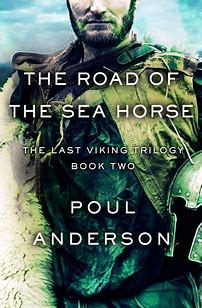
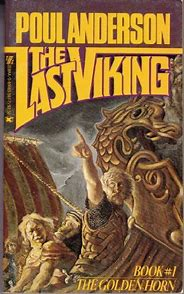
Volumes I and II, and presumably also Volume III not yet in my possession, display distinctive cover illustrations presenting Harald as described in the text.

Anderson's rich vocabulary remains evident but in this volume some of it is explained. The familiar word "Viking":

" '...means a man of the vik, the inlet.' " (p. 18)

A farmer tells Harald, " '...this is odal land.' " (p. 19) However, he does immediately explain that:

" 'By law, it cannot be sold out of the family...' " (p. 19)

Sweden, still heathen, is haunted by elf, drow, were-bear and troll. Drow? Offerings are made to goblins and dead chiefs. Ghosts are heard in the wind and some men swear they see Odhinn leading the dead through the sky. In Anderson's fantasies, Odin interacts with Kings of Denmark like any other character in the narrative but here he is merely imagined.