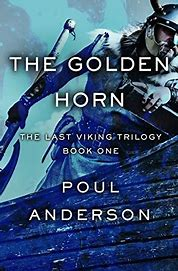
Showing posts with label The Golden Horn. Show all posts

Tuesday, 18 December 2012

The Road Of The Sea Horse

The Last Viking, Volume II: The Road Of The Sea Horse by Poul Anderson begins with a seven page Foreword summarising earlier relevant events, including those already described in Volume I: The Golden Horn. The Foreword ends by stating that Harald and his co-ruler of Norway, Magnus,

"...had a claim on the throne of England." (p. 13)

That statement prefigures how Volume III must end.

Volumes I and II, and presumably also Volume III not yet in my possession, display distinctive cover illustrations presenting Harald as described in the text.

Anderson's rich vocabulary remains evident but in this volume some of it is explained. The familiar word "Viking":

" '...means a man of the vik, the inlet.' " (p. 18)

A farmer tells Harald, " '...this is odal land.' " (p. 19) However, he does immediately explain that:

" 'By law, it cannot be sold out of the family...' " (p. 19)

Sweden, still heathen, is haunted by elf, drow, were-bear and troll. Drow? Offerings are made to goblins and dead chiefs. Ghosts are heard in the wind and some men swear they see Odhinn leading the dead through the sky. In Anderson's fantasies, Odin interacts with Kings of Denmark like any other character in the narrative but here he is merely imagined.

Gaining And Sharing The Kingdom


Although Harald Hardrada ends the first volume of Poul Anderson's The Last Viking Trilogy as a king of Norway, he has to share the kingdom with his kinsman, Magnus, so the scene is set for continued political conflict in Volume Two.

He has gained this partial kingship by deserting an ally and:

"...Harald steered for the nearest hamlet, cut down the folk on the beaches who tried to stop him, and plundered and burned." (The Golden Horn, New York, 1980, p. 261)

One of his men protests, " 'This is no way to fight...against women and harmless farmers.' " (p. 263)

- but Harald says that it is necessary. He refuses to farm as his father did. The father was right and Harald is wrong. But, in this series, Anderson is writing realistic historical fiction. Harald is not Conan, the wholly admirable hero of a heroic fantasy.

Addendum, 18/12/12: The blurb on my copies of The Last Viking misdescribes Harald as "...the real-life CONAN..."!

Synopsis II


In Poul Anderson's The Golden Horn (New York, 1980), Chapter XV, How Harald Came Home, Harald Hardrada, now thirty years of age, for the second time synopsizes his life to date, this time more briefly:

"He had seen Olaf fall, he had housed in a forest hovel, he had fled out of the land, he had served foreign kings with homesickness black in his heart, he had left the only woman he loved because he was powerless to take her with him." (p. 260)

Now, to make up for all this, he must become king! And he will. This novel, the first volume of a trilogy, ends:

"Naught on earth would ever again take from him what he held dear, now that he was a king." (p. 284)

The only extension of the synopsis is the reference to the woman he loved and it was to her that he had summarised his life on the first occasion back on page 135. Housing in a forest hovel was that first time described as "...refuge in the wilderness..." In fact, it was only a few weeks of recuperation from battle wounds. Both synopses make it sound like a longer or more significant period of his life.

Harald has completed a full career, mainly as a Captain of the Varangian Guard, by the age of thirty and now has twenty one years and two volumes left for his second career as King of Norway.

Monday, 17 December 2012

St Olaf


In Poul Anderson's heroic and historical fantasies, warriors can both pray to Odin and also, occasionally, meet him. In Anderson's historical novel, The Golden Horn, Harald Hardrada both meets and, later, prays to St Olaf.

In other words, Harald's kinsman, King Olaf, dies in battle and, later, is canonised. Thus, Harald and his contemporaries cannot meet Olaf after they have started praying to him - unless, indeed, one of them reported a vision of the saint? Visions are reported in history. Therefore, a report of such a vision could be incorporated into a historical novel without thereby automatically transforming the novel into a historical fantasy.

But Harald, unlike the Emperor Constantine, does not have visions. At least, I do not think that he does, although I have yet to read the third volume of The Last Viking Trilogy of which The Golden Horn is Volume One.

I think - I will find this on rereading - that, somewhere in the second volume, a character says that he misses old Thor but St Olaf will do in his place. (He would not have done for me but that is another story.) This sounds a bit like "We miss Connery as Bond but the present guy will do in his place" or "We miss the original Superman but the current version is OK." It's show biz - kind of.

Harald And Maria


At the beginning of Chapter XIII of Poul Anderson's The Golden Horn (New York, 1980), Harald has left Constantinople and returned to Russia from where he intends to claim Norway. It is 1044 so he is now twenty nine. There are still twenty two years, and most of the Trilogy, left until Stamford Bridge...

When escaping arrest and imprisonment in Constantinople, he had had to leave behind, never to see again, his fiancee, Maria, because her parents and brothers would have been killed if it were known that she had fled with him. Instead, he will make a suitable marriage alliance back in the North.

Could he not have rescued Maria's entire family? In theory, yes, although this would have presented a more difficult practical problem. However, the main difficulty is that Anderson is writing historical fiction and King Harald Hardrada did not have a wife called Maria. Snorri Sturluson is the source for the story of Maria which may or may not be true but makes a powerful love story in Anderson's novel. Harald has started to escape with Maria but she persuades him that she must stay...

I cannot help thinking that they could have arranged to smuggle her whole family out later but that did not happen in history.

More Vocabulary


In Poul Anderson's The Golden Horn (New York, 1980), as in his Rogue Sword, we, or at least I, continue to encounter unfamiliar terms.

(i) The Byzantine Empire is divided into regions or districts called "themes." (p. 112) I know the word of course but not in this context and do not remember noticing it on first reading.

(ii) Harald gives a "calyx" as a present. (p. 132) The recipient describes the image of Aphrodite on the calyx but not the calyx.

(iii) Harald heard "...struggles of the guard and the tchukanisterion" (p. 173) - an Eastern Imperial term, obviously, but rather a long one.

(iv) Harald, imprisoned, "...thought of draugs and devils crawling from the earth." (p. 208) I have often thought of devils but never of draugs and my lap top does not recognize them either.

There may be more; I am still in mid-novel.

These words will be explained in dictionaries or on google and I leave it to the alert reader to track them down - unless, of course, you know already?

Synopsis


In Poul Anderson's The Golden Horn (New York, 1980), the account of the battle of Stiklastadh is on pages 29-47. Ten years and eighty eight pages later, Harald recounts his life from shortly before that battle to the present:

"...of his youth, Olaf the Stout and the battle of Stiklastadh; of his refuge in the wilderness, the ride across the Keel, the winter in heathen Sweden and the journey across the Baltic; of Jaroslav's folk; of warring in the marshes of Poland and on steppes where cornflowers blazed blue under an endless mournful wind; of the fleet that went down the Dnieper toward Miklagardh the Golden; of the years since, roving and lurching about the Midworld Sea, remembering while whetted metal sang how the young beech trees had laughed in a Northern springtime." (p.135)

This kind of synopsis comes well at the end of a novel. Dornford Yates' narrator often reviewed the high points in the last paragraph. This evocative paragraph in The Golden Horn confers a greater unity and continuity on Harald's life so far than maybe the preceding necessarily episodic chapters had done, particularly the phrase "...of the years since, roving..." It is only a few years but this phrase makes it seem longer. Chapter IV, How Three Made Merry, recounts a single memorable night that would have been one of many.

And the paragraph ends by informing us that Harald had always remembered where he came from.

A Literary Pagan


In Poul Anderson's The Golden Horn (New York, 1980), Harald's friend, Nicephorus Skleros, is what I call a literary Pagan. He quotes the Classics the way another Christian would quote the Bible:

" '...a country dweller who seldom left his Homer and Plutarch for the city.' " (p. 122);

he says that Harald smote the infidel " '...as if Achilles had come back from Elysium...' " and quotes Homeric lines (pp. 122-123);

serves in a military campaign to see " '...where the Athenian expedition ended and where Archimedes wrought...' " and to understand war so that he might better understand the poets and historians (p. 123);

says that the Varangians are like the Achaeans returned and Harald a new Odysseus;

regrets that " '...the life of Hellas has run out in memories, old books and dusty dreams...' " (p. 124);

promises to read Aristotle to Harald, " '...clear cool reasoning...' " (p. 124);

values Hellenic thought, not mysticism;

admires an image of " 'Aphrodite risen new-born from the sea...' " (p. 132);

describes the Norse Harald as " '...heir to the throne of Hyperborea.' " (p. 133);

swears " 'By Zeus...' " and " '...by Apollo...' " (pp. 134, 139);

shows Harald the Bellerophon statue of Perseus and his winged horse;

listens to Aeschylus' Agamemnon read by his daughter.

The Hebrew scriptures were "Moses and the prophets." The Greeks likewise recognized "Homer and the poets" as divinely inspired authorities on theology and morality. Nicephorus lives imaginatively in Greek literature, not in Christian scripture.

(A Neil Gaiman character, asked what he thinks about a hereafter, quotes Kipling: "They will come back..." If poets are authorities in such matters, then I am with Shakespeare: "Our little lives are rounded with a sleep.")

Sunday, 16 December 2012

Chapter VI

(The image shows the cover of another book that identifies Harald Hardrada as "The Last Viking.")

On page 125 of Poul Anderson's The Golden Horn (New York, 1980), Harald is "...nearing the ripe age of twenty five years..." so I had calculated his age correctly in a recent post.

On page 124, Harald speculates on the place of origin of the Aesir, until recently worshiped as gods. The human originals of these Norse deities are thought to have come from around the Black Sea area about the time of Christ. In particular, Harald notices that the place names "Asgorod" and "Azov" are similar to "Asgard."

And, indeed, in Anderson's The Golden Slave, a one-eyed man called "Eodan" and his companion, Tjorr, led people called the Rukh-Ansa north from near the Azov Sea just before the time of Christ. Here is another strong connection between two works by Anderson and a further reason to read his historical fictions in their historical order. Harald has now referred directly to Gunnhild and indirectly to Eodan, both of whom we have already met if we have read the novels chronologically.  

The Last Viking Continued


Poul Anderson's The Last Viking is a three-volume biographical novel. The title character, Harald's, age continues to mount. Known to the Byzantines as Captain Araltes, he fights for Constantinople for a year, spends three years leading the Varangians on military campaigns in Syria, then is two years in Sicily where he captures Saracen-held cities by ingenious ruses.

That brings his age to twenty four or slightly higher unless I have missed some time while he was in Constantinople, so he is nearing his half way point and is not yet King of Norway. I think that that happens at the end of this first Volume, The Golden Horn (New York, 1980). I have currently reread as far as Chapter VI, section 1, p. 121, the capture of the third Sicilian city.

The opening sentence of Chapter II seems on first reading to introduce a legendary element. After a defeat in battle:

"Rognavald Brusason left Harald with a poor hind he knew, deep in the forest." (p. 48)

We almost recognise this. Legendary heroes, their lives threatened in infancy, are brought up in humble circumstances until they are ready to come forward to claim their inheritance. But that is not what happens here. Harald, already fifteen, had fought in the battle and stays in the forest long enough only to recuperate from his wounds, then goes abroad to win fame and fortune before returning.

Nevertheless, that "...deep in the forest..." strikes a legendary note. Meanwhile, other events, like an eclipse, occur that weave their way into legendary reconstructions of then recent history:

"After a few years they believed that the sun had gone out at the moment of St. Olaf's death." (p. 24)

If this work were not biographical fiction but historical fantasy, then its plot would comprise legendary and mythical events. 

Chapter II


By the end of Chapter II of Poul Anderson's The Golden Horn (New York, 1980), after three years in Russia, the now eighteen year old Harald has travelled to Constantinople and joined the Varangian (Northern barbarian) Guard.

We have by now seen Harald aged three, fifteen and eighteen and know from history that he will die at fifty one in 1066, the single most memorable date in British history, although Harald's last battle at Stamford Bridge (see image) is overshadowed by the more famous "Battle" that same year at the opposite end of England.

Earlier in the Chapter, newly arrived in Russia, Harald had presented the complicated family history to a younger relative. Of one king, he says:

"He planted Christendom firmly in the land, killing whoever would not be baptized." (p. 57)

- not only unfortunate but also unnecessary since Christianity was spreading and displacing Paganism for social and historical reasons in any case. But this single comment reminds us to what extent all the traditions change over the centuries. Killing those who refused conversion would, thankfully, now be unthinkable.

Saturday, 15 December 2012

Prologue And Chapter I


I have made little progress with Poul Anderson's The Golden Horn (New York, 1980) thanks to Christmas preparations and other reading. So far, this much is clear:

in the Prologue, the three year old Harald meets his half-brother, King Olaf;
in Chapter I, the fifteen year old Harald fights for Olaf at that king's last battle;
fifteen Chapters and two further Volumes later, the fifty one year old King Harald will fight his own last battle. 

Olaf, later canonized, has imposed Christianity on Norway, accepts military service only from baptized men - even turns away five hundred on that account - and is opposed by:

"...common folk who did not like being taxed and fined and herded into a church they hardly understood." (p. 38)

I agree with them. Even if I were a church-goer, I would oppose, and indeed would believe that I also was oppressed by, any law that made church attendance compulsory just as, although heterosexual, I would be oppressed by any criminalization of homosexuality. My religious observance and sexual preference are my business only, not the state's.

Harald, a man of his time, sees things differently:

"...the regrowth of heathendom that he had seen during Olaf's exile had angered him - that men should do what their rightful lord had banned." (p. 34)

Two less serious observations:

does Harald's friend eat a meat sandwich?

"Rognvald Brusason was ripping flatbread and salt flesh with his teeth." (p. 32)

Anderson sometimes smuggles a scientific or even science fictional perspective into earlier periods:

"Harald Sighurdharson went to sleep with the feeling that this whole earth was a ship, plunging through a foam of stars to an unknown port." (p. 29)

It is, but how can Harald sense that?

The Golden Horn

When we have enjoyed one kind of work by Poul Anderson, it is good to move on to a similar one. That is why I have continued rereading his novels and stories set in various periods of the past, rather than returning to his futuristic fictions, for so long. I am now rereading The Golden Horn (New York, 1980) although as yet I have barely begun the Prologue.

The Foreword shows us the wealth of the author's sources and also that this text is more firmly embedded in the relevant literature than would usually be expected of an adventure novel published as a paperback:

"...all skaldic poetry translated in this book, including Harald's own, is authentic." (p. 11)

Anderson quotes some of the same sources as for his historical fantasies, eg, Saxo Grammaticus, but in the Trilogy of which The Golden Horn is Book 1, as in The Golden Slave and Rogue Sword, he presents straight historical fiction so:

"...Saxo's yarn of Harald's fight with a dragon is pretty clearly mythical, and therefore omitted..." (p. 12)

- whereas a fight with a dragon is included in Three Hearts And Three Lions because that novel is a heroic fantasy. As I have said before, Anderson was a master of all the genres. And The Golden Horn is good to read after completing Rogue Sword.