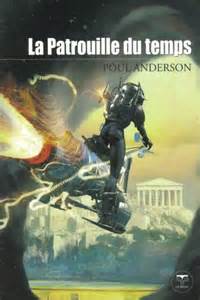
In Poul Anderson's Time Patrol series, the Danellians are primarily concerned about the preservation of their timeline. Are they equally concerned about the moralities of the human beings who serve them in the Time Patrol? After all, they preserve a timeline inhabited by conquerors, mass murderers and torturers. Also, human moralities have varied enormously throughout history. Manse and Wanda, born just a couple of generations apart, have opposite attitudes to hunting animals. Might there be eras when the Patrol agents think nothing of murdering or torturing to achieve their ends? And would the Danellians object? A million years is a long time and a lot of social change.
Alexander Solzhenitsyn wrote:
"If only there were evil people somewhere insidiously committing evil deeds, and it were necessary only to separate them from the rest of us and destroy them. But the line dividing good and evil cuts through the heart of every human being. And who is willing to destroy a piece of his own heart?"
-Alexander Solzhenitsyn, The Gulag Archipelago (London, 1974), p. 168.
The following paragraphs are equally insightful and are not quoted here only because of their length. From my own experience, I agree with Solzhenitsyn. To answer his question: I am willing but unable to destroy that part of myself - but Zen is the practice of inner awareness, not violence.
The Service in James Blish's The Quincunx Of Time is described as an Event Police, not a Thought Police. The Service receives messages transmitted in the future and uses that information to cause future events. However, those who use the Dirac transmitter must never mention the date of anyone's death. The Event Police must not become an Assassins' Guild - but could the Time Patrol become that?
Showing posts with label Alexander Solzhenitsyn. Show all posts
Sunday, 18 October 2015
Friday, 16 October 2015
Reading History
Poul Anderson's Time Patrol series requires us to think about history. Only thus can we appreciate the significance of Cyrus, Scipio, Stane etc. Who was Stane? He was one whom the Patrol prevented from having any influence - but we must still understand the post-Roman British history that he tried to alter.
We might go on to read some history and, of course, we need not restrict our attention to the periods directly covered by Time Patrol stories. Manse Everard does not have any mission in Russia, 1917-1989. However, he does refer to it. More importantly, what happened in Russia resulted from the Great War which, as Anderson does tell us, ended an era that had started in 1815.
Thus, I feel that my current reading of Alexander Solzhenitsyn's The Gulag Archipelago is very much Patrol-related. And this is our history, not just Everard's. Meanwhile, Anderson's Mother Of Kings is still on the agenda.
We might go on to read some history and, of course, we need not restrict our attention to the periods directly covered by Time Patrol stories. Manse Everard does not have any mission in Russia, 1917-1989. However, he does refer to it. More importantly, what happened in Russia resulted from the Great War which, as Anderson does tell us, ended an era that had started in 1815.
Thus, I feel that my current reading of Alexander Solzhenitsyn's The Gulag Archipelago is very much Patrol-related. And this is our history, not just Everard's. Meanwhile, Anderson's Mother Of Kings is still on the agenda.
Subscribe to:
Posts (Atom)

