Showing posts with label "The Troublemakers" by Poul Anderson. Show all posts

Friday, 15 January 2016

Early Interstellar Travel II

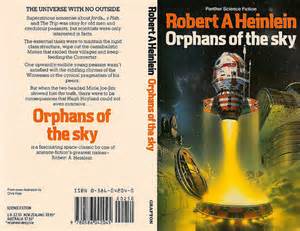
(The first edition of Heinlein's Orphans Of The Sky.)

Here, I began to reflect on early interstellar travel in Poul Anderson's Psychotechnic History. Since then, I have profitably reread "The Troublemakers" as far as here.

Of the three lost FTL ships:

one became the first Nomad (see first link);

one founded a women only colony;

the crew of the third ship were stranded on an inhabited planet, as recounted in "Star Ship."

As I had suspected, the crew of the Star Ship in "Star Ship" are a small exploratory team, not the nucleus of a colony.

In the FTL period of the Psychotechnic History:

"Gypsy," "Star Ship" and "Virgin Planet" are a trilogy about lost starships;

"Teucan," "The Pirate" and The Peregrine are a trilogy about human-alien interactions;

"Star Ship" is also about human-alien interactions;

"The Acolytes" and "The Green Thumb" remain uncollected as yet;

"The Chapter Ends" is a far future culmination of mankind's conflicts with itself and its environment.

I must now return to SM Stirling's Draka History when I can establish how far I have read in The Stone Dogs.

Disagreements

Now I must state my disagreements with Poul Anderson's "The Troublemakers" (Cold Victory, New York, 1982).

The purpose is to colonize a planet of Alpha Centauri. However, the means to achieve this purpose is a six mile long spaceship taking a hundred and twenty three years, five or six generations, to deliver ten thousand people to Centauri. Is the sole purpose of those five or six generations to deliver human genes to Centauri?

Surely this particular means generates a subsidiary purpose: to study the cosmos from the unique vantage point of an interstellar spaceship for a hundred and twenty three years? Such cosmic exploration has two aspects:

how much can be learned about astrophysics, cosmology, cosmic radiation, the interstellar medium, the structure of space, unexpected discoveries en route etc?;

how will this new, small, purposive community express itself artistically and culturally during nearly a century and a quarter in space?

To begin with, the crew's attention needs to be focused outwards at the universe, not inwards at their own environmental or social arrangements. When discussing this with the secret psychologists, Friday concedes too easily that perhaps only ten percent of the population would be able to occupy themselves with science, art or music. What population? That may have been true of the seven thousand people on board in 2205, as described in the story. However, the Pioneer had been launched in 2126 with a crew of only two hundred. That crew could have been picked for their expertise in the arts and sciences. Heredity, education and culture would ensure that the majority of the following five or six generations remained focused on scientific and artistic endeavors.

Captain Gomez refers to:

"'...lives...spent in a cramped and sterile environment far from the green Earth...'" (p. 106)

The fact that their enclosed, artificial environment is entirely changeless and unchallenging is supposed to account for the crew's internecine strife. But the environment should not be like that. If conscious beings are going to cross interstellar distances, then they need to carry their environment with them and a human environment is more than cabins and corridors. In fact, the psychologists even seem to have made the Pioneer more cramped than necessary to suit their purposes. However:

even in the Pioneer, the parks simulate a Terrestrial sky;

Anderson's later Selenarchs show us that, given enough energy and creativity, an entirely enclosed environment can nevertheless be spacious, colorful, dynamic and stimulating;

the Pioneer crew could have access to audiovisuals from Earth and to projections of what their Centaurian environment might look like instead of to the giant telescreens showing mindless, tasteless programs aimed at a lower social class.

The psychologists seem to seek the lowest common denominator instead of the highest.

Detail And Depth

(There are many covers of Orphans Of The Sky. This is the edition that I read in the 1960s, never suspecting that I would discuss a successor story, "The Troublemakers" by Poul Anderson, on a world-wide computer network in 2016.)

Anyone who has read Poul Anderson's many novels and collections might think, as I did, that his Psychotechnic History is a minor work, especially when contrasted with the same author's later future histories. I hope that I have demonstrated that this is not the case. Careful rereading and reflection reveal apparently endless details and depths in this series. I have still not finished discussing "The Troublemakers," in Cold Victory (New York, 1982).

Inside the generation ship, a small group of psychologists:

secretly controls and directs the "inevitable" (?) social conflicts, thus preserving a dynamic society while also providing a hard school for the rigors of colonization;

do not object when some crew members practice personal aggrandizement because such activity keeps those crew members occupied (!);

have engineered social injustices so that men of goodwill will campaign against injustice.

Both self-aggrandizement and social campaigning sharpen the crew. Events take their natural course with the few (how few?) psychologists "'...as unnoticed guides.'" (p. 107) They know that the demoted Evan Friday is organizing a Guildsmen's protective association but they had arranged for his demotion precisely so that he would engage in such activity. When Councillor Wilson plans mutiny, the Captain's assistant, Lieutenant Farrell, secretly a psychologist, is at Wilson's side, apparently as an ally.

However, no one, not even the transparently self-seeking Wilson, can be controlled like a puppet. Outwitting even his own supporters, he has acquired weapons from a sympathetic police officer so that now his men have the bulk of the police force bottled up in a park after an arranged riot. The attempted mutiny has "'...got out of hand...'" (p. 95) from the psychologists' point of view. Farrell, unable to leave Wilson, can nevertheless get a message to Friday to save the ship, knowing, or at least hoping, that Friday has sufficient following and resources to do this.

Explanations

Poul Anderson, "The Troublemakers" IN Anderson, Cold Victory (New York, 1982), pp. 31-110.

Of course, our hero must save the ship. Fortunately, Anderson makes it plausible that he should be able to do so. The mutineers guard the armory against anyone approaching along the corridors. However, Evan Friday, formerly of Astrogation, knows the plan of the ship. During the mutinously caused blackout, he is able to lead his men along dark corridors, avoiding key points held by mutineers, to an airlock. Walking across the outside of the ship in spacesuits with magnetic boots, they enter the armory by another airlock... This time, unlike in "Brake," Anderson spares us what could have been an interminable account of the fighting until the mutiny is defeated.

After the fighting, three men, the Captain, his assistant and the chief of Astrogation, explain the secret to Friday. The voyage will last one hundred and twenty three years. Approximately the first twenty years were spent completing the construction of the ship's interior. What is the crew to do for the remaining hundred years? Friday suggests science, music and the arts but is forced to concede that perhaps only ten per cent of the population can be occupied in this way. A static culture for the rest would not prepare them for the rigors of colonization.

However, the descendants of personnel chosen for energy, initiative and ability, looking for something worthwhile to do, will pursue personal aggrandizement! The psychological planners of the expedition knew that the original small private enterprises would become monopolies provoking reactions that could be predicted in general terms - although some events, like the great strike and the more recent riots and mutiny, did get out of control. Nevertheless, there is a plan. Asimov's Seldon would not have been able to make psychohistorical predictions about a few thousand people. His science and its Foundation Plan needed a Galactic population. But the few psychologists in the Pioneer are unable to predict its future history exactly.

Men like Wilson were allowed to pursue selfish ends but (i) they were to be defeated eventually and (ii) others responded more positively like Friday, who is to be the next Captain! Wilson was unexpectedly smart and nearly succeeded but, fortunately, Friday was on hand to stop him. The idealist Friday had been demoted precisely so that he would learn practical politics. Next, because of their role in quelling the mutiny, the Guilds will, after some further necessary difficulties, gain a seat on the Council, where they will be represented by Friday. Then, the Guilds will join with Astro, oust the other factions, hopefully without violence, restore a mercantile economy and make Friday Captain.

"The Troublemakers" is set in 2205. Friday should become Captain in about 2210. The psychologists, who will by then include Friday, will have reunited humanity in the Pioneer four or five years before 2249, when the ship is due to reach Alpha Centauri. Thus, Friday will spend about thirty five years leading the crew through social struggles that will eventually reunite them with the common purpose of colonization.

I have done my best to summarize the argument but I also disagree with it and will explain why in another post.

Thursday, 14 January 2016

Directions

"This is revolution, he thought. You don't know what's happened, you don't know who's fighting or where the fighting is, you sit and wait and listen to the people going they don't know where."
-Poul Anderson, Cold Victory (New York, 1958), pp. 88-89.

That is one side of revolution. The other side is people who do know that they are fighting and where they are going, whether a clique seizing power or a population overthrowing a dictatorship.

"They wound up the levels, feeling their bodies grow heavier..." (p. 94)

Surely, if they are approaching heavier levels, then they should experience this approach as a descent? But I am confused about how centrifugal force works. Earlier:

"An elevator took them up to officer level. Actually, thought a dim corner of Friday's mind, the term should have been 'down,' since they were increasing centrifugal 'gravity'; but the notion of the upper classes living 'upward' was too ingrained for usage to change, even though on any one level 'down' meant the direction of acceleration." (p. 76)

We understand the difference between physical up and down and social up and down. Someone might travel "down" to London because it is in the south of the country or"up" because it is the capital. However, if the elevator is experienced as descending, then it is hard to imagine that it would be thought of as going "up." And the direction of acceleration is "down" within a single level? I do not get that last bit.

The Size Of The Ship

Turning down an offer from Wilson, Evan Friday quits his machine job to become the paid organizer of a Guildsmen's protective association about three weeks before Wilson's Brotherhood of Workers mutinies. Friday comments:

"'The ship is six miles long and two miles in diameter. How does Wilson expect to take it over with a thousand men at best?'"
-Poul Anderson, Cold Victory (New York, 1982), p. 88.

He can seize key points and officers but how can he resist the better armed police?

I never before knew the size of a generation ship. Is anyone able to calculate its volume or diameter?

I nearly bypassed "The Troublemakers" but it is proving to be the most substantial installment of the Psychotechnic History. Heinlein's generation ship crew had mutinied. They must have gone through experiences similar to those that Anderson describes here.

History In The Pioneer

The Pioneer left the Solar System in 2126. Evan Friday, twenty four in 2205, studies the history of the ship but does not tell us every date:

the small private farms of the early years were replaced by a food trust;

in 2160, leading Engineers provoked a violent general strike by underpaid workers in that trust;

the strike overthrew the trust;

the Engineers had wanted to divide and weaken food producers by returning them to the earlier system;

however, upper Administration preferred to socialize food production, packaging and distribution under its own bureaucracy;

Admy won and confronted Engy as a powerful new rival;

when Captain Petri died in 2162, Engy and Admy, ignoring the rule that the first mate should have succeeded, nominated instead the young Juan Gomez from Astrogation;

Astro, a small officers only group, played the two more powerful Departments off against each other;

for a few years, the overlords' bully gangs clashed, green and gray workers became restless, young officers became arrogant and exclusive and Admy used ship's law to aggrandize its leaders;

in 2171, the private forces of Engy and Admy waged war over the extent of Admy jurisdiction;

although the two small sides lacked effective weapons, there was death, damage and suspension of services;

Astro rallied police and other groups to end the war;

ship's articles were amended with police power transferred from Admy to the Captaincy, thus effectively to Astro;

Admy opposed the move but Engy supported it because it weakened Admy;

Astro acquired followers, investments and political contacts;

in 2176, lower Engy ranks violently revolted and were suppressed although the Captain's Court then made concessions disliked by most officers;

in 2182, Duncan, chief of Admy, tried to seize the Captaincy but was defeated with the help of Engy;

however, his power passed to his successor with help from Astro;

in 2187, Admy and Astro ended officer ownership of factories and socialized them, having acquired sufficient fighting strength to enforce this;

from 2187 to 2201, the ship owned all important facilities, with ultimate control exercised by the Captain and his Council;

a combine mainly of Astro officers held, and struggled to keep, the balance of power;

characteristic ship art, literature and music began plus scientific advances in astrophysics and the biological effects of cosmic radiation;

the laboring classes organized unions which merged as the Brotherhood of Workers, led by Wilson;

independents organized in Guilds but had no effective voice;

in 2201, the Council violently suppressed a general strike but let Wilson onto the Council from which position he began to make alliances with younger, more liberal, officers;

in 2205, Wilson wants all but purely personal property to belong to the ship with plants governed by workers' councils;

other factions want either a return to some earlier stage of the ship's history or an advance, e.g., to complete economic and political control by a hereditary officer caste;

Captain Gomez, chairing the Council and controlling the police, is supported by conservative officers and possibly by most commons although McMurtrie, chief of Astro, might hold ultimate power;

the ship is ready for another upheaval.

Wednesday, 13 January 2016

Society In The Pioneer

In Poul Anderson's "The Troublemakers," Evan Friday, formerly a junior officer, now a machine worker in Engineering, befriends a family of shopkeepers who sell ornaments and household objects of wood, plastic and metal. Thus, Friday gains perhaps a unique perspective on the social diversity within the Pioneer.

The demagogic Councillor Wilson declaims that farming and Engineering workers, greens and grays, comprise more than six of the seven thousand people on board and that:

"'Everybody else on board is riding on your backs...'" (Cold Victory, p. 66)

- but goes on to list professions like doctor and teacher which are surely necessary.

Friday challenges Wilson's figures. The latest census shows:

1000 Engineering;
500 food;
300 public service;
700 Guildsmen and other independents;
500 officers and their families;
4000 housewives, children and aged -

- so there are 1500 greens and grays. Dictatorship by them would not be democratic. (However, I would count their entire families as members of the same socioeconomic class.)

Friday tells his shopkeeper friends that Wilson's rule would be "'...nominal communism...'" (p. 73) but really old style dictatorship. Here then is a recognition that "communism" does not mean "dictatorship."

Politics in The Pioneer

A crewman says:

"'Any ship is a natural communist state.'" (Cold Victory, p. 53)

I would say that a large interstellar spaceship with a population of seven thousand is a natural communist society. Here, "communism" means common ownership and control, not a bureaucratic dictatorship falsely claiming to administer common ownership and control. A "communist society" is one that is not, or not yet, divided into economic classes - the earliest such classes being slave-owners and slaves. Thus, hunting and gathering societies are primitive communisms.

A "state" is a body of armed men that becomes necessary to maintain social order when society has divided into classes - the earliest such state being soldiers guarding granaries controlled by priests. It follows that "a communist state" is a contradiction in terms. But the man who uses this phrase means by it what I mean by "a communist society."

Evan Friday considers three ways of organizing the ship:

(i) "...a politicking communism..." (p. 54);
(ii) "...a realm of little, short-sighted tradesmen..." (pp. 54-55);
(iii) "...the rule of the best, the aristos..." (p. 55).

(i) The communist movement within the ship is led by Wilson. Friday thinks that Wilson is a demagogue who would not let workers have much say if he got what he wanted. This is "politicking communism," clearly different from communism as discussed in the opening paragraphs of this post.

(ii) is clear enough.

(iii) "...rule..." implies government through a state apparatus. Thus, rule is unnecessary if there is no need for a state. Leadership by the best, i.e., by those who are best able to lead, is necessary in any society.

Friday elaborates his idea of aristos:

"...a hierarchy restrained by law and tradition and open on a competitive basis to anyone with ability." (p. 55)

A hierarchy competitively open to those with ability ceases to be hereditary whereas I think that a hereditary hierarchy is our idea of an aristocracy? But, in any case, the meaning of "aristos" can evolve. However, if, as is possible, the entire population of the ship were to be involved in discussion and decision-making through meetings and communications systems, then the "most able" would be able to lead that democratic process without needing to be organized into a separate hierarchy.

Friday concludes:

"...it had to be an unquestioned rule, or you got the sort of anarchy which had prevailed aboard the Pioneer." (p. 55)

"Anarchy" means "no rulers" whereas Friday instead means conflict and chaos. Democratic discussion and decision-making do not automatically generate blackjacks, knuckledusters, private armies or riots. But any attempt to impose unquestioned, thus undemocratic, rule would provoke physical resistance.

This is my condensed response to an extremely condensed and substantial passage in Poul Anderson's "The Troublemakers."

Tuesday, 12 January 2016

Life Inside A Generation Ship

The Pioneer

2126 departure, crew 200.
2205 en route, crew 7,000.
2249 arrival, crew 10,000.

The early crew spent the first ten or twenty years completing construction of the ship's interior. Later generations:

repair or replace machines;
build new ones;
work as technicians.

Human labor makes robots unnecessary;
a thirty hour week provides a living wage;
some crew work part time, then earn more as, e.g., prostitutes or goons;
self-employed tradesmen, artists, artisans and writers work their own hours, some on officer decks;
parks have simulated skies.

One crewman's explanation of the social degeneration within the ship:

a ship is a natural communist state;
but private groups were allowed to run farms, factories and recreation;
companies were founded, fought each other and oppressed workers;
workers had to form unions;
food processors won against producers and formed a trust;
the Engineering Department took over industries;
food and factories competed for control of the ship;
farm collectivization came too late to stop the power struggles;
solution - socialize everything under the Council, giving workers the main voice.

Wilson, demagogic crew representative on the Council, leads a communist movement.
The Guilds agitate against monopolies and for a petite-bourgeois economy.
Officers are aristocrats but interpret this as personal aggrandizement, not as traditional responsibility.

Who dealt this mess?  

Seven Thousand People

A mere seven thousand people in the starship, the Pioneer, live less like a spaceship crew and more like a small planetary population.

Officers
Astros
Engys
Admys

They are divided not only departmentally but also on issues of power and policy.

Crew
machine workers
farmers
deckhands
graded technicians
"chants" (I cannot find this word)
small manufacturers

The different groups riot. Chants and manufacturers want a return to free enterprise and independent representation on the Council. Factions and powerful individuals maintain gangs of goons and bullies outnumbering the police. The Captain is (seen as) a puppet of continually shifting groups wielding real power.

I admit that, when I first read that many years ago, I just accepted it but it is the strangest description of a spaceship crew that has ever been written. An explanation will be given but will it be adequate?

Histories Within Histories

Poul Anderson's Time Patrol series spans prehistory and history. One installment, "The Sorrow of Odin the Goth," is a mini-history because it covers four generations of a Gothic family, from 300 to 374 AD.

Anderson's Psychotechnic History begins with World War III in 1958 and ends fifty thousand years after the fall of the interstellar "First Empire." That Empire existed after the Third Dark Ages, which began in 3200.

Within the Psychotechnic History, "The Troublemakers" gives the sense of a mini-history. The Pioneer leaves the Solar System in 2126 and should reach Alpha Centauri in 2249, although the Chronology does not confirm its arrival. I reasoned in an earlier post that, because of the length of the journey, many who are born and die in the ship should at different times know those who left Earth and those who will reach Centauri.

"The Troublemakers" confirms this. In 2205, the second Captain has ruled for forty three years and begins to train his successor who will complete the voyage. Thus, the second Captain, Gomez, has been born and will die in the ship but, despite this strange life, is sufficiently trained and motivated to do whatever is necessary for the success of the expedition. Gomez applies individual and social "psychology" to his crew but curiously does not refer either to "psychotechnics" or to "psychodynamics."

A Slum In Space

In crew quarters on the starship Pioneer:

halls are drabber and dingier;

the smaller apartments are poorly furnished;

metal-working is audible;

many crew spit and swear on seeing a policeman;

unmarried workers sleep in tiered bunks in cave-like barracks where a giant telescreen shows mindless, tasteless entertainment suitable for this class;

when Friday, the officer who wanted rights for the crew, is demoted to the crew, he must fight one of them;

fortunately, as a member of his aristocratic caste, he has learned fighting techniques to keep fit.

On Earth, such slums have grown from unplanned social interactions but this one is in a spaceship launched by a civilization ruled by psychotechnicians. Something does not add up but all will be explained in due course.

Suspicious Social Stratification

The absurd social stratification in the starship Pioneer (see here) becomes evident when Friday is demoted to crewman:

he is separated from his parents;

he is given "...two changes of clothing and a couple of dollars to last till payday..." (Cold Victory, p. 36);

the police are now able to kick him around although he retains "...the manners they were trained to salute..." (p. 37) so they are confused;

crewmen dislike officers and take out their resentment on any who are demoted;

Friday can complain to the police if he is beaten up but is advised not to because then he would never be accepted and might even be murdered;

he was taught self-defense because fitness is part of the Astro code;

Astrogation is the smallest faction but at present holds the balance of power (!);

Astrogation is above Engineering which is above Administration and both are divided into ranks;

the police cannot prevent brawling but must intervene if there is a riot!

The ship has only been in flight for eighty years. Friday, twenty four years old, was born on board but the departure from Earth was only a long lifetime ago. Society within the ship cannot possibly have degenerated to this extent in so short a time. Psychotechnicians were in control on Earth back then. What did they plan for the social dynamics within the ship?

Monday, 11 January 2016

Generations And Lifespans

 "A hundred and twenty-three years to Alpha Centauri - five or six generations, more than a long lifetime...
"Enrico Yamatsu, Starward!"
-Poul Anderson, Cold Victory (New York, 1982), p. 32.

I was told at school that a generation was about twenty years - long enough for someone to be born, to grow up and to start having children. Someone else said twenty five years. The fictional Yamatsu effectively says twenty or twenty five years. That is a lot of generations to be born inside a spaceship. But, of course, it is not five or six generations living and dying inside the spaceship. Yamatsu says that one hundred and twenty three years (just under a century and a quarter) is longer than a long lifetime - but it is not very much longer.

Now, in 2016, I remember my maternal grandmother, born in the late nineteenth century, and know children who should live into the twenty second century. Thus, three overlapping lifespans cover more than two hundred years. Therefore, some people who are born and die inside the Pioneer should know many who were born on Earth and many others who will die on a planet of Alpha Centauri. It is strange to think of those intermediate lifespans spent on neither planet.

Robert Heinlein introduced the idea of a generation ship and, I think, has conditioned sf readers to imagine many generations both living and dying inside such a ship. However, the crew of his Vanguard had mutinied and killed their officers. Subsequent generations lost all scientific knowledge and came to regard their enclosed artificial environment as the entire "Universe." Many never went to the front of the large, spinning vessel to look out at the stars. They knew only cabins and corridors and, of course, devised a mythology to account for this environment. No one knows how long they drifted through space. By contrast with this, a generation ship that remains on course should be expected to reach its nearby stellar destination in a few decades and therefore in a manageable number of generations. Anderson's psychotechnicians socially engineer the crew to avoid the fate of the Vanguard.

In The Slower Than Light Ship

In Poul Anderson's Psychotechnic History:

the first slower than light interstellar spaceship, the Pioneer, is launched in 2126 on a hundred and twenty three years journey to Alpha Centauri;

in 2205, there are seven thousand people on board and the ship is under its second captain, Gomez;

the Captain's Court, which rules the ship and tries cases, comprises the Captain, three officers, representing Astrogation, Administration and Engineering, and one crew member;

the Captain invokes "'...a tradition that junior officers should be seen and not heard...'" (Cold Victory, p. 35);

the occasion is the trial of junior officer, Evan Friday, found guilty of sedition, mutiny and bribery, punishable by death or imprisonment;

in his statement to the Court, Friday alleges that -

he has been framed;
the ship has endured eighty years of tyrannies, revolutions and corruption;
there is "'...a ceaseless struggle for power which is used only to oppress...'" (p. 34);
two successive Captains have not exercised due authority;
the Captaincy is a farcical figurehead;
the officers are a tyrant caste;
the crew are an ignorant mob!;
on this basis, the expedition will fail.

Because of his youth and good record, he is merely demoted to Engineering Section crewman, his property sequestered.

Something is wrong:

only one crew member in the Captain's Court;

the third person narrator describes the Astro officers as a rigidly mannered caste;

junior officers are treated like children in Victorian England;

are any of Friday's allegations about the ship and the flimsy, perjured case against him true?;

how can this be happening in a spaceship where the common purpose should be to reach Alpha Centauri and colonize a planet, not to play power politics en route?

Having read the story before, I know what is going on but maybe I should have suspected something on the first reading?