Showing posts with label "Lodestar" by Poul Anderson. Show all posts

Thursday, 15 January 2015

Hydrogen And Helium

There are two ways to reread a text. The first way is just a second reading. The second way is a careful examination of each paragraph for note-taking or, nowadays, blogging purposes. I found a wealth of information in "Lodestar," which has led me back into Mirkheim.

One passage read several times previously suddenly impressed me with a detail that I do not remember having noticed before. Poul Anderson informs his readers of relevant cosmogony by having Adzel screen documentary coverage of the Mirkheim crisis. The speaker intones:

"We believe all matter began as a chaos of hydrogen, the smallest atom. Some of it was fused in the primordial fireball to form helium; more of this process happened later, in the enormous heat and pressure at the hearts of stars which condensed from that gas. And there the higher elements were built..."
-Poul Anderson, Rise of The Terran Empire (New York, 2011), p. 42.

I had known that:

hydrogen is the first and smallest atom;
helium is next in size;
there was a lot of hydrogen and a much smaller quantity of helium at the Beginning;
stellar fusion generates heavier elements -

- but had overlooked the fact that there was pre-stellar fusion and that that is where the original helium came from.

I am currently rereading Mirkheim for information about Coya Conyon/Falkayn but find that I continue reading even when Coya goes offstage. Technic civilization becomes more alive with each detail and datum.

Early tomorrow morning, I will drive Sheila, to whom I have been married since 1974, into the next county for a hip replacement operation which will be followed by several months of recuperation. Posts may be fewer and further between for a while.

Ages

In Mikheim, Prologue, Y minus 9, David Falkayn is forty one. He is also thirty years younger than Nicholas van Rijn and eighteen years older than Coya. Thus, van Rijn is seventy one and Coya is twenty three. (Have I got that right? Every time I publish calculations here, I reread them and find that I have got them wrong.) However, in "Lodestar," set slightly earlier, Coya was twenty five. A recently posted chronology shows that Poul Anderson exercised tight control over the chronological relationships between events in this crowded part of the Technic History. The stated numbers of years elapsed are usually consistent.

Falkayn is thirty three in the opening passage of "Lodestar." Thus, ten years later, when Coya is twenty five, he should be forty three which does make him eighteen years older.

Van Rijn is usually, not always, described as seen by another character. Trader team stories are narrated from Falkayn's point of view unless the characters separate. Thus, both Adzel and Chee Lan are alone at different times on Merseia. In accordance with these rules of thumb, "Lodestar" divides into a trader team passage narrated from Falkayn's point of view and a van Rijn passage narrated from the point of view of a new character, his granddaughter, Coya Conyon. Coya becomes a heroine of the series and I will reread the passages of Mirkheim in which she features.

When, in that Mirkheim Prologue passage, Hanny Lennart of the Home Companies warns van Rijn not to oppose the Garver bill, she says that, "The popular mood being what it is..." (Rise Of The Terran Empire, p. 15), he would be bound to fail. Here is another clue about social conditions on Earth. Sure, the Commonwealth government, the Home Companies and the media will manipulate the "popular mood." Nevertheless, that mood also represents a global population many of whom can think for themselves. I would want my union, not van Rijn, to control my pension fund. Van Rijn complains that the unions are tied in with government. I would want my union to be independent of the government. So there would be plenty to play for if we were citizens of the Solar Commonwealth.

Van Rijn does not want to discuss the unwelcome news but Coya suggests that he will feel better if he does. Thus, of course, the author through Coya's intervention informs the reader of current political developments.

Wednesday, 14 January 2015

Living With Aliens

Traveling in the Ythrian spaceship, Dewfall, Coya Conyon:

"...didn't mind being the sole human aboard besides her grandfather."
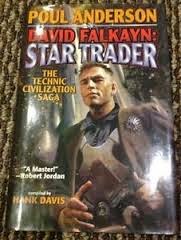
-Poul Anderson, David Falkayn: Star Trader (New York, 2010), p. 641.

She befriends winged Ythrians, watches their aerial dances and shows them ballet - including, no doubt, some movements from Swan Lake? When Captain Hirharouk orders that everyone be prepared for emergencies whether cosmic or military:

"A species whose ancestors had lived like eagles could take this more easily than men. Even so, tension had mounted till she could smell it." (pp. 641-642)

This sounds like a difficult situation to deal with. Ythrians look like large birds although they have mouths, not beaks. I am not sure whether this would make them look less threatening or like birds gone wrong. How would you cope if surrounded by nearly man-sized winged feathered talking carnivores?

Coya, astrophysicist and frequent space traveler, is at home in the universe, able to identify the brightest stars among the rest. The Dewfall has traveled at high speed for nearly a month from Quetlan towards the Deneb sector. Since Quetlan is 278 light years from Sol towards Lupus, they are now a hundred parsecs from Earth in unknown space. Coya knows this. To that extent, she is as at home there as a Londoner is in Hyde Park. The universe is our home and we ought to be one with it.

More On "Lodestar" And Mirkheim

Mirkheim discloses a little more about social conditions on Earth. Loyalties become more personal as confidence in public institutions declines despite the arrogant claim of a Homes Companies director that the Solar Commonwealth "'...has had fifty years of progressive reforms to strengthen democracy.'" (Rise Of The Terran Empire, p. 68)

The Polesotechnic League series mainly expresses the views of those who want to get out into space more than anything else. Entire species feel held back by their inability to afford off-planet training and careers for their more gifted members. Coya Conyon provides a welcome contrast. She is content to work as an astrophysicist at Luna Astrocenter and to see other planets as a tourist. Granted that Luna is off Earth but only just! Most Anderson characters would not be content with that in an era of faster than light interstellar travel. "The stars" attract them.

Coya joins the trader team when she marries David but stops, and persuades him to stop, a mere five years later when she starts a family. Unlike an earlier "...less settled generation..." (p. 34), Coya regards a stable Terrestrial home for her children as more important than roaming around in space. This is, effectively, a comment on her grandfather who had never married and had at least two children by different women.

The Richness Of "Lodestar"

The Lodestar/Eka-World/Mirkheim is rich in industrially valuable supermetals. The short story, "Lodestar," and the novel, Mirkheim, are rich in solid information about the fictional universe of Technic civilization. As a single example from Mirkheim, David Falkayn's mother, Athena, is named and appears in just one passage of this novel. Some readers might be surprised to be told or reminded that Athena's involvement is that brief. Nevertheless, we learn a great deal about the Falkayns' position on Hermes and about David's impacts elsewhere.

Without any of its incidents occurring on Earth, except in Coya's momentary reminiscences, "Lodestar" informs us about:

social changes over three generations;
economic imperialism and monopolies in the Polesotechnic League;
the plight of aspiring peoples left behind by Technic civilization;
conditions on the remnants of a large supernova and of its massive planetary companion.

Poul Anderson referred to "Lodestar" as "...this ending of a saga..." (David Falkayn: Star Trader, p. 682). If he had not gone on to write Mirkheim, then "Lodestar" would have ended the Polesotechnic League period of the History of Technic Civilization. Despite the welcome addition of Mirkheim, "Lodestar" does end the saga of the trade pioneer crew led by David Falkayn, if by "the saga" we mean the written account. The crew continues for another five years but between installments of the History. In Mirkheim, the original team is reassembled once more after three years but for a different purpose. Thus, Mirkheim is not a conclusion but a sequel to the saga.

The Supermetals warships try to kill everyone in Dewfall, including van Rijn. But van Rijn would have left enough information for his employees and maybe a couple of League frigates to follow his trail. Thus, the destruction of Dewfall and, in particular, the murder of van Rijn would have been a crime with dire consequences for Supermetals.

When Coya blackmailed van Rijn to take her along, he warned her that it could be dangerous but is the danger that he subjects them to warranted? Especially since, if detained, he could have awaited rescue while continuing to negotiate/bluff/plan escape etc? Especially if, as Coya thinks, he had suspected that Falkayn was involved?

"Lodestar" does belatedly tell us the first name of Coya's grandmother.

Fashions II

See here.

"They had both stopped space roving when their Juanita was born, because it meant indefinite absences from Earth. An older, more hedonistic, less settled generation than Coya's had bred enough neurotics that she felt, and made her husband feel, children needed and deserved a solid home. And now she had another on the way."
-Poul Anderson, Rise Of The Terran Empire (New York, 2011), p. 34.

(The next installment of the Technic History is a short story about that second child's son.)

Is that older, more hedonistic, generation the one before Coya's or the one before that? Does Coya reflect that too many of her contemporaries are neurotics or that too many of her parents' generation were? Either way, we see social change in the Technic History.

Coya prays:

"Please, God of my grandfather Whom I don't believe in..."
-Poul Anderson, David Falkayn: Star Trader (New York, 2010), p. 666.

-or is it a prayer if there is no belief? I would say so. I suggest that at least some deities would heed even agnostic invocations. I say, "To Whom it may concern, to whatever gods may be..." although I cannot practice the prayer of the monotheist faiths.

In recent history, we have been used to children or grandchildren not accepting the beliefs of their elders and Coya's remark sounds like more of the same but remember that she is living in the twenty fifth century. Many fashions will have come and gone. She and her grandfather differ on this question but that does not tell us anything about their respective generations as such. However, we do feel that we get a good sense of changing social mores in that future century.

Tuesday, 13 January 2015

Fine Tuning The Chronology

See here and here.

Trying to fill in a bit more of the chronology:

2482  Satan episode
           Tametha uprising
           David Falkayn seeks and finds Mirkheim
2489  Supermetals begins trading
2492  Van Rijn repeats Falkayn's search
           Coya Falkayn joins the trade pioneer crew
2497  The trade pioneer crew disbands
2599  Knowledge of Mirkheim is made public
2500  The Babur War

I have started with Sean M Brooks' date of 2482 for the Satan episode and have added years in accordance with what is either said by the characters or stated by the omniscient narrator. Some of what is said suggests that my dating may be out by at most one year but no one gets down to specific months so this is the best that I can manage for the time being.

Addendum, 14 Jan '15: I have had to revise this Chronology because I got some details wrong, I don't know how. The data are:

Tametha and Falkayn's search happen shortly after the Satan episode;
van Rijn visits Mirkheim ten years after the Satan episode and three years after Supermetals starts;
David and Coya become linked when van Rijn is at Mirkheim;
Coya joins the team after marrying David;
the team disbands five years later;
Mirkheim becomes public knowledge one year before the Babur War;
the war happens eighteen years after David found Mirkheim.

At Mirkheim And Its Sun

What sun? It exploded. Yes. However, a nova or supernova always leaves a remnant. Mirkheim is the remnant, the blasted core, of a companion planet too large to have been entirely vaporized or disintegrated by the stellar explosion. Similarly, the supernova itself left a remnant, imperceptibly shrinking towards black hole status. Thus, two unusual heavenly bodies still orbit in close proximity. Coya Conyon says that they had originated as a double stellar system, not as a star with a planetary system.

The stellar remnant is six Solar masses compressed into one Terrestrial volume. Therefore, it "...has stupendous gravitational power..." (David Falkayn: Star Trader, p. 676) which warps space so that "...the laws of nature take on an eerie aspect." (ibid.) Anderson does not elaborate although readers of popular science and science fiction have learned that spatial distortions affect time and matter in counter-intuitive ways described by Einstein, not by Newton or by common sense. (Common sense generalizes our experience on a macroscopic scale but at sub-relativistic velocities.)

Secondly, the fantastically rapid spin of a dwarf star also "...generates relativistic forces, describable only if you have determined the precise quantities involved." (ibid.) Thirdly (I think that this is a separate point), pulsations usually found only inside atomic nuclei stretch across interplanetary distances. Fourthly, as with any star, there is radiation although this is comparatively easy to guard against, dim visible light but lurid gamma and X-rays.

The Ythrian spaceship, Dewfall, chartered by Nicholas van Rijn, finds the sun - so small as to be undetectable except within a few parsecs but van Rijn had known where to look. Maximum photoamplification reveals a white spark but makes other stars painfully brilliant. Expensive equipment installed by van Rijn detects the light-bending due to a sub-stellar object between forty and fifty astronomical units from the star. To establish its position, they need a long baseline which would take weeks at sublight speeds. However, Dewfall's engines are well-tuned enough to use hyperdrive even this deep in a gravity well.

As Dewfall approaches Mirkheim, three Supermetals warships move to intercept and block escape. The Ythrian ship's approach has been observed. Relative speeds and distances are such that one ship can engage until the others arrive. They intend to detain crew and passengers but will fire if Dewfall attempts to escape. Having come prepared, van Rijn takes charge and accelerates on negagrav back towards the sun. No enemy missiles can accelerate fast enough "...to get past defensive fire..." (p. 675) Dewfall goes hyper, though not at full speed, and reverts to normal state when nearly at the sun but still continues toward, then around, it. Prior computations ordered by van Rijn and readings taken by Coya as they approached the sun are in the data banks. Now Coya inserts current data that enable van Rijn and Hirharouk to steer. Commodore Nadi of Supermetals can neither pursue nor predict where his enemy will emerge.

The Ythrian beats his wings while the man kneels in prayer. They must cope with a meteoroid swarm and a plasma cloud but:

"They won past reef and riptide..." (p. 677)

I have found it rewarding to summarize other battles in space. See here and here.

Monday, 12 January 2015

A Few Choice Malapropisms

We need a list of all the van Rijn malapropisms. Some display insight:

when asked whether he knows who is behind an undertaking, van Rijn replies that he knows who the undertakers are - and, although he does not add this, they might be just about to kill him;

he warns one of these "undertakers" that Old Mother Hubris always finds an empty larder, thus juxtaposing the harmless nursery rhyme figure with the overweening pride that brings Nemesis;

having ordered a computer program that translates Anglic language, Arabic numerals and metric units into their Planha equivalents, he adds "'...whatever else kind of ics is useful...'" (The Van Rijn Method, pp. 669-670).

"...ics..." is not good English and probably not good Anglic but comprehensibly summarizes at least three kinds of symbols in just three letters and is the sort of abbreviation that, if used often enough, would be incorporated into the language and included in later editions of sufficiently comprehensive dictionaries.

Sorry for short and infrequent posts, folks. I am starting to acquire a few more domestic responsibilities and, right now, am intermediate between Latin class preparation and Zen meditation group. Later.

What Happened At Mirkheim, Continued

Muddlin' Through detects Dewfall, makes contact and lays alongside. Falkayn, Adzel and Chee Lan board. Van Rijn provides food, drink and music. Before relaxing, Falkayn asks what has happened to those in Dewfall. Hirharouk describes pursuit and escape.

Falkayn asks what van Rijn will do about Supermetals. In payment for the attack, van Rijn wants ten percent. Falkayn replies that, for van Rijn, money has become a counter in a game whereas Supermetals are not playing a game. Hiraharouk explains that they want to fly free and that the shadow of God is over the League. Coya asks van Rijn to remain silent.

Van Rijn says that Falkayn has broken fealty. Coya thinks that he suspected but would not admit it until she let out the truth. Did she? What did van Rijn think that his trade pioneer crew were doing there if he was still not admitting to himself their involvement in Supermetals? And how did what she said make a difference?

Falkayn suggests that they let the past stay dead. Watching Falkayn and Coya, and himself watched by Adzel, Chee and Hiraharouk, van Rijn agrees and pours a drink. With that gesture, a historical turning point has passed.

Sunday, 11 January 2015

What Happened At Mirkheim

Poul Anderson's "Lodestar" comprises a trader team story followed by a Nicholas van Rijn story followed by a meeting between van Rijn and the team. In the van Rijn story:

van Rin asks Coya Conyon to calculate the probability of a particular kind of supernova remnant, then sets out to follow the resulting search pattern in the hired Ythrian spaceship, Dewfall;

knowing that David Falkayn had run the same program ten years previously, Coya writes to warn David and blackmails van Rijn to take her on Dewfall;

when Dewfall finds Mirkheim, Supermetals ships try to detain her but she escapes;

then Dewfall meets Falkayn's ship, Muddlin' Through, which is returning to Mirkheim in response to Coya's letter. I want to discuss the meeting but am being interrupted.

Fashions

Carl Farness tells a fellow Time Patrol member from his future that he and his wife grew up during the sexual revolution of the 1960's. The colleague, unmoved and unimpressed by this reference to a particular decade in a past century, merely remarks that:

"'Fashions come and go.'"
-Poul Anderson, The Time Patrol (New York, 1991), p. 235.

This also happens in the Technic History:

van Rijn's generation seldom married;
but his children's generation did;
and his grandchildren's even revives patrilineal surnames.

Offered every alcoholic drink in creation, his granddaughter Coya accepts coffee. (Every drink includes "'...ansa...'" (David Falkayn: Star Trader, p. 647) so that planet has a drink named after it as well as an onion soup.) Van Rijn remarks that nakedness has become less acceptable and notices that Coya does not smoke. When he makes this a generational issue, she replies that:

"'A few of us try to exercise some forethought as well as our consciences...'" (p. 648)

"A few..." She does not go along with his categorization of every member of an entire generation. She does not entirely approve of the Polesotechnic League and, when van Rijn remarks that, as young people become more prudish, "'...companies and governments get more brutish.'" (p. 659), she replies that the latter causes the former.

Yet again, Anderson conveys a strong sense of social differences and complexities.

Saturday, 10 January 2015

Ever Ready

Nicholas van Rijn sprawls, smokes and refills his two-liter beer tankard from a convenient spout as his chartered spaceship, approaching the unknown, is just a few hours away from potential danger. Captain Hirharouk advises him, in Anglic, to stop drinking well in advance of arrival because his sobriety drugs "'...may show side effects when quick decision is needed.'" (David Falkayn: Star Trader, p. 645)

Van Rijn replies, in Planha, that:

he is hardened to alcohol;
his large body "'...has corresponding capacity...'" (ibid.);
drinking is his way of resting before trouble like flight for the Ythrians.

Hirharouk has to concede that, having survived for so long against so many enemies, van Rijn must know what he is doing. He does. Apparently relaxed, he is alert and able to reply in the captain's language. Every seemingly spontaneous action is considered. He deliberately reddens with apparent anger when addressing an enemy. He does feel anger but controls whether he shows it. For saving his companions and himself on Diomedes, he deserves a medal.

I would feel more comfortable in the company of Falkayn, Flandry or Everard but must concede that van Rijn is an omni-competent survivor who does good for others.

Eka-World

"Eka" is a Sanskrit term! See here.

The short story title, "Lodestar," and the novel title, Mirkheim, refer to the same fictitious heavenly body which is called "Mirkheim," not "Lodestar," in the series. Before she knows its name, Coya Conyon in "Lodestar" gives it yet another appellation:

"...the murk and chill and weight and radiation and millionfold perils of Eka-World...."
-Poul Anderson, David Falkayn: Star Trader (New York, 2010), p. 672.

I had to google "eka" and was surprised that it was not Greek. See the above link.

The omniscient narrator of "Lodestar" informs or reminds us that the primordial element is hydrogen-1, one proton and one electron, "...with which creation presumably began..." (p. 655). But where did that come from? Maybe the word "creation" should be avoided or at least clarified? Of course, what the narrator means is something like "this observable phase of creation/the universe." Hydrogen-1, still the bulk of this universe, condenses into stars hot enough to melt atoms into heavier elements which are spread through space not only by novae and supernovae, as I already knew, but, "...more importantly...," (p. 656) by red giants. A later generation of stars starting with heavier elements generates planets with life.

Atoms with too many protons are unstable because they generate repulsive forces that overcome the attractive forces. However:

"Beyond a certain point, nuclei become more stable." (p. 657)

The first such, element 114 or eka-platinum, would be industrially useful but cannot be produced artificially even on Satan. Then the new Supermetals Company starts selling it and other supermetals in quantity...

The rogue planet Satan bypassing the blue giant Beta Crucis in a hyperbolic orbit becomes a base for the industrially valuable transformation of elements into heavier isotopes when its cryosphere becomes atmosphere and hydrosphere, coolants for heat waste. (Copied)


Falkayn spells out why Satan alone is ideal for producing heavier isotopes. This cannot be done:

on inhabited planets because heat and radioactive waste would make them uninhabitable;
on uninhabited planets because heat waste added to solar radiation would vaporize the rivers needed for coolants;
on uninhabited planets with orbiting albedo-raising dust clouds because these would trap home-grown heat;
in newly formed systems because factories would be bombarded by meteors and asteroids;
on airless planets because the necessary heat exchangers are expensive and put engineering limits on the size of a plant;
on Jovoid planets because free hydrogen diffuses through materials and interferes with nuclear reactions;
on ordinary rogue planets because temperatures near absolute zero affect the properties of matter and because liquid water and gaseous atmosphere are necessary coolants. (Copied)

A Mystery Solved?

See here.

The opening passage of the Prologue of Poul Anderson's Mirkheim states that:

a massive planet orbited a massive star;
there may have been smaller planets;
however, the star exploded, utterly destroying any lesser planets;
only the core of the massive planet remained.

In the earlier published "Lodestar," the astrophysicist, Coya Conyon, had explained the unusual existence of any planet near a giant star. The massive, superjovian, barely substellar, planet was not simply in orbit around the massive star but was its partner in a double system. It was the probability of such an unusually matched double star that had been calculated by Falkayn, then by Coya working for van Rijn. If this is the case, then there is no need to postulate any planetary system in orbit around the giant star.

The Prologue of Mirkheim describes the giant planet as a "...companion..." (Rise Of The Terran Empire, p. 1) of the star but also states that this companion was orbiting the star, not that star and companion were in orbit around a common center of gravity. Maybe, given the differences in their relative sizes, the point is moot? An astronomer told me that Earth and Moon are a double planet but with its center of gravity inside the Earth. However, the Prologue of Mirkheim does seem to contradict Coya's account.

Trade Pioneer Crews II

I detoured from "Lodestar" to trade pioneer crews. We know that Falkayn's is not the only such crew. Chee Lan will join another when Falkayn's disbands. Before that, in "Lodestar" itself, we are told that:

"The crews maintained rendezvous stations."
-Poul Anderson, David Falkayn: Star Trader (New York, 2010), p. 642.

How many trade pioneer crews does Solar Spice & Liquors have and have other companies copied the idea? - assuming they have found out about it.

Coya Conyon writes a letter to Falkayn and gives it to a trustworthy trade pioneer bound for the same volume of space as Muddlin' Through. Either that pioneer will hear of Falkayn's team at a rendezvous station or he will leave the letter there to be collected. The rendezvous stations are described as "...turbulent..." (ibid.) Hundreds of robot probes explore thousands of planets on the hither side of the galactic frontier. A pioneer crew must be ready to hurry to any planet deemed promising by a probe - all the more so if other companies have by now adopted the same practice, although we are not told whether they have.

Events accelerate. We see Falkayn leading his team only twice before he has become:

"'...a target figure. Right-hand man and roving troubletwister for Old Nick.'" (p. 332)

Not just another Master Merchant leading a pioneer crew but right-hand man! And his role will become greater still. Eventually, he will:

found the Supermetals Company;
run SSL while van Rijn, traveling around in Muddlin' Through, does necessary damage limitation work throughout the League;
found a colony that will survive the Solar Commonwealth and defeat a fleet of the Terran Empire.

Today, Saturday, will be a day trip to Liverpool so maybe no blogging.

Friday, 9 January 2015

Hloch's Introductions

Hloch's introduction to "Lodestar" in The Earth Book Of Stormgate also links several characters from diverse contexts:

van Rijn, Falkayn and Captain Hirharouk are in "Lodestar";

Arinnian/Christopher Holm is in The People Of The Wind, set centuries later, where he marries a descendant of Falkayn;

Rennhi and her son, Hloch, the latter Arinnian's collaborator, are specially created for the Earth Book interstitial material and do not appear in any of the stories.

However, Hloch clearly locates himself in relation to Arinnian.  Hloch's Wyvan is "...Tariat son of Lythran and Blawsa..." (The Van Rijn Method, p. 75) while Arinnian's Ythrian friend, Hrill, is a daughter of this same Lythra and Blawsa (Rise Of The Terran Empire, p. 443). Thus, characters who are on-stage in The People Of The Wind are referenced in Earth Book introductions.

We read the Earth Book in English but Hloch's text must have been published in Planha - or simultaneously in Planha and Anglic? It is addressed to Ythrians, explaining to them human perspectives on the joint colonization of Avalon, and is a companion volume to Rennhi's The Sky Book Of Stormgate, which had given the Ythrian perspective.

I started out simply to reread the text of "Lodestar" but then got drawn into discussing its place in the Earth Book. I must now return to Coya Conyon's reflections on the Polesotechnic League.

Authorship Across The Timelines

While summarizing Poul Anderson's "Lodestar," I went on to say that, by leading the colonization of Avalon, David and Coya Falkayn would enrich Anderson's History of Technic Civilization with The Earth Book Of Stormgate. I need only have added that that Earth Book includes "Lodestar" itself.

In our timeline, "Lodestar" was written by Poul Anderson and published in a John W Campbell Memorial Anthology whereas, in the Technic History timeline, exactly the same text was written by Hloch and Arinnian of Stormgate Choth and published in Hloch's Earth Book. Further, Hloch tells us how it came to be written:

van Rijn and Falkayn transferred records from Earth to Hermes;
Rennhi transferred the molecular patterns to Avalon where their code was broken;
the records included the ship's log for van Rijn's and Coya's journey to Mirkheim;
thus, Rennhi was able to contact the Wyvan of Wryfields Choth on Ythri (the ship's captain was of that choth and had kept a journal);
thus, finally, Hloch and Arinnian were able to write accounts both of Falkayn on Merseia and of van Rijn's arrival at the "Lodestar," Mirkheim.

Since Falkayn had been understandably reticent about his betrayal of van Rijn, Avalonians had not known the details until now. Hloch's introduction adds immeasurably to the History and in fact traces a sequence of events involving no less than six planets:

Earth;
Hermes;
Avalon;
Merseia;
Mirkheim;
Ythri.

Thursday, 8 January 2015

Later Days

The main section of Poul Anderson's "Lodestar" begins by summarizing the ten years of Nicholas van Rijn's life immediately following the Satan episode:

he has sworn never to leave the Solar Commonwealth again;
his business blooms in established sites while trade pioneer crews open new ones;
he sells franchises on the industrially valuable planet, Satan, and continues to confound his competitors;
much of his success comes from appointing excellent personnel -

- we know from other stories that he trains entrepreneurs like Emil Dalmady and owns a trading squadron commanded by Bahadur Torrance.

This ten year summary segues into an account of the ultimate confrontation between van Rijn and the leader of his first trade pioneer crew, David Falkayn, a confrontation that does take the unwilling van Rijn back outside known space. The link is van Rijn's twenty five year old granddaughter, Coya Conyon, here introduced to the reader for the very first time. Coya was fifteen at the time of the Satan episode and has admired the hero of that episode, Falkayn, since then. Her grandfather has taken her around most of the Solar System and she also space travels both as a tourist and as an astrophysicist working at Luna Astrocenter. Her parents are Malcolm Conyon and Beatrix Yeo. Malcolm's ancestry includes Scottish via Hermes and African via Nyanza. However, he has settled on Earth and married Beatrice, daughter of the Dutch-Malayan van Rijn and a Chinese-Mexican woman. Van Rijn complains about how moralistic Coya's generation is. She herself has never fully approved of the waning Pax Mercatorica but also dreads the future. As we continue to read Poul Anderson's History of Technic Civilization, we learn that some of the post-League future is indeed dreadful.

These ten years are "later days" for the elderly van Rijn although the next installment of the History, Mirkheim, informs us that his long life will have at least two further phases: patching up the disintegrating Polesotechnic League, then exploring unknown space. And we wish that we could follow him there. David and Coya will colonize Avalon, thus enriching the Technic History with The People Of The Wind and The Earth Book Of Stormgate. Avaolonians will remember David Falkayn as "the Founder" and will need to be reminded of the historical importance of his mentor, and children's great-grandfather, Nicholas van Rijn.

Polesotechnic Problems

Poul Anderson's "Lodestar" has a short introductory section and a longer main section. The introductory section brilliantly focuses two of the Polesotechnic League's several problems through the single planet, Tametha.

One problem, (i) League merchants arming backward races, has already been introduced in "Margin of Profit" and "A Little Knowledge."

A longer term problem, (ii) the enmity of an alien race, was introduced in "Day of Burning."

(iii) Cartels, will not be introduced until the next installment, Mirkheim.

"Lodestar" shows (iv) the exploitation of a primitive race and also mentions (v) the plight of aspiring races that cannot afford to buy their way into Technic Civilization.

Further, Falkayn links problems (iv) and (v): any race that does start to accumulate capital will all too easily be robbed by someone already established. He even mentions, "'...the few monopolists we've got.'" (David Falkayn: Star Trader, p. 638) Thus, (iii) cartels are not far away.

The reader might not appreciate the ingenuity in Anderson's introduction of a partial solution to (v). In fact, it is not explained at first and has to be reread. Falkayn seeks a secret source of wealth to enrich the poorer planets. He jokes about a van Rijn isotope, then reflects that it would more appropriately be a super-isotope, then spots the nebular remnant of a supernova, then (although we are not told this until later) reflects that the core of a sufficiently massive planet of a star that had supernova'ed might survive the explosion coated in supermetals.