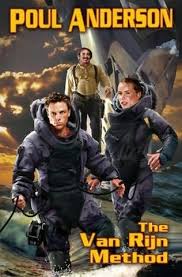
Poul Anderson's Time Patrol series describes real historical events and processes. Anderson's History of Technic Civilization and Isaac Asimov's Foundation Trilogy describe such processes recurring on an interstellar scale in the future. Since the Technic History is just one of eight or nine future histories by Anderson, we can summarize this post so far by stating that, whereas Asimov presents a future, Anderson presents the past and several futures.
The Mule disrupts Seldon's psychohistorical Plan but the Second Foundation restores it. Neldorians disrupt recorded history but the Time Patrol restores it. Later Foundation novels reveal that Seldon's Plan is subordinate to a robotic plan for humanity. A later Time Patrol novel reveals that time criminals, like the Neldorians and the Exaltationists, are a lesser threat than temporal chaos. The Technic History presents a less implausible interstellar empire and less incredible preparations for its inevitable Fall.
Either the Time Patrol or the Technic History would be a better candidate for "Best SF Series Of All Time" although the Foundation Trilogy won a Hugo Award in this category.
Anderson contributed:
one novel to Robert E Howard's Conan series;
one US Robots story to Asimov's future history;
two stories to Asimov's "Isaac's Universe" series;
one chapter to Murasaki;
one War World story story to Jerry Pournelle's CoDominium future history;
three Man-Kzin Wars stories to Larry Niven's Known Space future history;
one story to Harlan Ellison's Medea series;
one story to Fred Saberhagen's Berserker series;
the concept, the Introduction and one story in A World Named Cleopatra.
We must soon return to the Man-Kzin Wars.
Showing posts with label The Time Patrol. Show all posts
Sunday, 3 April 2016
Friday, 25 March 2016
Futures Reassess Pasts II
(Roman remains, Lancaster.)
See here.
If we are to understand a fictitious future, then we must understand its, very different, perspective on our present and past. A character in William Morris' News From Nowhere refers to "...those poor wretches of the twentieth century."
Poul Anderson's Time Patrol series has time travelers active throughout history whereas his The Boat Of A Million Years has a small group of immortals surviving through history into an indefinite future. Jerry Pournelle's and SM Stirling's "The Hall of the Mountain King" has "the Brotherhood" surviving through history into the period of the Man-Kzin Wars. We learn that Frederick Barbarossa and Lenin were members who rebelled and were crushed.
I would have appreciated a historical novel by Anderson featuring a character whom the reader recognizes as a time traveler or an immortal but only from having read other works. Historical novels assuming the active presence of the Brotherhood would certainly present a different perspective!
Thursday, 21 January 2016
Multiple Worlds
Multiple worlds exist in theory and in fiction but do they also exist in reality?
First, for philosophical precision, we need some more general term than "exists." In the literal sense, fictions do not exist. However, and for good reasons, the meanings of words are extended when they are used in diverse contexts. Thus, we say that Sherlock Holmes exists in several books and films although not in reality. Children need time to learn this distinction. Holmes stories are neither truths nor lies but something else.
When analyzing Poul Anderson's Time Patrol series, we can discuss the relationships between timelines without considering whether or in what sense other timelines exist. Thus, timelines alpha and beta are related as cause and effect even if inhabitants of beta deny the existence of alpha. The Temporal language is supposed to have appropriate tenses.
I read somewhere that there are two theories of many worlds:
that the universe splits every time a particle makes a quantum jump;
that macroscopic events diverge after every human choice and/or historical turning point.
One thing is certain. If multiple worlds do exist, then they will be very different from any fictional representations of them. Compare From The Earth To The Moon or The First Men In The Moon with Apollo 9. I think that travel between alternative histories is regarded as theoretically impossible? And, even if it were possible, it would certainly not be as easy as stepping through a silver screen in SM Stirling's Conquistador.
Are alternative histories entirely a matter of probabilities? How probable was it that the Germans would win World War II? I do not know the answer to the second question but let us consider that question while asking another: in a world where the Germans did win World War II, how probable is that you or I would appear from nowhere complete with our memories of having grown up in a world where the Germans lost that war?
I would think that our appearance in that timeline, although logically possible, has the lowest possible probability level.
Saturday, 12 September 2015
Poul Anderson's Two Main Series
Poul Anderson's Time Patrol series, complete in one omnibus collection and one long novel, begins when Manson Everard is recruited into the Time Patrol in New York, 1955, and ends when Unattached Agent Everard, having just begun a relationship with Patrol Specialist Wanda Tamberly in San Francisco, 1990, has also just completed a mission to Paris, 1307. However, Wanda trained at the Patrol Academy in 31, 275, 389 BC. Further, a million years after the twentieth century, humanity will have evolved into the Danellians who will found the Time Patrol when time travel is discovered in 19352 AD. In the early twenty fourth century, an Unattached agent will live on Venus and a Patrol physician will work on the Moon. Time criminals are sent to an exile planet. Thus, the series presents a vast panorama of space and time although mainly of time.
Anderson's History of Technic Civilization, complete in seven omnibus collections, begins with the exploration of the Saturnian system about 2055 AD and ends with the exploration of the Cloud Universe star cluster in 7100, when mankind has spread through three spiral arms. An earlier star-faring race became extinct in the galactic past, leaving a legacy of ruins with inscriptions and of small organisms that are telepathic parasites. Thus, the History presents a vast panorama of space and time but mainly of space.
Sunday, 26 July 2015
Anachronisms
Time Patrollers meet. First, Unattached agent Everard visits Unattached agent Shalten:
"Entering, Everard found the interior cool, dim, anachronistic."
-Poul Anderson, The Shield Of Time (New York, 1991), p. 66.
Later, Everard meets Specialist Wanda Tamberly:
"They met downtown next morning, in the anachronistic opulence of the St. Francis Hotel lobby." (p. 430)
It seems appropriate that time travelers should meet in anachronistic surroundings. I heard that one idea for Doctor Who was to identify him with the Victorian period and to furnish the TARDIS accordingly.
Shalten appreciates knowledge of social change:
"'...my preferred pied-a-terre is Paris of the Belle Epoque. Refinement that will turn into revulsion, innovation that will turn into insanity, and thus, for the foreknowledgeable observer, piquancy becoming poignancy.'" (p. 66)
Far from regretting the loss of innocence, Shalten relishes it. When Everard visits Shalten's Belle Epoque in 1902, he:
"...tried not to remember that in a dozen years this world would crash to ruin." (p. 119)
Time Patrolmen cannot avoid their knowledge of what is to come. When Carl Farness visits Berlin in 1858:
"Occasionally, a uniformed Prussian officer strode by, but his shoulders did not obviously carry the future."
-Poul Anderson, Time Patrol (New York, 2006), p. 400.
Not obviously, but a Time Patrolman knows...
Wednesday, 22 July 2015
This World And Two Nearer Ones
Imaginary worlds are inside us so they are nearer to us than the external world.
Although I recently compared SM Stirling's Angrezi Raj to Poul Anderson's Terran Empire, the two imaginary worlds of this post are the timelines of the Angrezi Raj and of Anderson's Time Patrol.
The Patrol prevents divergent timelines whereas Stirling's seeress, Yasmini, tries to prevent an end-of-life-on-Earth timeline;
in the Patrol timeline, John Watson recounts the real adventures of Sherlock Holmes whereas, in the Angrezi Raj timeline, Conan Doyle recounts the fictional adventures of a detective in an alternative timeline...
Common to these timelines and ours is Bradshaw's Guide.
"Mainwethering consulted his Bradshaw. 'You can get the 8:23 out of Charing Cross tomorrow morning,' he said."
-Poul Anderson, Time Patrol (New York, 2006), p. 23.
""The Lancer officer dug into one of the bundles, pulling out a copy of Bradshaw's Indian
Imperial Railways, by Newmans of Calcutta, and lost himself in thought."
SM Stirling, The Peshawar Lancers (New York,2003), p. 343.
I posted about Bradshaw before. The subject of Bradshaw has come up again because, on Sheila's birthday yesterday, her presents included the dvd's of Michael Portillo's third, fourth and fifth TV series based on Bradshaw. Thus, Bradshaw ties together our three timelines.
Friday, 3 July 2015
Flashbacks
The main action of SM Stirling's Conquistador (New York, 2004), Chapters One to Twenty Three and Epilogue, is set in the viewpoint character Tom Christiansen's "present," from June to December, 2009. The Prologue and Interludes are flashbacks to:
April, 1946
May, 1946
1950
1971
1962
1968
2001
1954
1997
1996
2003
2007
The Interlude following Chapter Eleven is the last as I have discovered by flicking ahead. I noticed that the second last Interlude, following Chapter Ten, is set in the author's present, the year of copyright of the novel. Thus, 1946-2003 is past, i.e., events on FirstSide are the same as in our history apart from the existence of the Rolfe family and of other fictitious characters, whereas 2003-2009 is future, i.e., events on Firstside may differ from those in our history although it is possible that Stirling avoids reference to such events in order to preclude any emergent discrepancies. In 2003, the Russians in New Virginia hope to learn how to create their own Gate or Gates, thus ending the Commonwealth monopoly.
Poul Anderson's Manson Everard, recruited by the Time Patrol in 1954, still lives in New York in 1990 and presumably knew of, e.g., Gorbachev as early as '54 although, of course, Anderson does not refer to that Russian Premier until The Shield Of Time, published in 1990.
Wednesday, 1 July 2015
Soap Bubbles II
See Soap Bubbles.
Although I argue that a time traveler who prevents his own birth does not cease to exist, time travelers would nevertheless need to proceed with extreme caution. How can they know which kind of scenario they are in? -
(i) you cannot prevent your birth because your timeline is single and continuous;
(ii) you can prevent your birth because your timeline is single but discontinuous;
(iii) you can prevent your birth because timelines are multiple and divergent.
If a group of people found themselves in what seemed to be their own California long ago and if they wanted to return to their remembered version of the twentieth/twenty first century, then they would have to be very careful not to change the course of events in any way. Rolfe tests whether the Gate has taken him to the past:
"'The first time I came through, I carved numbers on rocks in places I could locate on both sides - boulders, cliff faces - carved them deep enough to last for thousands of years. There's no trace of them back on our side of the Gate, where we know it's 1946. I'm still going to get some astronomers to look at pictures of the night sky - the stars change with time, you know - but I'm pretty certain this is the same time as back in California, the spring of 1946.'" (pp. 26-27)
So he is in the present of an alternative timeline, not in the past of his original timeline although, even here, he was taking a risk. He might have been changing the past/initiating a divergent timeline by carving on those rocks.
Poul Anderson's The Corridors Of Time and There Will Be Time are set in scenario (i). His Time Patrol series is ambiguous between (ii) and (iii).
Monday, 1 June 2015
"Death And The Knight"
Clark Kent grew up with Lana Lang and would later marry Lois Lane. Poul Anderson married Karen Kruse and later sold a Time Patrol/Knights Templar story to Katherine Kurtz. Real life is stranger than fiction. (I once knew of an interconnected Nichols, Nicholson and Nixon.)
"Death and the Knight" conveniently represents the Time Patrol series in the retrospective collection, Going For Infinity, not only because it is short but also because the paperback Tales Of The Knights Templar was less readily available by then. "Death and the Knight" has since been included in Time Patrol but should really be republished as a coda to The Shield Of Time.
Just as the Avalonian editor, Hloch's, introductory passages in The Earth Book Of Stormgate were incorporated into The Technic Civilization Saga, maybe Poul Anderson's interstitial passages in Going For Infinity could be reproduced before their respective stories in an eventual Complete Works of Poul Anderson? Obviously the many overlapping collections should not be republished as they stand.
Anderson writes of the next story in Going For Infinity (New York, 2002):
"If some of the thinking and feeling in it seems a bit strange, please remember that it's from the 1950's. That was another country." (p. 128)
"The past is another country" is a true and evocative saying, especially appropriate in time travel fiction as when Manson Everard visits World War II London in the first Time Patrol story. Everard lived through the War but now he is time traveling to it - a different experience.
Friday, 29 May 2015
Starfarers And The Time Patrol
In the Time Patrol series:
macroscopic time travel is possible - people can go;
past events can be changed;
a post-human Danellian confirms that the purpose of the Patrol is to prevent random changes, which would preclude life or consciousness.
In Starfarers:
subatomic time travel is possible - information can be sent;
past events cannot be changed;
a message from the future confirms that the interstellar drive stabilizes the universe.
Thus, in Starfarers, interstellar travelers fulfill a cosmic role similar to that of Time Patrollers. Among its many other qualities, Starfarers is a contribution to the theory of time travel.
Monday, 25 May 2015
From Wells To Anderson; From One To Many
HG Wells wrote one classic, definitive time travel novel merely hinting at the paradoxes whereas Poul Anderson presents multiple fictions:
in the Old Phoenix sequence, many timelines coexist;
in the Time Patrol series, one mutable timeline exists because time travelers can change past events;
in The Corridors Of Time and There Will Be Time, one immutable timeline exists because time travelers cannot change past events;
in Starfarers, one immutable timeline exists because physical time travel is impossible.
Vast, systematic and comprehensive. And don't forget Wells.
Sunday, 17 May 2015
The Roman Tradition
The Aeneid, with which I currently struggle, is the epic of the Roman myth. As such, it explains the wars between Rome and Carthage as originating in the personal conflict between Aeneas and Dido. (Not trade rivalry but mythical founders explain everything.)
Thus, the Aeneid is variously relevant to Poul Anderson's works:
the originals of Odin and Thor escaped from Roman slavery;
the Time Patrol ensured Roman victory against Carthage, kept Germania in the Empire despite the pagan prophetess preaching the destruction of Rome and prevented a post-Roman-British-European world civilization;
the last King of Ys was a Roman centurion;
Manuel Argos based his Terran Empire on the Roman Empire.
Thus, Anderson's antecedents are considerably older than Wells, Stapledon or Heinlein.
Have I said that I detect parallels between Classical and Biblical traditions?
Homer and the poets, like Moses and the prophets, were regarded as divinely inspired authorities on theology and morality;
Greek "philo-sophia" is love of wisdom and the Hebrew Writings include Wisdom literature;
Virgil's poetry of the Augustan Age is like a pagan New Testament;
the Fourth Gospel identifies Jesus with the Word that was in the Beginning, an idea adapted from Greek philosophy, while Virgil's Aeneid has Caesar's soul in Hades waiting to be born long before the founding of Rome;
the promise to Abraham and the promise of everlasting Roman greatness are fulfilled in a single church - if you see it that way, of course! (And Anderson appropriately speculates on the future of that church.)
Monday, 20 April 2015
History In Parallel Works
"The marriage brought [Lugo] certain useful connections, her father being a curial, though no dowry worth mentioning, the curial class being crushed between taxes and civic duties."
-Poul Anderson, The Boat Of A Million Years (London, 1991), p. 5.
I thought that Anderson had described the plight of the curials before, or indeed that both of the Andersons had alluded to this issue in their King of Ys tetralogy, so I googled "Poul Anderson curials" and was referred to this blog. See here. Thus, both Gratillonius' father and Lugo's grandfather were impoverished curials. Lugo/Hanno was born in Tyre when Hiram was king there. Manson Everard of the Time Patrol visited Tyre in that period and even met Hiram.
These are three works of two kinds:
Ys is historical fiction with the fantasy elements of gods and magic;
Boat... is historical science fiction with the sf elements of immortality and a high tech future;
the Time Patrol is historical science fiction with the sf element of time travel from the future.
Ys, published as a tetralogy of novels, is a single long narrative;
Boat..., published as a single long novel, could have been serialized or its concluding futuristic section (145 pages) published as a sequel to the historical and contemporary sections;
the Time Patrol is a series.
Thursday, 9 April 2015
Before The Beginning
This blog began with a post dated 28 March 2012. Thus, the blog is now just over three years old. That first post, about the Time Patrol, acquired addenda linked to six later articles. Although all of these articles have been copied to the blog, the links from the post are to the articles as they appeared on the pre-blog website.
Since then, there have been many more blog posts about the Time Patrol as can be seen by searching the blog. The present blogger may have exhausted his ability to comment on the Time Patrol series for the time being. However, an interesting observation by Anderson himself on the limitations of the first volume of the series was referenced in a more recent post.
Since I never quite finish rereading the Time Patrol series, there may be more to post about it in the future.
Wednesday, 1 April 2015
Non-Interference
SM Stirling, The Sky People (New York, 2006).
Good morning. A new month and a new post.
"...Non-interference as far as humanly possible was official doctrine..." (p. 208)
Sounds familiar - Prime Directive, Starfleet, Time Patrol, Okies. It is as if this principle has proliferated between universes. However, Poul Anderson also presents the opposite perspective. His Allied Planets set out to re-civilize human populations that had been isolated during the Long Night and, in at least three different Anderson stories that have been discussed on this blog, aliens among us secretly manipulate Terrestrial civilization for good or ill.
Which stories? This time, instead of listing titles or giving links, I invite page viewer participation in remembering three - or maybe more? - stories that fit this description. Meanwhile, SM Stirling's "Lords of Creation" series - a designation bestowed on the mysterious planet designers by the viewpoint character, Marc - continues to be an enjoyable read. I have yet to finish reading the first of the three installments.
Monday, 9 March 2015
Bradshaw
Bradshaw's Guide is consulted by:
Sherlock Holmes;
Mainwethering of Poul Anderson's Time Patrol London office;
a character in a ghost story by Rudyard Kipling;
Athelstane King in SM Stirling's The Peshawar Lancers (New York, 2003), p. 343;
Michael Portillo, former Conservative Member of the British Parliament (see image).
King has Bradshaw's Indian Imperial Railways by Newman's of Calcutta. Bradshaw himself died in 1853, well before the Fall.
Portillo, in a BBC TV series, traveled around Britain, and later Europe, guided by Bradshaw. His brief was to find out how much of Bradshaw's world still survived and how much had changed. For example:
the railway takes Portillo to the building that was the first factory (and here) in the world;
Bradshaw describes the Crystal Palace which burned down in 1936;
Birmingham will soon have a majority non-white population, unlike in Bradshaw's time! - there is a Central Mosque and many Indian restaurants and one restaurant owner intends to found a college to teach authentic Indian cooking.
It would have been remiss of either Anderson or Stirling not to mention Bradshaw but, of course, they both do.
Saturday, 21 February 2015
The Time Patrol
The first post was about the Time Patrol series. Since then, there has been discussion of:
"Time Patrol"
"Brave To Be A King"
"Gibraltar Falls"
"The Only Game In Town"
"Delenda Est"
"The Sorrow Of Odin The Goth"
"Ivory, And Apes, And Peacocks" (and here)
The Shield Of Time
"Death And The Knight"
"Star Of The Sea"
"The Year Of The Ransom"
Veleda
the Danellians
Everard's apartment
the Exaltationists
the Neldorians
Wanda Tamberly
temporal paradoxes
- and other aspects of the series.
Thursday, 5 February 2015
Continuing Comparisons
Having just compared Robert Heinlein's and Poul Anderson's future histories and multiverses, let's look again at their time travel. Whereas Heinlein presents three ingenious statements of the circular causality paradox in futuristic sf settings, Anderson presents many more statements of the two time travel paradoxes, circular causality and causality violation, not only in futuristic but also in historical settings.
Anderson's The Corridors Of Time, There Will Be Time and The Dancer From Atlantis all contain that historical dimension that is absent from Heinlein's The Door Into Summer, "By His Bootstraps" and " -All You Zombies." (The Door Into Summer hints that Leonardo da Vinci was Leonard Vincent, Time Traveler, but does not dramatize this.) Anderson's Time Patrol series not only ranges throughout history but also presents a unique and subtle perspective on causality violation whereas Heinlein's works do not address that paradox.
Thus, Heinlein and Anderson resemble Newton and Einstein: the latter incorporates the former in a wider context.
Thursday, 29 January 2015
Genesis: A Few Details
(i) In "Genesis And The Time Patrol" (see here), I suggested:
three successive emulations;
in the first emulation, only one time traveler disappearing and not (re)appearing;
in the second emulation, two Time Patrolmen returning from the distant past only to discover that history had been changed.
But, of course, the two Time Patrolmen would have had to have disappeared from the first emulation as well. Since they arrived in the altered timeline/second emulation, they cannot also have arrived in the unaltered timeline/first emulation.
(ii) "In Gaia's and Alpha's kind laired no ancient beast, Christian thought. The human elements in them were long since absorbed, tamed, transfigured." (Genesis, p. 194)
In general, the nodes' only motivation is to cooperate in learning, which includes improving their own abilities to learn. Thus, there should be no conflicts between them. However, Gaia's protectiveness towards her newly created humanity motivates her to attempt the murder of Brannock. To terminate the existence of "...a reasonable being..." (English law) is to commit murder.
(iii) The emulations can be extremely pleasant environments. Christian and Laurinda have three full days of:
sunlight;
sparkling fields and hedges after occasional showers;
riding along English lanes;
rambling through English towns;
meeting local people;
evensong in a Norman church.
Surely the creator of the emulation would be able to program unconscious processes to play the servile roles, thus avoiding the moral problem of recreating past suffering?
(iv) It is possible to revisit a single passage of Genesis and find more in it. Quotations about "'...the traditional God...," "'...a specialized African ape...'" and "...no ancient beast..." (see above) are all taken from the single conversation on pp. 193-194.
Wednesday, 28 January 2015
Genesis And The Time Patrol
Time Patrol Academy instructor: As for the Babylonians, time travel just wasn't in their world-picture. We had to give them a battle-of-the-gods routine.
Whitcomb: What routine are you giving us?
Instructor, regarding Whitcomb narrowly: The truth....As much of it as you can take.
- dramatized from Poul Anderson, Time Patrol (New York, 2001), p. 14.
Another routine might make more sense of the characters' experiences:
An AI emulates the Time Patrol universe from "'...the Beginning..." (p. 83) to the Danellian Era and beyond;
(can an AI emulate even the post-cosmic phase if there is one?);
all four space-time dimensions of the emulated universe coexist within the AI;
thus, although an emulated organism, e.g., Everard, experiences duration from birth to death, if an external observer were able to look into the AI, then he would see every moment of Everard's life, as of the entire universe, existing simultaneously;
thus, the observer would see Everard as a static world-line enduring along the same temporal axis as the AI and as the observer himself;
the temporal dimensions of the emulated and external universes can be regarded as at right angles to each other;
at many space-time points within the emulation, a "time traveler," in a time shuttle or on a timecycle, disappears;
all but one of the disappeared time travelers appear at another set of spatio-temporal coordinates, either earlier or later;
after some time has elapsed in the AI's temporal dimension, the AI deletes that emulation and replaces it with another;
the second emulation is identical with the first except for two differences;
first, the single disappeared time traveler who did not (re)appear in the first emulation does (re)appear at an earlier time in the second emulation;
secondly, having (re)appeared, that time traveler changes the course of events in some way, e.g., helps Hannibal to sack Rome and to win the Second Punic War;
from that point onwards, of course, there is a changed history within the emulation;
that changed history can include a couple of Time Patrolmen arriving from the far past, seeing that history has been changed and disappearing on their time cycles with the intention of rectifying the alteration;
after another while in the AI's temporal dimension, the AI deletes the second emulation and creates a third emulation in which the two Time Patrolmen appear early enough to prevent the time criminal from helping Hannibal, thus restoring the original history.
I have simplified the plot of "Delenda Est" for the sake of this example but I hope to have shown that apparent time travel could be an emulation and that apparent causality violation could be a succession of emulations. And this would make more sense of the Time Patrollers' idea that timelines can be "deleted."
Addendum, moments later: I have just thought of a slight complicating factor even for this simplified scenario but will post more later although, since this is the 130rd post for January, I am as ever inclined to conclude the month with a round number.
Subscribe to:
Posts (Atom)