Showing posts sorted by relevance for query the Olga. Sort by date Show all posts

Saturday, 5 July 2014

Wings Of Victory II

The Grand Survey spaceship Olga was on a three or more year mission to seek out strange new worlds and new civilizations, to boldly go where no Terran had gone before. One of the Olga's discoveries was an uninhabited, potentially colonizable, terrestroid planet. Later, the explorers of this planet provisionally named it Gray after the captain of the Olga. Later again, its colonizers called it Avalon but its largest city came to be called Gray. Thus, the casual reader encounters a Captain Gray in the second story of Baen Books' Technic Civilization Saga Volume I and, seven centuries later, a city of Gray in the concluding novel of Volume III but might not notice the historical continuity represented by these names.

The Olga always sends a minimal team of three for first contact with a new race. On the inhabited terrestroid planet of Ythri, Gray sends:

Vaughn Webner, xenologist;
Aram Turekian, pilot;
Yukiko Sachansky, gunner.

Gray thinks that women make better gunners because they are better at watching and waiting. There will be conflict between Webner and Turekian and a relationship between Turekian and Sachansky. The narrative is quite complicated. The first person narrator is on the Olga but not on the contact team. She mentions, then quotes, Manuel Gonsalves, another crew member. Her name and profession, Maeve Downey, planetologist, are revealed not in the text of this story but in the Ythrian Hloch's introduction to the following story in The Earth Book Of Stormgate.

Monday, 4 January 2021

Hloch's Passages

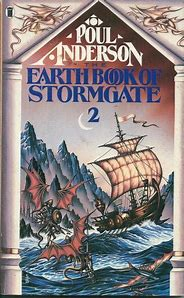
In Poul Anderson's The Earth Book Of Stormgate, Hloch's opening, closing and eleven interstitial passages are printed with neither numbers nor headings. The opening passage introduces the entire book, not specifically the first story, "Wings of Victory." The closing passage is an afterword to the entire volume, not specifically to the twelfth and last story, "Rescue on Avalon."

Although the two-page passage between "Wings of Victory" and "The Problem of Pain" does briefly introduce the second story, most of its text summarizes the intervening history:

the planetologist, Maeve Downey, published her autobiography, Far Adeventure, from which Hloch has extracted "Wings of Victory";

other members of the Olga expedition submitted scientific reports;

the Discovery gale-seized many Ythrians;

Terrans returned to Ythri for study, then trade;

Ythrians adopted modern technology;

to prevent international conflicts from destroying their planet, Terrans eventually established the Solar Commonwealth;

(the off-stage establishment of the Solar Commonwealth in the Technic History corresponds to the on-stage establishment of the UN world government, then the Solar Union, in the Psychotechnic History);

the Commonwealth was temporarily benign;

human beings explored their part of the galaxy and colonized habitable but uninhabited extra-solar planets;

Ythrians began interstellar travel, at first usually with Terrans;

the Olga had discovered Avalon which, too distant to be colonized in the early period, was eventually explored by Ythrians and human beings;

that exploration generated the second story in the Earth Book.

Today, the first working day of 2021, has been busy even for two retirees living under pandemic restrictions. Tomorrow, the blog should consider how Hloch's passages are presented in The Technic Civilization Saga and whether "The Problem of Pain" could be validly adapted as a Star Trek episode. (In fact, I am thinking more about that now.)

Wednesday, 7 March 2018

On The Edge Of One Spiral Arm

"As far as we know - but how much do we really know, in this one corner of this one galaxy which we have somewhat explored? - Avalon was the first planet whereon two different intelligent species founded a joint colony."
-Poul Anderson, "Wingless" IN Anderson, Rise Of The Terran Empire (Riverdale, NY, 2011), pp. 293-323 AT p. 295.

"'So many, many stars...a hundred billion in this one lonely dust-mote of a galaxy...and we on the edge, remote in a spiral arm where they thin toward emptiness...what do we know, what can we master?'"
-Poul Anderson, A Circus Of Hells IN Anderson, Young Flandry (Riverdale, NY, 2010), pp. 193-365 AT Chapter Three, p. 217.

"...what are we? What are four million stars, out on the fringe of one arm of the galaxy, among its hundred billion; and what is the one galaxy among so many?"
-Poul Anderson, "Outpost of Empire" IN Anderson, Captain Flandry: Defender Of The Terran Empire (Riverdale, NY, 2010), pp. 1-72 AT p. 7.

"Too big, too big. If a single planet overwhelms the intellect, what then of our entire microscopic chip of the galaxy, away off toward the edge of a spiral arm, which we imagine we have begun to be a little acquainted with?"
-Poul Anderson, The Day Of Their Return IN Captain Flandry..., pp. 74-238 AT 3, p. 89.

"There are so many, many worlds, in this tiny segment of space we have somewhat explored."
-Poul Anderson, A Stone In Heaven IN Anderson, Flandry's Legacy (Riverdale, NY, 2012), pp. 1-188 AT VI, p. 70.

"Space is that big, that full of worlds."
Poul Anderson, "Lodestar" IN Anderson, The Earth Book Of Stormgate (New York, 1979), pp. 368-408 AT p. 377.

How often does this thought, expressed in by now familiar words and phrases, recur in Poul Anderson's Technic History? I am sure that I have not quoted every example. Are there similar interstellar civilizations of oxygen- and hydrogen-breathers at the ends of other spiral arms and in other galaxies?

The Technic History also shows us earlier periods: interplanetary exploration in "The Saturn Game" and early interstellar exploration in "Wings of Victory":

"Our part in the Grand Survey had taken us out beyond the great suns Alpha and Beta Crucis. From Earth we would have been in the constellation Lupus. But Earth was 278 light-years remote, Sol itself long dwindled to invisibility, and stars drew strange pictures across the dark."
-Poul Anderson, "Wings of Victory" IN The Earth Book..., pp. 1-22 AT p. 3.

This opening paragraph is full of significance for the later History:

the rogue planet Satan will swing around Beta Crucis;

the Terran Empire will establish a Sector Alpha Crucis;

Christopher Holm/Arinnian of Stormgate Choth will remark that, from Terra, Quetlan and Laura are in Lupus, whereas, from Avalon, Sol, 205 light-years away, is in the Maukh.

The Grand Survey ship, the Olga, is about to discover Quetlan and its inhabited planet, Ythri, and, later, Avalon in the Lauran System will belong to the Domain of Ythri.

The Technic History also shows us a later period:

"They still named [Earth] Home, but she lay in the spiral arm behind this one, and Laure had never seen her. He had never met anyone who had. None of his ancestors had, for longer than their family chronicles ran. Home was a half-remembered myth; reality was here, these stars on the fringes of this civilization."
-Poul Anderson, "Starfog" IN Flandry's Legacy, pp. 709-794 AT p. 713.

But there is still a "fringe" to the explored and civilized part of the universe.

I used to think that Anderson overdid his "What do we know at the edge of this one spiral arm that we have begun to explore?" motif. It was as if too many of his characters were thinking the same thing. However, imagine how the knowledge of the smallness of the explored part of the universe would permeate everyone's consciousness.

See also What We Know.

Wednesday, 24 January 2018

Characters And Their Contributions

In Poul Anderson's History of Technic Civilization, as in real history, many minor characters make major contributions:

Colin Scobie must have the courage to kill two fantasy characters;

Aram Turekian realizes how an intelligent species is able to fly on Ythri;

the planetologist of the Grand Survey spaceship, the Olga, writes an autobiography that contributes a chapter to The Earth Book Of Stormgate;

James Ching's notebooks preserved by his descendants also contribute to the Earth Book;

Emil Dalmady has a daughter who moves to Avalon with Falkayn and writes stories for the magazine Morgana, three becoming chapters in the Earth Book;

thus, an incident in the life of Falkayn's grandson is recorded;

Christopher Holm, a major character in one novel, The People Of The Wind, makes several additional contributions, three chapters of the Earth Book and translations from Planha to Anglic;

Captain Gray of the Olga has an enlightened attitude to women gunners;

when one of the planets discovered by the Olga is explored, the exploratory group unofficially calls it "Gray";

when the planet is jointly colonized by human beings and Ythrians and renamed "Avalon," its main city is called "Gray."

This post lists nine characters apart from the major figure Falkayn and summarizes a lot of details.

Friday, 28 June 2013

The Game Of Empire

Two correspondents have explained how the opening and closing sentences of Poul Anderson's The Game Of Empire (IN Flandry's Legacy, New York, 2012, pp. 189-453) pay homage to Rudyard Kipling. I imagine that the title does as well?

The novel begins:

"She sat on the tower of St Barbara..." (p. 195)

The opening paragraph establishes that this tower is not on Earth by telling us that the sun is called Patricius and that two moons are in the sky. The paragraph closes by telling us that the planet is called Imhotep, that its Mt Horn is twelve kilometers high and that "her people" have modified the climate since coming here.

In the second paragraph, "she" becomes "Diana" as she looks from the old quarter towards the city center where "...the Pyramid ...housed Imperial offices and machinery..." (ibid.) Of course, we already know that this novel is part of a series. Nevertheless, we can study the text to find out how soon it informs us of its relationship, if any, to other works by the same author. Thus, we might at this stage wonder whether these "Imperial offices" indeed represent the Terran Empire of Anderson's Technic Civilization series. At the end of the second paragraph, and of the first page of the text, we learn that the old quarter has:

"...a brawling, polyglot, multiracial population, much of it transient, drifting in and out on the tides of space." (ibid.)

Space has no tides but the metaphor is apposite. We expect interesting things from a varied and variable population.

The third paragraph not only informs us that Imhotep was colonized centuries previously but also refers both to the Troubles and to the Terran Empire, thus unequivocally confirming which fictitious timeline we are in. Also, we learn more about this particular planet, Imhotep, which has not appeared in the series before:

first, there was an exploration base, sometimes threatened by stampeding ice bull herds;
secondly, the planet was threatened by marauders during the Troubles;
thirdly, "...the hand of the Terran Empire reached this far..." (p. 196).

St Barbara's, originally part of the defensive works against ice bulls and marauders, has long since been obsolete, its guns scrapped, its chambers empty, its vine-covered yellow stone crumbling, its neighboring towers demolished and a market square surrounding it. It is "...in Olga's Landing...," which seems to be the name of the city (ibid.).

We do not yet know who Diana is or why she sits on St Barbara but a lot more information will be imparted before she speaks for the first time in our hearing in the middle of p. 199.

Sunday, 7 December 2025

What Happened After

We would like to know what happened to the characters after the story ended. (I mean stories in general, not just any particular story.)

And I remember that some old-style novels did conclude by summarizing subsequent biographies for one or two of the major characters. That constrains what can be written in a sequel. However, many novels are constructed as self-contained units neither requiring nor expecting a sequel.

A sequel published twenty years later can either reflect the passage of time in the real world by commencing its action exactly twenty years after that of the first book or, alternatively, can begin five minutes after that action because fictional time is not real time. 

Poul Anderson never describes the death of a major series character - except Harald Hardrada, The Last Viking, because Harald was a historical figure with a known time and place of death. 

It is useful to have a copy of The Earth Book Of Stormgate alongside The Technic Civilization Saga even though the entire contents of the Earth Book are reproduced in their chronological positions in Volumes I-III of the Saga.

Hloch, fictitiously editing the Earth Book, does satisfy some of our curiosity about what happened afterwards. First, he informs us that the curiously off-stage first person narrator of "Wings of Victory" was called Maeve Downey. She was a planetologist who later wrote an autobiography, Far Adventure, from which "Wings of Victory," about the discovery of Ythri, is extracted. Ythri was discovered after the first three years of the Grand Survey and:

"After five years the survivors would meet and compare experiences."
-Poul Anderson, "Wings of Victory" IN Anderson, The Earth Book Of Stormgate (New York, 1978), pp. 15-32 AT p. 16.

Five years: shades of Star Trek! An entire series could have been set during the Grand Survey. But we have only this one story. The Olga, which discovered Ythri, also discovered Avalon which was provisionally named Gray after the captain of the Olga.

And I think that that is all that we can glean about what happened after "Wings of Victory." It is marginally more than the story itself tells us.

Monday, 3 February 2014

A Trick With A Time Machine

Poul Anderson, "The Nest" IN Anderson, Past Times (New York, 1984), pp. 71-111.

I basically understand what Trebuen and his companions do with their time machine, the Rover, but nevertheless have some questions about it.

There are four people in the Rover:

Trebuen, the Cro-Magnon;
Don Miguel, the Spaniard;
Olga, the Martian colonist;
Inini, the Babylonian.

The first three agree on what they will do. Inini, recently rescued from slavery by Trebuen and Don Miguel, cannot yet understand time travel.

Having taken the Rover a thousand years into their future, they then return to within a second of their departure time and:

"We stepped out of the machine." (p. 109)

Does "We..." mean three or four?

As they leave the chamber, the Rover appears again beside itself and three figures get out. This time the number is stated. The Rover appears yet again several times and soon there is a crowd of people who have stepped out of it. This crowd, numbering at least three hundred, and armed, exits the chamber and the castle and joins the battle which Trebuen etc had left where liberated slaves are attacking their Norman oppressors.

The three hundred or so stick together firing at the Normans but they do this for only twenty minutes. At the end of twenty minutes, they would return to the chamber where they would re-enter the Rover, take it back into the future:

"...and return within one second and some feet of our last departure point." (p. 109)

Why go back into the future? Why not simply travel back to within one second and some feet of their last departure point? Or do they take time to rest in the future? (Anderson probably does mean this but I have only just reasoned it out while writing about it.) But doesn't he mean that they return within one second of their last arrival point? All three hundred are there simultaneously, not in threes (or fours) successively.

After twenty minutes of sustained fire from the three hundred, the enemy breaks and runs:

"...and the four of us were all there - victors." (p. 110)

So here we are told that all four were involved.

Trebuen comments:

"I hate to think about seventy-five of myself acting as targets at the same time..." (ibid.)

Seventy-five multiplied by four gives us three hundred. This confirms that all four were involved in the time traveling - except that, on at least one occasion, only three left the Rover.

If there were seventy-five coexisting Trebuens, then let us call them Trebuen-1 to Trebuen-75. If, e.g., Trebuen-20 were shot and killed, then Trebuens-21 to -75 would not exist. Therefore, the fact that there were seventy-five Trebuens at the beginning of the twenty minutes is sufficient proof that none of the Trebuens were going to be killed during the twenty minutes.

Trebuen refers to:

"...twenty minutes - or twenty-four hours, depending on how you look at it." (p. 109)

He means twenty minutes of objective time and twenty-four (?) hours of subjective time. If he experienced the same objective twenty minutes seventy-five times, then his subjective duration was twenty-five hours. But, even if it were only twenty-four, they would certainly need some rest periods in the future. However, time travel allows both these possibilities:

a time traveler co-existing with himself for, e.g., twenty minutes;
a time traveler sleeping for eight or more hours between living through a twenty minute period and again living through that same twenty minute period.

Monday, 1 July 2013

On The Highroad River I

A long boat journey down a river offers comfort, in the boat's saloon or a cabin, and adventure as the travelers encounter each new place along the river. Poul Anderson describes two such journeys, the first in The Day Of Their Return, the second in The Game Of Empire. The place names on the maps at the beginning of The Game Of Empire become invested with meaning as the characters travel to and through them.

The relevant map of one part of the surface of the planet Daedalus shows the capital Aurea as just upriver from Paz de la Frontera, which is the head of navigation on the Highroad River. Targovi arrives on Daedalus by landing his ship, Moonjumper, at the spaceport in Aurea. The original town, which had been small because "...colonization was far-flung, enclaves in wilderness..." (Poul Anderson, Flandry's Legacy, new York, 2012, p. 221) has been mostly demolished or engulfed by sector defense command, civil bureaucracy, private enterprises, towers and industrial plants linked by streets, elways and air-space with round the clock traffic.

Aurea is on a plateau above a steep slope retaining a small part of the old town. Descending from the plateau, Targovi walks along a lane down the side of a cliff with, on his left, time-worn walls and, on his right, beyond the railing, a view of:

ice fields beyond northern mountains;
the headwaters and the river valley;
native growth;
farms and plantations;
southern plains receding to invisibility.

Ju Shao, a Cynthian, runs an inn perched on the cliff.

Hospitable inns are a major feature of Anderson's fictional worlds. There is one between the universes and there are several in the city of Ys as well others scattered among many times and places. In the Patrician System, Hassan runs the Sign of the Golden Cockbeetle in the old quarter of Olga's Landing on the planet Imhotep and Ju Shao runs her place in old Aurea on Daedalus.

Friday, 28 June 2013

The Game Of Empire II

The fourth paragraph of Poul Anderson's The Game Of Empire (IN Flandry's Legacy, New York, 2012, pp. 189-453) informs us that Diana, still with no surname revealed, is homeless. She hides her few possessions in a ruined temple and sleeps there in a sleeping bag when she does not find a doss anywhere else.

She sits on the tower of St Barbara in the middle of the market square in the old quarter of Olga's Landing on the planet Imhotep:

"...to enjoy the ever-shifting scenes..." (p. 196);
to spy chances to earn credits by guiding newcomers - "Nonhumans were safe." (ibid.);
to run errands or find information for acquaintances who pay with money, meals, a doss etc.

The fifth paragraph, a colorful description of the life in the market square, refers to two intelligent species that we know from earlier in the Technic Civilization series. We learn that Imhotep is where the vaz-Siravo from Starkad were settled and that the Merseians have attacked recently.

The sixth paragraph begins:

"Folk were mainly human..." (p. 197)

- so some were not. Imagine living in such an environment. The human beings, most of whom have never seen Earth, differ in appearance according to the planets that they inhabit. Because of Imhotepan gravity, the locals are "...muscular and never fat." (p. 197) and, if their families have been on the planet for the generations since Olga's Landing was just a scientific base, are usually dark and aquiline.

That gets us to the end of the third page of the text. Unless we pause to savor these details, we miss many of them because we continue reading until the dialogue and action begin.

Sunday, 3 January 2021

Deducing Alien Psychology

"Wings of Victory."

How much can be deduced about alien psychology? The crew of the Grand Survey ship, Olga, observe a newly discovered terrestroid planet where the population is scattered and roads are mere dirt tracks but cultures vary "...from Stone Age through Iron." (p. 5) The metallurgic societies do not seem to have enough trade or communication to sustain their level of technology. The chief xenologist of the Olga deduces that the natives are carnivorous and that the primitive economies are hunting and gathering whereas the advanced economies cultivate large areas to provide fodder for meat animals. 

Grazing herds are either domesticated or hunted. When it is suggested that the natives are scattered because a large area is necessary to support each individual, the xenologist replies:

"'Then they must have a strong territoriality... Stand sharp by the guns.'" (p. 6)

On what is this conclusion based?

Knowledge of the behavior of Terrestrial organisms;

maybe abstract reason - a conscious organism that does not defend the territory that it needs for survival does not survive;

the Olga has already surveyed many other extra-solar planets.

Webner is right about territoriality but is missing something else.

Friday, 5 July 2013

The Map Of Daedalus

Because my thought processes are entirely abstract and non-visual, I have disregarded the maps at the beginning of Poul Anderson's The Game Of Empire on every previous reading whereas, in fact, heeding the maps greatly increases the pleasure of reading.

One map of Daedalus shows Aurea, Paz de la Frontera, Lulach and Ghundrung along the Highroad River. Diana travels from Aurea to Paz by cable car, then from there to Lulach by riverboat. Thus, we learn that Aurea is the capital city, Paz is a colony of retired military personnel from other colonies and Lulach is mainly an arboreal Cynthian town.

Next, if we have consulted the map first, we wonder what will be revealed about Ghundrung. When Diana tells Targovi that Axor and she intend to investigate reports of Ancient ruins in the jungle to the south of Ghundrung, Targovi responds by referring to Ghundrung as the Donarrian settlement. We know from previous installments of the Technic History that the Donarrians are intelligent quadrupeds active in the Terran Empire and we also know from a previous chapter of this novel that Diana saw a Donarrian in the market square of Olga's Landing on Imhotep, the other colonized planet in the Patrician System. However, we have only ever seen individual Donarrians, usually in combat, so what will a Donarrian community be like?

We do not find out because Targovi persuades Axor and Diana to accompany him immediately to the ocean island of Zacharia which also appears on the map. Thus, of five places indicated on the map, four are visited whereas one, Ghundrung, is not visited but is described very briefly. When I read through the novel without having consulted the map, the name "Ghundrung" meant nothing when it appeared just once in the text and I certainly did not remember afterwards that there was a Donarrian settlement on Daedalus.

Because the trio travel only from Paz to Lulach by river, then proceed to Zacharia by air, the adventurous potential offered by a long river journey on a strange planet is cut short but the theme of an adventurous river journey is developed more fully in the earlier novel, The Day Of Their Return.

Tuesday, 15 November 2016

In Gray

Regular readers might remember that "Gray" is the name of the main city on Avalon. The city is named after Captain Gray of the Olga, the Grand Survey ship which, during a flight of several years - like that of the Enterprise -, discovered many planets, including Ythri and an uninhabited globe that was provisionally named "Gray" before David Falkayn's granddaughter renamed it "Avalon" when Falkayn led the colonization.

When the Founder's descendant, Tabitha Falkayn, visits Philippe Rochefort in hospital, the color of her hair and skin tell Rochefort that she has been under "...a stronger sun than shone over Gray." (Rise Of The Terran Empire, p. 644)

Why is the comparison made with Gray? Because the hospital "...building had been hastily erected on the outskirts of Gray." (p. 646)

When Tabitha leaves the building, a double space between paragraphs marks the change of point of view from Rochefort to Tabitha. As ever, Poul Anderson makes the Avalonian setting seem real with many concrete details and with appeals to at least three of the senses:

"Where she stood, a hillside sloped downward, decked with smaragdine susin, starred with chasuble bush and Buddha's cup, to the strewn and begardened city, the huge curve of uprising shoreline, the glitter on Falkayn Bay. Small cottony clouds sauntered before the wind, which murmured and smelled of livewell.
"She inhaled that coolness. After Equatoria, it was intoxicating." (p. 647)

So she has been on Equatoria, where the Terrans were defeated. What better name for an equatorial continent? And imagine looking at scenery where a major feature bears your own surname. The mention of the wind is appropriate because Tabitha, as a member of a choth, is one of this novel's title characters, the "People of the Wind." In fact, she stops to don her gravbelt as she leaves the hospital. We have learned many details of Avalonian life and want to know more but unfortunately this novel is about to end.

Wednesday, 24 January 2024

Holm And Avalon

The People Of The Wind, Chapter II opens:

"Avalon rotates in 11 hours, 22 minutes, 12 seconds, on an axis tilted 21 degrees from the normal to the orbital plane. Gray, at about 43 degrees N., knows short nights always; in summer the darkness seems scarcely a blink." (p. 452)

The first sentence reads like the omniscient narrator imparting physical information directly to the reader. In the second sentence, the phrase, "...the darkness seems...," maybe reflects the collective experience of the Avalonians rather than just another fact about their environment. However, the third sentence, which completes the opening paragraph, reads:

"Daniel Holm wondered if that was a root of his weariness." (p. 452)

Thus, we learn that the entire paragraph, and indeed the entire ensuing chapter, are narrated from the point of view of Daniel Holm who had conversed with his son, Christopher, at the beginning of Chapter I. It is Holm that knows and reflects on Avalon's rotation period. The omniscient narrator, who is always present however marginally, has been pushed further into the background.

Holm goes on to reflect that his ancestors have lived on Avalon for centuries and indeed had:

"...arrived with Falkayn." (ibid.)

David Falkayn, whom we first saw as a Polesotechnic League apprentice, has become a historical figure. That is what happens in future histories. When James Blish's John Amalfi, preserved for centuries by antiagathics, revisits the planet, He, he learns to his embarrassment that the highest mountain on the planet has been named Mount Amalfi.

On Avalon, the city of Gray is on Falkayn Bay:

the Grand Survey ship, Olga, under Captain Gray discovered Avalon;
David Falkayn founded the colony on Avalon;
Falkayn's granddaughter named the planet.  

Sunday, 20 August 2023

The First Grand Survey

"Our part in the Grand Survey had taken us out beyond the great suns Alpha and Beta Crucis."
-Poul Anderson, "Wings of Victory" IN Anderson, The Van Rijn Method (Riverdale, NY, December 2009), pp. 75-102 AT p. 79.

Participants in the first Grand Survey do not know that it is the first such interstellar survey just as participants in the Great War did not know that it was the First World War. The Terran Empire will have a Sector Alpha Crucis. The rogue planet, Satan, will swing round Beta Crucis. Rereading the earlier Technic History instalments, we appreciate their later significance.

After three years, the Olga under Captain Gray, discovers Ythri. Poul Anderson's Technic History series might have included a Grand Survey collection that would have constituted a "higher and greater Star Trek." This is a description that the British publisher, Charles Monteith, applied to James Blish's Cities in Flight but the Grand Survey comes even closer to the Enterprise's five-year mission.

"A ship of the first Grand Survey noted [Valenderay's] existence."
-Poul Anderson, "Day of Burning" IN Anderson, David Falkayn: Star Trader (Riverdale, NY, March 2010), pp. 209-272 AT p. 211.

Valenderay is the supernova that threatens Merseia.

"When the Survey team arrived [on Merseia], the Wilwidh culture stood on the brink of a machine age."
-ibid., p. 232.

Merseia, dominated by old Wilwidh, will be the main opponent of the Terran Empire.

"They found [Paradox] during the first Grand Survey."
Poul Anderson, "A Little Knowledge" IN David Falkayn: Star Trader, pp. 599-630 AT p. 601.

Paradox is not major player but is a fascinating detail of the Technic History. Hloch, compiler of The Earth Book of Stormgate, compares "A Little Knowledge" to a dewdrop reflecting the glade wherein it lies.

Have I missed any Grand Survey references? 

Friday, 5 December 2025

Multiple Narratives

Of the eleven Technic History instalments, including one novel, that are collected in The Technic Civilization Saga, Volume I, The Van Rijn Method, Hloch of Stormgate Choth on Avalon introduces the seven instalments (including that one novel) that had previously been collected with five others in The Earth Book Of Stormgate.

"The Saturn Game" is a third person narrative about a team of characters exploring the outer Solar System but with no viewpoint character.

"Wings of Victory" is a first person narrative by a character who remains in the orbiting Olga instead of descending to the surface of the newly discovered planet, Ythri, so that most of the narration is in the third person with one member of the landing crew as the viewpoint character.

In the framing passages of "The Problem of Pain," an unnamed first person narrator describes his conversation with Peter Berg on the planet Lucifer. The main story is a third person account of Berg's experience on Avalon with him as viewpoint character. 

"Margin of Profit" introduces Nicholas van Rijn but with Rafael Torres as the main viewpoint character in a third person narrative although, additionally, there are two short passages when, unusually, van Rijn, who is and remains the central character, also becomes the viewpoint character.

"How To Be Ethnic In One Easy Lesson" introduces Adzel but with James Ching as both viewpoint character and first person narrator.

"Esau" is a third person narrative with Emil Dalmady as viewpoint character both in the framing passages where Dalmady confronts van Rijn on Earth and in the main story which recounts Dalmady's experience on the planet, Suleiman.

Those are just six of the eleven but they are also the six with the most complicated narrative structures.

Friday, 4 July 2014

The Exploration Of Gray IV

See previous posts.

Like some later Terran invaders of Avalon, Olga Berg is dying of hell shrub poisoning, although Pete and his Ythrian companions do not yet know the cause. Pete leaves the camp so that he can be alone when he screams at heaven:

"'Why did You do this to her, why did You do it?'"
-Poul Anderson, "The Problem of Pain" IN Anderson, The Earth Book Of Stormgate (New York, 1979), pp. 26-48 AT p. 44.

After kneeling for an hour, he is able to say, "Your will be done," (p. 45) and return. Like an Ythrian, he has fought with and honored God, although Pete would not see it like that.

"Israel" means "he struggled with God"?

"Did I request thee, Maker, from my clay
"to mould me man? Did I solicit thee
"From darkness to promote me? -"
(Adam in Paradise Lost, quoted by Frankenstein's Monster.)

"Lord who made me as I am,
"Would it upset some divine plan,
"If I were a wealthy man?"
(Fiddler On The Roof, from memory.)

I ask similar questions although I cannot address them to a personal Creator.

After the death of Arrach, the crippling of Enherrian and Olga's mortal illness, the climax of "The Problem of Pain" is reached when Pete returns to the camp. He had sedated Olga so that she would sleep peacefully till death. Instead, he finds her awake and in extreme pain and a second injection has little effect. He must hold her till she dies:

"...it was like seeing a light blown out." (p. 45)

Enherrian says it is well that she is fallen. Thinking that Pete had miscalculated, he gave her a stim shot. Enherrian honors both Pete and Olga too much to deny Olga her deathpride. Did Pete not want her "'...to give God a battle?'" (p. 46)

Thursday, 18 January 2024

Why The Universe Was Created

"The Problem of Pain."

These posts are written while reading or rereading. Thus, I missed a point. At the end of this story, Peter Berg explains that, according to the Ythrian New Faith, when a conscious being gives God the Hunter:

"'...a good chase, a good fight.
"'Then He wins honor....
"'That's why God created the universe.'" (pp. 133-134)

So God the Hunter is God the Creator. OK, this might be Berg reading his Biblical concept of creation onto the Ythrian ideas. Nevertheless, the word, "created," is used at this one point. 

Meanwhile, the planet Gray, not yet given its final name of Avalon, acquires some of its local terminologies. Olga Berg has christened "atlantis weed." The tree whose waving thin branch slices off Enherrian's left wing is later called the surgeon tree. The bush whose vapours poison and kill Olga has already been named the hell shrub.

Misunderstandings continue. Peter Berg wonders whether God would really blame the crippled Enherrian if he committed suicide whereas Whell is horrified at the suggestion that her husband might rob God of honour.

That atlantis weed is a good adaptation of plants to life not in but on the ocean. Why has something like it not evolved on Earth? Could intelligent beings colonize the floating islands, living on platforms and fishing while cultivating smaller plants that grow on the weeds?

Tuesday, 16 January 2024

Five Characters On Ythri

"Wings of Victory."

One of Nicholas van Rijn's trade pioneer crews comprises one Master Merchant of the Polesotechnic League, one xenologist and one planetographer, of different species. Before the Commonwealth/League period, a ship of the Grand Survey had a larger, human-only crew. The Olga has a Captain, a xenologist, a planetographer, pilots and gunners for landing craft and no doubt many others.

Planetographer Maeve Downey, named not in the text of the story but later by Hloch, recounts her conversation with Xenologist Vaughn Webner before the landing party of Webner, Pilot Aram Turekian and Gunner Yukiko Sachansky descends to the surface of Ythri. Webner wonders how the Ythrians maintain a civilization with only local dirt roads and water transport. He does not yet know that the Ythrians fly and initially resists this idea by arguing that, in terrestroid conditions, any organism capable of flight has to have too low a body weight for intelligence.

Another planet discovered by the Olga is provisionally named after Captain Gray. Later, when the planet has been renamed Avalon, "Gray" becomes the name of an Avalonian city. Thus, Captain Gray, although he is merely referred to in this story, has an indirect impact on later history. None of these five characters, Downey, Weber, Turekian, Sachansky or Gray, appears again. Strong continuing characters emerge not immediately but gradually. By the end of Volume I, we have seen Adzel once, David Falkayn twice and Nicholas van Rijn four times and Falkayn has entered van Rijn's employment but has not yet met either Adzel or van Rijn.

Captain Gray prefers women as gunners because he thinks that they are better watchers and waiters and less likely to open fire. During the Northern Irish Troubles, a woman emerged from a toy shop holding a toy gun which she pointed at a patrolling British soldier. He pointed his real gun at her. She fainted and was carried away. The soldier acted correctly. Apparently under attack, he pointed his gun but did not open fire and immediately saw that this was unnecessary.

Monday, 25 January 2021

Where's Olga?

A Stone In Heaven, II.

From his battlemented tower on an extinct volcano in the middle of the Hermetian continent, Greatland, Edwin Cairncross, Grand Duke of Hermes, sees:

Antares;
 
Mogul, sun of Babur, the Hermetian Protectorate;
 
Olga, the constellation that contains, invisibly of course, the extinct sun of Mirkheim;
 
 
not Sol, which is too far away.

How many Olgas are there in the Technic History?

The Grand Survey spaceship, Olga, discovers Ythri and Avalon;
the explorers of Avalon include Olga Berg;
Olga's Landing is a city on Imhotep;
Olga is a constellation on Hermes.

Sunday, 8 February 2015

New Settings

In Poul Anderson's The Game Of Empire, the city of Olga's Landing is so well realized that a new reader might be forgiven for thinking that it was an already established setting whereas, in this case, Anderson is exercising the sf writer's prerogative to create ex nihilo an entire inhabited planet in any new story, even when that story is the concluding installment of a series or sub-series.

Continuity in the Technic History is provided more by the characters and by the interstellar situation than by any particular planetary environment although these also may recur:

Diomedes, the setting of The Man Who Counts, reappears in A Knight Of Ghosts And Shadows;

Aeneas, introduced in The Rebel Worlds, becomes the setting of The Day Of Their Return;

Talwin, introduced in A Circus Of Hells, reappears in A Knight Of Ghosts And Shadows.

Further details on Imhotep include:

Olga's Landing, like the University of Nova Roma on Aeneas, began as a scientific base;

descendants of the original settlers are "...dark-skinned and aquiline-featured" (Flandry's Legacy, p. 197);

the landlord at the Sign of the Golden Cockbeetle is called Hassan;

outback miners, joygirls and Tigeries drink at tables but a Wodenite is so large that he must lie on the floor.

So far, this information covers only one city. However, other regions of Imhotep have been colonized by Tigeries and vaz-Siravo and there is another colonized planet in the same planetary system.