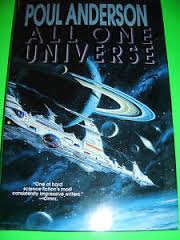
Monday, 19 August 2013
Requiem For A Universe
We gather that the narrator and viewpoint character of "Requiem For A Universe" is an African-American called John Henry. He is addressed as "Jack" (p. 37) and as "Sr. Henry." (p. 38) At first glance, I misread "Sr. Henry" as "Sir Henry," which, of course, would have been a British form of address and would have meant that "Henry" was his first name rather than his surname.
Jack, like characters in The Avatar and in a few other Anderson works, is a human-computer link, adding human creativity to electronic computation, although, in the terminology of this story, he is a "linker," not a "holothete." (p. 43) A linker can imagine the origin of a planetary system and apply the laws of physics to it whereas a holothete can change the laws creatively while running the program.
Jack, addressing the reader, says:
"The world outside our skins is real, but what we directly experience is our sensory impressions. From those we infer - we construct - sunlight, trees, lovers, everything. We do this on so deep, instinctive a level that we can properly say we experience these things themselves." (p. 43)
He goes on to say that atoms and galaxies must always be abstractions, not immediate realities, except to holothetes in linkage.
Jack contradicts himself, first denying that we directly experience the external world, then saying that we can properly say that we do experience it. My way of accounting for perception is to say that we do directly experience the real world outside our skins and do not merely infer it. Cerebrally processed sensory impressions are the means by which we perceive the world. I see you and infer, for example, the existence of your parents - but I do not see sensory impressions and infer you.
If we place an inanimate object and some increasingly sensitive and complex organisms near a hot fire, then, after a while:
the object and the organisms are hot;
organisms capable of sensation feel hot;
organisms capable of perception see and feel that the fire is hot;
some of the organisms capable of conceptualization understand heat.
Members of this fourth group infer a cause of the fire but they do not infer the fire. They see and feel it.
Sunday, 2 July 2017
"What Is Truth?" (Again)
-Poul Anderson, ""Requiem For A Universe" IN Anderson, All One Universe (New York, 1997), pp. 33-46 AT p. 35.
I have begun to reread this story because of its relevance to SM Stirling's Emberverse. See here. The second paragraph contains the above question which was also quoted by Anderson's Dominic Flandry. See here. In fact, the second linked post shows that we had discussed this question twice before, once in relation to "Requiem For A Universe"! I hope that these posts are worthy of perusal for a multi-faceted perspective on this issue.
Having been stopped by its second paragraph, I will continue to reread "Requiem For A Universe," which is almost a title story for All One Universe. There are at least three unpredictables:
what will happen next in the external world;
what thought or memory will enter the conscious mind from moment to moment;
what I will find to post about when reading or rereading a text.
Monday, 19 August 2013
Requiem For A Universe II
It makes sense in the light of the article, "Wellsprings of Dream," later in the same collection. Freeman Dyson, John Barrow and Frank Tipler reason that, either at or after the heat death of the universe, consciousness will be able to survive, thinking slowly because of reduced energy but remaining alert and accessing knowledge of the entire past, maybe even resurrecting everyone that has lived and died. There are two possibilities here and I do not fully understand either, particularly not the option that fits an infinity of experiences into a finite time.
But this is the point of the ending of "Requiem For A Universe." Someone who expected quiescence after the heat death had not allowed for the activity of conscious beings capable of finding a way to transcend the heat death. Anderson says, "I don't believe in it myself." (p. 247) But we don't know. If this can be imagined now, what might be achieved in the future?
Sunday, 2 July 2017
In The Emberverse
In Stirling's The Sword Of The Lady (New York, 2009), Chapter Twenty-One, the Triple Goddess shows Rudi Mackenzie three visions of cosmic history. In the first vision, the universe begins and ends in darkness. In the second, there is a light in the darkness after the end of the universe. The Goddess identifies that light as Mind, Wisdom, Hope and Love.
In the third vision, two sheets of Being move through a space vaster than universes. Contact between these sheets generates the light that was at the beginning of the universe in both previous visions. However, Mind also passes from one sheet to the other and thus moulds a universe from its beginning.
"'And now there is a God,' the Wise One said." (p. 649)
However, this contradicts the Christian belief that God did not originate within a universe but creates all universes:
"'There is one God, maker of Heaven and Earth...'" (p. 642)
Father Ignatius is instructed not by the Goddess but by a fellow Benedictine who tells him that Ignatius' companions, including Rudi:
"'...are being told as much Truth as they can bear, in the words that will mean most to them.'" (ibid.)
When the Goddess asks Rudi whether God is one or many, Rudi replies, as we expect in such a context, "'Both at once.'" (p. 650)
I have recently thought that the number of gods must be none or many, i.e., a single creator before the creation would be a self without other which is like a square without sides whereas a number of powerful though finite beings is at least logically possible.
I do not understand why disagreements within Mind should produce beings like those that control the Church Universal and Triumphant. (p. 650) And it seems that the good guys caused the Change, which is a surprise. (p. 652)
Addendum, 24 July 2017: Rereading this post, I find it contradictory. I state that:
in the first vision, the universe begins and ends in darkness;
in the second vision, there is light in the darkness after the end of the universe;
in the third vision, there is a light that was at the beginning of the universe in both previous visions!
I have currently misplaced my copy of The Sword Of The Lady but a replacement copy will arrive tomorrow. Then I will, with additional care, reread the passage that I tried to summarize in this post.
Wednesday, 24 May 2023
Revisiting "Requiem For A Universe"
For previous discussions, see here.
We recognize features of a particular kind of fictional future. There is a "'...Peace Command.'" (p. 36) This is an equivalent of the Space Patrol in Robert Heinlein's Adult and Juvenile Future Histories. There is also a "...World Union...," (p. 37) This is an equivalent of Heinlein's World Federation.
"The compound occupies a hill with a view over the medieval city, the river, green countryside, distant Alpine snowpeaks. Even stronger than seeing Earth from space, a scene like this brings to me the sense of home, that here is where we belong." (p. 38)
Tuesday, 20 August 2013
What Is Truth?
empirical;
logical;
poetic;
musical.
I can buy poetic truth because poems are composed of words but what is musical truth? My Aesthetics Tutor at Lancaster University informed me and fellow students that people listening to music sometimes remark, "How true!" - so apparently it is a philosophical question what they might mean by this. My response was, "Do people really say that? Well, if they just didn't say it, then we wouldn't have the question of what they might mean by it!"
I have sometimes wondered what it would be like to see a film of events that I had been involved in. The nearest I came to this was a trailer for a film about Margaret Thatcher that showed political events that I had lived through. Conversations, which we cannot remember in detail anyway, would have to be fictionalized. A television "docudrama" showed a British Prime Minister speaking one sentence that he was documented as having uttered whereas the author of a historical fiction would compose fictitious, although hopefully authentic, dialogue.
Shadowlands, a stage play about CS Lewis became a TV play, then a feature film, then a novelization of the film. In the film, the number of Joy's sons was reduced from two to one. Relatives of Lewis, having seen one of these dramatic presentations, commented that the conversations were made up, the actors did not resemble the real people and the order of events was changed and simplified but, despite all this, it was true. I can buy this although perhaps philosophically the word "authentic" is more appropriate.
Sunday, 2 July 2017
"The Living God!"
Rhys Davis, holothete, consciously runs a self-evolving computer simulation of the entire history of the universe. Because Davis becomes visibly distressed, a "linker," who is in circuit although not participating in the program, cancels the operation and Davis goes catatonic.
The explanation comes at the end of the story. However, Anderson plants a clue earlier. Davis is not overtly religious but was taken to church as a boy by his parents and says that he walks in awe. It seems that he became distressed while experiencing the heat death of the universe but also saw something that made him cry out, "'"The living God!"'" (p. 40)
In the darkness after the universe, a smiling and loving spirit, appearing as a flame, refers to us as "'...my forebears...'" (p. 46) So this "living God" is not our Father but - the Son of Man. I do not use this phrase lightly but I do know that this was not its original meaning. See here. A "son of man" is a man but "one like a son of man" is supernatural humanoid being whereas the "God" encountered by Davis is literally our descendant.
"Requiem For A Universe"
The narrator has spent a year helping with the construction of a Galactic Analyzer fifty astronomical units away from Earth;
he and his wife are holidaying in a primitive cottage on Kauai where they can be alone with sea, sand, flowers, sun and rainbows;
their phone, visual as well as auditory, can be set to respond only to important messages;
the narrator is a "linker" and his friend, David Rhys, is a "holothete";
both somehow interact with computers;
the narrator's wife is a school teacher;
most children are taught by computers although gifted children of well-off parents can instead have human teachers;
there is an Institute of Holothetes and also a Peace Command (the latter sounds familiar from other Anderson futures);
the Peace Command lends the Institute a sub-orbital rocket to take the narrator to France where his friend is catatonic.
A future full of information technology has been outlined and a human drama is about to begin.
See also here.
In The Omnicontinuum
Throughout the "omnicontinuum," indeterminacy generates an unlimited number of dissimilar universes;
some universe are cyclical whereas others expand indefinitely;
nothing can pass between them.
If the universes cannot interact, then does it make sense to say that they are parts of a single "omnicontinuum"?
Our universe began as a quantum fluctuation about twenty billion years ago;
energy concentrations called strings caused "'...the cellular distribution of galactic clusters...'" (p. 42);
this universe will expand indefinitely;
a unified field theory was formulated over a century before the action of the story;
the theory enables scientists to understand -
- matter;
energy;
space-time;
other dimensions.
Four items are listed here. The list does not identify matter with energy.
Sunday, 11 June 2023
Quanta And Gods
I might also reread The King of Ys by Poul and Karen Anderson although we have been all the way through that Tetralogy on this blog at least twice before. It is long and good and we are bound to find things to say about it that we do not remember having said before. The Tetralogy represents an earlier conceptual stage when people responded to ultimate realities by personifying them as the Three of Ys, the Olympians, Mithras and the new God born in the age of Augustus. The Nine Witch-Queens of Ys recognized that the heavens were changing.
Anderson's Time Patrol agents travel between eras:
Monday, 10 July 2017
What Is Possible?
(i) God creating universes.
(ii) An uncreated universe with a Mind evolving in and surviving the end of that universe, then influencing the evolution of subsequent universes.
(iii) The Mind of (ii) time travelling and thus becoming the "God" of (i)?
Two Problems
(iii) does not conform to theistic belief.
I still argue that the creator before the creation would be a self without an other which is like a square without sides, therefore that (i) is impossible.
Friday, 25 August 2017
Being And Seeming
Being becomes conscious of itself/appears to itself. Beings do not perceive appearances and infer reality - we perceive reality/it appears to us. But it is perceived differently by/appears differently to different perceivers.
We distinguish between being and seeming:
"Ruling is as much about seeming as being. If there's a difference..."
-SM Stirling, The Given Sacrifice (New York, 2014), Chapter Five, p. 99.
Maybe there is not always a difference but usually there is. A while back, British farms were threatened with Foot and Mouth Disease. Farmers had to avoid physical contact with their customers. While addressing our meditation group, a monk from a Buddhist monastery that bought dairy products from a local farm began to say, "We must not seem insensitive to their situation," but then corrected herself and said, "We must not be insensitive to their situation." An important difference.
Wednesday, 24 May 2023
Truth
The first person narrator informs us that we are forever haunted by the question: "What is truth?" (p. 35) Some of us are. This is a Biblical question that we have considered before in relation to Poul Anderson's works. See here. He lists different kinds of truth:
Saturday, 28 January 2023
Continuing Characters In Three Future History Series
Of the eleven instalments comprising the first half of the Psychotechnic History, Etienne Fourre appears in the first and second and is referenced as an authoritative historical figure in the eleventh. This is star treatment for a character in the Psychotechnic History and contrasts sharply with the extensive coverage given to Nicholas van Rijn, David Falkayn and Dominic Flandry in the Technic History. "The Acolytes" and "The Green Thumb," about a single colonial family on Nerthus, are almost a continuous narrative. Anderson introduced Trevelyan Micah in The Peregrine (1956), then reused this character, and his companion Braganza Diane, in "The Pirate," (1968), set earlier, simply because the character fitted this new narrative.
By minimizing the role of continuing characters in the Polesotechnic League, Anderson followed his model, Robert Heinlein's Future History. DD Harriman died in "Requiem" (1940), then reappeared as the title character of "The Man Who Sold The Moon" (150), set earlier. Andy Libby appeared in "Misfit" (1939) and Methuselah's Children. (1941) "Universe" (1941) acquired a sequel, "Common Sense," (1941) with the same set of characters. Chairman Dixon chairs a meeting in "Blow-ups Happen" (1940) and again in "The Man Who Sold The Moon." Harriman's associate, Strong, is at both meetings.
Rhysling, Dahlquist and Lazarus Long appear only once. Nehemiah Scudder, despite his importance, remains off-stage.