Thursday, 22 January 2015

Future Geography

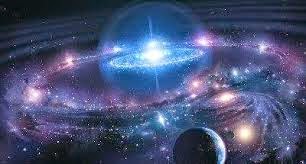
(This image illustrated Nyanza, the oceanic planet in the History of Technic Civilization, and now the Windroad Sea in Kalava's period on the future Earth.)

East from Ulonai
wild tribes
the Shining Fields

South
the desert of Zhir
unpeopled desolation
the uninhabitable Burning Lands

West
a few islands
empty ocean
maybe land too far away to reach

North
wild waters
driftwood of unknown trees
storm-borne flyers of unknown breed
legends of the High North
glimpses of mountains from ships blown off course
"...stories about uncanny sights..." (Genesis, p. 116)
"...old tales of monstrous things glimpsed from afar..." (p. 115);
wild huukini in open sea
but no craft or wreckage
less heat and more rain
mild climate, timber and plowable land with neither natives nor creeping desert?

Poul Anderson's Genesis, Part Two, is set so far in our future that it is meaningless to ask how this geography corresponds to ours. Without seeming to do so, Anderson deploys an increasingly detailed picture of Earth in Kalava's period. Equatorial heat isolates the Northern and Southern Hemispheres.

Needless to say, as a self-respecting and entrepreneurial character in a Poul Anderson novel, Kalava has every intention of leading an exploratory voyage to the North.   

Above And Below

In Poul Anderson's Genesis (New York, 2001), different chapters tell us how gods and men perceive global warming.

A powerful, undying intelligence in the sky learns that Terrestrial life will be extinct in about a hundred thousand years, wonders whether to intervene and sends its many-bodied manifestation to investigate.

Meanwhile, Kalava, a man, knows that the desert advances. Towns that flourished two generations ago are:

"...now empty, crumbling houses half buried in dust, glassless windows like the eye sockets in a skull." (p. 113)

Although civilization came to Ulonai from the empire of Zhir, that realm, desert for centuries, is now inhabited only by starving nomads and bandits. Kalava's third son:

"...fell while resisting robbers in sand-drifted streets under the time-gnawed colonnades of an abandoned city..." (p. 110)

- in Zhir.

The armies of the Ulonaian League sustained "...fearsome losses..." when they repelled:

"...barbarian invaders swarming north out of the desert..." (p. 109)

Two perspectives: Kalava lives it; the gods observe it.

Human Effort

In Genesis, Poul Anderson as always shows human beings coping to the best of their ability within the limits of current knowledge and resources.

In Christian Brannock's period, solar energy is beamed from Mercury and human-AI linkages have begun. Laurinda Ashcroft's generation has sufficient technology to counteract an Ice Age and an interstellar nebula. In Kalava's period:

the civilized nations must resist encroaching barbarians, then, unfortunately, must fight each other;

learning is respected, preserved and extended;

a moot settles a dispute;

Kalava is too quarrelsome to preserve his wealth but then plans a transoceanic expedition.

It is this human spirit that the Solar AI wants to restore despite all the problems that it creates. Poul Anderson not only speculates about the human and post-human future but also reflects on how it is worthwhile to live here and now.

Kalava's Period II

The image shows not a scene on Kalava's Earth but an emulation inside the Solar node, Gaia, during Kalava's period.

Sirsu is a city of Ulonai. At Broken Mountain, the Ulonain League defeated the barbarians attacking from the southern desert but, when the League dissolved, Sirsu and Irrulen fought each other. Kalava, having fought well at Broken Mountain, then fought Irrulen at sea and on land, capturing treasure and slaves. After the Peace of Tuopai, he became a trader and rich but lost much of his wealth in neighborhood and family quarrels. A clanmoot gave his estranged wife a third of the family wealth and the rest will be inherited by kin who hate him so he plans an exploratory expedition across the Windroad Sea.

He rides up the Spirit Way to Council Heights, sacred to all Ulonai, to request the advice of the skythinker, Ilyandi, one of the Vilkui:

dream interpreters;
scribes;
physicians;
mediators;
preservers of ancient lore and learning;
teachers.

After the annual Vilkui rites and conference on the Heights, Ilyandi stays to practice astronomy. Kalava, who trusts more to blood sacrifices and to his own strength, must recite a formula of Confession that is wiser than he is:

"'What a man knows is little, what he understands is less, therefore let him bow down to wisdom.'"  (Genesis, p. 112)

A Scientific Myth

See here.

The account of the preparations for "...the mission to Earth" is a "...myth..." (Genesis, p. 103) because:

the node and its manifestation have identities instantly recognizable to each other but do not need names;

they exchange information without requiring speech, discussion or explanation;

they have not as yet even separated into distinct individuals.

Therefore, the omniscient, or at least very well informed, narrator rather clumsily advises us to think of them as named entities in dialogue.

"...the galactic brain was in perpetual growth, which from a cosmic viewpoint had barely started." (p. 102)

We would like to read about its maturity but Poul Anderson was pushing the limits of what even he could imagine and even more "myth" would have become necessary.

"I have not discovered an America but I have discovered a Columbus."

Wednesday, 21 January 2015

Kalava's Period

Kalava's period is so far in our future that his Earth might as well be another planet:

plants include bloomgrain, paperleaf, richen and shipwood;

Kalava sails the River Lonna, the Gulf of Sirsu, the North Coast and the Windroad Sea as far as the Ending Islands and visits a port of the people of the Shining Fields;

in Sirsu, he knows the Grand Fountain in King's Newmarket, the Flame Temple, the column in Victory Square, the Helki suburb, docks, workshops, bazaars and inns;

his skin is coal-black, long hair bleached white, mustache dyed red and he is a big man who daunts warriors;

his chariot is pulled not by horses or similar beasts but by four huge, long-legged slaves bred for generations to be draft animals;

his ship is pulled across the sea by a great tailed and flippered blue sea animal called a huukin;

Ruvio the Thunderer is the favorite god of most mariners.

There is more but I am finished for today and hope not to dream about Kalava.

Observations On Culminations

Two observations emerge from recent posts. First, although Poul Anderson's long series, the History of Technic Civilization, and his single novel, Genesis, are entirely dissimilar works, each is equally a culmination of the American future history tradition initiated by Robert Heinlein - additionally, Genesis readdresses and updates the themes of the British future historian, Olaf Stapledon.

Secondly, Genesis presents an awesome array of future historical periods:

Christian Brannock as a boy in Alaska;
Brannock as a man on Mercury;
Laurinda Ashcroft;
Mikel Belov;
Brannock as an upload on an extrasolar planet;
Serda and Naia;
artificial intelligence in the Solar System;
the nodes of the galactic brain;
Alpha manifesting as Wayfarer incorporating Brannock;
Kalava;
Gaia incorporating Laurinda;
alternative histories as "emulations;"
speculations about remote cosmic and post-cosmic futures.

If Genesis had been constructed on the Heinlein model, then Brannock, Laurinda etc would each have appeared in one or more separately published short stories before the stories were then collected into several volumes. Anderson's compact writing fits an entire future history into a single volume. And each of the periods is fully realized even though, unlike much earlier sf by Heinlein, Anderson and others, they first appeared in a single novel, not in magazine serials or series.

Genesis, Part Two, Chapter II

Poul Anderson's Genesis, Part Two, Chapter II, is a total surprise. We could be in an alternative timeline. However, this is another occasion when I have previously posted about the same chapter.

"There was a man called Kavala..." (Genesis, p. 108) recalls the opening lines of Anderson's stories based on the sagas. We begin not with Kavala's point of view but with the words of a story teller. Kavala is or has been:

tribe member;
soldier;
fighter of barbarians;
mariner;
sea captain;
plunderer;
trader;
explorer;
rich man;
farmer;
outcast;
adventurer.

We recognize aspects of other characters. This is familiar Anderson territory as were the futuristic and galactic settings of the preceding chapters. The reader must be patient to find out how everything fits together.

Continuing From The Previous Post

We are told that the nascent galactic brain affects the course of the universe (Genesis, p. 103). . How? The whole universe? Are there similar developments in at least some other galaxies? If so, are they near enough to interact?

One node remembers Earth and transmits the memory. Some other nodes agree that Earth deserves attention and discuss it further. Over centuries and light years, the discussion becomes a decision that is sent to the node best able to implement it. The narrator reminds us of Terrestrial myths:

the sun as a fiery chariot;
the year as a god dying and reborn;
death as a punishment for sin -

- and then presents a myth of the mission to Earth:

the node's primary consciousness has a primary aspect, Alpha;
Alpha has synthesized a lesser manifestation of itself, Wayfarer, to release into separate existence and has incorporated the record of Christian Brannock into Wayfarer;
copies of Brannock have been spread across the galaxy;
Alpha is the apex of large structures, mainly comprising force fields, orbiting a dwarf star fifty parsecs from Sol;
stellar movements have brought it about that this is now "...the settlement nearest to Sol" (p.105);
the settlement was established in an earlier age to study curious life forms on one of the planets but Alpha now has other concerns, mainly its own self-evolution;
Sol will remain stable for billions of years but will boil life off Earth in a mere hundred thousand years;
human Earth is remembered while post-human Earth approaches the post-biological phase;
Gaia, the Solar node, has responded evasively to inquiries;
the Solar System was last visited two million years ago;
should the resources of nearby stars be used to save Earth as a first step towards remaking the universe so that awareness can survive stellar mortality?;
Wayfarer will visit Earth to find out;
a laser accelerates to near light speed a spaceship containing a matrix to run the Wayfarer programs, a database, sensors, effectors and several bodies.

Genesis, Part Two, Chapter I, section 1

Poul Anderson, Genesis (New York, 2001), Part Two, Chapter I, section 1 (pp. 101-108).

Millions of post-organic intelligences exploring the galaxy form an infant - or fetal? - galactic brain. We were told that the stars were also evolving. Are the intelligences directing this?

They have spread through the spiral arms, the halo, nearby clusters and the Magellanic Clouds and some seeds of intelligence have reached the edge of the Andromeda galaxy, two million light years away. (Part One, Chapter I, informed us that Christian Brannock as a boy had seen the Andromeda.) Light speed messages take years or decades to cross space but are received, understood, thought about, relayed and replied to in nanoseconds. Intelligences contemplate the universe, virtualities, abstract creations and their own self-evolution.

Each intelligence is a network of machines and "organisms." The latter contain little carbon and most of their processes are on the quantum level. However, they maintain themselves, reproduce and are conscious, sensuously, intellectually or transcendentally. Their numbers rise sharply as intelligences reach new vantage points and initiate new generations. Members of the brain remain individuals and therefore are not cells but nodes, each more unique than a protoplasmic organism. Chaos, quantum fluctuations and environments prevent any node from exactly imitating its initiator. Environments are planets, moons, asteroids, comets, nebulae and interstellar space. Each node decides which bodies and sensors to use and can also divide and reunite its mind. Some nodes specialize in mathematics, aesthetics or the observation or creation of organic life. Continuous inter-nodal communication generates a single united self that does not, however, absorb the nodes. This galactic self contemplates a single appropriately immense thought for millions of years and can consider either an eon or a day in equal detail. Thought has had time for only one or two thousand journeys across the ever-expanding diameter of the brain. Earth is almost forgotten.

I have summarized just two pages of text and must pause there.