Showing posts sorted by date for query merpeople. Sort by relevance Show all posts

Wednesday, 3 September 2025

On Bornholm

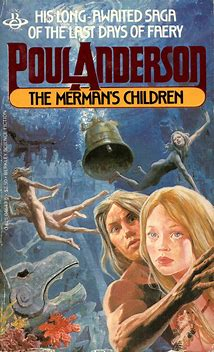
The Merman's Children, Book Four, IV.

A ship crosses the Baltic Sea from Copenhagen to Bornholm and docks at Sandvig near Hammer House.

Whitecaps are gray. The sky is pale and whistling. Pebbles rattle. Gulls fly and mew. Brown tangled kelp, strewn on the sand, bladders popping, smells of the deeps. Also: dunes, grass, moor, heather and a standing stone. (Three senses.)

The merman's children wade ashore, naked, Tauno's hair greenish-gold, Eyjan's bronze-red with a seaweed undertint.

Conversation commences but I have formed the habit of pausing on the descriptions. And what descriptions these are with the merfolk effectively personifying the elements and the deeps. In fact, in the prevailing mythology, merpeople are entirely of nature because they lack the human souls that would link them to the supernatural. But they have been in those deeps that the kelp evokes.

(Here, it is time for a pause for other reading.)

Friday, 29 August 2025

Off Greenland

The Merman's Children, Book Three, VII.

Merfolk brother and sister, Tauno and Eyjan, swim near Greenland. The cold choppy sea water rocks their bodies, caresses their muscles, warms their interiors and tastes not only of salt but also of:

"...life and deeps and distances." (p. 156)

Winds have smelled of distance. Now water tastes of it. This water also whooshes and gurgles around the two merpeople but roars on the shore. As for colours, the blue-black whitecaps shimmer green. Thus, the water generates inner and outer bodily sensations, multiple tastes, sounds and colours.

There are many other sensations. The wind is sharp. Gull wings and cries fill the silver-gray sky where wrack flies like smoke. Cliffs are darkling. Autumnal meadows are yellow. Peaks are snow-covered. Inland ice is bleak but bright. Merpeople live in and with nature.

Wednesday, 27 August 2025

Storm

The Merman's Children, Book Three, III

After a feast, there is a storm. Outside, rain dashes against the walls of Ivan Subitj's castle. The night is said to howl. That must mean wind. OK. Outside, there is wind, rain and darkness. It must be comfortable inside, though? However, there, coldness is said to creep out of the tapestried stone walls and the lamps are surrounded by darkness which is even said to besiege them. Ivan's wife, seated in a corner, tries to warm herself at a brazier. 

This is the appropriate setting for a sad story recounted by Ivan to Vanimen. A young woman who had drowned in the lake now haunts it. A narrative about merpeople can also include ghosts...

Sunday, 17 August 2025

Naive Mythology

The Merman's Children.

Since any fantasy assumes counterfactual premises, Poul Anderson bases this particular historical fantasy novel on:

"...the naive, half-pagan mythology of peasants and seafarers in the early fourteenth century..." (p. viii)

- which he sharply distinguishes from Thomist theology. Indeed. In this mythology:

pictures and images turn their faces to the wall when a merman enters a church;

some rational beings, e.g., merpeople, do not have souls - but can be given them!

This contradicts not only what I believe now but also what I was told to believe in school but it does not matter because the work is a fantasy. Soulless rational beings coexisting with souled rational beings is a fictional premise just as much as merpeople and revolving images.

This fantasy does not have to be set in a parallel universe because the idea is that, as in Neil Gaiman's The Sandman series, Faerie withdrew from Earth in historical times so it should be completely gone by the time the novel is written.

Friday, 23 September 2022

Aquatic Men


In Poul Anderson's The Merman's Children, merpeople exist because the novel is historical fantasy.

In Anderson's "The Horn of Time the Hunter," human colonists of an extra-solar planet have adapted to become sea dwellers.

In James Blish's The Seedling Stars, one group of Adapted Men lives in pools of water on an extra-solar planet.

In James Blish's and Norman L. Knight's A Torrent Of Faces, the Tritons are genetically engineered human amphibians on Earth.

Maybe that fourth group is the least implausible. They colonize Terrestrial oceans, not other planets.

Monday, 4 April 2022

Then, Now And Later

The Merman's Children, Book Three, I.

Father Tomislav knows of merpeople, Leshy, domovoi, poleviki and viljai. Is it feasible that such beings were known to exist back then yet are believed never to have existed now? Many medieval accounts that were thought to be fanciful must have been literally true.

If Faeries fades as Christianity advances, will Christianity fade as secularism advances? The Bible recounts what God did miraculously in the past whereas future histories recount what mankind will do technologically in the future. CS Lewis replies with his Ransom novels. A revived Merlin and descending angels will sabotage an attempted scientific reorganization of society. A likely story. Poul Anderson and James Blish show religious belief and doubt continuing to coexist in future.

(I am experiencing difficulty with retrieving images.)

Sunday, 23 December 2018

The Wersgorix And Souls

Poul Anderson, The High Crusade, CHAPTER IV.

Brother Parvus' problems:

if the Wersgorix have souls, then it is the Christians' duty to try to convert them;

if they do not have souls, then it is blasphemous to administer sacraments to them although provisional baptism can be given if requested;

an authoritative definition of doctrine is required;

when asked whether he has a soul, Brantithar replies only that scientists lack sufficient data to answer the question whether personality is a pattern that can be transferred to another matrix.

Such a pattern would not be a soul. Parvus acknowledges that the Wersgorix can reason. I was taught, although I no longer believe this, that the soul comprised precisely the combination of intellect/reason and will. If this were true, then it would follow that the Wersgorix have souls. However, in Anderson's The Merman's Children, medieval Catholics believe that merpeople can reason yet lack souls.

Monday, 6 August 2018

Vocabulary And Fantasy

Caitlin says:

"'... - lost memories rise before me like merrows from the sea - ...'"
-Poul Anderson, The Avatar, XLIV, p. 368.

What are we to make of such a statement? I have never encountered the word "merrow" anywhere else. My computer does not recognize it. It is not in my edition of Chambers Dictionary. On previous readings, I might not had a dictionary to hand or might not yet have learned that it was advisable to keep a dictionary nearby when reading Poul Anderson. I would have guessed a (completely wrong) meaning from the context, then would have instantly forgotten the word while continuing to follow the narrative. I have no memory of reading this word before although this is at least my third reading of the novel. Now I google it. See here.

The appearance of the Others as gods and Caitlin's reference to merpeople remind us of Anderson's fantasies and of Clarke's third law. Anderson's most comprehensive fantasy-sf interface is the Time Patrol story, "Star of the Sea," where successive sections are mythological writing, historical fiction and science fiction with a contemporary setting and the concluding section is a prayer.

Today begins a new working week except for those of us who are unemployed or retired. I will gym and swim, visit Ketlan for lunch, attend meditation group this evening and hopefully also blog more. I have yet to reread The Avatar, XLIX and L.

Tuesday, 5 June 2018

Echoes

A Poul Anderson fan can enjoy historical references when they occur elsewhere. This evening, on my car radio, I heard part of a drama in which a Norseman in the Varangian Guard had to swear allegiance to the White Christ although he knew that, when he drew his sword, it was Thor that was beside him. Right on, bro! I would prefer an Empire in which (as long as they wanted to) Norsemen kept Thor, Gratillonius kept Mithras, others followed the Buddha Dharma etc and, if the state insisted, all paid lip service to the official cult of the Jade Emperor, the Olympians or the White Christ etc. But I remember the merpeople fleeing from exorcism. See Filming It.

The Merman's Children has an Author's Note, in which the author addresses the readers, and both a Prologue and an Epilogue, which are parts of the narrative. See Foreword. Chamber's Dictionary identifies a prologue as an introduction.

Friday, 23 March 2018

Imaginative Multiverse

Dennitza may be the best realized of Poul Anderson's fictional planets with its geographical features like the Kazan and its capital city of Zorkagrad. See also here.

When Kossara and Trohdwyr hunt in the Kazan, Kossara reflects on Trohdwyr's ychani paganism in terms that reminded me of Father Tomislav's sermon at the end of Anderson's historical fantasy, The Merman's Children (see here).

Now imagine the Creator of a multiverse that encompasses merpeople in the fourteenth century on Earth as well as Kossara and Trohdwyr on Dennitza over a thousand years in the future. They are contained in Poul Anderson's imagination if not also in a material multidimensional multiverse.

Sunday, 8 October 2017

Some Shakespearen Reflections

(For the Latin and English verses under Shakespeare's funerary monument, see here.)

(i) "The Comedy of Errors" is a play by William Shakespeare; "A Tragedy of Errors" is a short story by Poul Anderson.

(ii) Anderson's Father Tomislav speculates here that everything created, including the soulless merpeople, might be resurrected to the glory of God. Merpeople are carved on seats in Holy Trinity Church where Shakespeare was baptized and buried.

(iii) I read an sf story about a future explorer of Earth who sickened and died after disturbing an ancient grave:

"Good friend for Jesus sake forbeare
"To dig the dust enclosed heare.
"Blese be ye man that spares these stones,
"And curst be he that moves my bones."
-see here.

Some previous posts resulting from holiday trips:

Ys And The Village
search result for Caernarfon

Sunday, 14 May 2017

Space, Time And Experience

We have discussed space travel and time travel and will now consider experience. We experience an empirically discerned spatiotemporal realm. The subject and objects of experience are both spatially differentiated and temporally enduring. If there were neither space nor time, then experience would shrink to an instantaneous point, i.e., would cease to exist. I think that experience is necessarily spatiotemporal and therefore that timeless consciousness is as impossible as a sideless square. Can there be transtemporal consciousness that would incorporate time just as three-dimensional space incorporates planes? I don't know.

If a fictional character has qualitatively different sensory experiences and/or thought processes, then how does the auther convey these qualitative differences to his readers? Poul Anderson describes the heightened sensations of werewolves, merpeople and Ythrians in flight. I was reminded of this by reading Elliot S. Maggin's accounts of Superman's ability to perceive the entire electromagnetic spectrum and of Lex Luthor's ability routinely to think his way out of any high security confinement.

Thursday, 9 March 2017

Westward

The few surviving merpeople are bound into the unknown:

"'Westward, maybe to Vinland or beyond. Whole vast realms of nature, Faerie, and man must be there, untouched by Christendom, open for our adventuring...we might become gods.'"
-Poul Anderson, The Merman's Children (London, 1981), p. 256.

Prince William asks Sir Nigel Loring, self-exiled from England, where he will go:

"Nigel shrugged, and looked westward, blinking a little as he saw the sun was already setting. It made a path of blood and fire across the water, stretching clouds like hot gold and molten copper along the horizon.
"'There, Your Highness. This part of the Lorings' story is over, and we've pulled up our roots. Somewhere there's new earth waiting for them.'"
-SM Stirling, The Protector's War (New York, 2006), Chapter Eight, p. 237.

Go west.

Friday, 22 July 2016

What Became Of Some Of The Merpeople

The former Liri King is now "...captain in the Royal Navy of Magyarorszag and Hrvatska..." (The Merman's Children, Book Four, Chapter VII, p. 230)

"On the feast of St. Matthew the Apostle..." (p. 239), his daughter is christened and becomes Dagmar.

Matthew is recognized as a saint in the Roman Catholic, Eastern Orthodox, Lutheran[30] and Anglican churches. (See St. Matthew's Church.) His feast day is celebrated on 21 September in the West and 16 November in the East. (For those churches which follow the traditional Julian Calendar, 16 November currently falls on 29 November of the modern Gregorian Calendar). He is also commemorated by the Orthodox, together with the other Apostles, on 30 June (13 July), the Synaxis of the Holy Apostles
-copied from here.

However, what is to be the fate of the former king's son, Tauno, who refuses Christianity?

Thursday, 21 July 2016

Incest II

"...boulders and sparse worts..." (The Merman's Children, Book Four, Chapter II, p. 200)

Poul Anderson sets the scene before recounting an incident between Tauno and Eyjan. I said here that the issue of incest arises at least three times in Anderson's fantasies. (See also here.) There is a fourth, in The Merman's Children.

Merpeople have no incest taboo. However, Tauno and Eyjan, brother and sister, are merfolk-human hybrids whose Christian mother did impress this taboo on them. However, alone together for a long stretch, they overcome the taboo and attempt sex. However, the taboo is stronger than them and they can't do it. Is there any right or wrong here? I have a strong distaste for the idea of brother-sister incest but that is not a moral judgment.

Tuesday, 19 July 2016

"The Freedom Of The Swan's Road"

"Vanimen and Meiiva walked down the wagon track that went through the forest. Snow had fallen of late, an inch or two that soon melted off bare dirt but abided in purity under the trees. Boughs and twigs reached austere across blueness. The air was quiet and nearly warm." (The Merman's Children, Book Three, Chapter V, p. 150)

Three senses: blueness; silence; warmth.

The two leading merpeople need a quiet walk and talk to discuss the future of their people:

Meiiva asks:

"'Do you really think that we should forsake Faerie?'...We had the freedom of the swan's road.'" (p. 151)

Vanimen replies in part:

"'Our people can do well enough. Their swimming skills are in demand...'" (ibid.)

Although this text is a fantasy, it expresses real historical social changes - from a way of life that was more spontaneous and closer to nature to an economy in which populations are integrated into urban civilization where they survive by selling their skills in the market place - and, I would add, where we can preserve "...the freedom of the swan's road..." in new ways. Shakespeare's plays addressed this transition: see here.

"'In one or two hundred years, the blood of Liri will be mingled unto evanishment, the memory of Liri be a myth that no sensible man believes." (ibid.)

However, people live by remembering old myths and creating new ones.

The Veil Of Subitj

The historical Pavle Subitj tells the fictional fantasy character, Vanimen the merman:

"'...I've worked harder than you imagine, to contain the news of you.'" (The Merman's Children, p. 147)

This is like the Veil Of Brennilis in Poul and Karen Anderson's The King Of Ys. By working hard to contain the news of a group of merpeople, Subitj "saves the appearances" of our history which has no record of such beings in Europe - except as legends.

Subitj continues:

"'Outside the Skradin vicinage, there go naught but rumors...Even when you join us, I'll strive that that happen quietly. No public tidings, no dispatches to King or Pope.'" (ibid.)

He does this because:

"'Did your story spread wide, excitement might easily take a dangerous turn.'" (ibid.)

And such excitement would more likely have been recorded. As it is, public, King and Pope will be kept in ignorance - and so are their descendants. In fact, Vanimen initially refuses this invitation for his people to be quietly and peacefully integrated into Western Christendom so what does happen to them? I must continue to reread but I do remember that some of the merpeople will remain free and wild and go West. Yet again, we would like another sequel.

Sunday, 17 July 2016

Sects And Sprites

Poul Anderson, The Merman's Children (Sphere Books, London, 1981), Book Three, "Tupilak," Chapter I, pp. 113-124.

The action is near the Adriatic coast at edge of the Svilaja Planina. The zhupan Ivan Subitz's castle is in Skradin, the largest community in the zhupe, near the town of Shibenik.

"'...the satnik's men...'" (p. 115) capture merpeople. The castle chaplain, Father Petar, lists the known religions that the captives do not conform to:

"'...Catholics of the Western rite, mauger that one of them knows Latin...'" (p. 115);
Catholics of the local rite;
Orthodox schismatics;
Bogomil heretics;
Jews;
paynim;
heathens.

They do not pray, sacrifice or worship. Petar seems to refer to the local rite as the Holy Glagolitic Church. (I am learning.) This Church is somehow threatened by the Pope, by Serbian and Imperial Orthodox and by the Bogomils. Mention of Serbian Orthodox reminds us of the Orthochristians on the planet Dennitza in Anderson's Technic History.

Father Tomislav, the priest of the zadruga, who studied in Zadar, lists "'...harmless sprites...'" (p. 117) who can be "'...good friends to poor humans...'" (ibid.):

Leshy
domovoi
poleviki -

- but Petar reminds him of viljai.

Thus, this chapter presents highly condensed data. I have read only as far as p. 117 and might need a break.

The Merman's Children And Operation Chaos

The premise of Poul Anderson's The Merman's Children is that magic used to happen but not any longer whereas the premise of his Operation Chaos is that magic happens now but in a parallel universe. Both premises recognize that magic does not overtly happen here and now. I have just noticed a structural and thematic parallel:

The Merman's Children, about merpeople, is divided into -

Prologue
Book One: Kraken
Book Two: Selkie
Book Three: Tupilak
Book Four: Vilja
Epilogue

Operation Chaos, narrated by a werewolf, collects -

"Operation Afreet"
"Operation Salamander"
"Operation Incubus"
"Operation Changeling"

Thus, these two volumes present ten kinds of mythical being. The Broken Sword also features a changeling.

The merpeople kill a kraken and are helped to return home by a selkie. I have not yet reread Books Three and Four. I have been noting nautical terms:

"...the halfworld lived yet along this littoral..." (The Merman's Children, p. 95)

"Vanimen tried to work clear of the lee shore..." (p. 96)

"Pole out the starboard clew!" (p. 97)

Friday, 15 July 2016

Blown Off Course; Steering A New Course

The Merman's Children.

The stolen ship has a cabin on the starboard and  larboard sides. During the storm, merpeople who cannot fit onto the ship hang onto lines but some are lost as is the accompanying orca.

Vanimen had intended to cross the Atlantic but the storm drives the ship south to the Gates of Hercules where dolphins advise him that Dalmatia beyond Italy in the Mediterranean might welcome Faerie creatures - whereas the  now damaged ship will never cross the ocean. We remember a Time Patrol mission to "Gibraltar Falls."

We have ordered Island In The Sea Of Time by SM Stirling in order both to appreciate a post-Anderson time travel/alternative history series and to compare it with Anderson's works on these themes. In previous posts, the conclusions drawn were:

Anderson comprehensively covered every aspect of sf, including alternative histories;
Stirling, specializing in alternative histories, has developed this concept further than Anderson.

However, although the past cannot change, our interpretation of it can so we will continue to read and reread without preconceptions.