Showing posts sorted by date for query gravshaft. Sort by relevance Show all posts

Monday, 29 January 2024

In The Nest

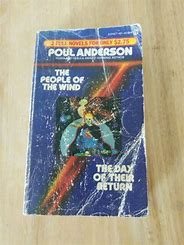
The People Of The Wind, VI.

One of my favourite scenes in Poul Anderson's Technic History is Christopher and Tabitha in the Nest.

Centauri is the second and only other city on Avalon after Gray. The Nest is the tallest building in Centauri. We are not told what is inside the building. A transparent canopy covers the unwalled rooftop tavern. Winged Ythrians and gravbelt-wearing human beings frequent the tavern and there is also a gravshaft. Stars, invisible from the street, are seen through the canopy. There is also a view of the River Sagittarius and the Gulf of Centaurs.

Dim fluoroglobes light tables and are circled by insectoids. Patrons drink from glasses or inhale from narcobraziers. Christopher and Tabitha hear a recorded steel harp. Sometimes bards perform. The human pair meet Eyath's fiance, Vodan, who is spending time with Quenna, a permanently on heat Ythrian female, before going to war in which he will be killed by the friendly fire of the Avalonian defence system - devised by the two Marchwardens who include Christopher's father - although, of course, no one can yet know whether or how Vodan is destined to die. He is just out in the Nest for some leave time like everyone else. A trundling service robot dispenses:

"...thick, strong New African beer." (p. 506)

We vicariously experience some everyday life on Avalon.

Wednesday, 13 September 2023

A Change Of Face

The Rebel Worlds.

In CHAPTER TWO, Dominic Flandry:

arrives by aircab on the 50th-level parking flange of Intelligence headquarters at Admiralty Center in the North American Rocky Mountains on Terra, a planet that we have not seen since the Emperor's Birthday at the beginning of Ensign Flandry;

is admitted by a marine guard after ID verification;

reflects on the fate of the Empire while walking along halls crowded with hurrying individuals of different ranks, roles and species;

gives directions to and exchanges addresses with a young woman;

ascends by gravshaft to the 97th level;

now walks among persons of higher rank than his;

enters the suite of Vice Admiral Sir Ilya Kheraskov who remarks, "'I see you have a new face,'" (p. 383) although they have never met.

In a film, this should be the first moment when we see Flandry's face and realize that he is played by a new actor who will remain in place for the rest of the series, aging thanks to Make Up. 

Tuesday, 29 August 2023

FUTURISTIC SEX by Sean M. Brooks


Fair warning to the prurient minded, despite the title of my article, this essay is not pornographic, so get your minds out of the sewers!
 
Over a career in writing spanning more than half a century Poul Anderson used or touched on a vast range of topics. Here I want to note how sex might be used or abused in the future, using his Technic stories for some striking examples.
 
Two basic premises for Anderson's Technic series are (1) a FTL interstellar drive was invented; and (2) many non-human intelligent races were discovered. With these premises many, many possibilities becomes thinkable.
 
I absolutely expect humans in the future to continue using and abusing sex in all the ways we see that being done in the real world, here and now. I also expect sexual encounters between humans and non-humans to happen, especially if these species are not physically repellent to each other.
 
I should also stress that intelligent races which had independently evolved on different worlds over billions of years will not be mutually interfertile. And that will remain true no matter how much two such species resembles each other.

The text quoted below came from Chapter II of A CIRCUS OF HELLS, one of Anderson's stories about Dominic Flandry, Intelligence officer for an interstellar Terran Empire set more than 1000 years from now in the future.
 
Outside a particular joyhouse, otherwise undistinguished
from the rest, an Irumclavian used a vocalizer to chant
in Anglic: "Come one, come all, come in, no cover, no
minimum. Every type of amusement, pleasure, and thrill.
No game too exotic, no stakes too high or low. Continuous
sophisticated entertainment. Delicious food and drink,
stimulants, narcotics, hallucinogens, emphasizers, to your
order, to your taste, to your purse. Every sex and every
technique of seventeen, yes, seventeen intelligent species
ready to serve your desires, and this does not count racial,
mutational, and biosculpt variations. Come one, come all--"
 
A little later, in the same chapter,  as Flandry left the "gravshaft" on the level where he was going to a "business" meeting with Leon Ammon, proprietor of this dubious establishment,  we read: "He was glad when Door 666 admitted him; that was on the sado-maso level, and he had glimpsed things. Further on in Chapter II, "Flandry had his suspicions about the origin of many of the subjects on the floor below. Consenting adults . . . after brain channeling and surgical disguise..."
 
The extremely disreputable business establishment Flandry had entered was a brothel, set more than a thousand years in the future. The distaste he had for the sado-maso shows readers he was not "into" the really gross and perverted types of sex. Over and over, in the Flandry stories, readers will see he was a normal male heterosexual who liked and preferred women. And, in the right circumstances, xenosophont females!
 
It's right to quote again from  A CIRCUS OF HELLS, to illustrate how kinky futuristic sex might be. The text quoted below came from the beginning paragraphs of Chapter III.  A major character, a prostitute named Djana, went to meet what she thought would be a human customer but was not.
 
Bracing herself and wetting her lips, she said, "I don't. Not with xenos--"
and in haste, fearing  offense might be taken, "I mean non-human sophonts.
It isn't right,"
 
"I suspect a large enough sum would change your mind," the other
said. "You have a reputation for avarice. However, I plan a different
kind of proposition. It moved slowly closer, a lumpy gray body on four
thin legs which brought the head at its middle about level with her
waist. One tentacle sent the single loose garment swirling about in
a sinuous gesture. Another clutched the vocalizer in boneless
fingers. The instrument was being used with considerable skill;
it actually achieved an ingratiating note. "You must know about
me in your turn. I am only Rax, harmless old Rax, the solitary
representative of my species on this world. I assure you my
reproductive pattern is sufficiently unlike yours that I find your
assumption comical."

I agree that, assuming a FTL interstellar community with thousands of intelligent races, some humans and xenosophonts will have sex. But others like Djana will believe that to be wrong or disgusting. Others, like that of Rax's species, will have reproductive patterns so different from those of other races that the idea of sex with them was merely laughable.
 
I wish to backtrack a bit  to comment about Rax, in the text quoted from Chapter III. I noted how Rax was referred to as "it," instead of either "he" or "she." That made me wonder if Rax came from a race which did not have male or female sexes, reproducing in other ways.
 
The quotes taken from A CIRCUS OF HELLS gives Anderson's readers some fascinating if speculative glimpses into the sordid, seamy underside of what an interstellar civilization could be like. And these glimpses Anderson gave us can be easily paralleled in many similar brothels and prostitutes of both sexes in the real world. The more squalid aspects of the steamy night life of Las Vegas and Atlantic City, in the US, comes to mind as two examples!
 
To be strictly fair even to Leon Ammon not everything offered at his disreputable establishment will be morally repugnant, such as his restaurant services. Or even some gambling, in moderation and only if the games are honest.
 
In Chapter 4 of ENSIGN FLANDRY, we see Dragoika, a ship captain and a very influential member of the Sisterhood of Kursoviki. She belonged to a species, the Tigeries of Starkad, physically resembling humans so closely that Dragoika found Flandry attractive.
 
"Pity you must wear that helmet," Dragoika said. "I'd like to taste your lips.
But otherwise we're not made so differently, our two kinds. Will you come
to my cabin?"
 
For an instant that whirled, Flandry was tempted. He had everything he
could do answer. It wasn't based on past lectures about taking care not
to offend native mores, nor on principle, nor, most certainly, on fastid-
iousness. If anything, her otherness made her the more piquant. But
he couldn't really predict what she might do in a close relationship,
and--
 
"I'm deeply sorry," he said. "I'd love to, but I'm under a--" what was the
word?--"a geas."
 
She was neither much offended nor much surprised. She had seen a
lot of different cultures. "Pity," she said. "Well, you know where the
forecastle is. Goodnight." She padded aft. En route, she stopped to
collect Ferok.

--and besides, those fangs were awfully intimidating.
 
This amusing quote from ENSIGN FLANDRY shows Anderson speculating that parallel evolution would make humans and some non-humans physically resemble each other closely enough to be sexually attractive. I also noted mention of those lectures stressing the need to avoid offending Tigery mores. Flandry was wise to very tactfully decline Dragoika's proposition. A thousand years and more must have taught humans and non-humans alike many hard lessons on the need for caution in such intimate matters. It was also entertaining for Flandry to be intimidated by Dragoika's fangs!

I want to touch on one more example of futuristic sex between a human and non-human from the Technic stories. Years after both ENSIGN FLANDRY and A CIRCUS OF HELLS, Captain Flandry was kidnapped by unusually humanoid aliens in "Tiger by the Tail." This quote segues into how he was able to act as he did on Scotha: "The being was remarkably humanoid. Certain differences of detail could quite likely be found beneath the clothes, and more basic ones beneath the skin. Among countless worlds, evolutionary coincidences are bound to happen now and then, but never evolutionary identities. Yet to the eye, crew member and captive resembled each other more than either resembled, say, a woman. Or an alien female? Flandry wondered. I'll bet this is a male, and equipped pretty much like me, too. (AGENT OF THE TERRAN EMPIRE, revised Gregg Press edition, 1979, page 2). That last part, "equipped pretty much like me, too," was Anderson's way of alerting readers that Scothans and humans were sexually compatible.

After being taken by these xenosophonts to their home planet Flandry met the wife of their king, Queen Gunli. Because of soon becoming aware of her unhappiness, he was friendly and obliging to the queen, as part of his efforts to undermine Scotha. Another apt quote is this: "Flandry gave her an appreciative look. He had ascertained that Scothanian and human females were extremely similar in outward anatomy. Queen Gunli was a stunblast, with dark rippling hair, big violet eyes, daintily sculptured features, and a figure that a thin, clinging gown scarcely hid." (AGENT OF THE TERRAN EMPIRE, page 20). Meaning humans and Scothans could be attracted to each other. 
 
Queen Gunli did not like the Frithians, the Scothan nation which conquered and unified the planet, or their plans for more aggression and war.  The text copied below came from the revised version of the story in AGENT OF THE TERRAN EMPIRE (Gregg Press: 1979), page 30.
 
"War is what they want."

"But not what the females want. Not to wait and wait and wait for the ships
to come back, never knowing whether only his sword will return. Not to rock
a baby and know that a few years hence he will be a corpse on the shores
of some alien planet. Not to--" She broke off and straightened her slim
shoulders. "Let me not whimper. Naught can I do about it."
 
"You are very brave as well as beautiful, Gunli," said Flandry. "Your kind
have changed fate ere now." And he sang, low, a stave he had made in
the Scothan bardic form:
 
"So I see you standing,
sorrowful in darkness.
But the moonlight's broken
by your eyes, tear-shining--
moonlight in the maiden's
magic net of tresses.
Gods gave many gifts, but,
Gunli, yours was greatest."

All at once she was in his arms.
 
It was danger, loneliness, common ends they both desired, as well as mutual attraction that brought Flandry and Gunli into having an affair, despite being of alien races. Anderson had too much good taste to feel any need to be sexually explicit, that was left implicit. I also appreciated the verse he wrote here, it moderated the breakneck pacing of the story, giving readers a moment for reflecting on the issues that story raised.
 
Last, near the end of "Tiger by the Tail," on page 40 of the Gregg Press edition of AGENT OF THE TERRAN EMPIRE, we read this, as Flandry and Gunli waited for the Terrans to land on Scotha:
 
She brought her left hand from beneath the cloak and took both his.
"And what will you be doing?" she asked.

He met her gaze. Loneliness was sudden within him. How beautiful
she stood there.
 
But what she meant could never endure. They were too foreign to each
other. Best he depart soon, that the memories remain untarnished in
them both. She would find someone else at last. And he--well-- "I have
my work," he said.
 
I agree with Flandry's decision, because he and Queen Gunli belonged to different intelligent species. No matter how much two such races may look like each other, billions of years of separate evolution on different planets inevitably means both races will have fundamental differences from each other. And that's going to remain true even if males and females can have sexual intercourse. Also, the genetic barrier would make it impossible for them to have children. It was right of Flandry to decide it was better, for both Gunli and him, that he soon leave Scotha, parting from each other in friendship.
 
I consulted the second edition of THE ENCYCLOPEDIA OF SCIENCE FICTION (ed. John Clute and Peter Nicholls. St. Martin's Press, 1993) to get some idea of how other science fiction writers handled the theme of human/alien sex. Alas, all I found on page 1090, in Nicholls' article "SEX" I thought relevant to Anderson's work was this: "A sensitive treatment of love between alien races is STRANGERS (1974, NEW DIMENSIONS; exp 1978) by Gardner DOZOIS, which draws attention to the ghastly errors that can occur from trying to understand a foreign society in terms of the assumptions of one's own."

But, when I looked up John Clute's entry for Dozois, this is what I found on page 352 of the ENCYCLOPEDIA: "...his first solo novel, STRANGERS (1974, NEW DIMENSIONS; exp 1978), an intense and well told love story between a human male and a ALIEN female, set on her home planet, in a Galaxy humans signally do not dominate, her death from bearing his child is biologically inevitable (the plot's derivation from Philip Jose FARMER'S The Lovers [1961] can be seen as homage) and stems from a mutual incomprehension rooted in culture and the intrinsic solitude of beings (see also SEX)."
 
This exasperated me! I agree it might be possible some intelligent races, human and non-human, could so strongly resemble each other that sexual attraction and desire will be likely. I also agree it's highly probable mutual alienness will breed strains, stresses, problems, and tragedies. I do not agree, given totally alien genetics and separate evolution over billions of years on different planets, that humans and aliens will be able to have children. I was disappointed that Clute and Nicholls seemed unaware of that scientific absurdity. That absurdity also discredits any stories by other SF authors who write of humans and aliens being able to have children.

Before offering some general conclusions I'll quote from Chapter III of THE REBEL WORLDS to show how some non-humans might reproduce: "I know of intelligent hermaphrodites, and sophonts with more than two sexes, and a few that regularly change sex. They all tend to look on our reproductive pattern as obscene." I can too easily imagine beings from some of these species "working" as prostitutes in Leon Ammon's "joyhouse."
 
Being, as I am, both Catholic and a conservative, I would not be at all surprised to find out brothels and sexual perversions of all kinds will exist in the far future. I believe in having no illusions about how flawed humans and xenosophont races, if they exist, are likely to be if they too have fallen.  Humans being what they are--and xenosophonts, as I suspect they will be--there will be sexual encounters between members of different species, but that will not always occur because of force and violence. I appreciated how Anderson drew out such implications without needing to be pornographic!

Appendix I: JIHANNATH
 
For the sake of completeness I am discussing here a few details which did not quite fit into the main body of this article. In Chapter V of A CIRCUS OF HELLS Djana said to Flandry: "came up from slavery--in the Black Hole of Jihannath--what I've been through makes the worse they've thought of in Irumclaw Old Town look like a creche game--"  And in Chapter XV Djana also said: "Where were the Emperor and his law when I tried to escape from the Black Hole, fifteen years old, and my contractor caught me and turned me over to the Giggling Man for a lesson?" As far as this goes, the point  we need to keep in mind is to have no illusions about prostitution, far too many times "sex workers" did not enter that "profession" freely, but by force and are often kept obedient and in line by abuse and torture.
 
But, the complication here was that Jihannath was not part of the Empire when Djana was  a child. A few years later, in Chapter II of THE REBEL WORLDS, as Vice Admiral Kheraskov was briefing Flandry we read: "I'm not letting out any great secret when I tell you the latest Merseian crisis is worse than the government admits to the citizens. It could completely explode on us. I think we can defuse it. For once, the Empire acted fast and decisively. But it demands we keep more than the bulk of our fleets out on that border, till the Merseians understand we mean business about not letting them take over Jihannath." And we know from THE DAY OF THEIR RETURN that the Roidhunate was forced to back down and let go of Jihannath. 
 
What I quoted above made nonsense of Djana's complaint about the Emperor and his law, because that planet was not ruled by Terra in her childhood. It was a formerly independent border world of little interest to the Empire until Merseia tried to seize it. Terra most likely took such decisive counter measures because the location of Jihannath would make Merseian occupation of the planet a threat to the Empire. But a lengthy explanation of all this in the middle of my article would have been too disruptive!

Appendix II: L. SPRAGUE DE CAMP
 
The disappointment I felt when I tried to use the second edition of THE ENCYCLOPEDIA OF SCIENCE FICTION to find out how other science fiction writers used the idea of human/alien sex irritated me. So much so that my memory was joggled into recalling how L. Sprague de Camp had some very pertinent things to say about that topic in his novel THE HOSTAGE OF ZIR (Berkley/Putnam: 1977).
 
From THE HOSTAGE OF ZIR, Chapter Nine, page 119:
 
Reith was going to explain that hybridization of species from different
worlds, no matter how superficially alike, was a biological impossibility.
On  second thought, he decided to say nothing for the present. If he
made a point of their mutual sterility, Shosti might find his presence an
embarrassment and have him pitched off the cliff. He finished lamely:
"Nought, madam. I did but hope that--ah--the key would fit the lock."
 
"Fear not, my lord. I have made trial of you Ertsuma before and find
them compatible...."
 
And from HOSTAGE, Chapter Ten, page 146, a non-human character asked if it was possible for males and females of their two species to have children: "Reith shook his head. "That were impossible, sir. Earthmen and Krishnans are as mutually sterile as-as an aya and a shomal. Professor Mulroy, among my tourists, could explain it; something to do with the tiny cells whence living things originate. The-the-our word is chromosomes-it fit not together."

If, in a book meant by de Camp to be humorous science fiction serious, even obvious points like these were made, the authors of the entries I quoted from THE ENCYCLOPEDIA OF SCIENCE FICTION should have done so as well!

Tuesday, 11 January 2022

The View From The Nest

The People Of The Wind, VI.

We have said before but it is worth repeating that one of the best views in Poul Anderson's Technic History is from the rooftop of the Nest, the tallest building in Centauri with a gravshaft to the roof although most customers fly. The rooftop tavern is unwalled, protected from rain by a transparent canopy through which stars are visible unlike on the brightly lit streets below. When Arinnian and Hrill enter, sinking Morgana silvers the river and Gulf. A rank breeze carries sounds of thunder from clouds in the east. Tables with glasses or narcobraziers are lit by dim fluoroglobes circled by insectoids. Shadowy forms, served by a robot, perch on stools. There is recorded harp music. Arinnian and Hrill join Vodan and Quenna and order New African beer. 

Saturday, 3 October 2020

The Nine And The Nest

Searching for something, we find other things of the same name. Searching this blog discloses that there are two groups called the Nine and two places called the Nest, three of the latter if we include Yotl's Nest (scroll down), a multi-species bar in another civilization-cluster in After Doomsday. This in turn displays the breadth of Poul Anderson's imagination. The two Nines and three Nests are scattered across:

"Time Patrol," the opening story of the Time Patrol series;

the King Of Ys Tetralogy, historical fiction with an element of fantasy, co-written by Karen Anderson;

"The Nest," a time travel short story;

The People Of The Wind, one volume of the History of Technic Civilization;

After Doomsday, an sf novel.

In The People Of The Wind:

The Nest, a tavern for ornithoids, is the tallest building in Centauri with a gravshaft to its rooftop for humans who have not brought flying gear. It is unwalled, protected from rain by a vitryl canopy. Insectoids circle fluoroglobes and a service robot serves New African beer.
-copied from here. (See: In The People Of The Wind, Chapter Six.)

Monday, 2 December 2019

Insectoids, Fluoroglobes And Narcobraziers

Arinnian and Hrill travel by taxibug, then gravshaft, to the rooftop of the Nest:

"Unwalled, the tavern was protected from rain by a vitryl canopy through which, at this height, stars could be seen regardless of the electric lunacy below."
-Poul Anderson, The People Of The Wind IN Anderson, Rise Of The Terran Empire (Riverdale, NY, 2011), pp. 437-662 AT VI, p. 505.

We read the "lunacy" on p. 500:

"(GROG HARBOR, DANCE, EAT, GENUINE TERRAN SENSIES, FUN HOUSE, SWITCH TO MARIA JUANAS, GAMBLING, NAKED GIRLS, LOANS, BUY...BUY...BUY...)"

Avalonians are either human or Ythrian. Human Avalonians will be attracted by anything that is genuinely Terran.

"Thunderheads piled in the east, and a rank breeze carried the mutter of the lightning that shivered in them." (p. 505)

Thunderheads and lightning are seen. The breeze is felt and smelled. The mutter is heard. Thus, four senses in one sentence.

"Insectoids circled the dim fluoroglobe set on every table." (ibid.)

We are grateful that the narrator refers to "insectoids," not to "insects," on an extrasolar planet.

"Business was sparse..." (ibid.)

War is imminent.

"...a few shadowy forms perched on stools..." (ibid.)

"...forms..." because the clientele may be human or Ythrian. The latter perch.

"...before glasses or narcobraziers..." (ibid.)

I googled "narcobraziers" and found this passage on-line. Braziers emitting narcotic fumes?

"...a service robot trundling about, the recorded twangs of a steel harp." (ibid.)

Robots, standard sf props, remind us which genre we are reading.

Internal Terminological Consistency

Sometimes, an sf story set in a future society introduces terminology specific to that society. For example, in Star Trek:

"transporter" means "teleporter";

"Star Date" means a way of avoiding saying when anything is happening.

The ground vehicles in Centauri are called "groundbugs." A few pages later, Arinnian and Hrill:

"...took a taxibug to the Nest..."
-Poul Anderson, The People Of The Wind IN Anderson, Rise Of The Terran Empire (Riverdale, NY, 2011), pp. 437-662 AT p. 505.

We have become accustomed to flying taxis or "aircabs" in Poul Anderson's works and in other sf. In fact, sometimes we are surprised when a future vehicle stays on the ground. However, it becomes clear that this taxibug is also a groundbug when we read the whole sentence:

"They took a taxibug to the Nest, which was the tallest building in the city, and a gravshaft to its rooftop since neither had brought flying gear." (For the reference, see above.)

Thus, Anderson remains consistent first in calling the local vehicles "bugs" and secondly in keeping them grounded. This might be the only time these vehicles are mentioned. Nevertheless, we get the impression that Anderson has created a complete environment including details that we are not told in this narrative, such as the design of these particular vehicles.

And here is a sentence that concretizes Avalon as an inhabited environment:

"Morgana was sinking toward the western bottomlands, though it still silvered river and Gulf." (ibid.)

As with Poul and Karen Anderson's Ys, we feel that we have been there.

I am on a roll with the Technic History and with a particular period of it so I will see if we can stay with Avalon for a while longer.

Friday, 31 May 2019

Three Stages

There are three stages in the colonization of Avalon.

To avoid possible friction at the beginning, human beings and Ythrians settle on different islands in the Hesperian archipelago. Thus, Nat Falkayn sees Ythrians rarely and then only because they have business with his father or grandfather.

When the two races move to the Coronan continent, they divide up the territories between them. Ythrians live by hunting and ranching, not by farming - so, when the Stormgate Choth grows, it exchanges prairie for the Andromedas/Weathermother. Such deals are arranged between the Parliament of Man and the Great Khruath of the Ythrians. It is good to read juvenile sf where such matters are decided peacefully instead of by invasion and conquest. Jack Birnam's family, sea ranchers living on the coast five hundred kilometers west of the Andromedas, rarely see an Ythrian and might be unfamiliar with the details of choth organization, like the role of a "Wyvan." When Stormgate holds the Weathermother, human beings will no longer have free access to the Andromeda mountains, not because of any inter-species segregation but simply because land allocated for habitation, hunting and ranching cannot simultaneously be used for unrestricted hiking, camping, climbing etc. At this early stage, the two races do not overlap much because they are too busy adapting themselves to the new world.

The third stage, planetary integration, is shown in The People Of The Wind. Choths receive human beings into membership. The tallest building in the human city of Centauri is the Nest, a tavern for ornithoids, with a gravshaft to the roof for human beings who have not brought flying gear. Both species eat from mixed menus.

Saturday, 3 February 2018

SF Detective Fiction II

The detective work continues. The author already knows what the aliens are like so he can introduce consistent details without yet presenting the totality. Probably some readers can deduce more than others.

When Falkayn and his human captor, Latimer, open their faceplates inside the alien spaceship, the breathable atmosphere is desert-like, hot and dry, full of stinging ozone and of odors like spice, leather and blood. Latimer is clearly used to it.

Ascending a gravshaft, they enter a large garden of flowers and trees that are brown-gold, not green, with a fountain in a clearly weathered stone basin. Its carvings are artistically exquisite whereas the bulkhead is decorated in tasteless splashes of color. Barbarians have conquered or succeeded a civilization?

The stateroom beyond is indeed barbaric: pelt on the floor; one bulkhead gold-plated; another decorated as in the garden; another draped in scaly leather; a screen showing flashing, jagged, abstract shapes to the sound of drums and horns; a large skull above the door; bitter smoke from time-worn censors; carelessly scattered cushions and miscellaneous items;  the Minotaur-like alien standing in another doorway protected from Falkayn's hand-held grenade by a transparent shield.

Walking into such a place would turn my stomach.

Saturday, 27 January 2018

Outsystem Food

My favorite food for eating out is Indian but we also have Chinese, Japanese, Thai, Italian etc. James Ching likes:

"...a snack in a restaurant featuring outsystem food."
-Poul Anderson, "How To Be Ethnic In One Easy Lesson" IN Anderson, The Van Rijn Method (Riverdale, NY, 2009), pp. 175-197 AT p. 187.

Adzel, on Earth, eats (a lot) at the Silver Dragon Chinese Food and Chop Suey Palace. Nicholas van Rijn likes onion soup a la Ansa here, Dominic Flandry recommends an Ansan vermouth here and I think that the Technic History has more about mixing Terrestrial and extraterrestrial foods?

In fact:

The only other Avalonian city is Centauri at the mouth of the Sagittarius in the Gulf of Centaurs. In the Phoenix House, Tabitha/Hrill orders a catflower cocktail. She and Chris/Arinnian eat piscoid-and-tomato chowder, beef-and-shua pie, salad of clustergrain leaf and pears and drink coffee spiced with witchroot and a bottle of vintage dago. The Nest, a tavern for ornithoids, is the tallest building in Centauri with a gravshaft to its rooftop for humans who have not brought flying gear. It is unwalled, protected from rain by a vitryl canopy. Insectoids circle fluoroglobes and a service robot serves New African beer.
-copied from Who Knows Of Avalon?

Monday, 7 November 2016

In The Nest

The only other Avalonian city is Centauri at the mouth of the Sagittarius in the Gulf of Centaurs. In the Phoenix House, Tabitha/Hrill orders a catflower cocktail. She and Chris/Arinnian eat piscoid-and-tomato chowder, beef-and-shua pie, salad of clustergrain leaf and pears and drink coffee spiced with witchroot and a bottle of vintage dago. The Nest, a tavern for ornithoids, is the tallest building in Centauri with a gravshaft to its rooftop for humans who have not brought flying gear. It is unwalled, protected from rain by a vitryl canopy. Insectoids circle fluoroglobes and a service robot serves New African beer.
-copied from here. See also The Food Thread.

If the Time Patrol series were to be filmed, then some dialogue would have to be in Temporal, Exaltationist or historical languages with subtitles. In the Technic History, some dialogue would have to be in League Latin, Eriau or Planha. Anglic would be rendered as English. In fact, Poul Anderson tells us nothing or next to nothing about the sounds or vocabularies of these languages. Here is one short piece of dialogue in the Nest:

"'Hoy-ah! Vodan, ekh-hirr.'" (Rise Of The Terran Empire, p. 505) 

We are told that Arinnian continues in Planha although the omniscient narrator translates for us:

"Good flight to you,' Arinnian greeted in Planha..." (ibid.)

- but then he resorts to Anglic:

"'I didn't expect to find you here.'" (ibid.)

"Hoy-ah" sounds as if it might be Anglic? - whereas "...ekh-hirr..." is clearly Planha.

I probably commented on this instance of pathetic fallacy before:

"[Tabitha] considered [Arinnian] for a while that grew. Lightning moved closer on heavy gusts. His rage ebbed..." (p. 509)

Some men find male-female interactions easy; some find them difficult. One kind of man can phone several women acquaintances and arrange to meet one of them for sex whereas another kind of man does not know how to initiate a sexual liaison. Many male human choth members have contrived a way to be both kinds of man simultaneously:

"'...promiscuous as kakkelaks provided they don't much respect their partners, but hardly able to touch birds of the opposite sex.'" (ibid.)

A double standard. However, human beings lived by double standards long before they migrated to Avalon: men who have sex with different women when single but insist that their own fiancees must be virgins. A guy I worked with swore regularly but commented, "F----in' foul-mouthed bitch!" when he heard a woman swearing.

Friday, 20 April 2012

Who Knows of Avalon?

In "The Problem of Pain"

"...intermediate in size between Earth and Ythri, surface gravity 0.8 terrestrial;
"slightly more irradiation, from a somewhat yellower sun, than Earth gets, which simply makes it a little warmer;
"axial tilt, therefore seasonal variations, a bit less than terrestrial;
"length of year about three quarters of ours, length of day a bit under half;
"one small, close in, bright moon;
"biochemistry similar to ours - we could eat most native things, though we'd require imported crops and livestock to supplement the diet.
"All in all, seemingly well-nigh perfect." (1)

South of the largest continent, a great gulf swarms with life. A strong eastward current is deflected north by an archipelago. Monstrous marine creatures graze on floating islands of densely interwoven "atlantis weed" probably also supporting lesser plants and animals. Higher solar energy input and rapid rotation make storms more violent than would be possible on Earth.

On an island in the gulf:

"A mat of mossy, intensely green plants squeezed out any possibility of forest." (2)

Surgeon trees' thin leaf-fringed bows, sharp enough to cut a wing from a swooping Ythrian, whip insanely in the wind which blows gorgeous blossoms torn from vines. Widespread low, russet-leaved, rankly odorous hell shrubs clutch at feet with raking twigs and emit vapours scarcely harming Ythrians but slowly poisoning human beings. Waterfowl fly through a rose, gold and silver-blue sunrise.

In "Wingless"

Ythrians and human beings settle different territories in the Hesperian Islands before jointly colonising the Coronan continent. Nat Falkayn, seventeen Avalonian (twelve Terran) years of age when visiting the Ythrian extended household of Weathermaker Choth:

"...stood on a balcony of that tall stone tower which housed the core families. Below were a paved courtyard and rambling wooden buildings. Meadows where meat animals grazed sloped downhill in Terrestrial grass and clover, Ythrian starbell and rye, Terrestrial oak and pine, Ythrian braidbark and copperwood, until cultivation gave way to the reddish mat of native susin, the scattered intense green of native chasuble bush and delicate blue of janie. The sun Laura stood big and golden-colored at morning, above a distantly glimpsed mercury line of ocean. Elsewhere wandered a few cottony clouds and the pale, sinking ghost of Morgana. A flock of Avalonian draculas passed across view, their leathery wings awkward beside the plumed splendor of Keshchyi's." (3)

Morgana is the moon, brighter and faster than Luna. Keshchyi is a young Ythrian.

Whirlpools around the dark coraloid reefs at a lagoon entrance hold "...thick brown nets of atlantis weed torn loose from a greater mass far out to sea..." (4)

In "Rescue on Avalon"

The highest Avalonian mountains are called the Andromeda Range by human beings and the Weathermother by Ythrians. (Hloch of the Stormgate Choth wrote The Earthbook of Stormgate on the peak of Mount Anrovil in the Weathermother.) Ironleaf trees draw metal from the soil and concentrate pure particles in shining purple leaves which attract pollinating bugs and also absorb radio waves. A hospital window opens on Avalonian king's-crown, Ythrian windnest and Earthly oak.

The Parliament of Man and the Great Khruath of the Ythrians divided continental territory between the species. Human beings need prairies for crops whereas Ythrian hunters occupy the Weathermother.

In The People of the Wind, Chapter One

The city of Gray on Falkayn Bay is surrounded by human-owned grain-fields, Ythrian-owned pastures for maukh and mayaw, forests of oak, pine, windnest or hammerbranch and treeless areas of native susin where some barysauroids survive. Even in Gray, humans, with ample room on Avalon, build low. Highrises are for ornithoids (Ythrians).

"Laura, a G5 star, has only 72 per cent the luminosity of Sol and less ultraviolet light in proportion; but Avalon, orbiting at a mean distance of 0.81 astronomical unit in a period of 0.724 Terran, gets 10 percent more total irradiation than man evolved under." (5)

Christopher Holm, thirty years Avalonian old, has joined Stormgate Choth as Arinninan. The Stormgate compound:

"...stood on a plateau of Mount Fairview. At the middle lifted the old stone tower which housed the senior members of the family and their children. Lower wooden structures, on whose sod roofs bloomed amberdragon and starbells, were for the unwed and retainers and their kin. Further down a slope lay sheds, barns, and mews. The whole could not be seen at once from the ground, because Ythrian trees grew among the buildings: braidbark, copperwood, gaunt lightningrod, jewelleaf which sheened beneath the moon and by day would shimmer iridescent. The flowerbeds held natives, more highly evolved than anything from offplanet - sweet small janie, pungent livewell, graceful trefoil and Buddha's cup, a harp vine which the breeze brought ever so faintly to singing. Otherwise the night was quiet and, at this, altitude, cold." (6)

Avalonian constellations include Wheel, Swords, Zirraukh, Ship and Maukh.

Chapter Two

"Avalon rotates in 11 hours, 22 minutes, 12 seconds, on an axis tilted 21 degrees from the normal to the orbital plane. Thus Gray, at about 43 degrees N., knows short nights always; in summer the darkness seems scarcely a blink." (7)

Human fluid balance and kinesthesia have had to readjust to a gravity field only 80 percent Terran. Ythrians shifting their breeding cycle to Avalonian conditions had low fertility in early generations.
Humans who join choths "go bird." Ythrians who leave choths to become atomic individuals within the global community become "Walkers." Mistwood Choth, like the home world Ythri, has successfully adapted Terran technology.

Chapter Three

Equatorial diameter: 11,308 kilometers. Highest Andromedan peak: 4500 meters. Corona, the north polar continent extending past the Tropic of Swords: eight million square kilometers, comparable to Australia. In the Southern hemisphere, Equatoria, New Africa and New Gaiila are small continents or large islands.
2000 kilometres west of Gray, the Oronesian archipelago crosses the Tropic of Spears, separating the Middle Ocean to the West from the Hesperian Sea in the northern hemisphere and the South Ocean beyond the equator. Oronesia supports a distinct ecology. Eccentrics flee there to settle islands and found choths of only a single household. However, the more numerous Highsky Choth occupies much of the archipelago and controls the fisheries around latitude 30 degrees North. Tabitha Falkayn, Hrill of Highsky, is a third generation human member of her choth and was brought up by Ythrians. Western Corona and northern Oronesia must defend the Hesperian Sea against Terrans.

Upper slopes have susin and a few shrubs. Lower, cultivated ground has red Ythrian clustergrain to feed shuas and Terrestrial fruit trees to feed Highsky humans. A herder and his uhoth control flapping shuas while an Ythrian sailor scouts for piscoids and native pteropleuron lumber around.

Chapter Four is about Terrans preparing to attack Avalon from Esperance.

Chapter Five

The main Ythrian language is Planha, the equivalent of Terran Anglic. Khruaths, gatherings open to all free adults in a given territory, have judicial and limited legislative authority. Wyvans, the presiding officers, explain the law and try suits but cannot compel. If non-compliance is deemed sufficiently serious, then the Wyvans cry Oherran, calling on everyone in the territory to attack the offenders. Rejection of the call would be a deathpride matter, with suicide the Wyvans' only option.

Addendum, Sun 23 Nov 2015: I was too brief about the Khruaths -

an ancient Khruath was a periodic gathering open to all free adults in a territory;
later, regional Khruaths elected delegates to Year-Khruaths covering larger territories;
Year-Khruaths send delegates to the High Khruath of the planet, meeting every six years or on extraordinary occasions;
Wyvans are chosen at each level;
however, any free adult can attend a Khruath at any level.

Chapter Six

The only other Avalonian city is Centauri at the mouth of the Sagittarius in the Gulf of Centaurs. In the Phoenix House, Tabitha/Hrill orders a catflower cocktail. She and Chris/Arinnian eat piscoid-and-tomato chowder, beef-and-shua pie, salad of clustergrain leaf and pears and drink coffee spiced with witchroot and a bottle of vintage dago. The Nest, a tavern for ornithoids, is the tallest building in Centauri with a gravshaft to its rooftop for humans who have not brought flying gear. It is unwalled, protected from rain by a vitryl canopy. Insectoids circle fluoroglobes and a service robot serves New African beer.

Most of Highsky keeps to the Old Faith, using drugs in sacred revels. Other planets in the Lauran System are Elysium, Camelot, Phaeacia and Utgard.

Chapters Seven and Eight describe a battle in space.

Chapter Nine

Morgana is smaller than Luna but, being close, raises twice the tides. The Avalonian vertebrate design is hexapodal. Winged creatures have four legs. The dense mat of low-growing vegetation prevents native forests and helps to explain why animals remain reptiloid, unable to compete with mammals or birds. Trees are low and thick or slim and supple to survive high winds caused by rapid rotation. Imported domestic animals had to be revamped genetically because local food lacks some vitamins.

In Chapter Ten, the Terran Admiral parleys with Avalonian leaders and a fallen Avalonian, the First Marchwarden, is laid to rest.

Chapter Eleven

High Wyvan Liaw of the Tarns addresses the Great Khruath of Avalon from outside David Falkayn's house on First Island in the Hesperian Sea. On a North Coronan prairie, a flapping youth leads a herd of quadrupedal burden-bearing zirraukhs. South-East from Oronesia are the Brendan's, Fiery and Shielding Islands. Atlantis weed patches are entire ecologies grazed by peaceful but huge kraken. David Falkayn's granddaughter named Avalon. Equatorian centaurs use tools of stone and bone.

Chapters Twelve and Thirteen are mainly about the consequences of the war in space.

Chapter Thirteen

In winter, snow falls in North Corona and in the mountains but not in Gray where "...the susin stayed green on its hills the year around." (8)

Chapter Fourteen

Zirraukhs are warm-blooded quadrupeds smaller than horses and unlike them but used for the same purpose.

Chapter Fifteen

An Ythrian swoops on a pteropleuron that had been hunting piscoids near the surface of the sea.

Chapter Sixteen

Grief causes premature ovulation in a bereaved Ythrian female. A male seeks her out. This is not against choth law and the female's human chothmate, Arinnian, has no cause to challenge so he insults the Ythrian male until the latter challenges him.

Chapter Seventeen

On the Scorpelunan plateau in Equatoria, hexapods graze under their parasol membranes. Packs of dog-sized hexapodal lycosauroids and throngs of twenty centimeter long cockroach-like kakkelaks attack Terran invaders who are being slowly poisoned by hell shrubs. Furious tropical storms caused by high irradiation and fast spin delay evacuation.

Chapter Eighteen

Smaragdine susin, chasuble bush and Buddha's cup grow on a hill above Falkayn Bay. 

Chapter Nineteen

Trefoil and sword-of-sorrow grow in the grass. Harp vines ring. Jewelleafs twinkle. Morgana is less bright because scarred by Terran bombardment.

Why Am I Doing This?

I have summarized an alternative reading. We read an Anderson novel to follow the story. We appreciate that there are rich background details but do not usually pause to savor the details. I have noted as many details as I can of the planet Avalon.

(1) Poul Anderson, "The Problem of Pain" IN Anderson, The Earth Book of Stormgate, New York, 1978, pp. 26-48, AT p. 33.
(2) ibid., p. 40.
(3) Poul Anderson, "Wingless" IN The Earth Book of Stormgate, pp. 411-420, AT pp. 413-414.
(4) ibid., p. 417.
(5) Poul Anderson, The People of the Wind, London, 1977, p. 7.
(6) ibid., p. 10.
(7) ibid., p. 18.
(8) ibid., p. 127.