Showing posts sorted by date for query Valenderay. Sort by relevance Show all posts

Sunday, 14 December 2025

The Solutions And A Culmination

"How To Be Ethnic..."

Adzel:

sings Fafner for the San Francisco Opera Company around the Solar Commonwealth;

wins unlimited meals at the Silver Dragon Chinese Food and Chop Suey Palace by parading as the dragon during the newly revived Lunar New Year celebrations;

uses connections gained through his League scholarship to persuade a Master Merchant to accept Jim Ching as an apprentice.

The Earth Book presents an Adzel trilogy:

in "How To Be Ethnic...," Adzel is a student on Earth;

in "Day of Burning," he is in the trade pioneer crew with David Falkayn and Chee Lan as they spearhead the League intervention to protect Merseia from the radioactivity caused by the nearby supernova, Valenderay;

in "Lodestar," he is with the team when they are confronted by Nicholas van Rijn at Mirkheim.

In American future historical writing, a main line of development begins with Robert Heinlein's Future History time chart and culminates, in my opinion, with Poul Anderson's The Earth Book Of Stormgate. In passing from time chart to Earth Book, we have switched authors and future histories and have not even reached the end of Anderson's Technic History. However, I think the Earth Book embodies what Heinlein had intended in his chart, a detailed fictional future. 

Saturday, 23 August 2025

Important Events

Pivotal changes happen in The Technic Civilization Saga, Volume III, Rise Of The Terran Empire, as its title indicates, but, in real history, many earlier events build up to such changes and this is true also in the Saga. Relevant earlier events in Volume II, David Falkayn: Star Trader are:

van Rijn initiates his first trade pioneer crew led by Falkayn;

that crew saves Merseia from the supernova, Valenderay;

the Shenna are revealed as an external threat to the Polesotechnic League;

some League merchants become piratical and worse;

the League cartelizes and Falkayn clashes with van Rijn.

Thus, five of the seven instalments in Volume II present events that build up to the major events in Volume III which are:

civil war in the League;
Falkayn's colonization of Avalon;
the Troubles;
the early Terran Empire;
war between Empire and Avalon.

Saturday, 7 June 2025

Fourteen Comparisons

James Bond is often hospitalized after a mission. Dominic Flandry is not.

Bond has a Scottish housekeeper, May, who is mentioned several times but appears only twice. Flandry acquires Chives who accompanies him on missions.

Bond drives fast cars. Flandry has an interstellar speedster.

Bond operates while the British Empire is being dismantled whereas Flandry operates while the Terran Empire is in long term decline.

Bond's conflict with Blofeld becomes a personal vendetta. Flandry regrets his conflict with Aycharaych.

Bond has a more powerful ally, the CIA. Flandry does not.

Bond blows up the Castle of Death. Flandry bombards Chereion.

We see more of Bond in his office than of Flandry in his.

Bond remains a Commander throughout his series whereas Flandry advances from Ensign to Fleet Admiral.

Bond dreads aging and is not seen to age, indeed is kept young, even in the books, whereas Flandry does age and interacts with a grown-up son and daughter.

Bond refuses a knighthood. Flandry accepts his.

In Japan, Bond prays at Shinto shrines. On Dennitza, Flandry addresses Kossara, martyred though not yet canonized, in a Cathedral.

Bond senses a response from a Jizo guardian whereas Flandry does not feel that he receives any answer in the Cathedral.

Bond works with the Union Corse, French organized crime, against SPECTRE. David Falkayn works with the Gethfennu, Merseian organized crime, against Valenderay.

Addendum: Maybe there is covert sf in Moonraker? - an impossible-seeming burst of speed from a Russian submarine before it is destroyed by a nuclear explosion. Maybe the Russians were experimenting with a superfast sub?

Tuesday, 6 May 2025

Spheroids And Cubes

Mirkheim, VII.

"Sandra could imagine the foreign ship, a spheroid like hers, never meant to land on a planet, studded with gun emplacements, missile launchers, energy projectors, armored in forcefields and steel, magazines bearing the death of half a continent." (pp. 115-116)

We have become used to such spacecraft in fiction, for example Valenderay in The People Of The Wind. However, I learned something new (to me) today. Borg spaceships include giant "Cubes" that are all of a piece, not divided into weapons, Engineering, life support etc, and that automatically repair themselves very quickly when damaged.

A cuboid, especially one several kilometers wide, seems an unusual object to move around in space but sf writers have to think outside the box. Larry Niven exported an alien species, the kzinti, from his Known Space future history series into a Star Trek animated episode and Poul Anderson contributed three stories to the Man-Kzin Wars period of Known Space but neither Niven nor Anderson tackled the Borg. I suspect, in any case, that they were not around in Anderson's time.

Tuesday, 22 April 2025

Philippe Rochefort

The People Of The Wind.

Maybe Philippe Rochefort is our main man in this novel.

Rochefort successively interacts with:

his crew, both killed in battle;
Eve Davisson on Esperance;
Hrill, Draun, Arinnian and Eyath on Avalon;
Admiral Cajal in the superdreadnaught, Valenderay -

- so he could be regarded as a unifying character.

Rochefort is like Dominic Flandry except that he does not save the day for Terra. But everyone cannot do everything.

A Philippe Rochefort series is one of many hypothetical extensions of Poul Anderson's Technic History. Where does Rochefort go and what does he do after Avalon? Hloch might have told us. He writes after the Terran War but does not incorporate The People Of The Wind into his Earth Book compilation. We would have welcomed another such Editor for the second half of the Technic History.

Sunday, 20 April 2025

Crucifixion


The People Of The Wind.

Admiral Cajal has a crucifix in his room in the middle of the superdreadnaught, Valenderay. When he has spoken bluntly to High Wyvan Trauvay of Ythri, there is a prolonged silence during which:

"Stillness murmured around crucified Christ." (XII, p. 575)

This is a moment in which the wind would usually make itself heard. However, Cajal is in a spaceship conversing with Trauvay by screen. There might be wind outside Trauvay's eyrie on Ythri... But, in Valenderay, stillness murmurs, paradoxically. There will be some slight sound from all the machinery. There has to be something like a sound in the ears or at least in the minds of the characters. 

Crucified Christ graphically represents the suffering threatened to Ythri if it does not yield. Poul Anderson's symbolism is always full on.

Here at Blog Central, we prefer the seated Buddha, the yin-yang symbol or even the fish to the crucifix. The Terran Empire is not officially Christian but Cajal is from Nuevo Mexico. All the people and planets seem real.

Thursday, 10 April 2025

Battle

The People Of The Wind, VII-VIII.

Poul Anderson describes the first space battle in the war between Terra and Ythri as experienced by:

Imperial Admiral Cajal in the superdreadnaught, Valenderay, named after the supernova that nearly wrecked Merseia;

Second Marchwarden of the Lauran System, Daniel Holm, at home in Gray on Avalon;

First Marchwarden Ferune in the superdreanaught, Hell Rock, named after the site of an ancient Ythrian battle;

Lieutenant Philippe Rochefort and his crew in their Meteor-class boat, Hooting Star;

Vodan in his torpedo launcher, the approximate equivalent of a Meteor, emblazoned with three golden stars.

All of these characters have already been introduced. We know where each of them stands on the issues.

Wednesday, 12 June 2024

Orion And The First Grand Survey

The planet t'Kela is a hundred light-years from the Solar System and in about the centre of the Orion constellation if we have understood van Rijn correctly:

"'...poor Nicholas van Rijn must come out on his own selfs, a hundred light-years in the direction of Orion's bellybutton he must come...'"
-Poul Anderson, "Territory" IN Anderson, David Falkayn: Star Trader (Riverdale, NY, March 2010), pp. 1-76 AT p. 9.

There is an Esperancian mission to t'Kela so we infer that t'Kela is not very far from Esperance.

Between Rigel and Betelgeuse, the star Valenderay, becomes a supernova. A passing exploratory Polesotechnic League scout ship alerts the scientific base at Catawrayannis on Llynathawr. A little over one parsec from Valenderay is the G-type star, Korych, with its inhabited planet, Merseia.

Paradox And Trillia, a hundred parsecs from Sol, are close to each other and not far from Avalon.

Planets Discovered During The First Grand Survey
Ythri (by the Olga)
Gray/Avalon (also by the Olga)
Paradox
Trillia (I checked on this before adding it to the list)
Merseia

Wednesday, 31 January 2024

Trap One

The People Of The Wind
, VIII.

The Terran Admiral Cajal's flagship, Valenderay, classed among naval craft as a "Supernova," is even more powerful than the Avalonian Ferune's flagship, Hell Rock. However, the latter, an artificial planetoid, does not manoeuvre but remains in close orbit, drawing enemy fire. She is far too well armoured and defended to be damaged even by a large horde of small attack craft yet must be destroyed before the Terrans can threaten Avalon. Consequently, Cajal sends four capital ships and their attendants against her. He has fallen into the first trap. (There will be a second, on the planetary surface, later.) When the ground-based defence forces strike, Cajal loses significantly more of his fleet than he had expected to and is obliged to withdraw. Pretty smart stuff. Poul Anderson knew how to write military sf.

That devastating Avalonian strike has lethal consequences even for some of the planet's defenders but nevertheless it achieves its purpose of preventing immediate subjugation of the planet. Readers are mainly on the side of the defenders but also see the Terrans as good people. This is a story basically without villains. I am inclined to see Governor Saracoglu, who had promoted the war, in that role but he remains in the background. 

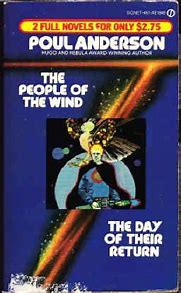
(That book cover rightly shows an Ythrian as winged and feathered but wrongly shows him as beaked.)

Three Good Guys

The People Of The Wind, VII.

As Admiral Cajal sits in the middle of the superdreadnaught, Valenderay, his chief executive captain relays:

"'...a report of initial hostilities from Vanguard Squadron Three. No details.'" (p. 515)

As Daniel Holm waits at home on Avalon, an Ythrian voice announces:

"'Contact with Terrans, about 12 a.u. out, direction of the Spears. Firing commenced on both sides, but seemingly no losses yet.'" (ibid.)

Poul Anderson gives us a glimpse of Avalon before advancing his war narrative. Holm looks out his window:

beautiful day;
autumn breeze;
salt odours;
glittering bay;
Laura and sky;
garden scents;
brilliant gardens;
distant hills;
blue haze;
skimming wings.

Holm does not notice. We should.

Ferune of Mistwood receives reports on his superdreadnaught flagship: 

combats; 
pincers from north and south; 
reserves approaching in the ecliptic.

Three good guys: one for Terra; two for Avalon. We will advance to a stage where good guys do not have to be on opposite sides - or we will not survive.

Tuesday, 30 January 2024

Valenderay And Duty

The People Of The Wind
, VII.

"Cajal sat alone in the middle of the superdreadnaught Valenderay." (p. 514)

That is an excellent future historical detail because this superdreadnaught flag vessel is named after the supernova that had been the ultimate cause of Merseian resentment of Terrans in the trader team story, "Supernova"/"Day of Burning."

Admiral Cajal is safe going into battle because Valenderay stretches for kilometres around him! Also, most of the Terran fleet precedes the flag vessel toward the enemy.

"Man's duty in this life, [Cajal] thought, is to choose the lesser evil." (ibid.)

This is almost word for word the teaching of Krishna in the Bhagavad Gita. Recently, the British Prime Minister, giving evidence to a public enquiry, swore on the Gita. I was not sure whether this was a Hindu practice but googling confirms that, at least for a while in India, Muslims swore on the Koran and Hindus on the Gita. Cajal, of course, would be a Bible man. He prays before a crucifix. Poul Anderson, like some other future historians, imagines the major Terrestrial religions exported to colonies on extra-solar planets. If human beings go there, then so will their beliefs.

Andrea, whom I visited today, is an expert amateur military historian and very pessimistic about the immediate future of this planet.

Sunday, 17 December 2023

Morning And Night

We first see Brechdan Ironrede when it is morning at Castle Dhanghodan on Merseia whereas we last see Tachwyr the Dark when:

"Winter night lay over the South Wilwidh Ocean."
-The Game of Empire, CHAPTER TWENTY-TWO, p. 445.

Brechdan stands and salutes the dazzling light of the sun Korych whereas Tachwyr sits in a stony room beneath the flying moon Neihevin, the lurid light of the Valenderay nebula, the speeding glints of satellites generating forcefields to guard against supernova radiation and a few forlorn stars.

Brechdan from his terrace sees morning mists, distant glaciers and a wheeling fangryf whereas Tachwyr in his islet stronghold hears crashing seas and shrilling wind.

Pathetic fallacy gone mad!  

Sunday, 20 August 2023

The First Grand Survey

"Our part in the Grand Survey had taken us out beyond the great suns Alpha and Beta Crucis."
-Poul Anderson, "Wings of Victory" IN Anderson, The Van Rijn Method (Riverdale, NY, December 2009), pp. 75-102 AT p. 79.

Participants in the first Grand Survey do not know that it is the first such interstellar survey just as participants in the Great War did not know that it was the First World War. The Terran Empire will have a Sector Alpha Crucis. The rogue planet, Satan, will swing round Beta Crucis. Rereading the earlier Technic History instalments, we appreciate their later significance.

After three years, the Olga under Captain Gray, discovers Ythri. Poul Anderson's Technic History series might have included a Grand Survey collection that would have constituted a "higher and greater Star Trek." This is a description that the British publisher, Charles Monteith, applied to James Blish's Cities in Flight but the Grand Survey comes even closer to the Enterprise's five-year mission.

"A ship of the first Grand Survey noted [Valenderay's] existence."
-Poul Anderson, "Day of Burning" IN Anderson, David Falkayn: Star Trader (Riverdale, NY, March 2010), pp. 209-272 AT p. 211.

Valenderay is the supernova that threatens Merseia.

"When the Survey team arrived [on Merseia], the Wilwidh culture stood on the brink of a machine age."
-ibid., p. 232.

Merseia, dominated by old Wilwidh, will be the main opponent of the Terran Empire.

"They found [Paradox] during the first Grand Survey."
Poul Anderson, "A Little Knowledge" IN David Falkayn: Star Trader, pp. 599-630 AT p. 601.

Paradox is not major player but is a fascinating detail of the Technic History. Hloch, compiler of The Earth Book of Stormgate, compares "A Little Knowledge" to a dewdrop reflecting the glade wherein it lies.

Have I missed any Grand Survey references? 

Friday, 31 March 2023

More Everyday Moments And Historical Continuity

Everyday Moments

(i) Conversation in  a wood-panelled waterfront tavern in Boseville on the River Flone on the planet Aeneas in The Day Of Their Return.

(ii) Diana sitting on the tower of St. Barbara watching the market in Olga's Landing on the planet Imhotep in The Game of Empire.

(iii) The Wodenite Axor having to sprawl on the floor at the Sign of the Golden Cockbeetle which is also frequented by miners, joygirls and a Tigery in The Game of Empire.

Historical Continuity

Later instalments of a future history series incorporate understated background references to earlier instalments. In "Day of Burning," the Polesotechnic League, represented by David Falkayn, arranges to protect the planet Merseia from the radiation effects of the supernova, Valenderay. In The People of the Wind, the superdreadnaught that is the flagship of the Terran armada is called Valenderay. This and similar connections enhance our appreciation of the series provided that we notice them.

Thursday, 13 January 2022

Future Historical References

The People Of The Wind, VII.

Any new installment of a future history series can and should both refer to information presented in previous installments and introduce new information. Thus, when the Terrans attack Avalon, their superdreadnaught command ship is named Valenderay, after the supernova that had nearly devastated Merseia in "Supernova"/"Day of Burning," as regular readers should remember, whereas the Avalonian command ship is named Hell Rock which, we are told for the first time, was:

"...the site of an ancient battle on Ythri." (p. 518)

Intending to show the Terrans why such a name was chosen, First Marchwarden Ferune has had its Anglic translation painted in large letters on the sides.

Similarly, The Game Of Empire, the last novel to feature Dominic Flandry, tells us where the Starkadians, from Ensign Flandry, had been settled but also imparts a ton of new information about:

the planets Imhotep and Daedalus in the Patrician System;
 
the genetically engineered Zacharians;
 
a long term scheme, only now reaching fruition, that had been spearheaded by Aycharaych even though that persistent opponent of Flandry had been probably killed or at least certainly neutralized two novels previously.

Also, a new addition to an earlier period of a future history can be designed to explain later events. Thus:

Mirkheim, the last Polesotechnic League novel, informs us that Supermetals profits funded the weather stations that we see on Vixen in "Hunters of the Sky Cave" during the later Imperial period;

I think that the demoralization of the Merseians at the end of The Game Of Empire is the beginning of their decline which helps to explain why they are not still around as an interstellar power in the stories set after the Fall of the Terran Empire.

Wednesday, 31 March 2021

The Polesotechnic League And A Criminal Organization

Because the Polesotechnic League is not an Intelligence service but a mercantile mutual support organization, it did not feature in the previous post, Intelligence Services And Criminal Organizations. Nevertheless, on Merseia, the League has occasion to do business with organized crime, the Gethfennu, because the latter is the only international network capable of a coordinated response to the planet-wide threat of radiation from the supernova, Valenderay. This plus the fact the Gethfennu is not an alien influence inserted into Merseian society but rather is the ancient baronial tradition in a distorted form bears out the suggestion that organized crime is an integral part of organized society. So, whether on Earth or on Merseia, how far does its influence extend?  

Tuesday, 9 February 2021

Hope

The Game Of Empire, CHAPTER TWENTY-TWO.

The Roidhun's Grand Council assesses the defeat of the Magnusson Rebellion. When Odhar the Curt consoles his fellow Councilors that their investment was little and their loss minor, Tachwyr the Dark responds:

"'Except for hope...'" (p. 447)

This reinforces my suspicion that the decline of the Roidhunate begins here. Tachwyr will continue his quest but now without hope.

Also relevant is that both the Valenderay nebula and the forcefield satellites are visible in the sky above the islet stronghold from where Tachwyr addresses the Council, permanent reminders of the portentous effects of Technic civilization on Merseia.

Wednesday, 20 January 2021

Valenderay

Poul Anderson, "Day of Burning" IN Anderson, The Earth Book Of Stormgate (New York, 1979), pp. 318-367.

The purpose of the first Grand Survey:

"...was to get some hint about this spiral arm which we inhabit." (p. 318)

So how much of this spiral arm did the Survey ships explore physically? Long after both the Polesotechnic League and the Terran Empire have come and gone, human civilizations will spread through several spiral arms but that is millennia in the future. (A millennium is a long time in this context only because of the hyperdrive.)

The Survey ship that noticed the massive star, Valenderay, did not notice that it was older than others of its type in this region and therefore must have wandered in from elsewhere. Thus, as in the concluding Technic History installment, "Starfog," the timescales of stellar movements become relevant to the plot of the story. A Polesotechnic League scout ship happened to pass near Valenderay as it exploded. Because the Technic History version of hyperspace comprises many quantum jumps per second, the crew were not killed outright but were nevertheless touched by a dangerous amount of radiation between jumps and therefore withdrew:

"...to the scientific colony on Catawrayannis..." (p. 319)

- which would be able to send a craft to study the supernova.

For the second time in the Earth Book, Catawrayannis is referred to as if it were a planet, not a city on a planet. See:

 
To observe the supernova, scientists need a base on a planet where suitable instruments can be produced to order. Survey records confirm that, two centuries earlier, a nearby planet was inhabited and on the verge of its scientific-industrial revolution. All this information is necessary to introduce Falkayn On Merseia.

Three Dual Discoveries

The Grand Survey spaceship Olga discovered the inhabited planet, Ythri, and the uninhabited planet, Avalon. We know how these planets later interacted.

An unnamed Grand Survey spaceship discovered the massive star, Valenderay, and the inhabited planet, Merseia. The Valenderay supernova threatened Merseia with both immediate and long-term consequences.

A second unnamed Grand Survey spaceship discovered the massive planet, Paradox. The follow-up expedition to Paradox also visited the nearby inhabited planet, Trillia. Consequently, Trillia started interstellar travel and the peculiar properties on the Paradoxan atmosphere enabled a wily Trillian to trap three human pirates.

When discovered, Ythrians had some Stone Age and some Iron Age cultures whereas Mersia and Trillia were each undergoing their first Industrial Revolution. Trillians developed a primitive form of interstellar travel whereas Ythri and Mersia were able to buy into Technic civilization.

Tuesday, 29 December 2020

A Cosmos Of Enemies

Mirkheim, VI

Sheldon Wyler, a human being, works for the Baburites because he has no loyalty either to the Solar Commonwealth or to the Polesotechnic League. We, the readers, know that Wyler previously worked for Stellar Metals, a member company of the Seven In Space cartel. However, Falkayn and his companions, who might have found this fact significant, do not know it.

Several Merseians, like Blyndwyr of the Vach Ruethen, have enlisted in the new Baburite space navy. Wyler comments:

"'Mostly they belong to the aristocratic party at home and have no love for the League, considering how it shunted their kind aside and dealt instead with the Gethfennu group. You know, not many League people seem to understand what a cosmos of enemies it's made for itself over the years.'" (p. 96)

In the trader team story, "Day of Burning," the Gethfennu, organized crime, were the only international network on Merseia capable of a coordinated response to the imminent threat of radiation from the supernova, Valenderay.

If this were an ERB novel, then the Good Guys would have many enemies, all of whom would be personally despicable and morally reprehensible: cowardly, spiteful, dishonorable etc. (In one of ERB's Land That Time Forgot novels, an IWW member works for the Germans during WWI and hates all Americans.) Poul Anderson shows us good and bad on both sides when the League encounters its "...cosmos of enemies..."