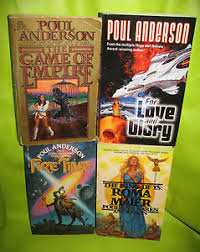
(In 1907, not only cars but even fountain pens were a new big deal!
See A Hundred Years Or So.)
For Love And Glory, XLV.
("XLV" means "45," doesn't it? The trouble with these Roman numerals is that you have to keep working them out. This one means "50 - 10 + 5.")
Lissa, Hebo and Dzesi are going somewhere important in a spaceship so we have to have a chapter set inside the ship as we do more than once with Dominic Flandry and others.
Stars seen through the viewscreen are:
"...gems of frost strewn through a crystal darkness. How often had she beheld this? Yet it never failed to stir awe deep within her." (p. 251)
How often has Poul Anderson described this, always differently?
Here is something that we did not know about life in spaceships:
"Full health on a long trip required weatherlike variations in air." (ibid.)
This chapter describes two variations:
"At the present stage of the cycle it bore a slight, electric tinge of ozone." (ibid.)
"The air rustled, cooling off, smelling more and more like a rainstorm drawing nigh." (p. 253)
Dzesi the Rikhan goes "'...to kshanta.'" (p. 251)
All that her human partner, Hebo, knows about kshanta is that:
"'It involves being alone for several hours.'" (p. 252)
Discussing the characteristics of intelligent races, Hebo comments:
"'I wouldn't call anything except their basic biology true of every culture and every individual in any race.'" (ibid.)
Right. Intelligence is the ability to change our environments and thus also to change ourselves in the process. Human variations look like different species. See:
"Homo Sum"
The Discovery Of The Past II
Showing posts sorted by date for query Rikhan. Sort by relevance Show all posts
Monday, 8 July 2019
Wednesday, 26 June 2019
A Cloud And A Scream
Poul Anderson, For Love And Glory (New York, 2003), III.
Lissa and the Gargantuan, Karl, discuss a large, newly discovered, Forerunner artifact with Hebo and the Rikhan, Dzesi. (I have to reread to get the names right.)
When Hebo suggests that the artifact is still working, maybe collecting data, Lissa leaps up spilling her drink and angrily stating that he has no right to keep this a secret. Of course, the others react, Dzesi with hand on knife etc, and, of course, nature also responds:
"A cloud passed over the sun, blown from the west. A wild creature screamed." (p. 25)
Precisely at this dramatic moment, the day darkens - momentarily - and an animal screams. In Anderson's works, natural phenomena - often the wind or the thunder of an approaching storm - punctuate the characters' conversations just as surely as the commas and the full stops. Readers probably do not notice - except that I have become alerted to every nuance of Anderson's prose. And please tell me of anything that you see that I miss.
Lissa and the Gargantuan, Karl, discuss a large, newly discovered, Forerunner artifact with Hebo and the Rikhan, Dzesi. (I have to reread to get the names right.)
When Hebo suggests that the artifact is still working, maybe collecting data, Lissa leaps up spilling her drink and angrily stating that he has no right to keep this a secret. Of course, the others react, Dzesi with hand on knife etc, and, of course, nature also responds:
"A cloud passed over the sun, blown from the west. A wild creature screamed." (p. 25)
Precisely at this dramatic moment, the day darkens - momentarily - and an animal screams. In Anderson's works, natural phenomena - often the wind or the thunder of an approaching storm - punctuate the characters' conversations just as surely as the commas and the full stops. Readers probably do not notice - except that I have become alerted to every nuance of Anderson's prose. And please tell me of anything that you see that I miss.
Thursday, 18 February 2016
Asborg
When an sf novel involves regular FTL interstellar travel, I would like to be told:
the galactic positions of the inhabited planets;
the distances between them;
the velocity of the FTL drive.
In the opening chapters of Poul Anderson's For Love And Glory (New York, 2003), Lissa returns from Jonna to Asborg via Gargantua and Xanadu whereas Hebo returns directly from Jonna to Earth. Hebo's companion, a Rikhan, may have returned to her home planet. So where are all these planets and how far apart are they?
Asborg is Sunniva III, thus the third planet of a star called Sunniva, just as Earth is Sol III.
Lissa is Lissa Davysdaughter Windholm of Asborg. Her father, presumably David or Davy, "'...has a major voice in Windholm's space operations.'" (p. 44) Windholm, Seafell and other Houses hold land on Asborg and "'...share in its governance...'" (p. 45) So what form does that governance take? Houses have different traditions and styles. Seafell's is commercial whereas Windholm's is communal. We have not been told much but it has not become necessary as yet.
the galactic positions of the inhabited planets;
the distances between them;
the velocity of the FTL drive.
In the opening chapters of Poul Anderson's For Love And Glory (New York, 2003), Lissa returns from Jonna to Asborg via Gargantua and Xanadu whereas Hebo returns directly from Jonna to Earth. Hebo's companion, a Rikhan, may have returned to her home planet. So where are all these planets and how far apart are they?
Asborg is Sunniva III, thus the third planet of a star called Sunniva, just as Earth is Sol III.
Lissa is Lissa Davysdaughter Windholm of Asborg. Her father, presumably David or Davy, "'...has a major voice in Windholm's space operations.'" (p. 44) Windholm, Seafell and other Houses hold land on Asborg and "'...share in its governance...'" (p. 45) So what form does that governance take? Houses have different traditions and styles. Seafell's is commercial whereas Windholm's is communal. We have not been told much but it has not become necessary as yet.
Thursday, 3 January 2013
Back To The Future
My edition of Poul Anderson's Mother Of Kings ends with a five page trailer for For Love And Glory, Anderson's last futuristic hard science fiction (sf) novel, which I have also not yet read.
Regular readers look out for any clue that a new novel belongs to an existing series. For example, a reference to an alien race of "Merseians" would instantly place any new novel within Anderson's main future history series, the History of Technic Civilisation.
Theoretically, this need not be the case. A fictitious species could inhabit more than one future timeline just as readily as terrestrial human beings do. For example, Lithians and their planet are destroyed in 2050 in James Blish's Trilogy yet still exist millennia later in one of his tetralogies. Nevertheless, an author usually signals that two stories are set in different futures by having the human protagonists of the stories meet different alien species.
This question arises here because For Love And Glory does return to the earlier sf idea of faster than light (FTL) interstellar travel in a multi-species galaxy where at least some extra-solar planets are humanly inhabitable whereas Anderson's other later works, the Harvest Of Stars Tetralogy and Genesis, had featured slower than light (STL) interstellar travel by artificial intelligences encountering very little organic life.
The trailer mentions:
" '...the Orcelin civilization...' " (p. 615);
"...an anthropard from Rikha or a Rikhan colony..." (p. 616);
the planet Gargantua;
Asborg - Sunniva III.
(That last must be either a planet called Asborg which is the third planet of a star called Sunniva or a city called "Asborg" on the third planet etc.)
None of these names is familiar so most probably this new novel exists in its own timeline. Another clue is that the human language spoken is "Anglay," not "Anglic" - as it would have been in the Technic History.
Artifacts left by Forerunners, clearly an earlier space traveling race, are mentioned. There were such forerunners in the Technic History although there they were variously referred to as Foredwellers, Ancients, Elders, Others and Old Shen. Even the use of a slightly different term, "Forerunners," implies that the new novel is set in a different timeline.
The Gargantuan resembles a tyrannosaur which makes him sound like a Wodenite from the Technic History except that the latter are centauroid/quadrupedal. Also, Wodenites appropriately speak in deep, rumbling voices whereas the Garagantuan, called "Karl" for human purposes, speaks inaudibly and communicates through an artificial translator.
Characters in the Technic History often refer to " '...this fraction of a single spiral arm which we have somewhat explored...' " (1) whereas Lissa Davysdaughter Windholm of Asborg reflects that "The galaxy's so huge, so various, and always so mysterious." (2) So maybe Lissa's people have fared further - with faster FTL?
The word "Windholm" occurs in the Technic History but as a place name, not as a surname. Patronymics are familiar from Anderson's Norse fiction. I cannot avoid the impression that familiar story elements are being rearranged somewhat.
(1) Poul Anderson, Flandry's Legacy, Riverdale, NY, 2012, p. 207.
(2) Poul Anderson, Mother Of Kings, New York, 2003, p. 617.
Regular readers look out for any clue that a new novel belongs to an existing series. For example, a reference to an alien race of "Merseians" would instantly place any new novel within Anderson's main future history series, the History of Technic Civilisation.
Theoretically, this need not be the case. A fictitious species could inhabit more than one future timeline just as readily as terrestrial human beings do. For example, Lithians and their planet are destroyed in 2050 in James Blish's Trilogy yet still exist millennia later in one of his tetralogies. Nevertheless, an author usually signals that two stories are set in different futures by having the human protagonists of the stories meet different alien species.
This question arises here because For Love And Glory does return to the earlier sf idea of faster than light (FTL) interstellar travel in a multi-species galaxy where at least some extra-solar planets are humanly inhabitable whereas Anderson's other later works, the Harvest Of Stars Tetralogy and Genesis, had featured slower than light (STL) interstellar travel by artificial intelligences encountering very little organic life.
The trailer mentions:
" '...the Orcelin civilization...' " (p. 615);
"...an anthropard from Rikha or a Rikhan colony..." (p. 616);
the planet Gargantua;
Asborg - Sunniva III.
(That last must be either a planet called Asborg which is the third planet of a star called Sunniva or a city called "Asborg" on the third planet etc.)
None of these names is familiar so most probably this new novel exists in its own timeline. Another clue is that the human language spoken is "Anglay," not "Anglic" - as it would have been in the Technic History.
Artifacts left by Forerunners, clearly an earlier space traveling race, are mentioned. There were such forerunners in the Technic History although there they were variously referred to as Foredwellers, Ancients, Elders, Others and Old Shen. Even the use of a slightly different term, "Forerunners," implies that the new novel is set in a different timeline.
The Gargantuan resembles a tyrannosaur which makes him sound like a Wodenite from the Technic History except that the latter are centauroid/quadrupedal. Also, Wodenites appropriately speak in deep, rumbling voices whereas the Garagantuan, called "Karl" for human purposes, speaks inaudibly and communicates through an artificial translator.
Characters in the Technic History often refer to " '...this fraction of a single spiral arm which we have somewhat explored...' " (1) whereas Lissa Davysdaughter Windholm of Asborg reflects that "The galaxy's so huge, so various, and always so mysterious." (2) So maybe Lissa's people have fared further - with faster FTL?
The word "Windholm" occurs in the Technic History but as a place name, not as a surname. Patronymics are familiar from Anderson's Norse fiction. I cannot avoid the impression that familiar story elements are being rearranged somewhat.
(1) Poul Anderson, Flandry's Legacy, Riverdale, NY, 2012, p. 207.
(2) Poul Anderson, Mother Of Kings, New York, 2003, p. 617.
Subscribe to:
Posts (Atom)