Showing posts sorted by date for query Clement Institute. Sort by relevance Show all posts

Sunday, 4 January 2026

Clement Planetology

For convenience, we have been rereading Poul Anderson's The Man Who Counts in a paperback edition with the alternative title, War Of The Wing-Men. Before that, we had been rereading this novel in the omnibus collection, The Earth Book Of Stormgate. However, if we are to reread an introduction that Poul Anderson, as opposed to Hloch of the Stormgate Choth, had written for the novel, then we must turn back to The Technic Civilization Saga, Volume I, The Van Rijn Method, where the Compiler, Hank Davis, re-presents Anderson's earlier introduction as an afterword. 

Anderson informs us that:

"...Hal Clement's marvelously detailed and believable fictional worlds..."
-Poul Anderson, AFTERWORD IN Anderson, The Van Rijn Method (Riverdale, NY, December 2009), pp. 513-515 AT p. 513 -

- were one "wellspring" of this early novel. 

This explains why Adzel studies at the Clement Institute of Planetology earlier in the Earth Book and on p. 187 of The Van Rijn Method. 

Anderson's account of Clementian creation:

a star's age, chemistry, mass, luminosity etc
a planet in a given orbit
the length of its year
its irradiation level
its surface features
its kind of life
the evolution of that life
the odour of a flower
that odour's meaning to an individual

A Clementian paragraph in Anderson's text:

"This atmosphere carried the dust particles which are the nuclei of water condensation to a higher, hence colder altitude. Thus Diomedes had more clouds and precipitation of all kinds than Earth. On a clear night you saw fewer stars; on a foggy night you did not see at all."
-War Of The Wing-Men, XV, p. 103.

Wednesday, 16 April 2025

Two Future Histories And Some Juveniles

There are similarities - although not identities - between extraterrestrial settings in:

Robert Heinlein's Future History;
Heinlein's fourteen juvenile sf novels;
Poul Anderson's Technic History.

However, Anderson combines detailed, colourful descriptions of planetary surfaces with scientific background information about planetary environments, their orbits, densities, metallic contents etc. In this, he is equaled or surpassed by Hal Clement whose Mission Of Gravity I read once about six decades ago. (In Anderson's "How To Be Ethnic In One Easy Lesson," Adzel, a future planetologist, has come from the extra-solar planet, Woden, to Earth to study at the Clement Institute of Planetology.)

Venus is colonized in the Future History, in the Technic History and in some of Heinlein's juveniles although, in the Technic History, this is merely alluded to. Some of the characters have spent time on the incompletely terraformed Venus but the action is elsewhere, mainly outside the Solar System. However, terraforming Venus is a major part of Anderson's earlier future history series, the Psychotechnic History.

Some Technic History instalments are Heinleinian juvenile sf: young human heroes interact with aliens in exotic settings. Thus, it makes sense to compare Anderson's main future history series with Heinlein's Future History and juveniles. The juveniles move forwards but also sideways in time. Thus:

Rhysling, the "Blind Singer of the Spaceways":

features in "The Green Hills of Earth," a Future History story;

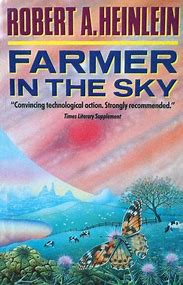
is quoted in Farmer In The Sky, a Scribner Juvenile novel and a volume of what I call Heinlein's Juvenile Future History;

visits Anderson's inter-universal Old Phoenix Inn.

Thursday, 30 May 2024

FIRE TIME: The Ballantine Edition


Poul Anderson, Fire Time (New York, 1975).

We can begin by appreciating the physical artefact of a book in our hands. I am holding a Ballantine Books edition of Fire Time. See image.

First, a cover illustration that indicates either fantasy or sf. 

Secondly, the front cover blurb: "A big, bold novel of interplanetary conflict and intrigue!" The publisher could have added: "Assuming that that is your idea of a good time, of course..." How many potential readers will be instantly warned off by that single word, "interplanetary"?

Inside the front cover: maps of the Anubelean System and the planet, Ishtar.

Inside the back cover: map of the Gathering of Sehala. (We are not supposed to know what this means yet and will probably not have looked this far ahead, in any case.)

Returning to the beginning but then glancing ahead, we find that the text commences, very properly, on page 1. Between the cover and page 1, there are eight unnumbered pages which we can enumerate as pp. i-viii.

p. i is three paragraphs of blurb introducing some of the characters and their setting.

p. ii lists two other titles on the Ballantine Books list, Brain Wave and A Midsummer Tempest. We reflect on how dissimilar these three works are, almost as if written by different authors:

A Midsummer Tempest is a fantasy novel set in an alternative seventeenth century, is a sequel to two Shakespeare plays and connects with other alternative historical fantasy works by Anderson;

Brain Wave is near future sf about a change in human nature;

Fire Time, set in an interstellar future, is a sequel to The Star Fox, although perhaps readers do not realize this yet.

p. iii is the title page (almost like an inside cover).

p. iv is publication information.

p. v is the dedication "FOR HAL CLEMENT, worldsmith". (Adzel studies at the Clement Institute in Anderson's Technic History.)

p. vii is blank.

p. 1 is the beginning of "FOREWORD" and that is all from me this lunchtime! 

Friday, 22 March 2024

Planetology

Planetology is a science and will exist in futures. 

In Poul Anderson's Technic History:

Adzel studies at the Clement Institute of Planetology;

a trade pioneer crew comprises a Master Merchant, a planetologist and a xenobiologist;

Adzel still reads planetological journals even when in a monastery.

In Dune:

Liet-Kynes is "'...His Imperial Majesty's Planetologist...planetary ecologist for Arrakis.'" (Dune, p. 259)

We also find references to planetography which might correspond to planetary geology. The latter is a planetary science, thus a kind of planetology.

Monday, 1 May 2023

Earth In The Solar Commonwealth II

"How To Be Ethnic..."

Adzel, the single Wodenite on Earth, commutes by gyrotrain from a rented shack in "...a moldering conurb..." (p. 189) of the San Jose district of San Francisco Integrate to his laboratory and lectures at the Clement Institute of Planetology and probably has problems feeding his massive body on his League scholarship. He drinks a lot of whiskey and champagne which seems unusual for a Buddhist but we must make allowances for differences of period and species. 

Whereas Jim Ching favours restaurants serving outsystem food, Adzel happily accepts:

"...an unlimited meal ticket at the Silver Dragon Chinese Food and Chop Suey Palace." (p. 195)

- after his performance as the dragon in a Chinese parade has led to a revival of the Lunar New Year celebration.

I have scoured this short story for information about life on Earth in the Solar Commonwealth but have perhaps exhausted it by now. "Lodestar," although set entirely off Earth, also conveys a sense of life in the Commonwealth a short while later.

Wednesday, 24 November 2021

Earlier Stories

The story that introduces Adzel as a member of Nicholas van Rijn's first trade pioneer crew includes the following dialogue:

Adzel: "'And when I got a scholarship to study planetology on Earth, I earned extra money by singing Fafnir in the San Francisco Opera.'"
Chee Lan: "'Also by parading at Chinese New Year's...'"
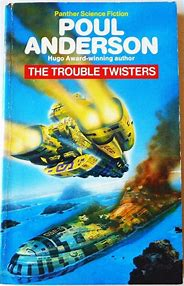
-Poul Anderson, "The Trouble Twisters" IN Anderson, David Falkayn: Star Trader (Riverdale, NY, 2010), pp. 77-208 AT II, p. 93.
 
Nine years after the publication of that story, Anderson brilliantly derived "How To Be Ethnic In One Easy Lesson" from it. Young Adzel is studying at the Clement Institute of Planetology in San Francisco and needs money...
 
In "Margin of Profit," which introduces van Rijn, that Master Merchant recounts the following anecdote from the days when he himself "'...was a rough and tumbler...'" (p. 143):
 
a petty native prince had conditioned a man to keep him as a technical expert;
van Rijn and his companions caught the man and took him home for treatment;
before leaving, they blew up the palace.
 
That anecdote also could have been expanded into a prequel story but we can't have everything.

Monday, 1 February 2021

Two Tributes

The Game Of Empire, CHAPTER ONE.

The Jerusalem Catholic Galilean Order maintains a university in Port Campbell on Woden. Although I have mentioned Port Campbell before (see Woden), I did not allude to the fact that its name is an obvious tribute. See John W. Campbell.

Thus, in Poul Anderson's Technic History, one Wodenite, Adzel, studies at the Clement Institute whereas another, Axor, studies in Port Campbell.

And I have a feeling that there is a third such tribute somewhere about.

Thursday, 7 January 2021

Ad Astra

How many ways are there to a life in space?

In A Life For The Stars, the juvenile novel in James Blish's Cities In Flight, Chris DeFord is shanghaied by the city of Scranton when it goes Okie. Chris transfers from Scranton to New York where eventually he becomes city manager for Mayor John Amalfi.

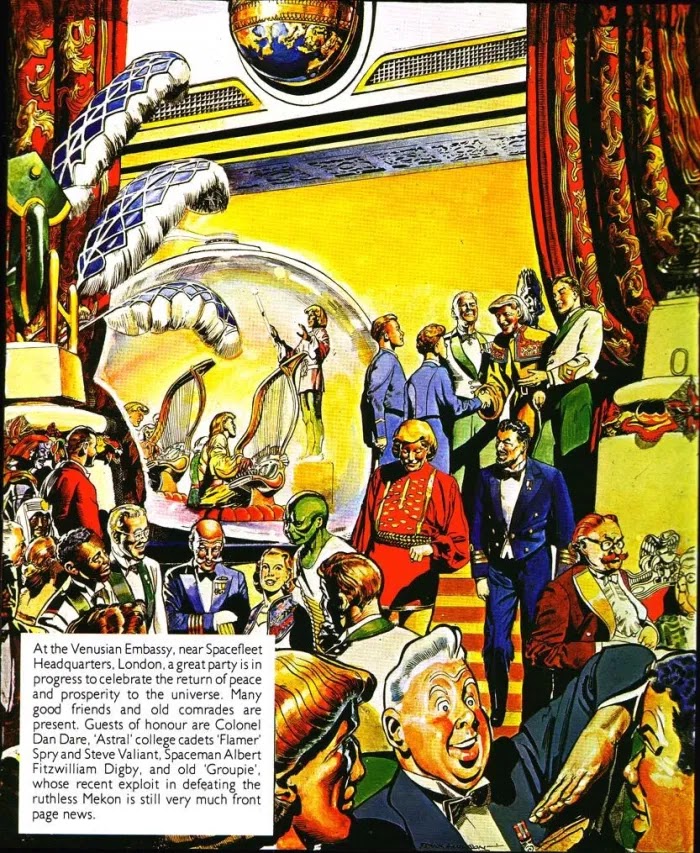
In the Dan Dare comic strip, Cadet Flamer Spry and other young Solar beings were enrolled in the Astral Space Academy from which they would graduate to the Interplanetary Space Fleet.

In Poul Anderson's "How To Be Ethnic In One Easy Lesson," (see here) Jim Ching wants to attend the "Academy" which seems to be run by "...the Brotherhood." (p. 51) Is this the Federated Brotherhood of Spacefarers, the trade union that represents Solar Spice & Liquors employees in "Margin of Profit," later to be replaced by the United Technicians in Mirkheim?

Also in "How To Be Ethnic...," Adzel from Woden has gained a League scholarship to study planetology at the Clement Institute on Earth and later will become the planetologist in SSL's first trade pioneer crew led by van Rijn's protege, David Falkayn.

Finally, in "How To Be Ethnic...," Adzel arranges an apprenticeship with a Master Merchant for Jim, thus enabling the latter to bypass the Academy. Finally for this post and this evening, see here for how Eric Wace, born in a slum near Triton Docks, became the SSL factor on Diomedes.

Our five young spacefaring heroes are:
 
Chris DeFord 
Flamer Spry
Jim Ching
Adzel
Eric Wace

Robert Heinlein's Scribner Juveniles are another story, too long to summarize here.

Saturday, 4 May 2019

Obscure Terms II

See Obscure Terms.

"'...German...'" (p. 187)

"...the Clement Institute of Planetology." (ibid.)

"...the San Jose district." (ibid.)

"...gyrotrain..." (ibid.)

"...the lotus position..." (p. 188)

"...'Om mane padme hum'..." (ibid.) (There might be Buddhists among human Ythrians, of course.)

"An Old Japanese screen..." (p. 189)

"...the Compassionate Buddha." (ibid.) (Again, the Ythrian Faiths are not long on compassion.)

"...pipa music..." (p. 190)

Adzel explains the Chinese dragons.

"...Richard Wagner's Siegfried." (p. 196)

Thursday, 28 September 2017

Hal Clement

In Poul Anderson's Technic History, Adzel studies at the Clement Institute of Planetology on Earth and, in Anderson's Genesis, Christian Brannock works in Clement Base on Mercury.

Poul Anderson referred to:

"...Hal Clement's marvelously detailed and believable fictional worlds."
-Poul Anderson, Afterword to The Man Who Counts IN Anderson, The Van Rijn Method (Riverdale, NY, 2009), pp. 513-515 AT p. 513.

In his SFWA Bulletin article, Anderson described The Man Who Counts as a Hal Clement-style novel and stated that Clement's works brilliantly hinted at the variety, strangeness and wonder of the universe.

Clement is to fictional planetology what Harry Turtledove is to alternative histories or Asimov is to robots. Anderson excels at all these themes. I read Mission Of Gravity once in the 1960s but have gone no further with Clement.

Sunday, 16 October 2016

Adzel On Earth

(Chinese New Year in Lancaster.)

Adzel, who will be the planetologist in Nicholas van Rijn's first trader team, studies at the Clement Institute of Planetology, a tribute to Hal Clement.

James Ching writes that:

"Adzel talks a lot about blessings in disguise..." (The Van Rijn Method, p. 177)

I suppose any painful experience potentially is, or at least can be seen as, a blessing because it is a challenge to reflect on experience. But the opportunity for reflection might be after, rather than during, the experience? Gautama who became the Buddha was untroubled while being brought up in secluded luxury but was shocked and began to look for answers when abruptly confronted with sickness, old age and death. Adzel learns to regard long delays in commuting as opportunities for study or meditation. Perhaps, despite their possession of bodies, experienced meditators can come to resemble the hypersomatic being described to CS Lewis by Ransom:

"'Not waiting. They never have that experience. You and I are conscious of waiting, because we have a body that grows tired or restless, and therefore a sense of cumulative duration. Also we can distinguish duties and spare time and therefore have a conception of leisure. It is not like that with him. He has been here all this time, but you can no more call it waiting than you can call the whole of his existence waiting. You might as well say that a tree in a wood was waiting, or the sunlight waiting on the side of a hill.'"
-CS Lewis, The Cosmic Trilogy (London, 1990), p. 168.

(There are some challenging thoughts in the Ransom Trilogy. This passage is in Perelandra/Voyage To Venus, Chapter 2.)

Adzel drinks whiskey in beer tankards, plays chess and poker, sings well and has converted to Buddhism.