Showing posts with label Tales of the Flying Mountains. Show all posts

Monday, 21 March 2016

STL Or FTL

We, or at least I, think of interstellar future histories as either FTL, e.g., Poul Anderson's Psychotechnic and Technic Histories, or STL, e.g., Anderson's Maurai, Flying Mountains, Rustum, Kith, Harvest Of Stars and Genesis histories or Larry Niven's Leshy Circuit series.

(The mostly Earth-bound Maurai History goes interstellar in the time travel novel, There Will Be Time.)

However, some future histories have an STL period followed by an FTL period:

Robert Heinlein's Future History has generation ships, then Libby's FTL drive;

the Psychotechnic History has a generation ship, then the hyperdrive;

in Larry Niven's Known Space History, the Thrintun had FTL but the Pak did not;

also in Known Space, the early Man-Kzin Wars were fought at sub-light speeds but men won decisively when they had acquired the hyperdrive.

In an STL period or history, interstellar journeys last for objective decades or centuries but the travelers benefit from time dilation which alters perceptions of aging and of social change.

Two kinds of -

- imaginative fiction: fantasy and sf;
- sf: hard and soft;
- future history: British and American;
- interstellar travel: STL and FTL;
- time travel: circular causality and causality violation. 

Sunday, 28 February 2016

A Unique Evolution

Let us consider the unique evolution of Poul Anderson's eight future histories in more detail. Since the first two histories have FTL, aliens and interstellar empires whereas the last two have STL, no aliens and human-AI interaction, that leaves four intermediate histories, none with FTL. It is as if Anderson deconstructs future histories, then rebuilds them from first principles.

In the Maurai History, mankind recovers from nuclear war and has barely resumed space travel by the end of the series - although the related time travel novel, There Will Be Time, tells us about an interstellar future.

In Tales Of The Flying Mountains, mankind colonizes the asteroids and is just beginning extrasolar colonization by the end of the series.

In the Rustum History, several extrasolar planets are colonized.

In the Kith History, there is interstellar trade. This history exists in two versions. In the first, there is a Star Empire and a journey to the galactic center at relativistic speeds by political exiles. In the second, there is a long journey to visit an alien civilization. So much time elapses that the theme of the rise and fall of civilizations returns.

In the last two histories, AI takes over.

Saturday, 27 February 2016

Flying Mountains

In Larry Niven's and Jerry Pournelle's The Mote In God's Eye (London, 1959), an asteroid is described as a "...flying mountain." (p. 159) This evokes yet another Poul Anderson future history, although not one of the sequence of seven: Tales Of The Flying Mountains.

In ...Mountains, as in James Blish's Cities In Flight future history, space technology is based on control of gravity although in this case such technology facilitates asteroidal colonization but does not lead to an FTL drive.

I identified six future historical themes:

(i) near future technological advances and social changes;
(ii) a period of interplanetary travel;
(iii) an FTL drive;
(iv) extrasolar colonization;
(v) interstellar imperialism;
(vi) the rise and fall of civilizations -

- while acknowledging that not every future history addresses all of these themes. In fact, ...Mountains can alternatively be summarized as follows:

(i) and (ii) as above;
(iii) an STL drive;
(iv) the first extrasolar colonists still in flight.

...Mountains focuses on (ii) the interplanetary period and thus parallels:

Heinlein's The Green Hills Of Earth;
Asimov's I, Robot;
Blish's They Shall Have Stars;
Niven's Lucas Garner/Gil the Arm stories.

Anderson's other future histories also diverge from the (i)-(vi) model by omitting (iii) FTL and (v) interstellar imperialism.

Friday, 25 September 2015

The Short Future Histories

The previous post postulated a conceptual sequence comprising one future history each by Heinlein and Niven and four by Anderson. Anderson succeeds Heinlein but also surpasses him both in the number of his future histories and in their length and scope.

For completeness, we should also mention four shorter and more specialized future history series by Anderson, covering respectively:

post-nuclear Earth;
asteroid colonization;
extrasolar colonization;
interstellar trade;
interstellar exploration.

The Kith history exists in two forms, the first emphasizing trade, the second emphasizing exploration. As always when formulating such lists, I learn more in the process.

Meanwhile, we have been assured that SM Stirling's Under The Yoke should still be in the post, Volume II not of a future history about men versus technology but of an alternative history about men versus men.

Tuesday, 21 April 2015

Pollution Of Space?

Comments on the post "Mountebanks And Bacaudae" raised the question: can space be polluted? Googling "Pollution of Space" reveals some articles on the subject. See here. The passage in Poul Anderson's Orion Shall Rise (London, 1988) that I had in mind was:

"'...we will never, never see Earth turned into a residential garden supplied by industrial parks throughout the Solar System. It is in the nature of man that he fouls his own nest.'" (p. 337)

The first sentence says not that space will be polluted but that space industries will not be used to make a pollution-free environment on Earth. However, the second sentence does imply that mankind will generate waste and destruction in any environment, here or elsewhere. If parts of the Moon are colonized but others are used to dump nuclear waste, will these areas encroach on each other - especially if rival groups are involved? We need palaces, not slums, off Earth. Anderson gave us the example of the Selenarchs in Harvest Of Stars. His "Sunjammer" shows how orbiting instruments could be damaged by chemical contamination of near-Earth space.

Friday, 17 April 2015

Jupiter

I like Poul Anderson's descriptions of vast three dimensional environments traversed by space explorers. see here and here. Another is the Jovian atmosphere. I know three kinds of fictional Jupiter:

those with a solid surface;
those that are dense gasses all the way down to a solid core - real gas giants;
the one in Poul Anderson's "What'll You Give?" which has a surface although it is too far down under a dense atmosphere for anyone to see it.

In that third case, Anderson describes a flight through the atmosphere. We will consider this in more detail when I am not rushing out to a social event.

Solar Flare II

OK. I have answered the questions that I asked in "Solar Flare." I just had to reread carefully. Some readers must be thinking that it is too obvious to be stated.

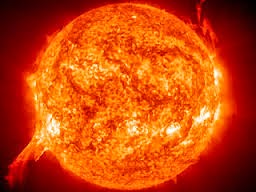
If the cargo had remained unshielded, then the solar flare would have detonated it, killing the herdship pilot and contaminating near-Earth space. The only solution was to haul the cargo away from near-Earth space, then to jettison the gas into space, and to do all this before the flare arrived - a race against time.

Removing the cargo from near-Earth space prevents contamination of that space. Jettisoning the gas prevents any explosion even further out. Doing all this as quickly as possible minimizes the period during which the pilot is vulnerable to an explosion caused by the flare. Even if a heavily armored man survived the explosion, he would soon be killed by flare radiation.

However, shielding the cargo with the sliced up sail prevents an explosion even after the arrival of the flare. By hauling the cargo away from the Sun until the flare subsides, the pilot saves the isonitrate to be collected by tugs. Future cargos will be shielded to prevent a repeat disaster. This time, only the sail must be sacrificed  - and parts of it might sell as souvenirs! (Anderson's heroes always solve economic as well as technical problems.)

Reviewing STL Future Histories

Here are three pieces of science fiction jargon:

sf;
STL;
future histories.

Poul Anderson's sf (science fiction) includes six STL future histories (fictitious histories assuming slower than light interstellar travel):

Flying Mountains, about asteroid colonization;
Rustum, about extrasolar colonization;
the Directorate, also about extrasolar colonization;
Kith, about interstellar trade and exploration;
the Harvest Of Stars tetralogy, about human-AI interaction:
Genesis, about human-AI interaction and post-human AI.

The arrival of the third NESFA collection of Poul Anderson's short works has diverted me from posting about Starfarers, the Kith future history novel. Instead, there have been posts on Rustum and Flying Mountains.

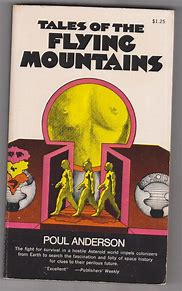
Tales Of The Flying Mountains is a single volume future history series comprising seven installments linked by a long introductory and interstitial conversation presented in a Prologue, six Interludes and an Epilogue. Four of these installments are re-presented in NESFA collections.

In NESFA Volume 2:

"The Rogue," with part of its introductory Interlude, under its original title, "Industrial Revolution";
"Say It With Flowers."

In NESFA Vol 3:

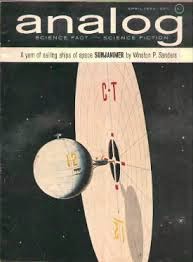
"Sunjammer";
"What'll You Give?" whose title had been translated into French for Tales...

That leaves only "Nothing Succeeds Like Failure," "Ramble With A Gamblin' Man," and "Recruiting Nation" which, I think, will not appear in any NESFA collections because they were first published in Tales... and therefore had not originally been published as "short works."

In "Sunjammer," which I have just reread, a sailship transports isonitrate to Earth whereas, in "What'll You Give?" a scoopship collects the ingredients for isonitrate from the Jovian atmosphere, so I will reread "What'll You Give?" next.

Solar Flare

(See recent posts.)

How To Save Lives, Prevent The Cargo From Exploding And Also Avoid Having To Jettison It In Space

Get crew from several ships to cut the sail into fifteen-yard squares.
Layer the squares within a welded framework to shield the cargo section.
Keep shield, cargo section and hauling herdship facing directly into the blast of the solar flare.
The herdship pilot, loaded with anti-fatigue pills and psychodrugs, must continually counteract gravity which tries to swing the ensemble into orbit.

I have done my best to understand both the danger and the means taken to avert it but still have some questions which arise purely from my lack of scientific and technical knowledge:

we are told that the herdship's own internal shielding "...drank up..." (p. 242) lethal radiation which seems to mean that the herdship crew would have been safe in any case?;

they haul the cargo to where a tug can collect it in the Moon's shadow whereas their previous plan had been to "...valve it out..." (p. 225) at a safe distance from Earth and Moon so why has the use of the improvised sail shield changed this part of the plan?

I am sure that the answers to these questions are obvious to readers with any knowledge of celestial mechanics.

Isonitrate II

I never thought that "isonitrate" would warrant a second post.

An interplanetary industrial process:

scoopships collect substances, including metal atoms, from the Jovian atmosphere;
an orbital station processes these complexes into dangerously explosive isonitrate;
unmanned sailships/sunjammers, moved outward by light pressure or inward by gravity, take months to tack between orbits;
a sail is a metal-coated carbon compound sheet, continually eroded by micrometeorites and eventually replaced;
each sailship also has sensors, automata, signalling equipment and motors that are powered by solar batteries and controlled by a pilot computer;
the motors control rotation and precession of the sail;
one sailship cargo is a ten yard diameter sphere containing cold, liquefied, high pressure, high energy isonitrate, shaded by the sail to prevent boiling;
Earth pays the asterite Beltline Transportation Company well for this cargo, needed to start several chemical syntheses;
Beltline herdships/maintenance ships stay close to the orbits of sail and power craft;
thus, when an isonitrate cargo is endangered by an imminent solar flare, a herdship crew is on hand to detach the sail and other mass, then hook the cargo to their ship and haul it to a safe distance from Earth and Moon before valving it out.

I have learned far more about these processes by summarizing them than by merely reading about them. Readers without a scientific or technical background are at a disadvantage with this kind of hard sf.

Thursday, 16 April 2015

Isonitrate

"'Cargo of...I say, this is an odd one. She's carrying eight hundred metric tons of isonitrate from the Sword's Jovian-orbit plant.'" (NESFA Vol 3, p. 224)

I thought that I was going to have to google "isonitrate." However, Golescu asks, "'Isonitrate what?'" (ibid.) and is answered:

"An important industrial chemical,' West explained. 'Alkali complex of 2, 4 benzoisopro -'" (ibid.) -

- at which point Golescu interrupts, saying that he is sorry he asked. I took this to mean that isonitrate was invented for story purposes by Anderson but then googled to make sure and found something that seems to be a different meaning of the word.

At any rate, Anderson's isonitrate will explode if, as expected, the sun flares, so it has to be hauled out of the danger area or should I say volume. The gaseous metallic-complex molecules would cause billions of dollars of economic damage by contaminating orbiting photocells, monitors, spectrometers, weather satellites, manned space stations and cybernets controlling radio relays or Mossbauer clocks. (Someone might have better luck than I did on googling "Mossbauer clock.")

This story is overly technical even for Anderson but, of course, the characters are real people arguing politics and wanting to get back home safe and sound.

"Sunjammer"

Over breakfast, I make a big decision. Should I continue to reread previously read stories in the third NESFA collection of Poul Anderson's short works or instead return, without further delay, to rereading his future history novel, Starfarers?

It is impossible to read or reread anything by Anderson without learning something. In the second paragraph of "Sunjammer" (NESFA Vol 3, pp. 221-243), we read that the Andromeda galaxy is one and a half million light years away. I thought that it was two million. To settle the matter, I check Wiki, which says two and a half million! Lesson learned: we really do only have approximations for cosmic distances.

In the same paragraph, Earth seen from space is described as "...a cabochon of clear and lovely blue..." and Luna as "...a tarnished pearl beyond." (p. 221)

Two thoughts:

beautiful, well-observed descriptions, as in the phrase that generated the title, A Stone In Heaven (see here);
another to me unfamiliar word.

I will reread the rest of "Sunjammer."

Monday, 6 April 2015

Moments Of Realization

Exhaustive though this blog may be, it falls well short of an Encyclopedia. Every time I find a "moment of realization" in an Anderson story or novel, I draw attention to it but there is no way that I am going to catalogue them all.

"The Dutch...fought themselves free of Spain and free of the ocean itself; when the French or Germans came, they made the enemy sea their ally -
"The bottle fell from his grasp."
-NESFA Vol 2, pp. 71-72.

In other words, this asterite, not at sea but in space, has just realized how he can fight the North Americans - but we will find out what he is going to do when we see him doing it. And I do not remember although I have read the story at least twice.

A surprise ending is a moment of realization for the reader. This story, "Industrial Revolution," begins with a reminiscent dialogue involving a "Missy Blades." (p. 48) The body of the story is an extended flashback during which Mike Blades interacts with two women, his secretary and an enemy North American. So which of them will become his wife and widow? Only the surprise ending will tell us.

"Cold Victory" in the Psychotechnic History begins with a dialogue, then presents an extended flashback featuring two brothers on opposite sides in a civil war, then ends by showing us that we had been misled as to which of the brothers was involved in the opening dialogue. Thus, another moment of realization for us.

Sunday, 5 April 2015

"That Flowing Spaceman's Pace..."

Robert Heinlein's Future History was rightly said to have given the future a daily life. Heinlein concentrated on lunar colonization. Poul Anderson and Larry Niven followed this with asteroidal colonization.

"He...stepped off toward the nearest entry lock with that flowing spaceman's pace which always keeps one foot on the ground. Even so, he didn't unshackle his inward-reeling lifeline till he was inside the chamber."
-Anderson, NESFA Vol 2, p. 51.

On an asteroid whose rotation counteracts its minimal gravity, Mike Blades wears grip-soled boots, keeps one foot on the ground and uses a life-line. Anderson writes as though he and his readers were familiar with that flowing spaceman's pace.

I distinguished between social and political stories when discussing Anderson's Psychotechnic History. Mike Blades' story in the Flying Mountains future history contains both of these elements, details of daily life in an asteroid but also political tension after a change of government back on Earth. I know from experience that members of armed services avoid political argument with civilians. They are probably warned against this. Yet a visiting Navy man blurts out that Belt companies are:

"...only using natural resources that rightly belong to the people, and the accumulated skills and wealth of an entire society." (p. 58)

This insensitivity plus intelligence-gathering questions from other Naval personnel indicate that trouble is brewing.

"Cold And Vacuum And Raw Rock..."

Michael Blades, hanging upside down from the wide end of a truncated pyramidal asteroid, seeing pitted rock, jutting crags, black shadows, glaring lamps, a cliff-like horizon mere kilometers away and crowding stars, thinks:

"You couldn't escape from people on Earth. Cold and vacuum and raw rock and everything, the Belt was better."

-Poul Anderson, "The Industrial Revolution" IN Anderson, The Collected Short Works Of Poul Anderson, Volume 2: The Queen Of Air And Darkness (Framingham, MA, 2009), pp. 48-80 AT p. 51.

Well, I prefer people! However, if enough people think like Mike, then the human race will colonize the Solar System. Poul Anderson and Larry Niven have shown that mining the Asteroid Belt will be profitable even if making it comfortable to live there will take a lot more work.

Friday, 6 December 2013

The Makeshift Rocket II

I did not read anything else last night because of the TV coverage of Nelson Mandela's death.

Poul Anderson's The Makeshift Rocket (New York, 1962) has the gyrogravitics of his Tales Of The Flying Mountains and, I think, the same fictitious Martian race as his "Captive of the Centaurianess," although it does not belong in the same timeline as either of those works.

With gravity control, it would theoretically be possible to terraform the asteroids, as in Flying Mountains and here. First, it would be possible to give them enough gravity to hold a breathable atmosphere. Then, if there were also an adequate source of heat, soil and plants could be imported. However, this does read like a fantasy rather than a hard sf version of the Solar System:

"Beyond the little spacefield was a charming vista of green meadows, orderly hedgerows, cottages and bowers, a white gravel road. Just below the near, sharply curving horizon stood Grendel's only town; from this height could be seen a few roofs and the twin spires of St George's. The flag of the Kingdom, a Union Jack on a Royal Stuart field, fluttered there under a sky of darker blue than Earth's, a small remote sun and a few of the brightest stars. Grendel was a typical right little, tight little Anglian asteroid, peacefully readying for the vacation-season influx of tourists from Briarton, York, Scotia, Holm, New Winchester, and the other shires." (pp. 8-9)

This sounds as if it belongs in a magical realm of broomsticks and flying carpets. A very sharply curving horizon, I should think. Some blue in the sky, because of the atmosphere, but not much. Imagine what would happen if the gravity control failed. And who brought the Stuarts back? A worldlet with only one town but with easy transport to and from several other worldlets.

As always, Anderson thinks through the physics of his fictional technology. In order to hold the atmosphere, the gyrogravitic generators at the center of mass maintain one gee to an altitude of 2000 kilometers but thereafter the artificial attraction drops to zero within one kilometer. It is not easy for a spaceship with its negative force to cross this boundary - although HG Wells' Cavor might have felt at home here.

Thursday, 28 February 2013

Asteroid Economics

 In the Asteroid Republic of Poul Anderson's Tales Of The Flying Mountains (New York, 1984):

" '...the government is committed to noninterference in private enterprise; most transactions are not a matter of public record.' " (p. 279)

Thus, fraud and theft that could well have sabotaged the first interstellar spaceship might have gone undetected.

Can the asteroid economy:

avoid a boom-slump cycle;
continue to employ the skills of all the asterites;
continue to raise standards of living across the Belt and back on Earth;
avoid further wars?

If so, then it will indeed be one version of "Utopia" (p. 271). Our present global economic system generates vast wealth but also concentrates it in fewer hands, thus paradoxically generating both wealth and poverty, production and destruction, simultaneously. Starvation coexists with technological warfare. Can this system resolve its internal contradictions simply by moving into space? I think not but would welcome the opportunity for mankind to answer this question either way in practice instead of just in the pages of speculative fiction.

We need some self-sustaining space colonies in case destruction overcomes production on Earth, or indeed in case a comet or asteroid sends us the way of the dinosaurs. Any organised society, whether on or off Earth, is preferable to barbarism or extinction. I say "any organised society" because even a despotism, which is certainly not advocated either by Anderson or by me, would eventually fall or be overthrown.

"Sunjammer"


The sixth story in Poul Anderson's Tales Of The Flying Mountains (New York, 1984), "Sunjammer," is yet another technical problem item. This time, the technicalities obtruded and I did not understand very well what was going on. As in "Ramble With A Gamblin' Man" and "Que Donn'rez Vous?," there was a moment when one of the characters suddenly realized the solution to the current problem although this was not divulged to the reader until nearer the end of the story.

The characters are asterite, British and American and there is lingering hostility from the revolutionary war, at least between the asterites and the Americans. The asterite Storrs thinks:

"There isn't a government of any importance anywhere on Earth these days that isn't based on some version of  'social justice.' So of course independent thinking, conscientiousness, ordinary competence have gone by the board." (p. 215)

That is a strong statement. The character, and behind him the author, disagrees with government policies so all government officials have become dependent, unconscientious and incompetent? This is to some extent counterbalanced by the British character West thinking:

"That's another thing I don't like about the Republic. They can brag as much as they want about free enterprise, but it still amounts to the rawest, most cold-blooded kind of capitalism. Maybe the welfare states on Earth have gotten stuffy and overbureaucratized - nevertheless, we don't let the devil take the hindmost!" (p. 220)

Here, the character is definitely not a mouthpiece for the author and does acknowledge some qualification of his own point of view. There is a brief political exchange between Storrs and West. When Storrs speaks disrespectfully of an American official, West remarks:

" 'Don't be too hard on the man...When a world gets as crowded as that one there, you have to operate by a rigid system.' " (p. 221)

Do you? Greater participative democracy might generate new solutions, including how to reduce the crowding?

West continues:

" 'Within the system, I presume he's doing his best.' " (p. 221)

- to which Storrs replies:

" 'A machine is judged by its output. How's your precious system performing in this mess?' " (p. 221)

- but West has the last word with:

" 'Oh, forget the political arguments. There's England [seen from space].' " (p. 221)

West thinks of "...the little house in Kent..." (p. 221) Anderson's characters remain first and foremost human beings, not sloganeering stereotypes. 

Recruiting Nation


In Brian Aldiss' one volume future history, Galaxies Like Grains Of Sand, individual short stories set in successive future epochs are linked by italicized interstitial passages bridging the temporal gaps between the stories.

In Poul Anderson's one volume future history, Tales Of The Flying Mountains (New York, 1984), individual short stories set during successive decades and generations of the colonization of the asteroids are linked by conversational passages set inside the first interstellar spaceship. (Another good conversationally linked series is Neil Gaiman's The Sandman: Worlds' End but that is not a linear history, more of a multitemporal cosmography.)

Anderson's cosy conversations sometimes serve the same purpose as Aldiss' cosmic commentaries. One of the speakers in Interlude 6 informs us that Earth became:

" '...steadily more comfortable, as material resources flowed in from space...The average Earthling took advantage of this opportunity to relax, to enjoy more leisure and security.' " (p. 250)

That is a relief. Until now, in this volume, the picture has been of Terrestrial resources strained by unemployed masses voting for expensive social welfare, then demonstrating and rioting if their standard of living is threatened.

The seventh story, "Recruiting Nation," confirms the rosier picture of a further future and even uses the term "Utopia," which is then explained as follows:

" 'Everywhere on Earth you can enjoy economic as well as physical security, a peaceful, orderly existence. If that starts feeling too stuffy, you can move into space. There the boom guarantees you can find work at high pay...' " (p. 272)

Terraformed asteroids have even become comfortable enough to breed "'...loafers...wastrels...'" (p. 273)!

Appropriately, this last story is set on the interstellar spaceship while it is being readied for flight. The narrator of the Prologue and Interludes, Winston P. Sanders, comes to the ship to solve a technical problem that turns out to have been a human problem (parts are not failing but the chief engineer is pretending that they are so that he can steal and sell them) and stays for the flight (as the new chief engineer). He ends the story in conversation with the man who is to become president of the civil government within the ship, Amspaugh. He and Amspaugh have been in the spaceship conversation from the Prologue so the flashbacks of the stories have at last caught up with the on-going narrative of the Interludes and the last story flows easily into the Epilogue. This is a very well crafted future history.

Tuesday, 26 February 2013

"Que Donn'rez Vous?"


In "Que Donn'rez Vous?" (Poul Anderson, Tales Of The Flying Mountains, New York, 1984), a spaceship engine has failed; the ship, with its single occupant, is sinking into the Jovian atmosphere.

A rescue attempt would:

almost certainly fail;
endanger the lives of the rescue team;
be prohibitively expensive in terms of resources.

Thus, the problem is technical, human and economic. A fellow pilot devises a way to reduce the danger to the rescuers: technical problem solved. The rescue attempt succeeds: human problem solved. By examining the recovered ship, the Chief Engineer discovers the cause of the engine failure. Thus, similar costly failures can be prevented in future: economic problem solved.

Neat, maybe too neat? We know that everything does not work out for the best every time. And Anderson certainly knows this. He emphasises the risks taken by the asterites, asteroid dwellers, to survive. But a skilful writer can tie all the threads together at the end of a story and it is enjoyable to read: enjoyable though not humourous like some earlier stories in the collection. The cause of the engine failure is extremely technical and could only have been written by a scientifically trained sf author.

This leaves just two more stories to reread in the collection.