Showing posts sorted by date for query Cyrus. Sort by relevance Show all posts

Wednesday, 8 July 2026

Search The Scriptures (Or At Least The Time Travel Texts)

"Let's Go To Golgotha" by Garry Kilworth

Behold The Man by Michael Moorcock

The Nantucket Trilogy by SM Stirling

The Time Patrol series by Poul Anderson

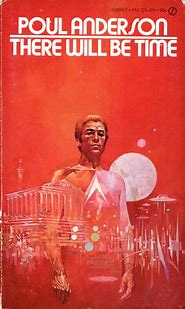
There Will Be Time by Poul Anderson

Past Times by Poul Anderson

Somewhere on Stirling's Nantucket, the question is asked: if time travellers go BC and prevent Christianity, will they thus also prevent salvation? A question for Christian theologians. Knowing them, indeed knowing people in general, they will give different answers.

The Time Patrol
"'England will be one kingdom, with Saxon strength and Roman learning, powerful enough to stand off all invaders. Christianity is inevitable, of course, but I will see to it that it is the right kind of Christianity, one which will educate and civilize men without shackling their minds.'"
-Poul Anderson, "Time Patrol" IN Anderson, Time Patrol (Riverdale, NY, December 2010), pp. 1-53 AT 5, p. 40.

"'Maybe you don't know how much Christian belief and ritual is of Mithraic origin, but believe me, it's plenty. Not to mention Judaism, which you, Cyrus the Great, are personally going to rescue. Remember?'"
-Poul Anderson, "Brave To Be A King" IN Time Patrol, pp. 55-112 AT 7, p. 87.

"....without the balance-of-power effect of Rome, the Syrians did suppress the Maccabees; it was a near thing even in our history. Judaism disappeared and therefore Christianity never came into existence.'"
-Poul Anderson, "Delenda Est" IN Time Patrol, pp. 173-228 AT 4, p. 197.

"...how could I in honesty have argued for a heathenism in which I had no belief and which I knew was going under? For that matter, how could I in honesty have argued for Christ?"
-Poul Anderson, "The Sorrow of Odin the Goth" IN Time Patrol, pp. 333-465 AT 1858, p. 404.

"'Patrol units are concentrated on guarding Palestine. You can well imagine what emotions are engaged, through how many centuries. Fanatics or freebooters who want to change what took place in Jerusalem, researchers crowding in and multiplying the chances of a fatal blunder, and the situation itself, the near-infinity of causes radiating into that episode and effects radiating out from it....'"
-Poul Anderson, "Star of the Sea" IN Time Patrol, pp. 467-640 AT 2, p. 492.

"'...this goddess would be the supreme figure, around whom everything gathered. She would give folk as much, spiritually, or almost as much, as Christ could. Few would ever join the Church.'"
-ibid., 11, p. 568.

"The habits of disguise took over. Koch crossed himself, again and again. Or maybe he was a sincere Catholic."
-Poul Anderson, The Shield Of Time (New York, July 1991), p. 313.

One Patrolman cannot in honesty argue for Christ but another might be a sincere Catholic.

There Will Be Time
"'...what he was, or if he was, makes only an academic difference. What counts is what people through the ages have believed. My life expectancy isn't enough for me to do the pure research I'd like.'"
-Poul Anderson, There Will Be Time (New York, 1973), VI, p. 56.

A thirteenth-century man-at-arms who tries to rescue the Saviour is stunned by the question:

"'How do you know that man really was your Lord?'" (p. 62)

"I do not know if my friend ever looked upon Jesus." (p. 64)

Past Times
"Thank you, Holy Father. This holy fire you have given us - we must never let it die."
-Poul Anderson, "The Little Monster" IN Anderson, Past Times (New York, November 1984), pp. 142-163 AT p. 163.

A bit cryptic in parts, maybe? OK. Just read them all.

Friday, 19 June 2026

Aryans

The Turn The Tide, CHAPTER ELEVEN.

To conclude the ceremonial transfer of Jewish merchant Josephus's Sarmatian woman warrior, Saruke, to time traveller Arthur Vandenberg, now called Artorius, Saruke raises her arms and addresses the four quarters in archaic North Iranian, then bows to Artorius with hands pressed together:

"...in a gesture that looked oddly Hindu.
"No, Artorius thought, with an eerie thrill.
"It's Aryan, original vintage, and survived in India all those thousands of years. And on the steppes where they came from in the first place, evidently; she's descended from the ones who stayed there when the others went south and ended up in the Punjab and became something different." (pp. 157-158)

Keith Denison of the Time Patrol traces:

"'...the migrations of the different Aryan clans.'"
-Poul Anderson, "Brave To Be A King" IN Anderson, Time Patrol (Riverdale, NY, December 2010), pp. 55-112 AT 2, p. 60.

Three Missions By Denison
(i) Denison and Manse Everard accompanied a prehistoric band from the Don over the Hindu Kush. There were steppes.

(ii) Denison went alone to Iran in 558 BC and played the role of Cyrus the Great in a divergent timeline.

(iii) In 1765 BC, Denison and Agop Mikelian stayed with the Bakhri of the Aryas until the tribe went to winter in the lowlands. When it was time for the two guests also to depart, Denesh (Denison) need only tell King Thuliash that his god beckoned him. Thuliash sensed that Denesh was a wizard.

(Some blog readers will already know this but that year of three emperors in "Star of the Sea" turns out to mean not that there were three contemporaneous contenders but just that two died in quick succession. Bit of an anticlimax.)

Wednesday, 14 January 2026

Relevance In The Technic History And The Time Patrol

Poul Anderson's Technic History suddenly became more immediately relevant to its current readers with the late (1981) addition of "The Saturn Game," set much closer to our present and featuring interplanetary although not yet any interstellar space travel. Before this belated addition, the Technic History had begun with "Wings of Victory," (1972) set some time, maybe, in the twenty-second century and featuring the interstellar Grand Survey, a very different kind of science fictional scenario although one that was familiar enough to Anderson's readers from sf in general and from, e.g., Star Trek in particular. ("Wings..." even mentions a planned comparison of experiences by different Survey crews after five years.) The first four stories collected in The Earth Book Of Stormgate, beginning with "Wings...," were the first four instalments of the Technic History but then the first five stories in The Technic Civilization Saga, Volume I, beginning with "The Saturn Game," became the first five instalments.

Sf that addresses important issues periodically regains relevance depending on what is currently happening in the real world. Thus, Simon Bolivar is discussed in the Time Patrol story, "Ivory, and Apes, and Peacocks," and Venezuela is currently in the news or at least competing for space in the news with several other major conflicts! 

"Ivory..." also mentions Solomon and shows us Hiram of Tyre. (For both, see here.) "Brave To Be A King" shows us Cyrus the Great. It may be thought that none of these three ancient rulers is currently relevant but it occurs to me that they might be regarded as perennially relevant by regular Bible readers? Sf readers spend a lot of their time in speculative futures. Bible readers spend perhaps even more time in a theologically interpreted past. And we all meet in the present.

Wednesday, 5 November 2025

Versions II

See Versions. 

Time Patrollers experience different versions of history. Keith Denison, having played the historical role of Cyrus the Great, sees the real Cyrus, who is younger than himself, and pronounces him satisfactory.

Lorenzo de Conti existed in a timeline where he did not kill King Roger of Sicily at the Battle of Rignano, then in a timeline where he did. There is a third timeline in which Lorenzo, charging to the attack at Rignano, sees Everard approaching, smiles and begins to engage but is then rendered unconscious by a stun pistol concealed in a sword. Everard knows this to be a new version of history whereas Lorenzo, while he is in any one timeline, knows nothing of any of the others.

We are used to different versions of stories but not of history.

I would have discussed this at greater length and might do later but right now I am about out of it. After posting and commenting earlier today, I have attended a demonstration, then a firework display, then eaten in a restaurant, then returned home to meditate and resume commenting and blogging and now want to read something else before turning in. The days are too short and so on.

Friday, 17 October 2025

Time Travellers And Famous People

"Ivory, and Apes, and Peacocks."

Manse Everard has an interview with King Hiram of Tyre. What happens when time travellers meet famous people? Different things. Keith Denison is Cyrus the Great in one timeline.

The Doctor met:

Henry VIII who threw (I can't remember what) at him which the Doctor threw back and was sent to the Tower - where the TARDIS was concealed;

Marco Polo who decided not to write about journeys through time because that would not be believed;

Winston Churchill, but they already knew each other whether from a previous episode or from an incident between episodes;

Queen Victoria who founded an organization to defend the British Empire against threats either extraterrestrial or supernatural.

OK. A trivial introduction to a big topic before going out for the evening.

Thursday, 16 October 2025

Prophetic Fiction

"Ivory, and Apes, and Peacocks."

Chaim and Yael Zorach's children will join the Time Patrol. Manse Everard reflects:

"If not...could you stand it, watching them grow old, suffer the horrors that will come, finally die, while you are still young of body." (p. 247)

The phrase that attracts my attention here is "...the horrors that will come..." Poul Anderson's Time Patrol series was published from 1955 to 1995, this instalment in 1983. Anderson avoided describing any near future events and this paid off. The series has not become dated by specifying any "horrors" that have not come to pass, e.g., in the 1990's or in the early twenty-first century - but it was a safe bet that there would be horrors. In 2025, we have experienced and are still experiencing them. Anderson was able to leave it vague and yet get it right. The Time Patrol could still be part of our timeline - and yet no, it could not, because, in the Patrol's timeline, Sherlock Holmes was a real person! Also maybe Cyrus the Great was not really a Zoroastrian? Changes in historical understanding can date time travel fiction.

In any case, the "...horrors that will come..." is accurate.

Sunday, 8 December 2024

Cyrus


See Myth And History.

Cyrus was referred to as the Messiah because he freed the Jews from Babylon. (The Silk Roads, p. 2) I admit to being interested in Cyrus both because of his role in the history of Judaism and because of his role as a member of the Time Patrol, albeit in a deleted timeline. There is or was - we lack Temporal tenses - a timeline in which it was Keith Denison that was killed by the Scythians who then carried his head in a skin of blood. (p. 3) Thanks to an intervention by Everard and Denison, the man who was born as Cyrus grew up to be Cyrus the Great and to be killed by the Scythians.

Historical fiction and time travel fiction add an extra dimension as we imagine fictional characters interacting with historical figures. Nicholas Pym saves the lives of Oliver Cromwell and Charles II.

Saturday, 3 June 2023

The Past In The Time Patrol Series: Persia

In 558-553 B.C., the Persian King of Anshan, Kuru-ush/Koresh/Cyrus, was increasingly in conflict with his Median overlord, Astyages.

Cyrus revolted and after three years of civil war was victorious but then spent another four years defeating counter-uprisings and Turanian incursions and extending his rule to the east.

In 546, the Lydian King Croesus led a Lydian-Babylonian-Egyptian-Spartan coalition against Cyrus.

Cyrus defeated this coalition and annexed the Lydians who then revolted and had to be re-defeated. 

While Cyrus' generals dealt with troublesome Greek colonies, he himself waged war against horsemen invading from the east.

In 542, all of Persia was peaceful and the Persian conquests were governed with a new humanity and tolerance.

In 539, Persia waged war against Babylon and acquired Mesopotamia.

Later, Cyrus died fighting the barbarians from beyond the Aral Sea.

(There is a timeline in which Cyrus is a Time Patrolman called Keith Denison but that is not in our history.)

Monday, 1 August 2022

History In Time Travel Fiction

"The Year of the Ransom," 3 June 1533 [Julian calendar].

By reading Poul Anderson's Time Patrol series, we learn some history concerning:

post-Roman Britain
Cyrus the Great
the Second Punic War
Tyre
the Spanish conquest of Peru
the Volkerwanderung
Bactria
the medieval church-state conflict
the Knights Templar

We can trust Anderson to get the historical details as right as he was able to at the time of writing. We can also check independently on, e.g., Atahualpa. The Spanish lured the last Inca Emperor into an ambush, slaughtered his men, held him to ransom, executed him anyway and justified their actions in terms of their religious ideology:

"'God's will... We bring the Faith to these heathen.'" (pp. 648-649)

Monday, 11 July 2022

Not Changing The Past

Time travellers can do a lot in the past even without changing events. For example, Feliz a Rach fell into a waterfall and it was thought that she had died. Tom Nomura did not prevent her from falling but did pull her out, preventing her death. Time travellers' ability to change the significance of known events without changing the events is even clearer in the immutable timeline of Poul Anderson's There Will Be Time. When Jack Havig is recruited into the time travelling organization, the Eyrie, one of his fellow recruits is an agent infiltrated into the Eyrie by an older and wiser Havig. This goes beyond the familiar circular causality paradox and is an aspect of time travel that could be explored further. In Michael Moorcock's Behold The Man, Christianity would have existed even without extratemporal intervention but would have been entirely mythical. History was a stage where the time traveller was able to play a role as we said in a different context of Keith Denison and Cyrus the Great.

Fight Scenes

Anderson wrote action-adventure fiction and more. In fact, a lot more. However, the action-adventure element remained in his works. "Brave To Be A King" includes two quite lengthy fight scenes but they are well-integrated into the plot. Having successfully passed off Keith Denison as Cyrus the Great, the Chiliarch Harpagus wants to prevent Manse Everard from taking Denison back to his homeland and also wants to appropriate one of the mysterious "engines." Hence, Everard twice fights for his life. When I first read Guardians Of Time, I was still at school and tried to imagine the second fight scene coming out differently but in fact it is just right for what happens in the story. Everard kills Harpagus in that timeline but then changes the timeline. Everard and Denison see the real Cyrus accompanied by Kobad, Croesus and a Harpagus who knows nothing of the events that both Everard and Denison remember. This is like a fulfilment of the sf tradition of time travellers changing the past. Anderson makes it work in multiple concretely realized historical periods.

Another Cyrus

I can reread and appreciate Poul Anderson's "Brave To Be A King" without thinking about its logical (in)consistency.

Two actors play the same character. We compare the actors. One is shorter etc. Keith Denison does this with a historical figure:

"'He's younger than I was... He would be, I guess And a little smaller...different face entirely, isn't it? But he'll do.'"

He is talking about the man born as Cyrus who would have been killed in infancy if not for an extratemporal intervention by Everard and Denison. And he is comparing this Cyrus with himself because he remembers playing that role. History as a stage where different actors can play the same character...

And there is also the Cyrus of the myth who was brought up in secret. That Cyrus remains a myth. Poul Anderson manipulates powerful forces in a single short story.

Sunday, 10 July 2022

Colonizing The Past

Timecycles and Time Patrol bases, like the Academy and the lodge, represent technological civilization reaching back into and partially colonizing its own pretechnological past, an extraordinary conception. On his mission to 542 B.C., Manse Everard blends in, dressing like a Greek and travelling on horseback, but his timecycle waits in the hills. Time Patrol agents are not recognized as such but are really in charge. They ensure that Cyrus the Great rules for as long as he should and no longer. They, the agents, could openly take control but do not, for their own reasons. 

Despite really being in control, Everard is vulnerable, and must fight for his life, when traveling alone. He also finds the era alien, maybe like any imperial envoy in a far flung province. A youth kills a bull on a painted ceiling:

"...and the Bull was the Sun and the Man." ("Brave To Be A King," p. 92)

That might remind us of solemn identifications in a later tradition but the figures identified are very different.

Guards bear strung bows. There is a large harem. Peasants sacrifice to a pre-Aryan Earth Mother. Mountains, visible beyond Cyrus' palace, are haunted not only by wolves, lions and boars but also by demons. At least, that is how they are seen now. Everard wants to return to the twentieth century.

Saturday, 9 July 2022

War And Peace

Poul Anderson, "Brave To Be A King" IN Anderson, Time Patrol (Riverdale, NY, 2010), pp. 55-112.

Manse Everard reflects on the reign of Cyrus the Great. Periods of peace were possible but were gained at the expense of a great deal of fighting both with other civilized states and with barbarians. Peace, when gained, was prolonged by humane and tolerant governance.

Poul Anderson imagines periods of war and peace alternating into an indefinite future. However, our present experience seems to be that war will destroy us soon unless we end it now. That is not happening. The War of Judgment of Anderson's There Will Be Time but with no Maurai Federation afterwards? (Sf is indeed highly relevant.)

Monday, 27 June 2022

Angels And Gods


The Shield Of Time, PART SIX, 1146 A. D., pp. 414-429.


"Tamberly had proposed taking Lorenzo back in time and making him decline the proffered marriage at the outset." (p. 426)

If they took Lorenzo back in time, then he would coexist with his younger self so what would they do with the younger Lorenzo? Kill or kidnap him?

Everard as an angel:

"'Sinner, beware!... Hell gapes for you!'" (p. 424)

He continues:

"'Lorenzo de Conti, most wicked among men...'" (p. 425)

That inverts:

“Blessed are you among women, (Luke 1: 42)

Everard tells Lorenzo that he will damn more than himself. His words recall Keith Denison's act as an angel:

"'O infamous vessel of iniquity, heaven's anger is upon you!
"'...this child Cyrus is favored of heaven...
"'...if you stain your soul with his innocent blood, the sin can never be washed away.'"
-Poul Anderson, "Brave To Be A King" IN Anderson, Time Patrol (Riverdale, NY, 2010), pp. 55-112 AT 9, p. 109.

- and similar Patrol performances:

"'You have seen the wrath of Poseidon.'"
-The Shield of Time, PART TWO, 209 B. C., p. 114.

"'Know that thou has guested Woden and Thunor, who will hereafter guard thy folk from harm.'"
-Poul Anderson, "Time Patrol" IN Time Patrol, pp. 1-53 AT 5, pp. 33-34.

And, of course, Carl Farness appears as Odin and Janne Floris as Niaerdh. How many apparitions are Time Patrol agents? Apparently the Middle Mohenjodaro office often uses angelic disguises.

Saturday, 25 June 2022

Wind And Sea

The Shield Of Time, II37 A. D.

The Beta timeline lacks the strong Pope Gregory with the result that the Popes become the Emperor's puppets. When Volstrup relates this to Everard and Tamberly:

"The wind sobbed." (p. 378)

That wind works overtime. It whooped when demands on Volstrup increased. Now it sobs for the weakened Papacy. Time Patrol agents are not (all) Papists but they need a Papacy that can resist the Empire just as they need an Empire that resists the Papacy. They need a Cyrus the Great that ends Jewish captivity in Babylon and Nazis that can be defeated, but must first exist, in the twentieth century.

By the end of this novel, the Patrol has ensured the growth of science and of "'...the first strong ideal of liberty.'" (1990 A. D., p. 434)

- and, when a Danellian points this out:

"The wind cried, the sea growled nearer." (ibid.)

Friday, 17 June 2022

Versions Of History

We are familiar with the idea that stories exist in different versions. We have discussed this before and need not give examples. Poul Anderson's Time Patrol series suggests that history might be like that. Manse Everard has experienced a timeline in which Keith Denison of the Time Patrol played the role of Cyrus the Great and another in which the man born as Cyrus played that role. The Patrol has records which state that Charles Whitcomb lived as a bachelor and was killed on active duty with the Patrol. In The Shield Of Time, PART FIVE, Guion recounts some minor discrepancies between actual events and the ways that they are recorded. The discrepancies indicate instability in certain sections of history. One of the discrepancies is around the time of the Second Punic War when there was a temporal alteration although how could these phenomena be connected?

Can we see clues of alterations in the series itself?
When was time travel discovered and the Patrol founded?
Is Temporal spoken only by the Time Patrol or by other time travellers?
How long a period of history does the Patrol guard?

Wednesday, 15 June 2022

The Time Patrol In History

Even before the revelation right at the end of Poul Anderson's The Shield Of Time, there is considerable evidence that the Time Patrol has much more to do than just to counteract the activities of time criminals. At the Academy, recruits are told that sometimes they will be asked to help time travellers who have got into difficulties. What kind of difficulties? An expedition from the far future visits Eighteenth Dynasty Egypt in search of cultural inspiration and somehow gets lost so an Unattached agent of the Patrol from their era has to travel then to try to track them down.

Patrol intervention is necessary to:

prevent Cyrus the Great from being murdered in infancy;

prevent the Chinese from conquering North America before Columbus;

ensure that Odin acts as recounted in the Volsungasaga;

prevent a goddess religion from taking over in Northern Europe before Christianity arrives;

ensure that the first emigrants from Siberia do not settle in Beringia but proceed south into the Americas;

cause the Templar fleet to escape when the order is suppressed.

That is a lot of history that would have been different without the Patrol and also without any time criminals being involved.

Friday, 3 June 2022

Causal Discontinuity

This post reiterates a by now familiar argument that remains a live issue as long as we are rereading the Time Patrol. Maybe this time some parts of the argument will be expressed more clearly.

In "Brave To Be A King," Manse Everard is in a timeline where the Cyrus who should have become King of Persia was murdered in infancy and where Keith Denison of the Time Patrol has been obliged to play the role of the adult Cyrus. Everard intends to "delete" this timeline and to replace it with a more acceptable one in which the infant Cyrus was not murdered so that neither Denison nor anyone else is required to impersonate the adult Cyrus.

Before making this change, Everard speaks as if he is in a changeable timeline, i.e., in a timeline which clearly exists because he is in it yet can be changed into or replaced by an alternative. He is in this timeline but will replace it. The tensed verbs, "is" and "will replace" refer not to different moments within a single timeline but to a temporal relationship between two timelines. However, after making the change, Everard speaks as if he is in not a changeable but a discontinuous timeline. He speaks as if Denison's career as Cyrus has simply never occurred in any sense whatsoever. It is true that, after making the change, he and Denison are in a timeline where it is true to say that, within that timeline, Denison has never been Cyrus. But Denison's impersonation of Cyrus was in the previous timeline.

If there were only a single, discontinuous timeline, then it would be impossible to travel into the past and to change the timeline. In such a timeline, causality is violated not by time travellers who have travelled into the past but only by those who have appeared from nowhere and nowhen with the mistaken memory of having travelled into the past. In such a timeline, it would be unnecessary to fear that anyone who has travelled into the past has changed it.

Tuesday, 17 May 2022

More Cans Of Worms

"Star of the Sea," which I am currently rereading, does not fit into the successive timelines theory of time travel which I think does account for everything else that happens in Poul Anderson's Time Patrol series although that theory has its problems. If we pull at a single thread, then the entire fabric starts to unravel.

The Successive Timelines Theory
A time traveller who travels into but does not change the past remains in timeline (i). A time traveller who changes the past thereby transports himself to timeline (ii) which is identical with timeline (i) except for any changes made by the time traveller, the first such change being his arrival. Timeline (ii) succeeds timeline (i) in a second temporal dimension just as a later three-dimensional state of the universe succeeds an earlier 3D state in the first temporal dimension.

In "Brave To Be A King," Cynthia Denison consults Manse Everard because Keith Denison has not returned from ancient Persia in timeline (i). We later learn that Keith was detained in ancient Persia because he was forced to play the role of Cyrus the Great. It follows that, in timeline (i), Keith played that role until Cyrus's historically recorded death. Everard departed into timeline (ii). Therefore, he also failed to return home in timeline (i). In timeline (ii), Keith departed with Everard at what would have been about the midpoint of Cyrus's career. Therefore, in timeline (ii), Cyrus did not die in battle but disappeared much earlier. Any Time Patrolman who, returning futureward from the further past, found himself in timeline (ii) would investigate but would find that the change was authorized and would return futureward into timeline (iii). In timeline (iii), the original Cyrus is not killed in infancy and plays the role of himself for his whole career.

Clearly Poul Anderson does not intend to imply all these discarded timelines but I think that they must be there in the past of the second temporal dimension.