Showing posts sorted by date for query "Holmgang". Sort by relevance Show all posts

Friday, 27 February 2026

"History of the Future" - Poul Anderson

We have acquired a copy of Startling Stories, Winter 1955. 

The Snows of Ganymede by Poul Anderson is on pp. 10-57.

p. 28 is interrupted by an editorial note entitled Poul Anderson's Future History. This note explains that Robert Heinlein wrote a "future history" and so also does Anderson.

p. 29 is a chart of "...the first 250 years of Anderson's history..."

The chart shows:

"Un-Man"
"The Sensitive Man"
"The Big Rain"
"Quixote and the Windmill"
"Holmgang"
The Snows of Ganymede

- as unequivocal instalments of this future history.

As in Heinlein's Future History Time Chart, some stories that are still "To be written" are also included although in brackets. These are:

("Marius")
("House in the Sky")
("Wolf")
("Cold Victory")

Only the first and fourth of these four were eventually written.

The article on p. 28 also lists instalments that had already been written but that could not be shown on the abbreviated chart:

"The Troublemakers"
"Gypsy"
"Starship"
"The Star Ways"
"Entity"
"Symmetry"

The disputed "The Chapter Ends," although published in 1953, is not mentioned.

Wednesday, 23 October 2024

Power-Beaming And John Milton

"The Snows of Ganymede."

Each future history instalment builds on the foundations of earlier instalments. Thus, power-beaming technology is developed in "Holmgang" and crucially contributes to the climax of "The Snows of Ganymede."

Sometimes Biblical quotations are supplemented by other literary quotations. Thus:

"'They also serve who only stand and wait...'" (IX, p. 206)

I think that we all know it but where is it from?

When I consider how my light is spent, Ere half my days, in this dark world and wide, And that one Talent which is death to hide Lodged with me useless, though my Soul more bentTo serve therewith my Maker, and present My true account, lest he returning chide; “Doth God exact day-labour, light denied?” I fondly ask. But patience, to preventThat murmur, soon replies, “God doth not need Either man’s work or his own gifts; who best Bear his mild yoke, they serve him best. His stateIs Kingly. Thousands at his bidding speed And post o’er Land and Ocean without rest: They also serve who only stand and wait.”

-John Milton, "On His Blindness."

The Planetary Engineers speed and post o'er the Solar System without rest.

Saturday, 12 October 2024

Martians

In "Holmgang," Bo Jonsson describes Martians as stiff and correct. In "Cold Victory," a Martian professor wears his academic gown even in a bar because Martians are like that.

Does that sound like Martians to you? Surely they are martial/warlike, or invaders of Earth or extinct by now or hidden underground where we cannot detect them? They are all these things and more. They are whatever an sf writer thinks that they are. CS Lewis tells us that HG Wells' Martians are very different from the real Martians - but he tells us this in a work of fiction!

And, of course, the point that I have glided over until now is that Poul Anderson's stiff, correct, academic "Martians" are human beings that have colonized Mars, not natives. There were native Martians earlier in the Psychotechnic History so what has become of them? An obvious answer springs to mind.

The Martians in Anderson's Technic History are extra-Solar colonists of Mars. Sf, and particularly Poul Anderson, covers every option.

Friday, 11 October 2024

Two Aspects Of SF

In "Holmgang" and in "Brake," the central character triumphs not by winning the philosophical argument but by a neat physical trick. Propelled by one of his air tanks, Bo Jonsson flies right around a small asteroid and hits his rifle-wielding protagonist in the back. In the later story, a disabled spaceship that has shed all unnecessary weight floats in the Jovian atmosphere until its surviving crew and passengers can be rescued. Thus, Poul Anderson combines two aspects of sf: issue-raising and problem-solving. The problems are specific to their particular stories whereas the issues, less easily resolved, continue throughout the series.

The eventual Galactic civilization seems to have transcended social conflicts.

One Race

"Holmgang."

Bo Jonsson makes the point that Lunarites, Venusians, Martians, asterites and Jovians came from Earth and owe their habitable environments to help from Earth. He concludes:

"'We're all men, all one race.'" (III, p. 34)

Lundgard, the self-professed Humanist, replies:

"'A fiction... The human race is a fiction. There are only small groups with their own conflicting interests.'" (ibid.)

A Humanist says that the human race is a fiction?

Small groups do not necessarily have conflicting interests. They have many common interests like efficient communication and transportation systems. Individuals and small groups owe their language, culture, traditions, technology etc to mankind as a whole. We are one race.

Two Hijackings And A Lot Of History

In "Holmgang," the Humanists try to hijack the experimental interplanetary power beam apparatus in order to adapt it for their own purposes, including military use. In "Brake," Western Reformers try to hijack a spaceship and terraforming equipment again for their own uses. Both stories present philosophical and political conflicts but also physical action that resolves the issue for the time being. But only for the time being. What is more fundamentally happening here is that the Solar Union, riven by irresolvable problems, will go down into the Second Dark Ages. When the Psychotechnic History resumes, there will be not only faster than light interstellar travel but also, soon after that, a Stellar Union with a Coordination Service. With humanity dispersed across self-supporting planets separated by interstellar distances, I would have expected any subsequent Dark Ages to be only local and planetary in scale. However, the Chronology informs us of a Third Dark Ages, this time affecting interstellar civilization. If "The Chapter Ends" is to be accepted as a valid conclusion to the series, then millennia of interstellar imperialism will precede an eventual Galactic civilization. Millennia of struggle toward eventual peace: we know that we are living through at least the first part of such a scenario.

Thursday, 10 October 2024

Solar Power

"'The sun pours out about a horse-power and a half, or one and one-eighth kilowatts on every square yard of surface on the earth that is faced directly towards the sun.'"
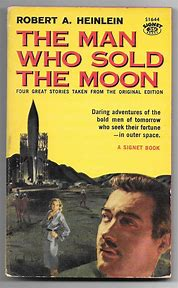
-Robert Heinlein, "Let There Be Light" IN Heinlein, The Man Who Sold The Moon (London, 1963), pp. 33-48 AT p. 41.

"'The sun is pouring out more than we'll ever need...'"
-"Holmgang," III, p. 32.

"'Free power! Riches for everybody! It's the greatest thing since the steam engine.'"
-Heinlein, op. cit., p. 43. 

"'There'll be factories springing up right away all over the Southwest - every place where there's a lot of sunshine. Free power!'"
-ibid., p. 47.

"'Power!... No more fuel worries, no more Martians freezing to death because a converter fails, no more clan feuds on Venus starting over uranium beds -'"
-"Holmgang," ibid.

The next step is a Dyson sphere and there is also sf about that.

Energy And Politics

Solar power screens are developed in "Let There Be Light," the second story in Robert Heinlein's Future History, and interplanetary power beams are developed in "Holmgang," the sixth story in Poul Anderson's Psychotechnic History. These energy sources have to be remembered and taken into account in all subsequent instalments of their respective future history series.

The early Future History is more "social" (how people live) and less "political" (how society is organized) than the early Psychotechnic History. However, a transport strike becomes a failed functionalist revolution in "The Roads Must Roll" and Dahlquist defeats a Space Patrol coup in "The Long Watch." The Future History becomes very much "political" in "If This Goes On -."

In the Psychotechnic History, the UN is opposed by the "gang" and by the Actionists and later the Solar Union is opposed by the Humanists and by the Western Reformers.

We continue to find future history parallels.

Boomtown

"Holmgang."

What interests me most in this story is the:

"...permanent boomtown atmosphere..." (I, p. 21)

- created by the miners on Achilles, the main asteroid at one of the Jovian Trojan points. Unfortunately, the Last Chance bar on Achilles is introduced only so that it can be setting for the murder of Johnny Malone. We learn that:

Venus has changed since "The Big Rain" because it is now the home of violent kilted clans;

a conspiratorial Humanist movement now opposes the Solar Union and the Psychotechnic Institute and has, for its own purposes, murdered Johnny.

So we have returned to the earlier theme of the protean enemy committing atrocities for supposedly noble reasons.

The action moves abruptly back and forth between Bo Jonsson stalking and being stalked on an asteroid and the earlier events that had led up to this "holmgang" duel. Bo and his antagonist argue about Humanism, then fight physically. There is a happy resolution to this story but there is also a successful Humanist Revolt between "Holmgang" and "Cold Victory." History marches on.

Changes In Space

More changes in space:

"Bo was larger and heavier than most spacemen - he'd never have gotten his certificate before the ion drive came in -..."
-"Holmgang," I, p. 22.

"The Goshawk was the first of Harriman's ships to be converted from chemical fuel to atomic power-piles - or rather the first that did not blow up."
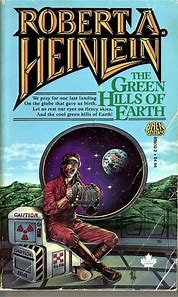
-Robert Heinlein, "The Green Hills of Earth" IN Heinlein, The Green Hills Of Earth (London, 1967), pp. 131-141 AT p. 132.

We are finding a very close future historical parallelism here. (I was surprised to read that Rhysling was on the first trip to Mars.)

"She was the old Falcon, youngest of the Hawk class and the first ship to apply the Harriman Trust's new policy of extra-fare express service between Earth cities and any colony with scheduled stops."
-Heinlein, op. cit., p. 137.

(Harriman gives way to the Harriman Trust.)

Heinlein presents more stories that read like magazine articles published during his future history series.

Luna City

D.D. Harriman, Robert Heinlein's "Man Who Sold The Moon," says that:

he might be the first mayor of Luna City;

he and his pilot will found Luna City;

he has thought of it as Luna City since he was a kid although maybe they will put Harriman Square in the middle of it.

Later, it is decided that Luna City will be founded on the second trip to the Moon.

Later Future History stories are set in Luna City and:

"Johnny was from Luna City...that roaring commercial metropolis."
-"Holmgang," I, p. 21.

The name has jumped between future histories.

One of Heinlein's Scribner Juvenile novels refers to Selene City on the Moon, maybe as a handy sf-type way of indicating that this novel is set in an alternative future.

Will there be a Luna City in our future?

Early And Later Days

"Holmgang."

Human life in the Solar System will, of course, have an early phase when everything is new or is being done for the first time followed by many later phases when much has become routine. Sf has to reflect this. For example, Johnny Malone likes the Last Chance bar on Achilles because:

"'Every place else is getting too fantangling civilized, except Venus, and I don't enjoy Venus.'" (I, p. 21)

Robert Heinlein's The Green Hills Of Earth is full of references to firsts and to how things used to be done:

"Things moved fast in those days."
-Robert Heinlein, "The Green Hills of Earth" IN The Green Hills Of Earth (London, 1967), pp. 131-141 AT p. 133.

I thought that the text somewhere said, "Space was changing," but can't find it. 

Elderly Miss Stone remembers:

"'...when Luna City was three air-sealed Quonset huts connected by tunnels you crawled through on your knees.'"
-"It's Great To Be Back!", pp. 74-92 AT p. 74.

Young Captains have had five years at Harriman Hall and cadet practice trips but no deep space experience.

And so on.

Addendum: More on Luna City later.

Wednesday, 9 October 2024

Beyond Mars

"Holmgang." 

The scene described after the opening proposition:

"Darkness and the chill glitter of stars." (p. 19)
"...a whirling speck of stone..." (ibid.)
no horizon
a jagged black rock cliff
shadows
the Milky Way
"...igneous wilderness..."
"...one long thin crag..."
no sound except heartbeat and breath inside a spacesuit
no air, heat, water, life or work of man
spinning "...granite nakedness..."
cold from the ground

I do not want to spend any time there! - at least not in just a spacesuit. Two guys have gone there to fight, hence the title. This is the The Green Hills Of Earth-equivalent period of Poul Anderson's Psychotechnic History. History will move on but it will go all the way downhill first.

Not By Bread Alone

Sandra Miesel's italicized passage between "Quixote and the Windmill" and "Holmgang" informs us that there were anti-robot riots whereas "Quixote..." had informed us that there was only one robot so the riots must have been against automation in a more general sense. 

"Mankind does not live by bread - or citizen's credit - alone."
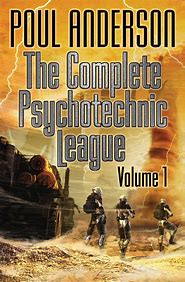
-Sandra Miesel IN Poul Anderson, The Complete Psychotechnic League, Volume 2 (Riverdale, NY, February 2018), p. 17.

No, indeed. Mankind lives by meaningful activity and by cultural and spiritual development. One expression of spiritual development, of course, is "...every word that comes from the mouth of God."

Miesel continues:

"Abundance may be harder to endure than scarcity." (ibid.)

No! Given a choice between abundance and scarcity, which will you choose? Some will not cope with abundance. Others will. As the robot said:

"''There will always be men who think and dream and sing and carry on all the race has ever loved. The future belongs to them...'" (p. 15)

Such men will say to former generations, "Thank you for working so hard to bequeath us abundance. Now we will use it to do more than we ever could have done before."

They and those who follow their example will inherit the Earth and more than the Earth. That is not what will happen in this future history series but eventually psychotechnicians will mentally control cosmic energy in a Galactic civilization.

No Robot POVs

Asimov's I, Robot is mis-entitled since it has no robot narrator or point of view (pov). A human reporter investigates the robots and introduces the stories.

Anderson's "Quixote and the Windmill" describes its single robot in the third person. At one point only, we begin to enter the robot's pov:

"His electronic detectors sensed the eddying pulses that meant nervousness, a faint unease..." (p. 8)

But we are also told how the surrounding human beings regard him. The main part of the story is a conversation between two men, then between them and the robot. All three are externally described and none is given a narrative pov. This is unusual but works.

Each of the following two instalments in Poul Anderson's Psychotechnic History begins not by describing a scene but by propounding an issue:

"The most dangerous is not the outlawed murderer, who only slays men, but the rebellious philosopher; for he destroys worlds."
-Poul Anderson, "Holmgang" IN Anderson, The Complete Psychotechnic League, Volume 2 (Riverdale, NY, February 2018), pp. 19-50 AT p. 19.

"It was the old argument, Historical Necessity versus the Man of Destiny."
-Poul Anderson, "Cold Victory" IN The Complete Psychotechnic League, Volume 2, pp. 53-70 AT p. 53.

They then do describe scenes to which we will return.

Tuesday, 8 October 2024

Death And The Future

"The Big Rain."

"The minutes dragged by. A man at the point of death was supposed to review his whole life, but Hollister didn't feel up to it. He was too tired." (VIII, p. 278)

Are we supposed to review our whole life? Or is the idea not just that our whole life is supposed to rush before us?

This paragraph continues:

"He sat watching the telescreen which showed the space field. Dust and wind and the skeleton cradles, emptiness, and a roiling gloom beyond." (ibid.)

Here are the wind and gloom from before together with a few more relevant details: dust, skeleton, emptiness. Hollister sees potential death and the unknown.

The story approaches its conclusion. After the upbeat ending, we turn to The Complete Psychotechnic League, Volume 2, where the contents page reveals a much broader sweep of future history:

"Quixote and the Windmill": a robot and men on Earth;
"Holmgang": combat on an asteroid;
"Cold Victory": interplanetary war;
"What Shall It Profit?": immortality?;
"The Troublemakers": a generation ship;
"The Snows of Ganymede": conflict in the outer Solar System;
"Brake": social disintegration;
"Gypsy": the first Nomads;
"Star Ship": an isolated extra-solar colony.

We recognize Asimovian and Heinleinian themes and the take-off of the Psychotechnic History into an interstellar future.

Sunday, 12 February 2023

Publishing The Complete Psychotechnic History

Two ways. 

First: two omnibus collections, STL and FTL. 
TLA's (Three Letter Abbreviations): 
STL = slower than light space travel; 
FTL = faster.

Second:

Vol I UN-Men
"Marius"
"Un-Man"
"The Sensitive Man"
"The Big Rain"

Vol II Cold Victory
"Quixote and the Windmill"
"Holmgang"
"Cold Victory"
"What Shall It Profit?"
"The Troublemakers"
"The Snows of Ganymede"
"Brake"

Vol III Gypsy
"Gypsy"
"Entity"
"Star Ship"
"Teucan"
"The Acolytes"
"The Green Thumb"
"Symmetry"
"Virgin Planet" (shorter version)

Vol IV Virgin Planet

Vol V Star Ways
"The Pirate"
The Peregrine
"The Chapter Ends" 

Un-Men covers the UN period. 
The title, Cold Victory, signifies the overthrow of the Psychotechnic Institute. 
Gypsy indicates the beginning of the interstellar period. 
From "The Acolytes" to The Peregrine is the Nerthus period.

Thursday, 19 January 2023

Again Two Future Histories

In Robert Heinlein's Future History:

pre-space flight: the first four stories
interplanetary period: The Green Hills of Earth
colonization of Venus: "Logic of Empire"
revolution on Earth: Revolt in 2100
longevity: Methuselah's Children
generation ship: Orphans of the Sky
FTL interstellar period: Time Enough For Love (but I discount it)

In Poul Anderson's Psychotechnic History:

pre-space flight: "Marius"
interplanetary period: "Un-Man," "Holmgang," "Brake"
colonization of Venus: "The Big Rain"
robots: "Quixote and the Windmill"
counterrevolution on Earth: "Cold Victory"
longevity: "What Shall It Profit?"
generation ship: "The Troublemakers"
FTL interstellar period: "Gypsy" etc

Monday, 16 January 2023

Men Fight On Asteroid

"Holmgang."

Perhaps the simplest kind of narrative is: Guys fight. More specifically, in this case, a guy armed only with a wrench fights a guy armed with a rifle on a small asteroid. Solution: Flee; fly right round the asteroid and hit the other guy from behind. Fight won. Problem solved. Neat solution. Andersonian heroes are problem-solvers who usually have a moment of realization before implementing their solutions.

However, this story exists as part of a series. Lundgard's role is not only to fight on an asteroid but also to expound anti-psychotechnic Humanism. This Humanist is defeated but his samideanoj (Esperanto: "members of a group having the same idea") seize power between episodes and are overthrown in the next episode. (Or, at least, one character recounts his role during the anti-Humanist counterrevolution after the event.) As in Anderson's model, Heinlein's Future History, much occurs between episodes. In fact, Anderson's revolutionary Humanists exactly parallel Heinlein's revolutionary Angels of the Lord while also being completely different from them.

This holmgang is on an asteroid instead of on an island. Earlier, on a boomtown asteroid, Boot Hill had become Helmet Hill. Viking and Western narratives project their echoes into space opera.

Sunday, 15 January 2023

Spaceships And Murder

"Holmgang."

Bo Jonsson and Lundgard fight in the spaceship. This is the kind of sf that I read in comic strips in the 1950s. In the 1960s, I started to buy prose paperbacks addressed to adults but with spacemen and robots on their covers. I did not yet know whether adult concerns would work in spaceships.

Lundgard felt entitled to murder an innocent man, Johnny Malone, to further the cause of the Humanist Revolt. Are there people who think like this? Yes: terrorists. I attended a public meeting about the Birmingham Six. A speaker from the floor said, "Not only are the men who were convicted of planting this bomb innocent. Whoever planted the bomb was also innocent!" He argued that any act was justified for the cause of national liberation. Needless to say, the party that pushed this line did not gain mass support. But it existed for a while.