Friday, 27 June 2025
Commentaries On Futures
Thursday, 26 June 2025
Utopianism
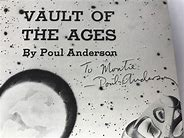
Vault Of The Ages, Chapter 3.
Ronwy to Carl and his companions:
"'Yes, [the ancients] were cruel and foolish and brought the Doom on themselves. But why can we not learn from their mistakes? Why can we not use their science to live as they did, and at the same time be kinder and wiser? The world today is a world of want, and therefore a world of war; but we could build a world in which there was no hunger, no fear, no battle against man and nature. Think it over, boys! Think it over!'" (p. 38)
An excellent speech! We are certainly capable of learning from mistakes, especially from mistakes on the scale of the Doom. A similar learning process occurs in Poul Anderson's Psychotechnic History although, in that case, initial gains made are soon overwhelmed by deeper rooted problems. Some human beings, at least in this generation, might be irredeemably foolish but we can certainly be less cruel, especially if the wisdom of the ancients, which we call science and technology, is used to eliminate want for everyone on Earth, not just for some as against others. I say "in this generation" because I am hopeful of a general rise in understanding and intelligence with improvements in material conditions and social interactions.
These are Wellsian themes. In The Time Machine, as in Anderson's Genesis, mankind degenerates because it has won its battle against nature but that is a mistake that can be guarded against. Sf authors can write utopias - as well as dystopias and everything else. Some potential mistakes can be anticipated, as Wells did. (He also anticipated the consequences of the use of aircraft in warfare.) There is no blueprint for a better future except - people, individually and collectively, must have the freedom and capability to build their own better future. Isaac Asimov's Machines, giant robotic brains controlling the global economy and ecology, reasoned that self-determination was the highest human good and therefore phased themselves out. But genuine self-determination requires a level playing field as David Falkayn - not Nicholas van Rijn - realized in "Lodestar."
These fictional characters are with us through all our present conflicts.
Wind In The City And Time In A Vault
Vault Of The Ages, Chapter 3.
The witch-folk or City dwellers use hammers, chisels and a crude blowtorch to extract lengths of steel from a skyscraper. Carl says:
"'Piece by piece, they're ripping out the steel to sell to the tribes.' A shivering wind rippled about his words and blew them down the hollow canyon of the avenue." (p. 33)
On cue, an appropriately shivering wind accompanies and underlines Carl's words and even blows them through the wrecked city. Over the page, an entire paragraph articulates Carl's feelings:
"There was a huge sadness in it - the little men of today, gnawing apart the mighty works they no longer understood. In a few hundred years, or a few thousand, what did it matter? Nothing would be left, nothing but rubble and waving grass and the wild dogs howling where men had once lived." (p. 34)
That explains why this is a shivering, rather than, e.g., a soothing, wind.
"Howling" often means the end of civilization.
Shortly, they find the "TIME VAULT." (p. 35)
Owl thinks that time cannot be kept anywhere because:
"'Time's not a thing. It's a - well - it's time. Days and years.'" (ibid.)
Owl's units of time are natural, days and years, not artificial, minutes or hours.
Tom thinks that storing time would be "'...a very strong magic...'" (ibid.)
And it is although not in the way that he thinks.
Old Pits
Vault Of The Ages, Chapter 3.
As you know, we can sometimes insert a purely personal note into the discussion of a text.
Carl and his companions will explore the City while its council meets:
"'Be careful, though,' said Ronwy. 'There are many old pits and other dangerous places hidden by brush and rubble.'" (p. 32)
My father was mining engineer in a gypsum mine in Cumberland (now Cumbria) decades ago. In the summer of 1961, some of us visited and entered the mine which was approached by a downward slanting tunnel, not by a vertical descent. That mine, long closed, is near here and it is possible to walk very close to it but there are signs warning, "Danger. Keep Away." Although I would really like to walk onto the remembered site and to see the buildings and the mine entrance, it would obviously be unacceptably dangerous to walk past the signs: either illegal or at least should be.
Every building or other location that we visit or spend time in will one day be disused. Sometimes it happens in our lifetimes. Poul Anderson and other sf writers imagine the far future when nothing familiar to us will remain.
Sources Of Light And Heat
Vault Of Ages, Chapter 2.
Ronwy, the Chief of the City dwellers lives on the first floor of an ancient tower where he:
"...lit candles, chasing the gloom back into corners..." (p. 30)
Again, darkness cannot be completely driven back, even indoors.
When one of his guests shivers in the evening chill, Ronwy stokes the fireplace which:
"...had been built in later days, with a chimney going up through the cracked ceiling." (p. 31)
Improvisation. Ronwy retains knowledge of ancient times:
"'In the ancient time,' said the Chief, 'there was always warmth in here, without fire; and if you wanted light, it game from little glass balls which only had to be touched.'" (ibid.)
Ronwy describes the achievements of the ancients as "'...magic...,'" (ibid.) which reminds us of Clarke's third law. The term, "magic," suffices for practical purposes, post-Doom.
We know about electricity but not about every other source of energy. It is to be hoped that we will survive long enough to learn more. Futuristic sf seems very relevant here and now.
What Will Future Cities Be Like?
(ii) People live in isolated houses and villages, separated by grass and forests. However, transport and communication are so rapid that Earth is effectively a single city. Old style cities are reborn around spaceports on colony planets. Anderson's The Peregrine.
(iii) Few people remain on Earth. There are starport towns. In Niyork, a few groundcars and pedestrians move between empty, ivy- and lichen-covered towers. Anderson's World Without Stars.
(iv) Cities, burned and wrecked in the Doom, a nuclear war, are taboo to the tribes and mostly uninhabited. Although encroaching forest and incessant weather have almost destroyed the suburbs where wild animals now lair and prowl, central towers still stand with many fallen walls, rusting steel frameworks, empty windows and wind blowing through dusty rooms. Anderson's Vault Of The Ages.
We can rely on Poul Anderson for comprehensive coverage of every imaginable option.
Cities fly through space faster than light in James Blish's Okie series and there is a flying city in Anderson's Psychotechnic History.
Fury From The Air
Vault Of The Ages, Chapter 1.
The Doom was:
"...terrible fury from the air..." (p. 20)
- which:
"...wrecked and burned..." (ibid.) cities.
Poul Anderson's twentieth century readers knew what that was.
Many early explorers of the wrecked and abandoned cities:
"...died of lingering sickness..." (ibid.)
- so the cities became taboo. Taboos make sense. They were the only precaution that could be taken.
However, something else happens:
"...many thought that the 'glowing death' was the sign of godly anger." (ibid.)
"...godly...," not "Godly." John says:
"'...the gods go with you.'" (p. 21)
The story is set in a:
"...region of the Allegheny Mountains.'" (p. 19)
Would polytheism return to a formerly civilized region? Is polytheism a kind of natural religion to which societies revert when civilization is removed? In some works by Anderson and by James Blish, interstellar travellers invoke "the gods." (Personally speaking, polytheism appeals to my imagination but not to my intellect.)
Darkness And Dogs
Vault Of The Ages, Chapter 1.
Without electricity, darkness seeps back indoors. The long single room of the farmhouse is lit by a fire in a stone hearth and by:
"The soft light of home-dipped tallow candles..." (p. 15)
When the fire has been built up:
"A wavering red light danced through the room, weaving a pattern of huge rippling shadows in the corners from which Arn looked superstitiously away. The farmer's eyes gleamed out of a face that was half in darkness..." (p. 16)
During an after-dinner conversation, Arn, a farm worker, fears the darkness not only outside the house but also inside the room with them. However, he and his fellow worker, Samwell, must take a brand from the fire to check the sheepfold when the wild dog howl comes closer. It is confirmed that these now dangerous animals are descended from domesticated dogs that had run loose at the Doom. There are indeed things to fear in the outer darkness, both animals and men, as the text will soon confirm.
Stillness Broken
Vault Of The Ages, Chapter 1.
Carl says:
Wednesday, 25 June 2025
Intimations Of Futurity II
Vault Of The Ages, Chapter 1.
Carl:
"'...our ancient cities yield so much metal that we can even trade it with other people.'" (p. 71)
With the benefit of having read later works by Poul Anderson, we recognize themes from his Maurai History and from his The Winter Of The World. This passage also confirms that Vault... is set in a post-apocalyptic future.
"'...I can see where these northerners, these Lann as they call themselves, would envy us.'" (ibid.)
Impending war is a familiar Andersonian theme as is men hearing the call and gathering to fight:
"'The men are gathering... the Dalesmen have heard the war-word of their Chief and are sending their fighting men to join him.'" (p. 16)
This happened when the Goths resisted the Huns in "The Sorrow of Odin the Goth."
Also:
"'...this is a matter I do not understand very well but some say the world is getting colder.'" (p. 17)
Even more like The Winter Of The World! Over the centuries, mankind must cope not only with world wars but also with world climate changes. Everything is here in embryo.