Wednesday, 25 June 2025

Tokens For The Future

"When a Chinese emperor in the third century B.C. tried to destroy certain texts, scholars hid copies in the hope that later generations would find them. This hope was realized, and so such writings as the Confucian Willow Books were saved for posterity."

History repeats itself, the first time as tragedy, the second time as farce. See here.

When I attended a College in Kent in 1988-'89, my friend, Peter, wrote and published what was generally regarded as a fairly damning critique of the training that we had received. The College Principal did not like it and might have disposed of some copies although I cannot remember details after all this time especially since I had completed my assessments and left early. Peter hid some copies around the College and might have contacted students of the following year to tell them where they were. Not exactly of Confucian standard...

"Time like an ever rolling stream..."

That emperor is millennia dead. Our College is no more. Peter and I are retired. I imagine that most staff are dead. The things that happen to us seem important at the time.

Intimations Of Futurity

Every work of fiction is set in the present from the point of view of its characters. No one thinks that he lives in the future although 2000 was "the future" when I read sf comics in the 1950's. It might help us to appreciate a fictional point of view by imagining that an sf novel is set not in a remote future but in an alternative present. This would mean that the past also had been different but that is conceivable because technology could have developed more rapidly than it did.

Poul Anderson makes us very familiar with periods when men travel on horseback and carry swords. Such periods are often historical but can also be located in post-apocalyptic futures or alternative timelines. Vault Of The Ages begins in this kind of period but, after three pages of text, informs us that the viewpoint character, Carl, looks at:

"...a faded picture of a man, one of the marvelous works which must have been handed down since the Day of Doom."
-Chapter 1, pp. 15-16.

A photograph. And the Day of Doom is the end of our civilization. In Anderson's There Will Be Time, the characters refer to an equivalent event called the Judgment War and do not remember much of what it was about. How could they? Why should they? Their duties are to survive and to avoid more Judgments. Ours is to prevent them.

Time Travel And Causality

How would time travel affect causality? To be time travel, it would have to involve travel into the past which would mean an effect, arrival, preceding its cause, departure. This alone is enough to allow the first time travel paradox, circular causality, an earlier event both causing and caused by a later event. Anything else that happens depends on the nature of time.

In A Single Continuous Timeline
An effect precedes its cause, e.g., a time traveller arrives in the twenty-first century and will depart from the thirty-first century, although he experiences departure as preceding arrival.

In A Single Discontinuous Timeline
An effect prevents the event that would have been its cause, e.g., a time traveller with memories of having grown up in a thirty-first century civilization arrives in the twenty-first century but then prevents that remembered civilization from coming into existence. ("Memory" acquires a different or extended meaning.)

In Successive Timelines
An event in an earlier timeline causes an event in a later timeline, e.g., Neldorian time criminals from a timeline where Rome won the Second Punic War arrive in a timeline where they will help Carthage to win the Second Punic War. In this example, the words, "earlier" and "later," describe a temporal relationship between the two timelines, not a temporal relationship within either of the timelines.

I think that that covers most coherent options.

When Did The Time Traveller Go?

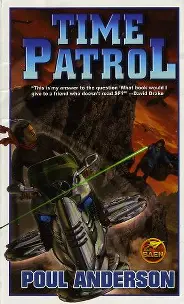
We know, because it is the basic premise of Poul Anderson's Time Patrol series, that those who go into the past on timecycles can alter the course of past events, whatever our theoretical understanding of this paradox, but we do not know the same of HG Wells' Time Machine. The outer narrator of The Time Machine reflects that time travelling suggests curious possibilities (scroll down) but Wells leaves it to his successors to explore such possibilities and Anderson is the most comprehensive such successor.

We have wondered what happened to the Time Traveller and also tried to tie him in with other fictional time travellers. Causality violation suggests somewhen else he could have gone. If he altered a past event, then he would have initiated a divergent timeline and gone into that timeline, disappearing from ours. Am I the first to suggest this?

"Changing The Past" Again

If someone, seating himself on either a Wellsian Time Machine or an Andersonian Time Patrol timecycle, threatens to travel into the past and to prevent my parents from meeting, then departs/disappears, should I fear that I will cease to exist after his departure? If he was in the past for half an hour before preventing my parents from meeting, will I then cease to exist half an hour after his departure?

Of course, it is logically possible for me to cease to exist at any time but why should that happen after this guy's departure, let alone half an hour after? (Matter ceasing to exist would break conservation laws but not logical laws.)

If we are in a single timeline, then the fact that I exist now is sufficient proof either that he did not attempt to prevent my parents from meeting or that, if he tried, then he failed. If he succeeds in preventing them from meeting, then he initiates an alternative or divergent timeline in which I was never born and never existed, not an impossible sequence of events in which I was not born and did not grow up but nevertheless somehow managed first to exist before his departure and secondly to cease to exist after his departure! Nor, if any of that did somehow happen, would there be any reason for a half hour delay.

People think of different times as different places existing at the same time, thus that someone who departs from the twenty-first century and spends half an hour in the twentieth century is obliged to return to the twenty-first century half an hour after his departure from it because that was how long he had been away!

Regular blog readers will know that these arguments have been presented many times before but they always seem fresh and there is always someone who assumes that preventing someone's birth makes him disappear in the present.

Timelines III

Maybe we need to be clearer about "timelines" and about hypothetical relationships between them? An sf story can be about timelines, about time travel or about both. Timelines are one solution to the time travel causality violation paradox, "changing the past." The only other paradox, circular causality, fits entirely within a single timeline. In my opinion, time travel within a single timeline is the only real time travel. Someone who travels from 2025 to 1939 and who then, by his own actions, puts himself into a timeline where he has assassinated Hitler, thus preventing World War II as we knew it, assuming of course that this is even possible, is no longer in our past which is surely what we want to visit if we time travel. If we travel through space, then we want to visit the Mars that exists in our Solar System. We do not want to wind up on either Edgar Rice Burroughs' or Ray Bradbury's version of Mars. Those would be interesting but they are not where Elon Musk is trying to go.

We inhabit a single timeline with three spatial dimensions and one temporal dimension, a four-dimensional continuum. We can conceptualize although not visualize four or more spatial dimensions. Can one timeline have two or more temporal dimensions? Maybe not. I think that a second temporal dimension would be not within a single spatiotemporal continuum but between two or more such continua. In a temporal relationship, timeline 2 would be not parallel to timeline 1 but subsequent to it. Within each timeline, each event would be either antecedent to or subsequent to other events but both timelines would be at right angles to the second temporal dimension connecting them. The Temporal language of Poul Anderson's Time Patrol needs more tenses than ours. At the end of "Delenda Est," it is true that Rome won the Second Punic War, in the history of the timeline protected by the Time Patrol, but it is also true that Rome lost that war in a now deleted timeline. Two past tenses are needed. If we try to discuss this in English with only one past tense, then conceptual confusion reigns.

Our timeline is one of many possible timelines even if it is not also one of many actual timelines. Regular readers will know that all of this is relevant to works by Poul Anderson although I have not being referring to particular titles - but here are some examples:

circular causality in a single timeline is in The Corridors Of Time, The Dancer From Atlantis and There Will Be Time;

multiple parallel timelines are in the Old Phoenix sequence;

deleted timelines, however explained, are in the Time Patrol series.

Our timeline has a particular set of physical laws and a particular course of Terrestrial history. Sf writers imagine:

alternative histories;
divergent histories;
different physical laws, e.g.: gods exist and/or magic works.

Poul and Karen Anderson's The King Of Ys Tetralogy is not alternative history because, in their account, the gods did manifest on Earth but have withdrawn.

In quantum theory, timelines possibly split and diverge every time a choice is made or a dice is thrown etc? In the Old Phoenix, Valeria Matuchek says that the multiple universes are distinct from the beginning but that the differences between them only become noticeable at some later point.

As a solution to the causality violation paradox, I prefer successive timelines to splitting timelines. The latter means entire universes being created. In change as we experience it, the entire three-dimensional spatial universe exists in a different state at every successive moment of a single temporal dimension. On exactly this model, an entire four-dimensional continuum can exist in a different state at every successive moment of a second temporal dimension.

Tempus fugit.
Tempora mutantur nos et mutamur in illis.
"Time, you old gypsy man..."
"No enemy but time."
"Bid time return."

Tuesday, 24 June 2025

Poul Anderson's Three Major Series

Because of a cataract operation this afternoon, I have a shield over my right eye which must not be removed until tomorrow morning. Although this shield is transparent, it does interfere with reading so maybe I will make this the last post for today and hope to do more tomorrow.

Over a long period of time, I have posted a great deal about Poul Anderson's History of Technic Civilization, far more than about any of his several other future history series.

I am fascinated by time travel, by its paradoxes and by Anderson's blend of time travel with historical fiction in his Time Patrol series.

A comparably substantial series is the The King Of Ys Tetralogy (with Karen Anderson).

These three series are:

a science fiction future history series;
historical science fiction with time travel as the sf element;
historical fiction with a fantasy element.

History is the common factor. The Terran Empire appears in the first of these series and the Roman Empire in the second and third.

In other reading, Goldfinger has a fascinating plan to raid Fort Knox.

Logic And Literature

I am not qualified to discuss the physics of time travel. The logic becomes abstract but that is the nature of logic and it is necessary for consistency. In fact, logic is consistency. People who do not understand "logic" or who get their idea of "logic" from Mr. Spock instead of from Aristotle, or who think that being logical means being unemotional nevertheless acknowledge that they should not contradict themselves in conversation. Someone who states that Socrates was executed in 399 BC, then that he was executed in 299 BC, accepts, when it is pointed out, that this is inconsistent and corrects what they have said, giving only a single date. If they did not do this, then they would not succeed in telling us when Socrates died. In fact, they would not succeed in giving us even an inaccurate account of when he died.

An inconsistent time travel story recounts a sequence of events that cannot happen even if some kind of time travel is possible. But this is no surprise. An inconsistent non-time travel also recounts impossible events.

However, Poul Anderson's Time Patrol series is infinitely more than just an exercise in logic. Many of its instalments are very detailed and concrete works of historical fiction. The time travel paradoxes are made real in this context:

Carl Farness investigates the origin of the Volsungasaga story that Odin appeared and betrayed his followers and learns that he himself, mistaken for Odin, must appear and enact the betrayal;

Manse Everard and Janne Floris travel backward through time to find the mysterious event that had launched the prophetess, Veleda's, campaign against Rome only to learn that that event was their own dramatic arrival and unplanned intervention at a crucial moment;

Everard and Whitcomb fight and kill the time criminal, Stane, in post-Roman Britain and retrieve the time shuttle that he had stolen but leave its fuel chest because that will be buried with Stane, thus becoming the mysterious contents of an ancient British barrow that will put them on his trail.

The Time Patrol is embedded not only in history but also in classical literature.

Timelines II

See Timelines.

Second Theory
Mutable Timeline/Successive Timelines (two ways of saying the same thing, I think)

It is obvious - we might think! - that the relationship between timelines 1 and 2 is a relationship of before and after. Timeline 2 - which, for the sake of argument, we might imagine that we are in - exists after timeline 1 which therefore existed before timeline 2. We are now using temporal language: the prepositions, "before" and "after," and the past tense of "exist." However, this does not mean that the events of timeline 1 occurred long ago in the past of timeline 2. That would make these two sequences of events parts of a single timeline. 

In timeline 1, there is a Holocaust and, later, the Danellians who found the Time Patrol. In timeline 2, there is no Holocaust and, because history has gone so differently in this timeline, no later Danellians. Each timeline is a complete four-dimensional continuum from the beginning to the end of the universe.

They are like two versions of a story, each with its own beginning, middle and end. In the example that we are considering, the stories diverge at some point in the 1939-1945 period and therefore have very different conclusions.

If timeline 2 is said to succeed, or to come after, timeline1, then this succession or coming after occurs in a second temporal dimension which is at right angles to the temporal dimensions of timelines 1 and 2 just as the three dimensions of space are at right angles to each other.

Every position in space exists at every moment of the first temporal dimension. Every event in timeline 1 exists in a single moment in the second temporal dimension. Many people live their entire lives in timeline 1 but do not exist in timeline 2 but there is no moment in either timeline when they first exist, then cease to exist. They are unaware of and unaffected by any historical changes made by time travellers.

We can say either that there is a single timeline which changes from one state to another or that there are different timelines which either precede or succeed each other. I think that this difference is terminological: either one mutable timeline or many successive timelines. 

Timelines

The time travel issue has come up again. See combox for Hero Meets Villain. As the first of two stages in addressing this -

If someone remembers having lived in a timeline where there was a Holocaust but experiences living in a timeline where there was no Holocaust, then we can designate these timelines as 1 and 2, respectively, without as yet committing ourselves to any theory either about the existence of either of these timelines or about the relationship between them.

Two Theories
(I) A Single Discontinuous Timeline
Only timeline 2 exists. Timeline 1 does not exist and never has existed in any dimension of time. Indeed, timeline 2 itself (now misnamed) is the only temporal dimension. The quantum nature of the universe is such that sometimes a time traveller randomly appears/arrives from nowhen with spurious memories of a timeline that does not exist and has never existed. This explanation is offered in Poul Anderson's Time Patrol series.

Problem:

Sometimes a Time Patroller says that he might travel into the past and delete the timeline that he is now in. If a deleted timeline has no existence and if the Patroller does carry through with deleting this timeline, then it follows that this timeline that he is now in - he is conscious of it and talking about it - does not exist. This is a contradiction.

Second stage later.