Monday, 23 June 2025

Carl, Son Of Ralph

Vault Of The Ages.

In Chapter 1, our viewpoint character, Carl:

travels on horseback;

is the son of the local Chief;

is sixteen;

is "...large and strong for his age...," (p. 14);

has long, brown hair, a sun tan and "...wide-set brown eyes..." (ibid.);

bears sword, dagger, shield, bow and quiver;

can live off game and farmers' hospitality;

carries news of impending war;

is impatient with Dalesmen who talk of trivia while eating.

Thus, he sounds like an ideal hero for a juvenile novel which this is. To regular readers, this is a very familiar Poul Anderson scenario although it was in fact his first novel.

To 6938

We get a lot of archaeology around Lancaster what with Roman remains and all. Someone unearthed an altar to Mars. In his introduction to Vault Of The Ages, Poul Anderson discusses the limitations of archaeology:

"...relics are usually few and in poor condition."
-Poul Anderson, Vault Of The Ages (New York, 1969), p. vii.

Anderson's Time Patrol solves this problem but their discoveries are of benefit only to dwellers in periods when it is known that time travel occurs - and only in their own timeline, of course.

Anderson presents a fascinating summary of the contents of the Time Capsule in New York which is meant to be opened in 6938. The novel features a larger "time vault" which is discovered and opened in a fictional future about five hundred years after Vault... was written. If this is going to be our only way to communicate directly with our descendants, then we should do more of it. 

See also a poem by James Elroy Flecker here.

Periods Of SF

Is it right to continue discussing decades-old popular fiction while global conflict escalates? Some would say not. However, fiction continues to be written during major conflicts. CS Lewis' major contemporary sf-fantasy novel, That Hideous Strength, was published in 1945.

In his introduction to the 1976 Science Fiction Master Series edition of Poul Anderson's Brain Wave, Brian Aldiss refers to:

Flowers For Algernon by Daniel Keyes
The Poison Belt by Arthur Conan Doyle
More Than Human by Theodore Sturgeon
The Space Merchants by Frederik Pohl and Cyril M. Kornbluth
The Demolished Man by Alfred Bester

- but not to HG Wells' In The Days Of The Comet which is surely the most directly relevant other sf novel?

Keyes' and Doyle's novels are mentioned because they have plot points in common with Brain Wave. The other three are mentioned because, like Brain Wave, they were published in the early 1950's which Aldiss identifies as a good period for sf.

He identifies 1976 as a period of commercialism in sf when quantity of output overcame quality. He acknowledges that Anderson was a big output man but praises what he calls this first novel as "...fresh and interesting." (p. 7) I have argued on this blog that Anderson excelled in both quantity and quality through his exceptionally long career.

High is heaven and holy.

Introductions To Books And A Book Of Introductions?

An introduction to a book can be written by the author or by someone else. There can be introductions to different editions. An introduction can outline the factual background to the text or can address the issues that it raises. Alternatively, an introduction can be an additional layer of the fiction as when Le Matelot, otherwise unknown but clearly identifying himself as a participant in Technic civilization, introduces Poul Anderson's Trader To The Stars or when Hloch of Stormgate Choth on Avalon introduces Anderson's The Earth Book Of Stormgate as well as each individual instalment collected in the Earth Book.

Thus, in the Earth Book, Hloch introduces "Lodestar." The Technic Civilization Saga, compiled by Hank Davis, includes Hloch's introduction but also reproduces Anderon's own earlier introduction as an afterword.

Poul Anderson's introduction to Vault Of The Ages is a factual account of archaeology and time capsules whereas Brian Aldiss' introduction to a later edition of Brain Wave addresses the issues that the novel raises.

A collection of introductions to major works as a lead in to reading some of the works themselves?

Sunday, 22 June 2025

Chronologies

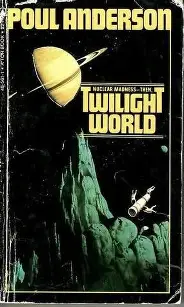
Any work of fiction holds a chronological position within its author's career. Thus, "Tomorrow's Children" (1947) was Poul Anderson's first published story, I think. (I regularly get historical or numerical details like this wrong.) Secondly, a story can have a different kind of chronological position as an instalment within a series. Thus, "Tomorrow's Children" became the first part of Twilight World. (Please correct me if I am going wrong here.)

Brian Aldiss' 1976 Introduction to Anderson's Brain Wave describes the work as "...this first novel..." (p. 7) However, Vault Of The Ages (1952) and Three Hearts And Three Lions (1953) preceded Brain Wave (1954). (I am assuming here that I got all these dates right when I compiled Significant Dates but I might check on that.)

Thus, we might say that Vault Of The Ages preceded Anderson's Technic History in the first kind of chronological order although not in the second kind. However, "Tiger By The Tail," (1951) "Honorable Enemies" (1951) and "Sargasso of Lost Starships" (1951) all preceded Vault Of The Ages and were later incorporated into the eventual Technic History. "Significant Dates," assuming that its dates are accurate, shows how various works and series interpenetrate in the first chronological sense. The novels and stories that separate into distinct series are parts of a single creative process.

Tuesday afternoon will be taken up with my cataract operation and the weekend after next will be spent in London in the cause of greater understanding of current conflicts.

Fair winds forever.

From 1953 To 2025

Yesterday, there was Armed Forces Day by the sea and an "East Meets West" cultural event with food in Lancaster Library. Today there was a Vintage Festival, a Norman Festival and Gay Pride in different parts of the District. I am getting onto my computer late in the day.

Poul Anderson's Brain Wave was published in 1953. Brian Aldiss wrote an Introduction to the Science Fiction Master Series edition in 1976. We are now in 2025. That gives us a vast historical perspective. What else happened in 1953?

Stalin died.
Queen Elizabeth II was crowned.
Edmund Hillary and Sherpa Tensing Norgay reached the summit of Everest.
Casino Royale was published.
I was alive but not yet at school.
SM Stirling born (added later)

That is a short and selective list, of course.

Brian Aldiss' introduction reflects the world in 1976. Because they are relevant to the plot of Anderson's novel, he mentions:

therapy
Eastern religions
new religions
drugs
"Karl Marx's prediction that the State would wither away..." 
-Brian Aldiss, Introduction IN Poul Anderson, Brain Wave (London, 1977), pp. 5-8 AT p. 5.

Aldiss comments that this prediction "...has been revealed in all its foolishness." (ibid.)

This is a common misunderstanding of Marx. His idea was never that States as we know them would wither away. Instead, they had to be overthrown and replaced by a qualitatively different kind of state. Then that state would rapidly make itself redundant and would start to "wither away" almost from its inception. But we do not need to debate that issue further here.

But it is relevant to Brain Wave where, because of a massive increase in human intelligence, familiar States do cease to function/"wither way." Individuals with enhanced intelligence come together to reorganize social activities in everyone's interests as Marx had hoped would/thought could happen as an outcome of struggles first within, but then going beyond, the old order.

In 2025, we still have all the problems.

Saturday, 21 June 2025

Quiz Question

This evening, we attended a garden party where there was a quiz which included the question, "Which was the earliest novel published by Poul Anderson?" I was expected to get this right but didn't or at least not quite. I wrote Brain Wave although Vault Of The Ages also came into the back of my mind. In fact (see Significant Dates):

Vault Of The Ages, which is juvenile sf, was the first novel and the correct quiz answer;

Three Hearts And Three Lions was the first fantasy novel;

Brain Wave was the first adult sf novel;

That is a complicated situation as I hope you will agree. 

In the 1960's, the two sf scenarios were spaceships in the near or further future (the majority) or post-nuclear war recovery in the near future (the minority). Some works by Poul Anderson, e.g., his Psychotechnic History, combined these scenarios. Vault Of The Ages was post-nuclear war but a few centuries in the future. I do not remember much about it so maybe I should reread it if I can find it where it should be on a shelf upstairs but it is too late to look for it this evening.

Meanwhile, my rereading of Ian Fleming has brought me to a game of golf between James Bond and Auric Goldfinger.

The "Best Of The Technic History"

We do not need a Best Of Poul Anderson's Technic History collection because we have the entire History in a uniform edition and can each make our own judgements as to which are the best instalments. In any case, the series is uniformly good right through.

If there were a collection of about half a dozen "best," which ones would they be? Or, rather, how many versions of such a collection would there be?

My suggestions:

"How To Be Ethnic In One Easy Lesson"
"The Season of Forgiveness"
"Lodestar"
The People Of The Wind
"Starfog"

These five are not distributed uniformly through the Technic History.

We have discussed each of these works more than once. "How To Be Ethnic..." is on my list because it introduces Adzel as seen through the eyes of one-off character, James Ching, and also gives us a glimpse of domestic life in the Solar Commonwealth; "The Season of Forgiveness" because it is an excellent Christmas story which also shows us another aspect of the Polesotechnic League without involving any of the continuing characters; "Lodestar" because it introduces Coya Conyon, dramatizes the generation gap between her and her grandfather, Nicholas van Rijn, informs us of the crisis in the League that will be fully developed in Mirkheim and climaxes with a crucial confrontation between van Rijn and Falkayn; The People Of The Wind because of its sense of living in troubled times, because it presents every point of view on war, because of its detailed realization of the environment of the planet, Avalon, and because of its presentation of the biracial society of Avalon; "Starfog" because it is our single glimpse of a remoter future far beyond League or Empire.

Reconciliations

At the end of "The Sharing of Flesh," Evalyth frees the man who had killed her husband, saying:

"'Go home... Remember him.'" (p. 708)

At the end of "Rescue on Avalon," Jack Birnham tells an Ythrian that he is not an enemy, adding:

"'I'll be proud to call you my friend!'"
-Poul Anderson, "Rescue on Avalon" IN Anderson, Rise Of The Terran Empire (Riverdale, NY, March 2011), pp. 307-322 AT p. 322.

Two short stories with neat happy endings. There are others. Poul Anderson's Technic History features several long drawn out and complicated conflicts but is also peppered with several shorter pieces such as these two. What is good about The Technic Civilization Saga is that they are all there together in seven omnibus volumes.

Friday, 20 June 2025

The Benefits Of Technology: The World Made Great

"The Sharing of Flesh."

"'...your wisemen talked of ways to end hunger, sickness, danger, and sorrow.'" (p. 695)

"'Suddenly the world was made great, that had been so narrow.'" (ibid.)

We take hungerlessness, health, safety, satisfaction and knowledge for granted but what would it be like to lose them or never to have had them? And the ending of hunger etc is not yet complete.

Every word of a futuristic sf story can be applied to the time in which it was written and to the changing times in which it continues to be read. There is a reason why the lowland Lokonese fight incessant wars. The Allied Planets can end that reason.

It takes longer in real life but we have the same goals.