Monday, 22 January 2024

Corona

Peter and Olga Berg were in a base on the southern shore of Corona. A strong current ran east from a great gulf and struck an archipelago which would be the Oronesia. Beyond Oronesia is the Hesperian archipelago and, beyond that, around the curve of the planet, the western coast of Corona. Is that "great gulf" the Gulf of Centaurs where the second Avalonian city, Centauri, will be built? Jack Birnam's family were sea ranchers dwelling on the west coast of Corona. Did they live on or near Falkayn Bay where the first city, Gray, would later be built?

We see Corona in three periods: when it is being explored, when it is being settled and when it has long been settled. There is also an intermediate period when the Hesperian Islands have been settled and a research and development team is planning the colonization of Corona so that there will then be some exploratory expeditions to the continent.

Within the Technic History, there is an Avalonian history.

Old And New In A Future History Series

Later instalments of a future history series build on earlier instalments and also add new information. In Poul Anderson's Technic History, the last instalment to feature Dominic Flandry, The Game Of Empire, introduces the Patrician System with its two colonized planets, Imhotep and Daedalus. We have never heard of either of these planets before so this is definitely new information. Starkadian land- and sea-dwellers have been settled on Imhotep and the planet is visited by one Wodenite. Cynthians and Donarrians have settled on Daedalus and the planet is visited by several Merseians. My point here is that all six of these species had already existed in the Technic History. Regular readers are already familiar with Merseians etc but will also learn more about most of them here. That is how rich this future history series is. When, on Imhotep, Diana Crowfeather overhears a Terran Marine complaining about "Merseian bastards," we know that we are on familiar territory but that we will probably also learn a lot more as in fact we do not only about the Patrician System but also about the Zacharians and about a second offspring of Dominic Flandry.

Sunday, 21 January 2024

Names

Names encapsulate history. Pope John Paul II was named after his predecessor who was named after his two predecessors who were named after two authors of the New Testament. One was named after the first King of Israel. The other bore a Biblical "J -" name, incorporating the Mosaic divine name.

In Poul Anderson's Technic History, two surnames and one inherited Christian name conduct the narrative through a series of historical transitions:

in "Wingless," Nicholas Falkayn speaks to his son, Nathaniel;

in "Rescue on Avalon," Ivar Holm speaks to Jack Birnam;

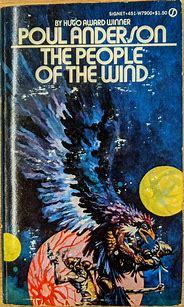
in The People Of The Wind, Daniel Holm converses with his son, Christopher, who marries Tabitha Falkayn;

in The Earth Book Of Stormgate, Hloch informs his readers about Nicholas van Rijn and David and Coya Falkayn and presents narratives written or co-written by Christopher Holm.

After these transitions, there are no more Falkayns or Holms and our attention shifts to one Flandry.

Avalonian Choths And Geography

Poul Anderson, "Rescue on Avalon" IN Anderson, Rise Of The Terran Empire (Riverdale, NY, March 2011), pp. 307-323.

"Choths differed as much in their ways as human nations did..." (p. 310)

In the early days, when only the Hesperian Islands had been colonized, the Weathermaker Choth comprised only an "...extended household..." ("Wingless," p. 297) Centuries later, choths on the northern polar continent of Corona each had thousands of members at least. By that time, it had become unusual that:

"In Oronesia, there were single households that bore the name..." (The People Of The Wind, III, p. 464)

- and, even more unusual that:

"...grown and married, the younger children were expected to found new, independent societies." (ibid.)

Gray, the larger of only two cities on Avalon, is on the west coast of Corona. Inland from Gray, are the Andromeda mountains called the Weathermother by Ythrians and occupied by the Stormgate Choth. Christopher Holm lives in Gray and is Arinnian of Stormgate. Two thousand kilometres west from Gray is the Oronesia archipelago stretching almost to the Antarctic Circle, much of it occupied, despite those unusual small choths, by the fisheries-controlling Highsky Choth. Tabitha Falkayn is Hrill of Highsky. In the northern hemisphere, Oronesia divides the eastern Hesperian Sea from the western Middle Ocean. This is meant to impart some information about where various characters live at different times. 

Small continents or large islands in the South Ocean are Equatoria, New Africa and New Gaiila. There are other smaller islands. 

We want to go there or even feel that we have been there.

Inter-Species Cooperation

"Wingless."

We notice optimal connectivity between the Ythrian instalments of Poul Anderson's Technic History. The curved boards for lateral resistance that Tabitha Falkayn explains to Philippe Rochefort are also explained, in slightly greater detail, by the Ythrian Keshchyi to Nat Falkayn. The boat is faster, with no water drag, because these boards interact with the wind in a particular way. The atlantis weed introduced in "The Problem of Pain" is central to the plot of "Wingless" because one of Keshchyi's wings becomes tangled in it and Nat has to go under water to free him from it. "Wingless" was originally published in Boy's Life as "Wingless on Avalon" and could have been called "Rescue on Avalon" but that is the title of the companion story. In both, a young human male rescues an Ythrian and some prejudices are overcome: Ythrian prejudice in the first story; human in the second. Nat envies the Ythrians' ability to swoop around in the air but then realizes that he can do much the same in the sea which they cannot.

These two stories are thought experiments in inter-species cooperation and an antithesis to military sf which Anderson also did well.

Ythrians At Sea And In Space

Why do Ythrians sail, as they do in "Wingless"? They can fly over water and are helpless if they fall into it, as happens in "Wingless." There is way more water on Avalon than on Ythri so maybe sailing is a sport that Ythrians learned on Avalon? And under human influence? Whatever the influence, they are better at it than human beings.

Rochefort: "'No keel? What do they do for lateral resistance?'"
Tabitha, pointing at curved boards pivoting in response to vanes: "'Those. The design's Ythrian. They know more about the ways of wind than men and men's computers can imagine.'"
-Poul Anderson, The People of The Wind (Riiverdale, NY, March 2011), pp. 437-662 AT XI. p. 567.

Ythrians are less apt in space. They cannot be enclosed in spacesuits or even in spacecraft without large viewports. They need room to spread their wings and their interstellar craft must have a large hold for them to fly about in.

Ythrians are people of the wind, not of the void.

Saturday, 20 January 2024

Planha

Nat Falkayn has learned the Ythrian language, Planha, which means that he has learned not only how to understand and utter certain sounds but also how to understand signs and symbols communicated by ripples across entire feathered bodies. At least, he has learned some of the conventional expressions although he comes to feel like a deaf-mute when he has spent days among Ythrians who converse like this all the time.

We find this aspect of Ythrian communication elsewhere, e.g.:

"'You had something to tell me,' she said with two words and her body."
-Poul Anderson, The People Of The Wind (Riverdale, NY, March 2011), pp. 437-662 AT XIX, p. 653.

Six words in Anglic, at least in our ancient Anglic: two words and some ripples in Planha.

"You are troubled, Thuriak said, not with his voice."
-"Wingless," p. 297.

Three words in Anglic. None in Planha.

Judith Lundgren describes "Yhtrian plumage" as "Infinitely variable..." (ibid.)

Perhaps like Poul Anderson's texts.

God's Moods

"Wingless."

"Had God been in a more joyful mood when He made the Ythrians than when He made man?" (p. 298)

Here we go again with meanings of "God." Literal or metaphorical? If literal, how anthropomorphic? A large invisible man who is in a good mood one day and a bad mood the next? I suspect, of course, that Nat's question is metaphorical, meaning: "Is it as if God had been in a more joyful mood...?"

But, if we assume a theistic doctrine, then how does God create the two species? Does He plan and initiate a universe in which such species must evolve? If so, then this is a single creative act. The idea that He could be in different moods for the different species must remain metaphorical or, if literal, then very anthropomorphic.

Such phrases invariably recur, especially in the works of a serious and reflective writer like Poul Anderson, but maybe we should just pass them by instead of commenting every time?

Ythrian Psychology


With two short stories and most of a novel, Avalon fills just under half of The Technic Civilization Saga, Volume I, Rise Of The Terran Empire. The other half, also a novel and two shorter works, covers human history in the League, then the Troubles, then the Empire.

In "Wingless," young Ythrians interact with one young human being. Keshchyi, taking flight, whistles, trumpets and challenges:

"'What are you waiting for, you mudfeet?'" (p. 296)

Keshchyi's less impetuous cousin, Thuriak, asks Nat Falkayn, who is able join them in the air with his gravbelt, whether he is coming. At this stage of the narrative, the Ythrians might come across just as human youths with wings. However, the earlier story, "The Problem of Pain," had shown us their alien attitude to suffering and death. Before taking off, Nat reflects on the differences between the species:

"...the Ythrians were alien, and not just in their society. In their bones, their flesh, the inmost molecules of their genes, they were not human. It was no use pretending otherwise." (pp. 297-298)

"They were pure carnivores, born hunters. Maybe that was the reason why they allowed, yes, encouraged their young to go off and do reckless things, accepting stoically the fact that the unfit and the unlucky would not return alive -" (p. 298)

Nat thinks about molecules, genes, bones, flesh, carnivores, hunting and finally psychology which arises from biology. Regular readers know that the philosophical mind-body problem is a sub-theme of this blog. Imagining alien psychology helps us to address the problem. To list the properties of a psychophysical organism as observed by others is not to describe the organism as experienced by itself. The organism's brain is part of the organism as observed by others whereas the organism's consciousness is its observations of everything else. So no wonder they are different. But how do objective processes generate subjectivity? Any attempted explanation just describes another set of objective processes.
Avalon And History

Reading The Technic Civilization Saga, Volumes I-III (of VII), we find Hloch mentioning Avalon in his first Earth Book introduction and a description of the planet in "The Problem of Pain." Volume III collects:

Mirkheim, the last Polesotechnic League instalment;

"Wingless" and "Rescue on Avalon," about the two-stage colonization of Avalon;

"The Star Plunderer," about the Time of Troubles;

"Sargasso of Lost Starships," about the early Terran Empire;

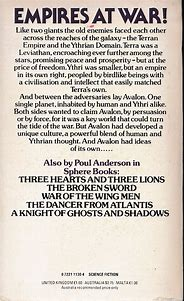
The People Of The Wind, about the Terran-Ythrian War and in particular about its effects on Avalon.

Thus, a future history in a single volume. By contrast, Volumes IV-VI and the first half of VII are set within the lifetime of a single individual. The Technic History incorporates both fictional history - mainly League and Empire - and fictional biography - mainly Falkayn and Flandry.

Avalon receives more coverage than Hermes or Dennitza. The Technic History also presents the histories of the interactions of both Ythrians and Merseians with Technic civilization.