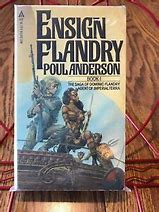
With the benefit of hindsight, we reflect that Admiral Enriques, Lord Hauksberg and other senior officers on Starkad have no suspicion of the future significance of the Ensign Flandry who is invited to meet some of them over drinks at the headquarters in Highport. (While writing this post, I am distracted by late evening TV news reports of events in a New York court house. Hopefully back here tomorrow.)
Tuesday, 4 April 2023
Falkayn And Flandry
Wives And Concubines
In fact, Ensign Flandry could have been one of Dragoika's lovers. The species are not too dissimilar. However, he is cautious enough to demur and she has fangs. But there must be some strange relationships in the Technic History as advertised at Leon Ammon's place on Irumclaw. A writer with different inclinations and interests could have developed this idea. Ythrians and human beings are impossible which is why Christopher Holm invests his galemate, Eyath, with a Platonic idea of purity.
Two Purposes
Ensign Flandry, CHAPTER FOUR.
Starkadian land- and sea-dweller are natural enemies like Terrestrial men and wolves. If the pacifist Esperancians had discovered Starkad, then they would have tried to help the two species to coexist peacefully. Instead, the Merseians back the sea-dwellers, obliging the Terrans to back the land-dwellers. If the Merseians had been able to operate on Starkad without the Terrans' knowledge, then they would have gained a secret naval base closer to Terra but what is the point of fomenting a proxy planetary war? There is a point which Max Abrams wonders about and Dominic Flandry learns.
Ensign Flandry serves two purposes. First, its hero must have colourful adventures on other planets while advancing his career from the ground up. Secondly, events of future historical significance must occur, in this period involving inter-imperial conflict between Terra and Merseia. Flandry's eventual discovery brings together these two purposes. The Young Flandry Trilogy is a perfect later-written prequel to the Captain Flandry series within the Technic History.
Fiction And Reality
Territoriality And Non-Territoriality
Starkadian land-dwellers owe nothing to the place where they live. A ship is ruled but a town or island is not. Instead, females are organized into Sisterhoods whose members live anywhere. Through their Sisterhoods, females own all the important property, make all the important decisions and even have distinctive languages.
Merseians of the Roidhunate want to conquer the galaxy but then to rule it through autonomous realms, not centrally from Merseia. For them, it is the race that matters.
In sf, it is important that aliens not only look different but also think and live differently. We expect and appreciate this in Poul Anderson's works.
Addendum: Cynthians have not nations or tribes but treetop trade routes. Members of just one trade route become spacefarers in Technic civilization.
A New Era
Ensign Flandry, CHAPTER FOUR.
Dominic Flandry, shot down over Starkad and now travelling in a native merchant ship, is having the kind of adventure that is appropriate in a juvenile sf novel but meanwhile future historical events are occurring. War is possible between the Terran Empire and the Merseian Roidhunate. Lord Hauksberg will go as a plenipotentiary to Merseia where the Merseians of the dominant culture, the Roidhunate, have become would-be galactic conquerors who must first eliminate the Empire because it stands in their way. We have seen the Merseians become embittered and begin to expand, the Solar Commonwealth go down and the Empire arise. A whole new era of the Technic History begins while four volumes of The Technic Civilization Saga still stretch ahead. I am almost breathless with excitement although I already know the outcome. Hunt well.
Monday, 3 April 2023
"This Kid, Ensign Dominic Flandry"
Ensign Flandry, CHAPTER FOUR.
At last, after Hauksberg on Terra, Abrams at Highport and Brechdan on Merseia, we come to:
"Ensign Dominic Flandry, Imperial Naval Flight Corps..." (p. 29)
- on a merchant ship of the Sisterhood of Kursoviki. Unlike Abrams, we had not really thought that this Flandry was dead because we could see the title of the novel and indeed the titles of The Technic Civilization Saga, Volumes IV-VII. However, I do not think that it would be legitimate to change the titles simply in order to conceal from prospective readers this one individual's survival into old age and Admiralty. Volume IV, Flandry's Legacy, collects:
Tribes And Clients On Merseia
Ensign Flandry, CHAPTER THREE.
On Merseia, a "tribe" seems to be an extended family within a Vach:
"The whole tribe waited, Elwych's stepmothers, sisters and their husbands and cubs, younger brothers." (p. 28)
See Peace-Holy.
Elwych is Brechdan's Heir. Brechdan is the Hand of the Vach Ynvory. He returns the salute of a sentry and of a gardener who are not slaves because their families have been clients of the Ynvorys since before planetary unification. Brechdan's wives are thrifty, trustworthy and cultivated "...as females should be." (p. 24) The Merseians read like a parody of backward human attitudes. Are they as a species stuck in that aristocratic/semi-feudal social setup or can technology and inter-species contacts help them to advance from it?
Character Introductions
The text of Ensign Flandry gives a whole chapter to the introduction of each of the major characters:
Brotherhood Of Beings
Ensign Flandry, CHAPTER TWO.
Commander Max Abrams thinks:
"In spite of what the brotherhood-of-beings sentimentalists kept bleating, Merseians did not really think in human style." (p. 18)
Of course not, any more than human beings think in Merseian style. But both species are indeed beings sharing a universe. Brotherhood of beings should involve valuing and learning about differences between species. Later, in CHAPTER FIVE, Abrams tells Flandry that all beings are not brothers and that not even all men are. Yet, later still, Dennitza demonstrates that human beings and Merseians can share a planet.
Poul Anderson projects familiar issues into a multi-species, interstellar future.