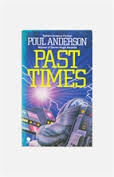
There is a good interplay between discussion of SM Stirling's works and discussion of Poul Anderson's. Their alternative histories spark off each other.
I suggested an Anderson collection:
The Old Phoenix And Other Universes
"The House of Sorrows" is set in an alternative history. Furthermore, it is a history in which the Jews did not return from Babylon.
"Eutopia" is about travel between alternative histories. Furthermore, the travelers originate in a history where Alexander the Great did return from Babylon.
"House Rule" and "Losers' Night" are set in a meeting place between alternative histories.
Three stages: presentation, elaboration and summation of the concept.
I hope that I present practical demonstrations of the value of rereading. Several works by Anderson and Stirling have been read and blogged about twice. There is always more to be found in their texts.
Yesterday, Sunday, was spent with the lap top while recovering from a party. The next few days will be spent in other activities. Thus, less time from blogging. I will continue to reread SM Stirling's Conquistador.
Showing posts with label "Eutopia" by Poul Anderson. Show all posts
Monday, 8 February 2016
Damned Ideologies
In his Afterword to "Eutopia," Poul Anderson quotes Robinson Jeffers:
"'Long live freedom and damn the ideologies.'"
-Poul Anderson, Past Times (New York, 1984), p. 141.
One meaning of "ideology" is a set of ideas that is generated by, then rationalizes, justifies and sanctifies, a status quo. Thus:
absolute monarchies generated the idea of the divine right of kings;
when James VI of Scotland became James I of England, thus uniting the kingdoms, he claimed to be restoring a lost Arthurian British unity, taking as his text Geoffrey of Monmouth's (unhistorical) History of the Kings of Britain;
the trans-Atlantic slave trade generated racism of skin color for the first time in history and with it came ideas of white superiority.
However, if by "ideologies," we mean simply theories of society, then we need them. In fact, we need several at this stage of history because we are in such disagreement. In politics as in science, theory guides practice but practice tests theory. We need not the practical instead of the theoretical but both of them and good theories instead of bad.
More On "Eutopia"
Continued from here.
"White Neathenai swept in grace and serenity down to the water."
-Poul Anderson, Past Times (New York, 1984), p. 139.
Does anyone know what "Neathenai" means?
Daimonax says of the Westfallers:
"'...they use nerves, glands, muscles more. So they know an aspect of being human which our careful world has denied itself.'" (ibid.)
However:
Eutopia has "...athletic fields..." (p. 115);
Iason himself is tall and broad and has been trained by Olympeion wreath winners.
So the Eutopians do already combine physicality with philosophy.
Of the Westfallers:
"'The family, the kingdom, the race is something to live and die for.'" (ibid.)
That is because these social units are still in dangerous conflict with each other. The human race can become something to live for, the only conflicts being with disease and with the recalcitrance of the physical environment that requires human action to satisfy human needs.
Daimonax Continued
See here.
"'We have ended every conflict, to the very conflict of man with his own soul...'"
-Poul Anderson, Past Times (New York, 1984), p. 137.
Is that bad? Does Daimonax want permanent inner conflict?
"'...we have mastered the planets...'" (ibid.)
Mastered them? Each planet is a whole world. We will never fully know and understand this one planet that we live on.
"'...the stars are too distant...'" (ibid.)
Are they too distant to reach? They are never too distant to observe and study. We live in the midst of the cosmos.
"'...were the God not so good as to make possible the parachronion, what would be left for us?'" (ibid.)
But, to use theistic language, he has made possible exploration of other histories.
"'Our leashing of the purely animal within us is simply another taboo.'" (p. 138)
Then acknowledge and integrate animality instead of merely "leashing" it.
"'We may love as we please, but not hate as we please. So are we more free than men in Westfall?'" (ibid.)
Does he want to hate?
"'We do not allow ourselves a single unthinking, merely felt impulse.'" (ibid.)
Why not? Then start feeling. I thought that Iason did feel passionate but was misdirecting his passion by abusing a minor.
"'By excluding danger and hardship, by eliminating distinctions between men, we leave no hope of victory.'" (ibid.)
Two issues here. Explorers can face hardship and danger without reintroducing social distinctions.
He says that they have become pure individuals, thus reducing their obligations to a single negative: not to compel other individuals. But they clearly do cooperate and function as a society.
He complains that the state takes care of each need and hurt. Is it bad that needs and hurts are taken care of? Of course, the problem here is the word "state." That makes it sound like something alienated and oppressive instead of just members of society making arrangements to take care of each other.
"'Where is the loyalty unto death?'" (ibid.)
Does he want situations where people have to risk death?
"'Where is the intimacy of an entire shared lifetime?'" (ibid.)
What is preventing this?
"'We play at ceremonies, but because we know that they are arbitrary gestures, where is their value?'" (ibid.)
They do not know this because it is not true. Ceremonies are a way of affirmation and celebration. It is not necessary to believe that they have any supernatural basis.
Of the Westfallers, he says that:
"'Their problems are real; hence their successes are real.'" (ibid.)
But how have the Eutopians stopped having real problems? Iason has certainly found his experiences in America and Westfall problematic.
"'They believe in their rites.'" (p. 139)
Does that mean that they invest their rites with a superstitious meaning? It is possible to understand the value of rites, as I think happens in some meditation groups.
I attended a talk on the causes of sectarianism in the Middle East. To demonstrate that sectarian hostility is not a permanent feature of religious traditions, the speaker quoted a Jesuit missionary of about 1850 who complained that Christians and Muslims interacted socially and attended each others' festivals. Thus, then there was diversity without divisiveness.
Sunday, 7 February 2016
Close Reading Needed
Like Poul Anderson's "Losers' Night," his "Eutopia," first published in Harlan Ellison's Dangerous Visions, is a story that clearly I had not read closely enough before. I had thought that it was nothing but chase scenes followed by a shock ending.
Instead, it presents:
a rational man's disgust with our timeline;
the unique and original Westfall timeline;
a proto-series, Iason "...could be reassigned to some history he might find more congenial." (p. 139);
a new version of familiar Andersonian arguments about humanity.
Iason asks whether Daimonax means that:
"'Without fighting, clannishness, superstition, ritual and taboo...man has nothing?'" (p. 137)
Daimonax replies:
"'More or less that?'" (ibid.)
More or less? How much more and how much less? I disagree. A false dichotomy is being set up. Is emotion without reason better than reason without emotion? Why not have both reason and emotion?
Daimonax asks:
"'Because we have made our world one, where are color and contrast...?'" (p. 138)
One world incorporates color and contrast. Unity need not be uniformity. My slogan is: "Difference without division; unity without uniformity." See "Fundamental Issues."
Daimonax continues:
"'...where is pride in being peculiarly ourselves?'" (ibid.)
Why do we need this? But, in any case, it is there for the asking. Humanity is diverse and everyone is unique. I will probably pick through more of Daimonax's speech but it is getting late here.
The History Of Westfall
Poul Anderson, "Eutopia" (see here).
The History Of Westfall
Arabs, Vikings and Magyars destroyed Christendom;
civil wars destroyed the Islamic Empire;
European barbarians developed undisturbed;
eventually, crossing the Atlantic but lacking the power to exterminate the natives, they instead came to terms with them;
lacking industry, they adapted to the forests, plains, deserts and mountains;
despite remaining divided into petty states, like Norland and Dakoty, the Westfallers have developed radio, gas engines, electric motors, aircraft and nuclear weapons;
several realms have built a lunar base and sent expeditions to Ares;
whereas the American timeline is an example of man gone wrong, the Westfallers have something to teach the complacent Eutopians who sacrifice their humanity to rationality.
Like Anderson's "Losers' Night," this is a story with a double surprise ending. See here. At the end of "Eutopia," we might be so shocked by the revelation in the last word that we forget the earlier realization that "'...Westfall is also the Good Land.'" (p. 137)
Eutopia, Westfall And America
Poul Anderson,"Eutopia" IN Anderson, Past Times (New York, 1984), pp.112-141.
Cross-time traveler Iason Philippou:
lives on a continent called "Eutopia";
is currently visiting a timeline where that continent is called "Westfall";
remembers visiting yet another timeline where it was called "America."
A region that is preserved as a wilderness for hunting on Westfall is, on Eutopia, groves, gardens, aesthetically designed villages and athletic fields. Because dielectric motors have not yet spread this far north on Westfall, Iason smells gasoline fumes and:
"He had thought that stench one of the worst abominations in America - that hogpen they called Los Angeles!..." (p. 118)
We are still rereading SM Stirling's Conquistador in which New Virginians unfavorably compare FirstSide, including LA, with their own unpolluted North American environment.
Iason mentally reviews the history of the American timeline:
Alexander the Great died from the fever that he had contracted in Babylon;
wars of succession destroyed his empire;
"Hellas and the Orient broke apart" (p. 125);
early science degenerated into metaphysics, then mysticism;
cold, cruel, uncreative Romans, claiming the Greek heritage while destroying Corinth, took over;
men despairing of life adopted a mystery cult founded by a heretical Jewish prophet;
this intolerant cult denied all but one way of seeing the God;
its priests cut down the holy groves, destroyed idols, martyred free men and kept their grip for nearly two thousand years;
after that, it became possible for science to be reborn;
however, the idea of conformity in belief remained;
hence, totalitarianism and the threat of nuclear war;
that history is filthy, wasteful, ugly, restricted, hypocritical and insane;
pretending to be an American was Iason's hardest task.
Relearning History
SM Stirling, Conquistador (New York, 2004).
Adrienne explains to Tom and Roy:
Alexander the Great (see image) did not die in 323 BC but lived for another forty years;
the Greeks assimilated the Jews, thus preventing Christianity;
Zoroastrianism died out;
some Scandinavians visited the American continents briefly but no one else;
Eurasia still has medieval technology;
Alexander is still worshiped as a son of Zeus.
Comments
Adrienne: "'The details don't matter.'" (p. 258)
me: They do! (But not from her practical pov.)
Adrienne: "'...our best guess is that the Industrial Revolution needed the equivalent of a toss coming up heads a thousand times in a row.'" (p. 259)
me: Is our history really that improbable?
Appendix Three: "Alexander the Great died in August of 280 B.C.E., in the summer capital of Ecbatanta..." (p. 589)
me: Is this the same as the Ecbatana visited by Time Patrolmen Manse Everard and Keith Denison?
me: When did Alexander die in Poul Anderson's "Eutopia"? Reading Stirling's alternative histories has persuaded me to reread Anderson's Old Phoenix stories and now his "Eutopia."
Tuesday, 30 June 2015
Anderson, Bear And Stirling
Alexander the Great living longer and consolidating his empire sounds like a single alternative historical premise, doesn't it? Further, a premise that could lead to earlier social and scientific progress and to a Greek-speaking technological civilization in the twentieth century? See "Eutopia" by Poul Anderson and Eon by Greg Bear.
In Conquistador, SM Stirling turns this Alexandrian premise on its head. Alexander lived to seventy and bequeathed a vast, undivided empire that lasted for a hundred years but then fell apart in civil wars and barbarian invasions. Its twentieth century legacy is city-states, kingdoms and tribes with late medieval technology worshiping Zeus-Alexander and an undiscovered New World ripe for conquest from a timeline very similar to ours.
That is it for this month, folks. Posts will resume some time in July.
Subscribe to:
Posts (Atom)