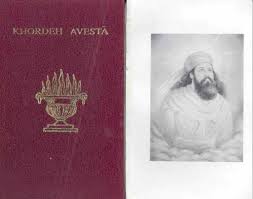
The narrator of Poul Anderson's "The House of Sorrows" (All One Universe, New York, 1997) lists three reasons for reading:
"The Zarathustrans study their holy writ but add nothing new" (p. 86);
"The rest of us...keep old books if they are useful or enjoyable, but otherwise, why should we care?" (pp. 86-87);
the Greeks loved learning for its own sake but he had thought that this love, like that of men for boys, had died with the Romans until he entered a library where he "...felt as though [he] stood among ghosts." (p. 87)
Knowledge of the movements of the stars helps navigation but knowledge of the nature of the stars would not be useful (he thinks).
The Zarathustrans reading their scriptures have the potential for learning more if they are exposed to other literature. Recent posts on this blog have been about the meaning of Lamentations and the nature of Zen experience. Usefulness and enjoyment are excellent reasons for keeping books. The narrator, sheltering in the barricaded library during a period of civil unrest, learns more as the librarians read to him:
"...I took happiness out of the vaults. Suddenly around me, speaking, loving, hating, striving, not dead but merely sundered from me in time, were the builders, the dwellers, the conquerors, Persians, Turks, Mongols, Romans, Greeks, Phoenicians, Babylonians, Assyrians, Pelishtim, Egyptians, endlessly manifold. In their sagas, I could lose myself, forget that I was trapped and waiting for whatever doom happened to be mine." (p. 97)
- and he even learns the concluding verses of Lamentations, which, in his world, are preserved only in that single library.
Showing posts with label The House of Sorrows. Show all posts
Wednesday, 21 August 2013
Tuesday, 20 August 2013
Lamentation
A previous librarian made a partial translation by comparison with known languages. The present librarian, having studied the text, is able to decipher parts of it.
It begins:
"Jerusalem hath grievously sinned..." (p. 98)
- and ends:
"But thou hast utterly rejected us -" (ibid.)
As a matter of fact, my Revised Standard Version gives Lamentations 5.22 as:
"Or hast thou utterly rejected us? Art thou exceedingly angry with us?"
- and the Good News Bible gives:
"Or have you rejected us forever? Is there no limit to your anger?"
But the King James ends Lamentations with a statement, not a question. The Lord, who is said to remain forever, is also said to "...forsake us forever..." (ibid.)
Imagine that you are a Hebrew prophet and that that is your last revelation: God is eternal but has ended the Covenant. You are on your own. What should you do? Serve other gods? Live as a free man without gods? Consider how much of the Law applies to human beings without reference to God? It is up to you.
Monotheism And Science
Was the monotheist idea that the entire world had been designed and ordered by a single creator necessary for the development of science and thus ultimately for the industrial revolution? Poul Anderson's "Delenda Est" and "The House of Sorrows" answer yes. In a history without Judaism or Christianity, the world remains divided between warring polytheist tribes and empires with very limited technology in the twentieth century.
Of course, however, people did not accept monotheism on the basis that, "This will lead us to something beneficial called "science'"! What my modern Pagan friends call "hard", i. e., literal polytheism became hard to sustain. Monotheism appealed to philosophers, priests and imperialists. The Jewish tribal confederation's exclusive covenant with its one god became full monotheism under the prophets. Paul freed this monotheism from divisive dietary laws, ritual cleanliness and circumcision. Constantine established Christianity and insisted that it be doctrinally uniform to unite his Empire.
There is a sense of historical inevitability about all this. But monotheism is not necessary for the continuation of science. On the contrary, scientific cosmogony and Darwinism now show what could not have been known before, namely that order need not have been designed. Many people are secularists although some revive hard polytheism while others develop soft versions. Some of us practice Buddhist meditation. It is good to know that Buddhist traditions and philosophical inquiries would have continued even in the polytheist timelines imagined by Anderson.
Of course, however, people did not accept monotheism on the basis that, "This will lead us to something beneficial called "science'"! What my modern Pagan friends call "hard", i. e., literal polytheism became hard to sustain. Monotheism appealed to philosophers, priests and imperialists. The Jewish tribal confederation's exclusive covenant with its one god became full monotheism under the prophets. Paul freed this monotheism from divisive dietary laws, ritual cleanliness and circumcision. Constantine established Christianity and insisted that it be doctrinally uniform to unite his Empire.
There is a sense of historical inevitability about all this. But monotheism is not necessary for the continuation of science. On the contrary, scientific cosmogony and Darwinism now show what could not have been known before, namely that order need not have been designed. Many people are secularists although some revive hard polytheism while others develop soft versions. Some of us practice Buddhist meditation. It is good to know that Buddhist traditions and philosophical inquiries would have continued even in the polytheist timelines imagined by Anderson.
The House Of Sorrows
I am rereading Poul Anderson's "The House of Sorrows" (All One Universe, New York, 1997), originally published in What Might Have Been, vol 1.
In some earlier posts, I drew attention to this conceptual sequence in a few of Anderson's stories:
"The House of Sorrows," an alternative history;
"Eutopia," travel between alternative histories;
"House Rule" and "Losers' Night," an inter-cosmic inn visited by travelers from various alternative histories.
I have suggested, and still think, that these four stories should be collected as The Old Phoenix And Other Universes, to be published in uniform editions with the four novels about inter-cosmic travel, one of which also features the Old Phoenix.
The two stories about Cappen Varra and a third that refers to Varra are also set in a parallel universe and one of the Varra stories even involves travel between universes. However, these works differ in tone, merely showing a universe where magic works but not specifying precisely how or when that world's history diverged from ours. So I think that these three stories should be collected elsewhere.
In our history, Mithraism lost out to Christianity because the Mystery of Mithras was open to men only. Thus, Mithraists' wives converted to Christianity and had all their children, both male and female, baptized. I have thought that Mithraists could have counteracted this by linking with a women only Goddess Mystery and this has happened in "The House of Sorrows," where a Mithraeum and a Shrine of the Mother are side by side.
The narrator is a Mithraist like the Andersons' King of Ys and is guided through a strange city by an urchin, called Herod (!), similar in this respect to the character called Pum who guides Manse Everard of the Time Patrol through ancient Tyre. We see alternative forms of religion like a Mithraeum where "...Odin and Thor flank the altars of the Tauroctony..." (p. 76). Mithras recognizes lesser gods so the Aesir could have been incorporated in an alternative history.
In some earlier posts, I drew attention to this conceptual sequence in a few of Anderson's stories:
"The House of Sorrows," an alternative history;
"Eutopia," travel between alternative histories;
"House Rule" and "Losers' Night," an inter-cosmic inn visited by travelers from various alternative histories.
I have suggested, and still think, that these four stories should be collected as The Old Phoenix And Other Universes, to be published in uniform editions with the four novels about inter-cosmic travel, one of which also features the Old Phoenix.
The two stories about Cappen Varra and a third that refers to Varra are also set in a parallel universe and one of the Varra stories even involves travel between universes. However, these works differ in tone, merely showing a universe where magic works but not specifying precisely how or when that world's history diverged from ours. So I think that these three stories should be collected elsewhere.
In our history, Mithraism lost out to Christianity because the Mystery of Mithras was open to men only. Thus, Mithraists' wives converted to Christianity and had all their children, both male and female, baptized. I have thought that Mithraists could have counteracted this by linking with a women only Goddess Mystery and this has happened in "The House of Sorrows," where a Mithraeum and a Shrine of the Mother are side by side.
The narrator is a Mithraist like the Andersons' King of Ys and is guided through a strange city by an urchin, called Herod (!), similar in this respect to the character called Pum who guides Manse Everard of the Time Patrol through ancient Tyre. We see alternative forms of religion like a Mithraeum where "...Odin and Thor flank the altars of the Tauroctony..." (p. 76). Mithras recognizes lesser gods so the Aesir could have been incorporated in an alternative history.
Subscribe to:
Posts (Atom)


