Here I had already quoted that passage.
(I could not quite remember how a reference to God Incarnate had been incorporated into Genesis.)
What had reminded me of this sentence in Genesis was Aliyat's reflection on her vision of Christ:
Here I had already quoted that passage.
(I could not quite remember how a reference to God Incarnate had been incorporated into Genesis.)
What had reminded me of this sentence in Genesis was Aliyat's reflection on her vision of Christ:
The Boat Of A Million Years, XIX.
When the "ruling intellects" agree to the Survivors' interstellar spaceship, they insist on some changes. The eight Survivors must go alone and must go to a different planet which is in the direction of a possible high tech civilization. Hanno agrees to these changes and realizes that he should have thought of them himself. This confirms the "ruling intellects"' ability to make acceptable decisions. It pays off because the Survivors do make First Contact.
I heard at school that it is wrong to begin a narrative with "And..." However, when mimicking Biblical prose, it makes sense. A chapter begins:
"And Christ appeared to Aliyat..." (24, p. 532)
This in a simulation which Aliyat knows to be such. More later.
While looking for Genesis, I found Isaac's Universe, Volume Two, which contains Anderson's "Woodcraft." Is this one of the two Andersonian Isaac's Universe stories that Anderson adapted and incorporated into his For Love And Glory? I will read or reread this story at least until I have confirmed that it is familiar.
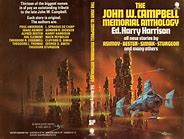
When farmer John gave me a lift home after the sf group, I found on his dashboard something that I had never previously seen or held, a paperback copy of The John W. Campbell Memorial Anthology. See the attached image. This anthology presented Anderson's "Lodestar." As I explained to John, this is a pivotal story of Anderson's main future history series and I have read it in that context, not in its original anthologization.
The Boat Of A Million Years, XIX, 22-23.
Pytheas is en route from Sol to Phaeacia Sun. "Others," exploring Star Three about 359 light-years to port from Pytheas' current position, have detected radio signals from Earth. Knowing that Earth might soon dispatch interstellar spaceships, the Other explorers send robots to intercept any such ship along the route from Sol to the nearest high tech civilization which is at Pegasi and which might also be the Others' home civilization. They also send such robots along the route from Sol to the nearest Sol-like star, Phaeacia Sun. Some of these robots send Pytheas pictures inviting them to detour to Star Three. A majority of the crew want to continue to Phaeacia but Hanno as Captain overrules them and now reveals that Pytheas is programmed to obey only him. First Contact is marred by human conflict.
A Time Patrol story set when Hiram was king in Tyre mentions the progression from seafarers to spacefarers to timefarers. Hanno, born in Tyre when Hiram was king, has been a seafarer and now a spacefarer and believes in the absolute authority of the captain.
The Boat Of A Million Years, XIX, 19, pp. 514-517.
"'Too bad, isn't it, that this tremendous quest of ours hasn't made us worthy of itself. We're the same limited, foolish, mixed-up, ridiculous primitives we always were. Today's Earth people wouldn't have our problems. But it is we, not they, who've gone out here.'" (pp. 516-517)
This is relevant to the two previous posts.
Well, that's something, then. It takes all sorts to inhabit a universe and a particular sort to explore it.
Pytheas has now been away from the Solar System for seven hundred and fifty Terrestrial years. We do not know what has become of Earth or its people in that time. Poul Anderson does not have to imagine it. If the Survivors do ever return to Earth, then it will be a considerably longer time later and long after the end of this novel. If there had been a sequel, then I would have preferred it to be about what they continue to find out in the galaxy.
Poul Anderson, "Flight to Forever" IN Anderson, Past Times (New York, 1984), pp. 207-288 AT CHAPTER FOUR, p. 261.
I have previously quoted this passage in:
Emotion And Intelligence In Four Universes
- and also referred to it in:
Both Hanno in The Boat Of A Million Years and Belgotai in "Flight to Forever" are survivors from past ages. Belgotai time travels whereas Hanno does it the hard way.
The Boat Of A Million Years, XIX.
There are three relevant passages, at least as far as I have reread so far this time.
First, Svoboda says:
"'We do need something to lift us out of ourselves. It's wrong to carry our pettiness along to the stars.'" (12, p. 499)
Hanno replies:
"'We will, though,' he said. 'How do you escape being what you are?'" (p. 500)
That is a big question to which different answers have been given but, before we return to it, let us consider an exchange between two other Survivors. Wanderer and Tu Shan share a virtual simulation of Phaeacia, the planet that they hope to colonize. They disagree about whether a particular kind of site should be farmed:
The Boat Of A Million Years, XIX.
Hanno thanks what the text describes as "...the ruling intellects of the world." (10, p. 490)
He is told:
"'Thank society. You think in terms of kings, but personal power is obsolete.'" (p. 496)
We are given to understand that these combined human and electronic intellects formulate a decision that expresses the understanding and interests of society as a whole. To launch a crewed interstellar ship will be expensive but will not impoverish anyone. There is some support for it and it might have beneficial consequences. It is agreed.
These are not really ruling intellects but are somehow foci for a collective decision. But the author thinks in the old terms and uses the archaic language of rule.
Next we will address the question of what the Survivors take with them psychologically when they leave the Solar System but first we, editorially speaking, must address a few other tasks closer to home.
The Boat Of A Million Years, XIX.
Hanno:
"'We could invent plenty of mere amusements. We doubtless will. If necessary, we can just wait. A year goes by fast after you've had hundreds or thousands of them.'" (14, p. 503)
And again:
"...as Hanno had once implied, it was as well that to immortals, a year could feel like quite a short span." (16, p. 507)
I remembered something as having happened a year ago, the previous summer, whereas a young child remembered it as something that had happened "a very long time ago." To a child of two, the previous year is half of his life to date whereas, to an adult of fifty, it is a fiftieth. To Hanno, who was an adult in 310 B.C., a year will seem like a month or even like a week does to us. I envy that perspective.
Poul Anderson's Time Patrolmen will have an even stranger perception of time. They might come to regard it as almost nonexistent. Some of their memories are of "deleted" events.
In The Voyage Of The Dawn Treader (I think), Aslan tells a human child that he will see her soon but, when asked what he means by "soon," replies, "I call all times soon."
(Aslan, like Krishna, is a good mythological/fictional divine incarnation. We can learn from these guys without expecting to meet them on the street.)
The Boat Of A Million Years, XIX, 15, pp. 504-506.
The Pytheas is in flight.
The indecipherable interstellar transmissions come from:
"'Black holes, condensing nebulae, free matrices -...'" (p. 505)
(What is a free matrix?)
Those are the places to which high tech civilizations will have sent probes which will then transmit messages back to their senders and also for others to detect. Eventually, inter-species contacts might be established.
I am drinking a hot chocolate between returning from the Gregson Centre and going to bed. Today it rained and there were ten short posts. During the day, workmen come and go in a new house. I would like to travel between the stars but we are doing, on a planet. We approach the Andromeda galaxy.