A Circus Of Hells.
A considerable quantity of prose fiction consists of dialogues between pairs of characters. Thus:
A Circus Of Hells.
A considerable quantity of prose fiction consists of dialogues between pairs of characters. Thus:
A Circus Of Hells.
Flandry has been assigned to the frontier planet, Irumclaw. He met a trader from there in Ensign Flandry.
He is in the only man in the base who speaks Eriau. He learned it in Ensign Flandry.
The visiting Merseians include Tachwyr whom Flandry met in Ensign Flandry.
Flandry intends to have his face changed. That will have been done before the next volume, The Rebel Worlds.
In A Circus Of Hells, Flandry's intervention will lead to a joint Terran-Merseian scientific base on Talwin. The base will be referred to in The Day Of Their Return and will be the site of later meetings of Flandry with Tachwyr and with Aycharaych in A Knight Of Ghosts And Shadows.
At the end of A Circus Of Hells, Djana puts a psychic spell/geas/curse on Flandry which will affect his life in The Rebel Worlds and in A Knight Of Ghosts And Shadows.
In A Circus Of Hells, Ydwyr tells Djana about Aycharaych the Chereionite and also mentions him to Flandry who, however, misses the opportunity to learn more.
Anything else?
We are definitely inside Dominic Flandry's narrative point of view half way down p. 198 when we read his italicized thoughts. Before that, some unidentified narrator is informing us about interstellar inter-imperial affairs and also about Flandry's position within those affairs. He and Tachwyr are in the same profession so it is possible that they will meet despite the size of their respective interstellar navies:
"...many such encounters were taking place..." (p. 197)
This phrase conveys a sense of large-scale inter-imperial interactions involving many individuals, not just Flandry and Tachwyr.
We are told what Flandry has learned on Irumclaw and what he already knows from previous experience but this information is imparted in the style of a biographer. The transition to a fictional narrative point of view happens when Flandry reflects on relations with the Merseians at the mid-point of p. 198. The story begins...
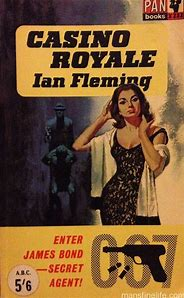
Bond's setting is the contemporary world at the time of writing whereas Flandry's is a fantastic and arguably impossible scenario of faster than light interstellar travel and many intelligent species.
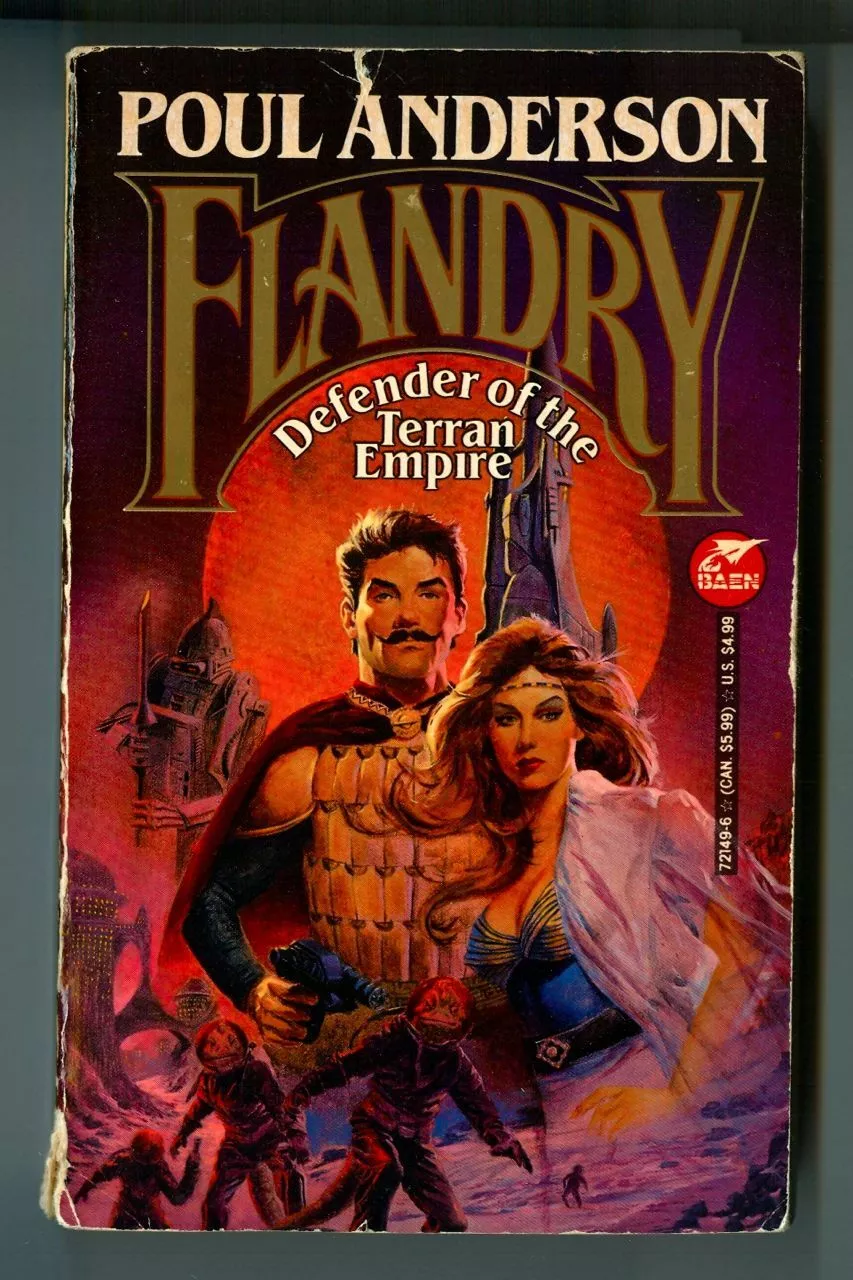
(That is definitely the best A Circus Of Hells cover.)
p. 193 is an internal title page. p. 194 is blank. p. 195 is a dedication. p. 196 is blank. Thus, CHAPTER ONE begins on p. 197.
In the opening paragraph, some unidentified narrator tells us what this story is about:
"...a lost treasure..." (p. 197)
- etc. There are seven items in total. Flandry is quoted as saying that:
"...it begins with a coincidence." (ibid.)
We are not yet in Flandry's narrative point of view. Someone else is telling us about him. In the second paragraph, this unidentified narrator discourses about the improbability of Flandry and Tachwyr the Dark meeting again.
I am being cut off. To be continued tomorrow.
I had skipped past the opening chapter so have glanced back at it. The Terrans make a bigger deal of the Emperor's Birthday than the British currently do of the King's, which we have recently passed: 14 November. Since King Charles' date of birth is 14 November 1948 and mine is 1 January 1949, he and I are the same age for most of the year with the King getting ahead in mid-November and me catching up in the New Year. Will I live into a fourth reign? The King has better medical care than me but is in poorer health so maybe this question is in the domain of my friend Andrea's preferred deity, Fortuna. This chapter introduces Crown Prince Josip who will have succeeded by the time of the third Flandry novel with disastrous consequences, his death later in the series sparking civil war and usurpation with loss of Imperial legitimacy. And that glance ahead covers most, although not all, of the remainder of the Flandry series. Each instalment, while it can be read as a discrete narrative, has its place in the series which has its place in the longer history, like the events in our lives.
Ensign Flandry.
Flandry to Persis:
Ensign Flandry.
Lieutenant (j.g.) Sergei Karamzin to Ensign Dominic Flandry:
Future histories are one kind of fictional history. Fictional past histories include Middle Earth, Narnia and, I suggest, the Bible. I do not mean that the entire Bible is a work of fiction. However, it incorporates multiple genres, including myth, genealogy, theologically interpreted history, some works of historical fiction (Ruth, Jonah, Job) and apocalyptic future history.
Because future histories are fictional histories, because much of Anderson's time travel is to the past and because he also wrote both straight historical fiction and other kinds of historical sf, e.g., about immortals, it follows that historical processes became major themes in his works. The Roman Empire withdraws from Northern Europe and eventually falls just as the Terran Empire falls although between instalments.
Anderson's two main series have to be the Technic History and the Time Patrol with The King Of Ys, co-written by Karen Anderson, as a close third. History, again. Which is better: the Technic History or the Time Patrol? This is not a comparison of like with like. Each excels in its own sub-genre. The Technic History is longer, seven omnibus volumes as against two, so it gives us more to reread. I cannot be 100% happy about Time Patrol treatment of causality violation but I am probably not going to be happy about anyone's treatment of that paradox. Skillful presentation of the circular causality paradox, which Anderson also does, is more intellectually satisfying.
In any case, my personal favourite series is the Technic History above any other.
Ensign Flandry, CHAPTER SEVENTEEN.
Unfortunately, we approach the end of this novel yet again. There are only two chapters left. It has been unexpectedly enjoyable to reread this account of Dominic Flandry's initiation into Intelligence. The second last chapter describes a space battle. See here. Previously, it took some work to study this chapter and summarize the battle but it is unnecessary to repeat that exercise. This time, I will reread at a leisurely pace, again looking out for any details missed before but not needing to keep track of the fates of Sabik, Umbriel etc.
What do the names of the ships mean?
Antarctica
New Brazil
Murdoch's Land
When I started to write this post, I did not expect to initiate those google searches. There is always more to be found in Poul Anderson's texts.