The Night Face, III.
Thursday, 20 October 2022
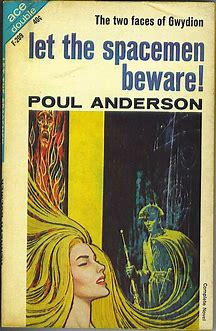
Gwydiona Mythology
Wednesday, 19 October 2022
Honourable Warfare And "Friends"
The Night Face, III.
Elfavy of Gwydion asks what germ makes men so sick that they want to hurt their own kind:
"Raven sighed. If she couldn't even visualize homicidal mania, how explain to her that sane, honorable men found sane, honorable reasons for hunting each other?" (p. 571)
But are they sane and honourable? I am not requesting answers to that question! I am only too aware that different people will give different answers. But an sf text, by presenting a culture clash and dialogue of this kind, raises such questions and invites its readers to question their own accepted norms, whether or not the author intended that outcome or whatever answer he would have given. Sometimes the issues are bigger than our individual ideas.
Meanwhile, rereading Dornford Yates' thrillers, I find several ironic references to the viewpoint characters' enemies as "our friends." Probably any word or phrase can generate a short story. Poul Anderson ingeniously constructed a story based on a changed meaning of that word, "friends."
Words And The Word II
In the combox for Words And The Word, we established that a word in the Merseian language, Eriau, and another in the Ythrian language, Planha, have been correctly translated as "God" because both refer to a transcendent person. However, the English word, "God," stretches a very long way. A word in the Gwydiona language has also been translated as "God" even though it refers not to a person but to a transcendent reality that is mythologized under Aspects like Green Boy and Huntress.
In Hinduism, it is possible to ask, "Is God personal or impersonal?" Sri Chinmoy described Hinduism as a mother. One of her children meditates for years and says, "Mother, God is impersonal." The mother replies, "I see, my child." Another of her children meditates for years and says, "Mother, God is personal." The mother replies, "I see my child." Non-dualists differentiate between the lower truth of a personal God and the higher truth of an impersonal Absolute but theists regard the former as higher. I am not sure whether the word, "transpersonal," can have any meaning.
When a friend told me about a mystical order that he had joined, I asked whether it was theistic. He asked what I meant so I changed my question to "Does it refer to God?" He replied, "Yes." Then I asked, "Does it refer to God as if God were a person?" He replied, "No"! So we have the paradox of non-theistic meanings of "God."
If "God" means "the transcendent" or "the object of religious experience," then I can buy into an impersonal "God." But we have to be clear about it. Apparently, someone asked Einstein whether he believed in God and he replied, "I believe in the God of Spinoza." Spinoza was a pantheist. His "God" was impersonal and identical with the universe but it was the object of religious experience. I am not concerned about whether we call this "God" but some people do call it that.
Tuesday, 18 October 2022
Words And The Word
The Night Face, II.
The Lochlanna and Gwydiona languages are descended from Anglic whereas the Namericans speak Ispanyo. Thus, Tolteca, a Namerican, does not find the Gwydiona speech easy. He recognizes a reference to "God" but is not sure whether he has understood it correctly especially since his own culture is secular. Whatever the Gwydiona mean by "God," they are at least using a word with a known history whereas, when Eriau-speaking Merseians refer to "the God," and, when Planha-speaking Ythrians refer to "God the Hunter," they are using a word that has been translated as "God" but that has had a completely different history in an extra-solar species. Might some other word have made a better translation? Or a word can simply be adopted into another language without being translated. The English for "yoga" is "yoga." Neither the Eriau nor the Planha concept seems to allow for a personal relationship with the deity - but then Terrestrial ideas of "gods" have been diverse and open-ended.
CS Lewis' Elwin Ransom must learn a language spoken on the planet Malacandra which he does not yet realize is Mars. When natives, the hrossa, tell him of a being called Oyarsa who knows everything, rules everyone and has always been in a place called Meldilorn, Ransom asks whether Oyarsa made the world. The hrossa are shocked. Do the people of Thulcandra not know that Maleldil the Young made and still rules the world? Maleldil is with the Old One. The Old One is not the sort that has to live anywhere...
Later, when Ransom has returned to Earth, his friend, Lewis, reflects:
Gwydiona Symbolism
The Night Face, II.
Gwydiona symbolism sounds Hindu but is schematic rather than chaotic.
A bronze and leather chair is decorated with fylfots and vines called crisflowers. The fylfot is the Burning Wheel, thus both the sun and Time. Crisflowers, blooming during the first hay gathering season, are sacred to the Green Boy Aspect of God. Thus, fylfot and crisflowers together mean Time the Destroyer and Regenerator. The leather, from the wild areas, is sacred to the autumnal Huntress Aspect. Linking Huntress and Boy recalls the Night Faces and their other side, the Day Faces. The man-made alloy, bronze, means that:
"'...man embodies the meaning and structure of the world.'" (pp. 563-564)
("Man, the measure of all things.")
Bronze, corroding to green, means that everything vanishes but into new life.
It sounds as if sometime made it up. Well, the author did make it up but it still sounds made up in the text. The Gwydiona mentality is working unconsciously to counteract and contain its own underlying insanity.
The Breakup
The Night Face.
"'It's been twelve hundred years since the breakup of the Commonwealth isolated them. The whole Empire rose and fell while they were alone on that one planet.'" (I, p. 549)
This is me starting to ask a question about the Breakup. See here. However, my first step was to search the blog for "The Breakup." See here. This showed that I had already discussed the question in sufficient detail and need not reiterate it yet again.
Basically, we wind up with two uses of the word "breakup/Breakup" which have to be differentiated by context but historical terminology is like that. For part of the twentieth century, "the War" meant the Great War, not the Second World War, because the latter had not happened yet.
No Atomics
The Night Faces, II.
The Gwydiona could easily construct spaceships by building a hull around a thermonuclear powerplant, a gravity beamer and a secondary-drive (hyperdrive) pulse generator. However, when Raven suggests this, his host, Dawd, goes pale and shouts, "'No!'" (p. 561) Recovering his equilibrium, he explains:
"'We do not use atomic power. Sun, water, tides, and biological fuel cells, with electric accumulators for energy storage, are sufficient.'" (ibid.)
This aversion to atomic power and emphasis on renewables is familiar to us but why do the Gwydiona do it?
First, they were hit by an atomic blast back during the Breakup so maybe that put them off atomics? Secondly, maybe they unconsciously know that there are periods when it would not be a good idea for them to have access to such potentially destructive power?
Next, we will ask a question about that reference to the Breakup.
Raven Assesses The Gwydiona
The Night Face, II.
"If you had a society with a simple economic structure (automation helped marvelously in that respect, provided that the material desires of the people remained modest) and if you had a homogeneous population of high average intelligence and low average nastiness, well, then perhaps the ideal anarchic state was possible." (p. 560)
"...anarchic state..." is a contradiction. "Anarchy" means no government whereas "state" means coercion by a government but we need only replace "anarchic state" with "anarchic society."
Monday, 17 October 2022
Sol And Earth In The Galaxy
The Night Face, I.
Both "A Tragedy of Errors" and The Night Face refer to a Nebula but I do not know whether these are the same Nebula. Close to the one in The Night Face, stars are blurred:
"Sol, of course, was hidden from telescopes as well as from eyes, an insignificant yellow dwarf two hundred parsecs beyond that veil, which its light would never pierce." (p. 553)
Earth and the Solar System have two contradictory roles in some sf: important as the birthplace of the race of Earthmen but physically insignificant on a galactic scale. In his future history, James Blish encapsulates these two roles in a single passage:
Golden Ages
The Night Face.
The Gwydiona have gained social peace at the expense of periodic insanity - including a short annual period of violence. Is it the message of some American sf that any apparent utopia must always have its dark side? I am not generalizing from a single instance. There are other examples. I believe that mankind can disprove such a message in practice but not that we inevitably will. In fact, right now, we are heading towards dystopia - but there are always different possible ways forward.
Alan Moore argued in Miracleman that the logical outcome of the superhero idea was a utopia and he showed this working in practice - although with some ambiguity. His successor, Neil Gaiman, is showing a Golden Age followed by a Silver Age, then a Dark Age. This story, still unfolding, is potentially harrowing.