Sunday, 17 April 2022

Lewis, Blish And Anderson

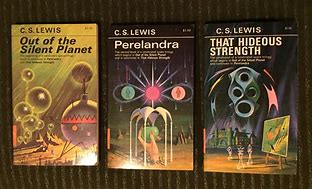
We find similarities and dissimilarities between works by CS Lewis, James Blish and Poul Anderson. We are currently considering:

the Ransom Trilogy (soft sf) and Surprised By Joy (spiritual autobiography) by Lewis;

the After Such Knowledge Trilogy (mixed genres), the Cities In Flight Tetralogy (hard sf) and The Quincunx Of Time (hard sf) by Blish;

several historical novels and historical fantasies and two later future histories by Anderson.

The Ransom Trilogy, Volume III, That Hideous Strength, mentions Prospero and Roger Bacon on the same page during a discussion of magic, thus indirectly linking this novel both to Anderson's A Midsummer Tempest and to After Such Knowledge, Volume I, Doctor Mirabilis.

In addition to historical novels and historical fantasy novels, Anderson wrote some intermediate works that were historical fiction with an element of fantasy. This description might also fit Doctor Mirabilis since Bacon's inner voice, inspiring him to seek the scientia universalis, is possibly demonic. In the Ransom Trilogy, Volume II, Perelandra, Elwin Ransom, a Christian philologist, contends with the demonically possessed physicist, Weston, on the sinless planet, Venus. In After Such Knowledge, Volume III, A Case Of Conscience, Ramon Ruiz-Sanchez, a Jesuit biologist, contends with an atheist physicist, Cleaver, on the sinless planet, Lithia.

We find some common ideas. However, a philosophical gulf divides Lewis from hard sf writers like Blish and Anderson. This is how Lewis summarized the philosophical position that he had held before his religious conversion:

"We maintained that abstract thought (if obedient to logical rules) gave indisputable truth..."
-CS Lewis, Surprised By Joy (London, 1964), XIII, p. 167.

Logical abstract thought gives indisputable truth? Not observation or experiment?

Roger Bacon, quoted by James Blish:

"Neither the voice of authority, nor the weight of reason and argument are as significant as experiment..."
-Roger Bacon, De erroribus medicorum, quoted in James Blish, Doctor Mirabilis IN Blish, After Such Knowledge (London, 1991), pp. 1-318 AT NOTES, p. 315.

Lewis was a prescientific Platonist.

According to Blish, Bacon defined scientific thinking as we understand it and invented:

"...the theory of theories as tools." (p. 316)

In Cities In Flight, Volume IV, The Triumph Of Time, Bacon is described as the inventor of scientific method. Thus, Doctor Mirabilis, although historical fiction, could be regarded as a remote prequel to Cities In Flight and indeed to hard sf in general.

Lewis' Venerian Adam prophesies a supernatural apocalypse millennia hence whereas Blish's characters in The Quincunx Of Time encounter many scientific paradigms in messages from their future and Anderson presents technologically dominated futures in his later future histories, the Harvest Of Stars Tetralogy and Genesis.

Wind In Greenland And Elsewhere Later

Poul Anderson, The Merman's Children (London, 1981).

When Eyjan questions the local chief, Haakon Arnorsson, in his steading:

"Haakon brooded. The wind moaned, the folk whispered and made signs in the air, not all of the Cross." (VIII, p. 164)

Brooding, moaning, whispering and signs portend evil. Of course the wind joins the chorus.

When, during their lengthy exchange, Haakon discloses that he and his men have slaughtered some Inuit:

"Shadows closed in as the fire waned. Dank chill gnawed and gnawed." (p. 169)

Shadows, dankness and chill underline the evil.

When Haakon requests the merfolks' help:

"Again was a windy hush." (p. 171)

When they refuse, Haakon's men overwhelm them. When they have spent a night bound on the floor:

"Wind blew whetted. Tauno wondered if the wind was always keening around this place." (IX, p. 173)

The wind keens throughout Poul Anderson's universes. When Tauno and his captors sail to battle, the cries of the black guillemots:

"...were lost in the sinister singing of wind. The sun was a dull and heatless wheel, barely above the mountains; it was as if cold radiated from their snows and the glacier beyond." (p. 175)

Wind sounds sinister when battle is imminent. Cold does not radiate but can seem as if it does.

Later and elsewhere, when Ingeborg and Niels bear good news to Margrete:

"A flaw of wind swooped into the court, raw and boisterous. A cloud passed overhead like a white banner. Crows laughed." (XI, p. 187)

Nature changes its tune. Wind is not sinister but boisterous. The text mentions not a cloud shadow but a white banner. Birds do not cry but laugh.

Temporal Thought Experiments III

A 2-Part Comic Strip
Part 1
Panel 1: At 2:00 pm on 1 June 2030, character A witnesses the assassination of the President.

Panel 2: A constructs a time machine in a laboratory.

Panel 3: A departs/disappears in his time machine.

Panel 4: The laboratory and indeed the universe continue to exist.

Part 2
Panel 1: At 2:00 pm on 1 June 2030, A witnesses an older version of himself preventing the assassination.

Panel 2: The President thanks the older A.

Panel 3: The older A converses with the younger A who will not construct a time machine or travel through time to save the President.

Panel 4: Both As continue to exist in what they agree is timeline 2.

In that scenario:

A's construction of a time machine succeeds the assassination of the President in timeline 1;

the President thanking A succeeds A's prevention of the assassination in timeline 2;

timeline 2 succeeds timeline 1 in a second temporal dimension.

An alternative scenario (scenario 2): the events of timeline 1 did not happen but are merely "remembered" by the older A who appeared/arrived from nowhere and nowhen to save the President.

My assessment:

scenario 2 is counterintuitive and contravenes conservation of energy;

however, both scenarios are logically possible;

however (again), any narrative that alternates between scenarios 1 and 2 is logically incoherent.

It makes no sense for a time traveller to say, "I exist now but, because of something that happened at an earlier time, I might not exist now." If he is talking about it, he does exist now.

Temporal Thought Experiments II

Now imagine a second 3-panel comic strip, Strip 2, directly under the first, Strip 1. The two strips are identical except that in Strip 2, panel 3, B's speech balloon reads not "Ha! Ha! Ha!" but "That's not funny!" It is easy to see Strips 1 and 2 as two parallel timelines. However, if there is an observer whose temporal dimension runs down the page, then that observer perceives Strip 2 not as paralleling but as succeeding Strip 1. He thinks that Strip 1 either has ceased to exist or has been transformed into Strip 2. 

But:

at no moment in the timeline of Strip 1 does Strip 1 either cease to exist or metamorphose into Strip 2;

readers of the page displaying the two strips continue to see both strips, one above the other.

Imagine instead that, some time after drawing Strip 1, the artist erases "Ha! Ha! Ha1" and replaces it with "That's not funny!" in panel 3. Now Strip 2 has succeeded Strip 1 not as perceived by an observer whose temporal dimension runs down the page but in the temporal dimension of the artist himself. To the characters in Strip 2, the events of Strip 1 never happened but, to the artist, Strip 1 did exist and, in panel 3 of that strip, B did laugh. Contradictions arise only when we confuse sequences of events in different temporal dimensions.

Temporal Thought Experiments

Poul Anderson's works present single, mutable and multiple timelines. Comic strips might provide a helpful way to think about them. This idea will probably be developed over several posts.

A 3-Panel Comic Strip
Panel 1: Two characters, A and B. A tells B a joke, short enough to fit into a single speech balloon.

Panel 2: B thinks. Silent panel.

Panel 3: B laughs. Speech balloon - "Ha! Ha! Ha!"

In this thought experiment, A an B are conscious, perceiving themselves and their environment as three-dimensional. In their experience, A jokes at time t0, then B thinks at t1 and laughs at t2. To readers of the comic strip, the left to right direction on the page is one of their three spatial dimensions. Within each panel, that direction is also a spatial dimension. However, for the 3-panel comic strip, the left to right direction on the page is A's and B's temporal dimension. The main point here is the total difference between the temporal dimension of the readers of the comic strip and that of the characters.

The readers can:

see all three panels at a glance;
read them in turn;
read them in any order - 123, 132, 213, 231, 312 or 321;
focus on a single panel for any length of time.

If A and B knew of this, then they would think that they were being timelessly observed by extra-cosmic beings whereas the readers are experiencing duration in the normal way. If anyone asks, "Does B laugh before or after a particular reader reads panel 3?" then he is conflating two completely independent timelines. I think that such conflation of timelines is a problem when discussing Poul Anderson's Time Patrol series but I will have to develop this idea further.

Science And Religion In Fiction IV

Hard sf by Poul Anderson and James Blish incorporates Christian characters asking theological questions:

Could God have created the Ythrians? (Anderson)
Or the Lithians? (Blish)
Could God have been incarnated on another planet? (Anderson)

In these works, such issues exist only inside some characters' heads. However, a prima facie contradiction between a character's experiences and his beliefs is more than enough to generate a story about that character.

Supernatural beings literally exist in works of fantasy by Anderson and Blish but there is usually a clear demarcation between the genres. I have to write "usually" because imaginative authors create exceptions and borderline cases:

Heinlein's Martians and Aldiss's Helliconians have direct contact with their hereafters;

Heinlein's and Bradbury's Martian Old Ones are similar;

Lewis's eldila have empirically discernible bodies;

in Volume III of Blish's After Such Knowledge Trilogy, Fr. Ruiz-Sanchez believes that Satan is active on Lithia whereas, in Volume II, the magicians had seen demons and, in Volume I, Roger Bacon's inner voice, might have been demonic;

Anderson's inter-universal Old Phoenix Inn is a meeting place for characters from hard sf and fantasy universes but its existence does not compromise the genres of individual works.

Saturday, 16 April 2022

Science And Religion In Fiction III

Science cannot be permanently saddled with an inadequate theory like behaviourism because the nature of scientific method ensures that theories progress as scientists continue to try to understand emergent properties of energy, matter and life. Chemistry becomes biology without needing an elan vital. Natural selection is not directed. A single water molecule is not wet. A single neuron is not conscious. How do higher-level properties emerge? We can continue to try to find our or we can say that God must have done it which is to end all enquiry.

Robert Heinlein and James Blish describe scientists making new discoveries. Poul Anderson's characters explore new regions of the universe.

CS Lewis wrote:

"The physical sciences, good and innocent in themselves, had already, even in Ransom's own time, begun to be warped, had been subtly manoeuvred in a certain direction. Despair of objective truth had been increasingly insinuated into the scientists; indifference to it, and a concentration on mere power, had been the result."
-CS Lewis, That Hideous Strength IN Lewis, The Cosmic Trilogy (London, 1990), pp. 349-753 AT CHAPTER 9, p. 560.

"...good and innocent..." is damning with faint praise. "...subtly..." means "demonically."

Elwin Ransom condemns scientific knowledge of the universe as:

"'...the enemy's talk which thrusts my world and my race into a remote corner and gives me a universe with no centre at all, but millions of worlds that lead nowhere or (what is worse) to more and more worlds forever, and comes over me with numbers and empty spaces and repetitions and asks me to bow down before bigness.'"
-CS Lewis, Perelandra IN The Cosmic Trilogy, pp. 145-348 AT 17, p. 339.

The "enemy" is the Devil.

"...Professor Weston...was a man obsessed with the idea which is at this moment circulating all over our planet in obscure works of 'scientifiction', in little Interplanetary Societies and Rocketry Clubs, and between the covers of monstrous magazines, ignored or mocked by the intellectuals, but ready, if ever the power is put into its hands, to open a new chapter of misery for the universe. It is the idea that humanity, having now sufficiently corrupted the planet where it arose, must at all costs contrive to seed itself over a larger area: that the vast astronomical distances, which are God's quarantine regulations, must somehow be overcome. This for a start. But beyond this lies the sweet poison of the false infinite - the wild dream that planet after planet, system after system, in the end galaxy after galaxy, can be forced to sustain, everywhere and for ever, the sort of life which is contained in the loins of our species - a dream begotten by the hatred of death upon the fear of true immortality, fondled in secret by thousands of ignorant men and hundreds who are not ignorant. The destruction or enslavement of other species in the universe, if such there are, is to these minds a welcome corollary."
-Perelandra, 6, p. 216.

When I first read that in my teens, I was a member of the British Interplanetary Society and was reading works by Arthur C. Clarke, Robert Heinlein and Poul Anderson.

In published private correspondence, Lewis referred to the then imminent Moon landing as a desecration. He is worth quoting at length, I think. We recognize obscurantism, "...God's quarantine regulations...," and the opposite of all that we usually appreciate on this blog.

Science And Religion In Fiction II

Most fiction still recounts human interactions on Earth where the Sun and stars are immemorial lights in the sky whereas science fiction recognizes that the Sun is a star and that Earth is a planet. "Hard," unlike "soft," sf assumes considerably more scientific knowledge than just that. In Poul Anderson's works, we are expected to understand or at least accept:

time dilation on an interstellar round trip in Starfarers and on a one-way intergalactic journey in Tau Zero;

quantum mechanics as the basis of hyperspace in the Technic History and of alternative histories in the Time Patrol series;

scientific rationales for alternative means of faster than light (FTL) space travel, based on the author's knowledge of physics, in other works;

evolution by natural selection of intelligent species on several extra-solar planets in the Technic History;

conditions on solar planets consistent with the latest scientific information at the time of writing;

interplanetary orbits consistent with Newtonian mechanics.

Soft sf writers accept that we are surrounded by interplanetary and interstellar space but otherwise disregard scientific knowledge. Ray Bradbury's and CS Lewis's versions of Mars are humanly habitable. FTL, even if mentioned, is never rationalized. A Bradbury story said, of interstellar explorers, that their speed was that "...of a god." Lewis's Venus bears a divinely created first man and woman and the planets are steered through Heaven not by gravity but by presiding angels.

However, Lewis in particular did not merely disregard science for fictional purposes. His opposition to materialist philosophy was based at least in part on a failure to understand scientific method. Lewis thought that a scientific world view entailed an unacceptable behaviourism and that the only philosophical alternative to that was idealism or, since an impersonal absolute mind made no sense, theism. Of course, many of us question whether an absolute person makes sense either. The absolute is the opposite of the relative whereas persons exist in self-other relationships. But the more basic point is about scientific method and this puts Lewis into a fundamental philosophical disagreement with the entire ethos of hard sf as represented by Poul Anderson.

To be continued.  

Science And Religion In Fiction

Thesis: In The Shape Of Things To Come by HG Wells and Last And First Men by Olaf Stapledon, man remakes himself with science. 

Antithesis: In the Ransom Trilogy, Volume III, That Hideous Strength, by CS Lewis, "man remaking himself with science" means some men using science to gain total control of all other men and, since Lewis was a Christian, the human controllers turn out to have demonic controllers. 

Synthesis?: Hard sf writers like Poul Anderson and James Blish show human beings continuing to use science for good or ill but usually without the apocalyptic outcomes prophesied by Wells or Lewis.

In fiction, any outcome is valid if the author can make it plausible. However, Wells and Lewis did not merely speculate but propagandized.

Any purportedly anthropocentric fictional future is not theocentric, therefore, according to Lewis, is demonic. For this reason, he would have continued to dislike most sf, e.g.:

in Blish's Cities In Flight, after a cosmic collision, human survivors create new universes from their own bodies;

in Anderson's Genesis, post-organic intelligence replaces, then re-creates, humanity;

in both of these future histories, humanity and/or its technology controls the future.

Read Wells, Stapledon, Lewis, Blish and Anderson in that order and see what you think.

Next, we will differentiate hard sf as represented by Poul Anderson, from soft sf and, more specifically, from Lewis's anti-science fiction. I have just coined that phrase but I think that it is appropriate.

Tuesday, 5 April 2022

Five Senses Near Greenland

The Merman's Children, Book Three, VII.

Tauno and Eyjan, merman-human hybrids, swim to intercept a kayak convoy.

Cold, blue, salt water whooshes, gurgles and roars: five senses if the salt is smelled as well as tasted. The sensory assault continues. The water also tastes of life, deeps and distances. (We have had a smell of distance before.) Choppy water rocks the swimmers. Green shimmer overlays multi-shaded blue black whitecaps. Wind is sharp. Sky is gray. Gulls cry. Cliffs are dark. Meadows are autumnal. Peaks are snow-capped. Inland ice is bleakly bright.

Next comes a description of the Inuit and their kayaks.