Sunday, 26 March 2023

What Hloch Tells Us

Although James Ching and Emil Dalmady each appear in only a single instalment of Poul Anderson's Technic History, the Earth Book Editor, Hloch, tells us more about their later lives and their descendants. It is also Hloch who informs us that:

Tales of the Great Frontier by A.A. Craig is the source for "Margin of Profit," introducing Nicholas van Rijn, and for "Rescue on Avalon" about the settlement of Avalon;

records moved from Terra to Hermes are the source for "Day of Burning," about Falkayn on Merseia, and for "Lodestar," about van Rijn at Mirkheim;

The Man Who Counts, about van Rijn on Diomedes, was published as a historical novel on either Terra or Hermes;

the narrator of "Wings of Victory," about first contact with Ythri, was a planetologist named Maeve Downey;

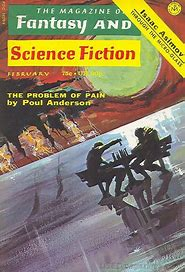
a private correspondence recorded on Terra and transcribed into the archives of the University of Fleurville on Esperance is the source for "The Problem of Pain" about the Ythrian New Faith;

Arinnian of Stormgate Choth, whose human name is Christopher Holm (and who married Tabitha Falkayn), is a co-author of the Earth Book;

the same Grand Survey expedition discovered both Ythri and Avalon.

Think how much poorer the Technic History would be without Hloch's contributions.

Saturday, 25 March 2023

Multiple Narrative Layers II

In "Esau," Nicholas van Rijn recruits young Emil Dalmady from Altai as an entrepreneur. Dalmady's parents had made sacrifices to send him to managerial school offplanet. That is all that we learn about the Dalmadys in any Technic History instalment.

Hloch's introduction to "Esau" tells us that:

some of Dalmady's children moved to Avalon with Falkayn;

one of them, Judith, heard Dalmady's reminiscences in her youth and had a good knowledge of the conditions in his youth;

she wrote "Esau" for the Avalonian magazine, Morgana (named after the Avalonian moon).

"The Season of Forgiveness" recounts an incident on the planet Ivanhoe previously visited by Falkayn.

Hloch's introduction to "The Season of Forgiveness" tells us that:

Emil Dalmady heard of the incident from one of the persons concerned when he was an entrepreneur in that volume of space;

he recounted the incident to Judith who wrote the story for Morgana.

"Wingless" recounts an experience on Avalon of the young Nat Falkayn, grandson of David and Coya and son of Nicholas who had been born near the end of Mirkheim.

Hloch's introduction to "Wingless" tells us that:

this is the last story that Judith Dalmady/Lundgren wrote for Morgana;

she was then in "high old age" but was drawing on fresh memories.

The Earth Book has carried us from Emil Dalmady in his youth to his daughter in her old age, writing about Falkayn's grandson in his youth. 

Finally, The Technic Civilization Saga changes the order of some of the stories so that we are informed that "The Season of Forgiveness" was also written by Judith Dalmady/Lundgren before we have been told that she had written any stories. Hloch's introductions sometimes assume knowledge of what is to come. Everything is disclosed if the Saga is read to its conclusion.

Multiple Narrative Layers

When Poul Anderson's "How To Be Ethnic In One Easy Lesson" was collected in his The Earth Book of Stormgste, its text was not expanded. However, the narrative was extended by Hloch's introduction. The story as originally published ends when its first person narrator, James Ching, is about to become apprenticed to a Master Merchant of the Polesotechnic League. Hloch additionally informs us that:

spaceman Ching wrote running reminiscences throughout his career and settled in Catawrayannis;

his descendants let Hloch's mother, Rennhi, read the notebooks;

the text that we read as "How To Be Ethnic..." is an extract from Ching's reminiscences.

These few sentences fictitiously written by Hloch immeasurably increase the wealth of our information about Ching's career and about the Technic History.

Likewise with "Lodestar." Records transferred from Terra to Hermes by van Rijn and Falkayn include the log of the ship in which van Rijn had travelled to Mirkheim. Since the log discloses the names both of the ship and of its captain, Ythrian researchers are able to contact the Wyvan of Wryfields Choth on Ythri and, through him, Captain Hirharouk's descendants who allow the captain's journal to be read. The narrative that we read as "Lodestar" is composed by Hloch and Arinnian. The latter is Christopher Holm in The People of the Wind. Hloch's Earth Book introductions add multiple narrative layers to the Technic History.

Haertel Scholium And Technic History

I will make some remarks about James Blish as a lead-in to making similar remarks about Poul Anderson. You might remember that the recurrent themes on this blog are:

remember Wells
reread Anderson
read Blish too
film Anderson's Technic History

The first time that I read "Beep" by James Blish, I thought, "This story should be novelized." Later, Blish made three changes to "Beep." First, he revised and lengthened the text so that it could be republished as the (very) short novel, The Quincunx of Time. Secondly, he added explicit references to his character, Adolph Haertel, thus more fully incorporating Quincunx into his "Haertel Scholium," a loose network of branching future historical narratives. Thirdly, since "Beep" had already been constructed around a number of Dirac transmitter messages received from different further future periods, Blish added more such messages, including two that linked Quincunx to his works, "A Style in Treason" and Midsummer Century, thus generating a new loose trilogy within the Haertel Scholium. Thus, a work originally complete in itself was incorporated into a vaster framework. (In fact, "Beep" originated as an indirect spin-off from Blish's Okie series but any further elucidation here would be a digression.)

I thought of "Beep" in connection with Anderson's "How To Be Ethnic In One Easy Lesson" and "Lodestar," not that I necessarily thought that either of these stories merited novelization. After all, "Lodestar" became the prequel to the novel, Mirkheim, both titles referring to a single planet. "Lodestar" is Mirkheim writ small. However, each of these stories conveys so much condensed information about life in the Solar Commonwealth that they are almost novelistic in impact if not in fact. Both are instalments of Anderson's Technic History and both gained in significance when they were incorporated first into The Earth Book of Stormgate, then into The Technic Civilization Saga.

Friday, 24 March 2023

Mining "Lodestar" II

Satan is a rogue planet temporarily warmed and energized by its close orbit around Beta Crucis, therefore an ideal environment for the manufacture of expensive isotopes although none higher than atomic number 100, whereas Mirkheim is a planetary core large enough to survive the supernova explosion of its primary, therefore coated with supernova-generated supermetals above atomic number 100. This comparison shows why, when Satan had been exploited for a few years, someone, namely David Falkayn, went looking for a planet answering the description of Mirkheim. Further, when the Supermetals company, secretly founded by Falkayn, had been selling supermetals for three years, someone else, namely Nicholas van Rijn, also went looking for a planet answering that description. Van Rijn agreed to keep the secret but eventually a third party found Mirkheim and a war resulted.

The Supermetals company comprises representatives of poor or primitive species like Diomedeans, Wodenites, Ikranankans and Ivanhoans. Also:

"...neglected colonies like Lochlann (human) and Catawrayannis (Cynthian)."
-"Lodestar," p. 659.

Two points about Catawrayannis:

it is not a planet but a city on the planet, Llynathawr;

the Cynthians later sold Llynathawr to the Terran Empire so that it became a human colony despite retaining its Cynthian nomenclature.

Mining "Lodestar"

Rereading Poul Anderson's "Lodestar," we realize that it is an extremely condensed text from which we can extract a wealth of information about, e.g.:

Coya Conyon's life and times;

the relationship between the planets, Satan and Mirkheim, featured respectively in the earlier novel, Satan's World, and in the later novel, Mirkheim;

the multi-species Supermetals company which mines expensive supermetals directly from the surface of Mirkheim.

Coya
She dislikes "...those money-machine merchant princes..." (p. 640) of the Polesotechnic League.

Her maternal grandfather, Nicholas van Rijn, was Dutch and Malay, her grandmother was Mexican and Chinese, her mother was called Beatrix Yeo and her father, Malcolm Conyon, was of Scottish-Hermetian, African-Nyanzan descent.

She is "...a typical modern human." (pp. 643-644)

Whereas van Rijn's generation rarely married, Malcolm Conyon's did and Coya's is "...reviving patrilineal surnames." (p. 644)

Although she never fully approved of the League, now that it is breaking down, she sometimes dreads the future.

Van Rijn says that, as youngsters become more prudish, the powers that be become more brutish but Coya replies that:

"'The second is part of the reason for the first.'" (p. 659)

There is social and generational change in the Solar Commonwealth.

Thursday, 23 March 2023

Domestic Life In "Lodestar"

In Poul Anderson's Technic History, "How To Be Ethnic In One Easy Lesson" shows domestic life on Earth in the Solar Commonwealth. There is some of this also in "Lodestar" Coya Conyon grew up with her parents on Earth. From her earliest age, her maternal grandfather, Nicholas van Rijn would visit their home, toss her high, give her presents from many extra-solar planets, tell extravagant stories and take her sailing, to a live performance or around the Solar System. She learned ballet. She also learned of the adventures of van Rijn's Muddlin' Through crew, became an admirer of David Falkayn and later had occasional outings with him. She works as an astrophysicist at Luna Astrocenter. That is about all. We would like to know more but this is a lot more than nothing.

A Pivotal Story II

"Lodestar":

brings together David Falkayn, the trader team, Nicholas van Rijn and Ythrians;

introduces van Rijn's granddaughter, Coya Conyon, who will become Falkayn's wife in Mirkheim, thus an ancestress of Nat Falkayn in "Wingless" and of Tabitha Falkayn in The People Of The Wind;

identifies the central conflict in the Polesotechnic League, which makes Falkayn break his oath of fealty to van Rijn and defy him to his face;

ends by confirming that van Rijn is "...indeed old." (p. 680)

Falkayn says:

"'Sir, you don't need the money. You stopped needing more money a long while back.'"
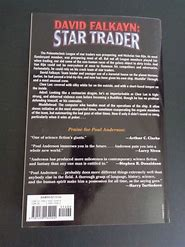
-Poul Anderson, "Lodestar" IN Anderson, David Falkayn: Star Trader (Riverdale, NY, March 2010), pp. 631-680, p. 679.

The perfect convergence of Technic History themes comes when the Ythrian, Hirharouk, sees the shadow of God the Hunter across van Rijn's way of life and advises avoidance of conflict.

A Pivotal Story

The most utterly pivotal story in Poul Anderson's Technic History has to be "The Star Plunderer," recounting as it does the transition from the Time of Troubles to the Terran Empire. Before the Troubles were the Solar Commonwealth and the Polesotechnic League. After this story is the early Empire incorporating planets successfully in "Sargasso of Lost Starships" and unsuccessfully in The People Of The Wind.

Also pivotal is "Lodestar":

written for Astounding: John W. Campbell Memorial Anthology;

the last Polesotechnic League story in The Earth Book Of Stormgate;

thus, also, the last League story to be read in the original reading order of the Technic History;

the last story in The Technic History Saga, Volume II, David Falkayn: Star Trader, where it is followed by an Afterword in which its author describes it as the ending of a saga although instead it wound up being the prequel to the concluding League novel, Mirkheim.

Interruption: more later.

My Favourite Future History Series

Regular readers of this blog already know that I remain fascinated with the structure of Poul Anderson's Technic History, particularly in its original reading order which would require some slight amendments if it were to be reproduced in a later edition. By the end of the opening Polesotechnic League Tetralogy, David Falkayn's career has advanced from apprentice to acting CEO of SSL and the League has begun its terminal decline. Thus, the narrative begins not at the beginning of the history but at one of its major turning points. Although these four volumes do not in themselves constitute a future history series, because their action is confined within the lifetimes of a single set of characters, they would nevertheless have remained a major sf series even if nothing else had been added. In particular, the culminating volume, Mirkheim, is:

a good novel, because it shows change in the lives of multiple characters;

a good political novel, because it shows how social divisions, conflicts and upheavals and an unexpected war affect these characters;

a good sf novel, because it fully develops the industrial and political consequences of a speculative premise, a superjovian planet orbiting a star that becomes a supernova.

After the Tetralogy:

one earlier and two later periods would be covered in a new collection, The Saturn Game and other stories;

a historically much later period is covered in The People Of The Wind;

periods earlier than, contemporaneous with and later than the Tetralogy, although all of them earlier than The People Of The Wind, are covered in The Earth Book Of Stormgate;

the chronologically latest event in all these seven volumes is the compilation and editing of the Earth Book by Hloch of Stormgate Choth on Avalon, the colony founded by Falkayn;

although Dominic Flandry has not yet been born, the Terran Empire that he will later defend has been founded between stories in The Saturn Game..., has waged war against Avalon in The People Of The Wind and informs the background of Hloch's editing of the Earth Book;

the Earth Book is followed by the nine-volume Flandry period and its single-volume sequel.