Friday, 2 September 2022

Decadence Again

Poul Anderson, "Hunters of the Sky Cave" IN Anderson, Sir Dominic Flandry: The Last Knight Of Terra (Riverdale, NY, March 2012), pp. 149-301.

Dominic Flandry reflects:

"Personally, I enjoy decadence; but somebody has to hold off the Long Night for my own lifetime, and it looks as if I'm elected." (I, p. 155)

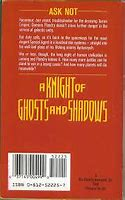
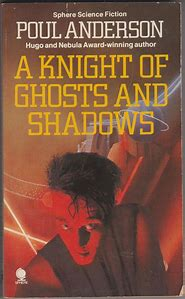
The appreciation and enjoyment of decadence is a recurring theme. However, in A Knight Of Ghosts And Shadows, which we have just reread, Flandry has a surprising insight:

"Was that always my real desire? Not to chase down enemies of the Empire so I could go on having fun in it, but to have fun chasing them down?
"No matter." (III, p. 382)

No matter, indeed. The show must go on, in any case.

The Last Chereionite

By travelling to 802,701 AD, the Time Traveller finds mankind devolved into Morlocks and Eloi. By travelling to an ancient planet in the Merseian Roishunate, Dominic Flandry confronts the last Chereionite. I think that these two sf climaxes are comparable. The Flandry novel, A Knight Of Ghosts And Shadows, is embedded in an action-adventure space opera series with Flandry of Terra as hero and Aycharaych of Chereion as villain. Nevertheless, Aycharaych's conclusion transcends his pulp magazine origins. Chereionite technology preserves the scanned and recorded likenesses of:

"'...the loftiest spirits of a million years...'" (XX, p. 599)

"'...- would you let your war lords turn these instruments to their own vile ends?
"'No!'
"And Flandry understood." (p. 600)

This might count as an Andersonian moment of realization except that this time we do not have to wait to be told what it is that Flandry has realized. If Aycharaych had not tricked the Merseians into believing that a few million powerful Chereionites did staff work to support his solo field work, then the Roidhunate would have sacked his planet, would have destroyed his heritage and then, with the appropriated Chereionite instrumentalities, have wrought even greater harm than he alone ever did on their behalf.

However, we cannot condone the manipulation of living beings that he regards as an art and a sport.

Kossara And God

A Knight Of Ghosts And Shadows, XVII.

Fiction reflects life. I am still thinking about Kossara Vymezal thanking God for letting her go into danger with Dominic. To a monotheist, everything that happens is part of a life-long interaction with God. Let's begin at the beginning. I wake up early, too tired to get up yet but not able to get back to sleep either. A monotheist would ask, "Why did You wake me? Do You want me to spend this time in prayer or meditation?" As a non-theist, I ask myself, "Can I use this time for meditation?" I can even utter the agnostic prayer: "To Whom it may concern; to whatever gods may be..." Of course, I cannot say the prayer of monotheist faith. However, many monotheists believe that God upholds us all whether or not we believe in him. Kossara thinks this about the pagan ychan, Trohdwyr. Thus, my experience parallels Kossara's and sometimes moves close to it, which is unsurprising since, despite our differences, we are two human beings in similar universes.

Thursday, 1 September 2022

Hunters And A Knight II

Because of their comparative lengths, The Technic Civilization Saga, Volume VI, Sir Dominic Flandry: The Last Knight Of Terra, collects only four instalments of Poul Anderson's Technic History:

"The Plague of Masters"
"Hunters of the Sky Cave"
"The Warriors from Nowhere"
A Knight Of Ghosts And Shadows

- which are four of the eight Captain Flandry instalments. Thus, "Hunters..." and A Knight... are separated only by a single short story. Further, these three works present both Chives and the Hooligan. Before "Hunters...," Flandry possessed neither.

My agenda for tomorrow or whenever is maybe to make some concluding remarks about A Knight..., then to revisit "Hunters..." which now seems to take on a greater significance as a turning point for Flandry. The Technic History somehow renews itself.

Hunters And A Knight

A Knight Of Ghosts And Shadows is the culmination of:

the Captain Flandry series;
the Flandry-Aycharaych conflict;
the curse that Djana put on Flandry in A Circus Of Hells.

Since we, editorially speaking, are not rereading the series in chronological order, a good Captain Flandry instalment to reread in conjunction with A Knight... is "Hunters of the Sky Cave" which is long enough to count as a short novel and has been published in a single volume with 121 pages of text.

The two works have several parallels:

action beginning in the outer Solar System, then going interstellar;

Vixen invaded by the Aradazirho and Dennitza threatened by the Merseians;

Flandry, Chives and Kit en route to Vixen in the Hooligan - Flandry, Chives and Kossara en route to Dennitza in the Hooligan;

in both, a conversation with Aycharaych, then later a decisive confrontation with that being, the first on a proto-planet, the second on a very old planet.

"Hunters..." is one of those works that has gained associations for me because of one of the places that I was when rereading it. See here.

Wind In Zorkagrad


A Knight Of Ghosts And Shadows.

I have probably quoted all of these examples before. They show the wind accompanying Poul Anderson's characters through the narrative as if commenting on the action.

When the ychani march to the Dennitzan Parliament:

"A west wind skirled against the sun, whose blaze seemed paled in a paled heaven." (XVII, p. 551)

Heaven pales as the crisis deepens.

When Flandry speculates about a Merseian agent meddling in Dennitzan affairs:

"The wind boomed between walls." (p. 555)

When Kossara Vymezal arrives unexpectedly to address the Shkoptsina (Parliament):

"A moan lifted out of the benched humans, as if the fall wind had made entry..." (p. 560)

This time, the wind outside is not heard but is present as a metaphor.

Finally, for now, when, after the attempted coup:

"Zorkagrad lay silent under bitter blue, as if killed..." (XVIII, p. 569)

- we are told that:

"Day broke windless and freezing cold." (ibid.)

What could be more appropriate than windlessness to accompany apparent death?

Tomb


A Knight Of Ghosts And Shadows, XVIII.

We have discussed what I call Flandry's "prayer" to (St.) Kossara before but there were parts that I did not quote or discuss at length:

"I didn't feel it was fitting that they mean to build you a big tomb on Founders' Hill. I wanted your ashes strewn over land and sea, into sun and wind. Then if ever I came back here I could dream every brightness was yours. But they understand, what they do, your people." (p. 577)

But do they? What is the best way to dispose of the dead? (Neil Gaiman lists every possible way in his The Sandman story, "Cerements.") I prefer cremation but, having participated in the scattering of the ashes of a family member, I do not know what is best - except that burial does not seem like a good use of the land.

Flandry continues:

"It's I who am the sentimental old fool. Would you laugh if you could know?" (ibid.)

Self-deprecation seems strangely appropriate in such circumstances. Humility is certainly appropriate. It is then that Flandry states that Kossara had believed that she would know, asks her to help him believe that she still is and receives no answer but:

"...the priest's voice rising and falling through archaic words." (ibid.)

For many, that is sufficient answer.

Strangely again, Flandry apologises to  Kossara - then says goodbye. Next, he will deal with Aycharaych.

From The Ice Cliff To The Black Ocean

A Knight Of Ghosts And Shadows.

In imagination, we might follow a single drop of water through Dennitzan geography. 

In the far north, there are glaciers and a two-kilometers-high ice cliff. A river from the melting cliff flows fast past Bodin Miyatovich's hunting lodge.

The "Melt-begotten...Lyubisha River..." (XIV, p. 524) flows through a canyon in the northern ringwall of the Kazan and eventually enters Lake Stolyan, site of the planetary capital city, Zorkagrad, at the centre of the Kazan.

The Elena River flows east from Lake Stoyan, cuts through the eastern ringwall and enters the Black Ocean where the ychani hero, Gwyth, dared climactic storms three hundred years ago. There are:

"...docks at the Elena River mouth..." (XVI, p. 544)

- and the Kazan ringwall is visible on the horizon, from the Obala, the east coast of the Rodna continent.

But our main focus here and now is on a single drop of water making its way from the ice wall to the Black Ocean.  

Empty Streets In Zorkagrad

A Knight Of Ghosts And Shadows, XVII.

From:

"...a parking lot at the edge of Zorkagrad..." (p/ 551)

- the four hundred ychani, concealing in their midst the cowled and cloaked Dominic Flandry and Kossara Vymezal, march through:

"...a new district of private homes and clustered condominium units..." (pp. 552-553)

- which is deserted apart from:

"An occasional militia squad..." (p. 553)

- because the residents have sought the protection of the inner city forcefield generators.

Older streets are also quiet because Dennitzan citizens:

"'...under discipline, often in their regular Voyska units...'" (p. 554)

- have confined Imperials in certain buildings as hostages for the release of the arrested Gospodar:

"'...and the good behavior of their Navy ships.'" (ibid.)

The good behavior of the Navy! I like the Khruaths (fully participative democracy) on Avalon and the ispravkai (citizens' direct action) on Dennitza. In fact, this ispravka traps a Merseian agent whom Flandry is then able to interrogate with crucial consequences.

Also...


Also in SM Stirling's Daggers In Darkness (I had not quite finished reading it before):

a description of the effects of flame-throwers (well, ok, if we are going to read about combat, then we are going to have to know what it is like);

another tribute reference to Wells, this time to The Invisible Man;

the disclosure in the Epilogue of yet another horrific SM Stirling villain, this one based on a real person who did not survive into 1922 in our timeline - we see where the series is going.

Two more children are introduced - adopted - and there is the prospect of the various daughters growing up and becoming more interactive characters in subsequent volumes.

Onward, Earthlings.