Saturday, 2 January 2021

The Home Companies

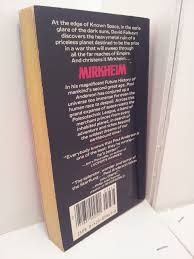
Mirkheim, XIX.

Van Rijn:

"'The Home Companies is become near as damn the government of the Commonwealth. At least, the government does nothings they don't want, and everythings they do want. I, an independent, see the threat in that; but I am not hungry for power myself, I simply want people should let me be to play my little games.'" (pp. 259-260)

Van Rijn does not want to run the government but does need the protection provided by its laws, courts, police and prisons although, out in space, the League organizes naval protection of its members property where governments cannot. Van Rijn confirms what Falkayn said about power here.

To forestall competition from the Home Companies when they do move out into space, the Seven In Space are secretly backing a strong Baburite state using a dominated Hermes as its human base. The Polesotechnic League is irretrievably split. The shadows of God the Hunter and of the Terran Empire move inexorably closer.

Van Rijn Refers To Theology

Mirkheim, XIX.

"'I am not sure anybody will ever grasp why mortals make war,' van Rijn answered soberly. 'Maybe someday we will find a sophont species what is not fallen from grace, and they can tell us.'" (p. 258)

This is mystification. Anthropologists can and do find socio-psychological reasons for wars whereas, by contrast, a species that had never waged war would not understand it!

For previous blog discussions of this issue, see:

Real Power

Mirkheim, XIX.

David Falkayn on power:

"'The politicians don't have that much. They put on a show, but most of the real decisions are made by owners, managers, bureaucrats, union chiefs, people who aren't conspicuous enough to need all that protection or all that secretarial prearrangement of their days.... Of course, the politicians think they lead.'" (p. 252)

This answers one of my questions in "Whatever That Means": "Will the real power continue to lie elsewhere?" Let's look at that hierarchy of power:

owners
managers
bureaucrats
union chiefs
 
This is deffo a hierarchy. It would be a falsification to suggest that these four groups wield power equally. Ownership is power. Bureaucrats change policies if owners threaten to move production elsewhere. The Polesotechnic League could impoverish the Solar Commonwealth. Union chiefs maintain their own intermediate social position by controlling their members but certainly do not share decision-making power with owners or managers.
 
Let's found an extra-solar colony!
 
For a book on land ownership, see here.

Unpredictable Interconnections

Henry Kittredge tells Adzel and Chee Lan that his planet's, Vixen's, share in the Supermetals company paid for a badly needed net of weather stations. (David Falkayn is Adzel's and Chee Lan's captain and founded Supermetals.)

Dominic Flandry visits a Vixenite weather station with Kit Kittredge.

Ensign Helen Kittredge of Vixen joins Olaf Magnusson's rebellion which is thwarted by Flandry's daughter and her companions.

Daven Laure from New Vixen establishes contact with remote descendants of rebels exiled by Flandry.

Unpredictable interconnections grew with the Technic History. Henry Kittredge gives us no inkling that Daven Laure lies ahead.

Friday, 1 January 2021

The Unexpected In Fiction

Poul Anderson's first, Psychotechnic, future history series was pre-planned and contains almost no continuing characters (three characters appear twice and that's it) whereas his second, Technic, future history series grew organically and incorporated two long sub-series, both packed with continuing characters. This meant that the author wound up developing his characters and their interactions in (some) directions as unexpected to him as to his readers.

"Margin of Profit" introduces Nicholas van Rijn.

"The Three-Cornered Wheel" introduces David Falkayn.

In "A Sun Invisible," Falkayn is employed by van Rijn's company.

In "The Trouble Twisters," Falkayn meets van Rijn.

"Lodestar," originally expected to conclude the series, introduces van Rijn's granddaughter, Coya Conyon.

Mirkheim introduces Falkayn's mother, brothers and sister and David and Coya Falkayn's daughter and son, the latter named after his great-grandfather.

"Wingless" introduces Nicholas Falkayn's son, Nat.

In The People Of The Wind, a remote descendant, Tabitha Falkayn, informs us that David Falkayn's granddaughter named the planet Avalon.

I think that Anderson introduced David Falkayn in order to have him employed by van Rijn but that that was as far as any pre-planning went. At the end of Mirkheim, Falkayn has become acting CEO of Solar Spice & Liquors while van Rijn embarks on an important mission elsewhere. "Wings of Victory" introduced the Ythrians as a distinct plot element but then "Wingless" fruitfully fused them, plot-wise, with the Falkayns in the colonization of Avalon.

"Whatever That Means"

Mirkheim, XVI.

People who dislike or disagree with a proposal sometimes pretend not to know what it means, which is a mere smokescreen. Henry Kittredge tells Adzel and Chee Lan what Benoni Strang proposes for Hermes:

"The whole scheme of law and property is to be revised, the aristocracy abolished, a 'participatory republic' established, whatever that means." (p. 228)

Whatever that means? No inherited privileges, equality before the law, equality of opportunity, democratic government, regular elections, equal voting rights, freedom of speech and assembly? The meanings of all these principles are perfectly clear. The real questions are: Are the proposals sincerely meant? Will the equality, participation and democracy be mere shams? Will the real power continue to lie elsewhere? Can democracy be established by Strang's undemocratic means? (And the answer to that last question is definitely "No.")

Hermetian Forest

Mirkheim, XV, p. 210.

The trader team are in a forest on Falkayn's home planet, Hermes, where:

the trees include "stonebark" - so named because its wood resembles stone?;

another tree is "rainroof," providing cover with its seasonally yellowed canopies;

flying insects include "buzzbugs";

larger fliers are not birds but "ornithoids" -

- my point being that this scene could not be filmed in a Terrestrial forest without CGI to reproduce these Hermetian details. A cinema or TV audience needs to be constantly aware of visual alienness.

At the same time, it must also be conveyed that this territory is familiar to Falkayn. The Thunderhead Mountains rear in crags and eternal snows but their eastern heights curve down to the Apollo Valley beyond which are the Arcadian Hills, the coastal plain, Starfall and the Auroral Ocean.

The human discoverers of this planet followed the practice of naming a celestial body after a deity, in this case the Greek messenger god who was identified with the Roman god, Mercury. As with "Woden," we soon forget the original meaning of the word and simply apply it to the planet.

Head Shaking

Mirkheim, XIV.

Chee Lan, enjoying a Terrestrial Pacific island beach but also homesick for Cynthia, points out that Adzel can pursue his Buddhist enlightenment anywhere. Wanting to acknowledge that he too misses his home planet, Adzel begins by shaking his head:

"The great head shook;..." (p. 203)

Does Anderson assume that Wodenites, like some human beings, shake their heads to mean no? See:

Scothanian Nods And Shrugs

No, he does not. The passage continues:

"...and that, meaning no, was a gesture learned among humans, not seen in any land on Woden." (ibid.)

Some readers will have accepted Adzel shaking his head. Others will have queried it. All will appreciate yet another example of inter-species interaction - like human beings and Ythrians on Avalon or human beings and Merseians on Dennitza.

An Oblique Connection

Mirkheim, XIV.

Eric Tamarin speaks to his father, Nicholas van Rijn:

"'...word will go out to handle me with velvyl waldos.'" (p. 198)

We deduce the meaning of "velvyl" from context. 

"...waldos..." is an indirect reference to Robert Heinlein's Waldo, companion story to Heinlein's Magic, Inc., which was the inspiration for Poul Anderson's Operation Chaos and its sequel, Operation Luna. Anderson's inter-universal inn, the Old Phoenix, is visited both by Valeria Matuchek from the Operation... novels and by - Nicholas van Rijn. But there is no hint of such a connection when Eric speaks to his father. The multiverse is a very big place.

Not A Conspiracy

Mirkheim, XII.

Good morning. Happy New Year.

Coya Falkayn explains to Eric Tamarin:

the Home Companies have become integral to the government of the Solar Commonwealth;

they have strengthened government, extending its control;

it protects them from competition and does them other favors;

however, "'This didn't happen because of any conspiracy, you realize. It just...happened.'" (pp. 177-178)
 
This is the truth in an sf novel. Certain parties profit from the status quo but they did not conspire to bring it about.
 
In a recent conversation, I repeated the standard understanding that the boom-slump cycle is inherent in the competitive economy, thus that even the most powerful billionaire or corporation does not fully control the course of events. I was informed that a small, powerful group does exercise complete control, deciding well in advance when and why there will be an economic slump...
 
Some people like to believe that someone controls everything, even if that control is (believed to be) malevolent.